
The phrase “specialty coffee” appears ever more frequently on shelves, but what actually determines it? Is it the origin name on the package, the roaster’s personal statement, or some certificate that costs money to see? In fact, the industry has three relatively hard yardsticks for measuring coffee quality: cupping score, standards and certifications, and a region’s specialty rate and deep-processing rate. They govern, respectively, one cup, one batch, and an entire producing region.
This article sorts out the dimensions and limitations of each of the three yardsticks, and combines a set of structural data publicly released for Yunnan to show how “quality” is actually counted at the industry level.
I. The First Yardstick: Cupping Score and the 80-Point Threshold
The currently prevailing international definition of specialty coffee comes from the Specialty Coffee Association (SCA): under a standardized cupping protocol, certified judges score the sample on dry/wet aroma, flavor, aftertaste, acidity, body, uniformity, balance, and cleanliness; a total score of 80 points or above qualifies as Specialty grade, while below 80 falls into the commercial grade.
The value of this system is that it breaks the subjective judgment of “tastes good or not” into reviewable sub-scores. Its limitations are equally clear: the score applies only to the one batch sample submitted, and cannot be equated with the level of an entire estate or region; moreover, cupping emphasizes cleanliness and flavor characteristics, with limited coverage of industrial indicators such as deep-processing adaptability and batch stability.
Therefore, in actual trade, the cupping score usually serves as the starting point of price negotiation, not the endpoint.

II. The Second Yardstick: Group Standards and Geographical Indications
The second yardstick governs “batch and category.” In China, a new type of tool that has emerged in recent years is the group standard—led by industry associations, it sets unified conventions for the terminology, grading, testing methods, and quality control of a given category or process.
For example, the relevant group standard launched by the Yangtze River Delta Coffee Industry Association elevates quality-control requirements from internal, experiential company practice to a common, checkable regional rule. The value of such standards is that they give the same “specialty” claim across different enterprises the same reference frame, reducing information asymmetry in transactions.
Another type of tool is the geographical indication. Both Pu’er coffee and Baoshan small-grain coffee have been included in geographical-indication protection and the China–EU geographical-indication mutual-recognition list, meaning only products produced in a specific region and by specific methods may use the name. The difference from the cupping score is that a geographical indication constrains the authenticity of origin and craft, not the sensory score of each batch.
In short, the cupping score answers “is this batch good,” while standards and geographical indications answer “is it what it claims to be.”
III. The Third Yardstick: Specialty Rate and Deep-Processing Rate
The third yardstick no longer fixes on one cup but measures the structural level of an entire region. Taking Yunnan as an example, a set of public industry data shows: provincial coffee planted area about 1.5188 million mu, output about 170,700 tonnes, specialty rate about 41.7%, deep-processing rate about 85%, and whole-chain output value about 8.968 billion yuan.
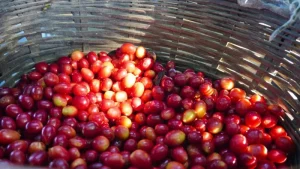
The indicator “specialty rate 41.7%” deserves separate explanation—it refers to the proportion of output that meets specialty-grade standards. A region’s rising specialty rate usually comes from three directions: variety improvement, maturity control at harvest (picking only red cherries significantly improves batch stability), and upgrading of primary processing (from traditional natural/washed to temperature-controlled fermentation, honey processing, etc.).
And “deep-processing rate 85%” measures something else: how much raw material completes roasting, extraction, instantization, and other processing locally rather than being shipped out only as green beans. The correspondence between this ratio and output value explains why, while expanding production, Yunnan has also been continuously adding processing-end capacity in recent years—the same tonnage, processed locally, yields several times the value of green beans.
Compared with Vietnam’s 2025/26 harvest year, the contrast is clearer: its green-bean exports showed “volume up, value down,” while deep-processed products saw both volume and value rise. Whichever end retains the added value has stronger price resilience.
IV. The Field Determines the Ceiling of the Cupping Table
Stringing the three yardsticks together reveals they all point to the same source: field management and primary processing. Variety determines whether a high score is possible; harvest maturity determines batch uniformity; primary processing determines whether flavor is “designed” or “left to chance”; and standards and certifications merely fix these processes into tradable credentials.
This is also the internal logic behind Yunnan’s shift in recent years from “expanding area” to “raising the specialty rate”—when area and output already have scale (1.5188 million mu, 170,700 tonnes), the room for continued growth lies in structure, not in adding new planted area.
Conclusion
The three yardsticks have their divisions of labor: cupping governs the score of one cup, standards and geographical indications govern the authenticity of identity, and the specialty rate and deep-processing rate govern the structural level of a region. For consumers, the first two yardsticks suffice to judge the pack in front of them; for practitioners, the third yardstick determines their position in the coming years. Yunnan’s 41.7% specialty rate and 85% deep-processing rate are two numbers more worth tracking than “national No. 1 in output.”
Sources
① SCA cupping scoring system and the public definition of the 80-point specialty threshold; ② Public reports on the relevant group standard of the Yangtze River Delta Coffee Industry Association; ③ Public information on Pu’er coffee and Baoshan small-grain coffee being included in geographical-indication protection and the China–EU mutual-recognition list; ④ Yunnan coffee industry public data (planted area ~1.5188M mu, output ~170,700 t, specialty rate ~41.7%, deep-processing rate ~85%, whole-chain output value ~8.968B yuan); ⑤ VICOFA 2025–2026 harvest-year green-bean and deep-processed breakdown data.
Note: This article is a synthesis of public materials and popular-science analysis, and does not constitute any procurement, pricing, or investment advice; all data are subject to the original issuing bodies and official texts, and specific quality determinations should follow the results of qualified testing institutions.
Originality Statement
- This article is an original work of coffeeyo.com. Without authorization, no media, website, or individual may reprint, excerpt, duplicate, or otherwise use it; violators will be pursued under law.
- The images, charts, and videos herein are originally photographed or produced by Coffeeyo, with copyright watermarks added; copyright belongs to Coffeeyo.
- For reprint authorization, commissioned writing, interviews, or business cooperation, contact: Tel 400-0000-641 (+86-18288016826) | Email 405854472@qq.com | Address: Jinghong City, Xishuangbanna, Yunnan Province / Tieling City, Liaoning Province
Related Reading
 Three Decades of Shanghai-Yunnan Collaboration: A Coffee Bean ‘Ferments’ at the Import Expo
 Why Yongde’s Coffee Beans Won Gold in Shanghai – A Taste of ‘Life in Yunnan: 365 Days’
- Yunling Commentary: Yunnan Coffee Turnaround Hinges on Autonomous Pricing
 A ‘Travel Pack’ Reveals Another Possibility for Pu’er Baristas
- Bean in Short Supply: A Taiwan Youth on Yunnan Coffee as a Shared Cross-Strait Stage
- Five Years, Eight Championships: Lincang Coffee Joins the World Stage




 Liaoning ICP Security No. 21122402000217