
At a Glance (China Coffee Network): When we say “China’s coffee,” most of the time we mean “Yunnan coffee.” In 2023, Yunnan’s coffee planting area accounted for over 98% of the national total, and its output similarly about 98%—in other words, the map of Chinese coffee almost perfectly overlaps the outline of Yunnan. But behind the two characters “Yunnan” lies not a homogeneous producing region, but a terroir map pieced together by six prefecture-level cities, dozens of counties, and elevations from 800 to over 2,000 meters. To understand Yunnan coffee, you must start with its geography and climate—because the most fundamental flavor in a cup is written into the beans the moment the seed hits the ground, by mountains, rivers and sunlight.
When we say “China’s coffee,” most of the time we mean “Yunnan coffee.” In 2023, Yunnan’s coffee planting area accounted for over 98% of the national total, and its output similarly about 98%—in other words, the map of Chinese coffee almost perfectly overlaps the outline of Yunnan. But behind the two characters “Yunnan” lies not a homogeneous producing region, but a terroir map pieced together by six prefecture-level cities, dozens of counties, and elevations from 800 to over 2,000 meters. Yunnan beans from the same province—the rich body of Baoshan’s Lujiangba, the bright fruit acidity of Lincang, the balanced weight of Pu’er—differ so much that newcomers often mistake them for beans from different countries. To understand Yunnan coffee, you must start with its geography and climate—because the most fundamental flavor in a cup is written into the beans the moment the seed hits the ground, by mountains, rivers and sunlight.
I. The “Coffee Belt” South of the Tropic of Cancer: A Double Gift of Latitude and Altitude
The coffee tree is a typical tropical-to-subtropical crop; the globally recognized “golden coffee belt” lies roughly between 25° north and south latitude, with core conditions of an annual average temperature of 18–24°C, frost-free, ample rainfall and distinct wet and dry seasons. Yunnan’s core coffee-growing areas sit precisely in a narrow strip from south of the Tropic of Cancer to its vicinity—Pu’er, Xishuangbanna, Lincang, Dehong, Baoshan and Nujiang arranged north to south, latitudes from about 21° to 27°, just catching the edge zone where coffee can grow stably. This “edge” is actually a flavor fortune: the closer to the tree’s viable limit, the slower the cherries ripen and the more fully flavor compounds accumulate.
More critical than latitude is elevation. Yunnan coffee is generally grown at 1,000–2,000 meters above sea level, far higher than many flatland estates in Central and South America. High elevation brings two direct consequences: first, temperature drops with altitude—about 6°C per 1,000 meters—which lengthens the cherry maturation period, allowing sugars and organic acids to accumulate at a measured pace; second, the diurnal temperature range widens significantly, so carbohydrates produced by daytime photosynthesis are consumed less at night and stay in the bean. The industry often summarizes Yunnan small-grain Arabica as “strong but not bitter, aromatic but not harsh, with a slight fruit acidity”—the root of this character is planted in the daily rhythm of high elevation.
Comparing with the world’s classic regions clarifies Yunnan’s position. Colombia’s core regions sit at 1,200–2,000 m, Kenya at 1,500–2,100 m, Ethiopia’s native forests even above 2,000 m; Yunnan’s main producing elevations overlap theirs closely. The difference is that Yunnan’s regions are spread across the southern extension of the Hengduan Mountains—deeply cut by rivers and mountains, with extremely fragmented microclimates, so that different slopes and elevations of the same mountain can cup like two different beans. This fragmentation is both a standardization difficulty and the natural soil in which concepts like “micro-lot” and “single estate” can take root in Yunnan.
II. Six Major Regions: A Terroir Mosaic, Each with Its Strength
Yunnan coffee is not evenly distributed; it concentrates in six prefecture-level cities: Pu’er, Baoshan, Lincang, Dehong, Xishuangbanna and Nujiang. Their output and positioning differ markedly, together forming a hierarchical structure of “large region containing small regions.”
Pu’er—the volume leader and transformation pioneer. Pu’er is Yunnan’s largest coffee region, with planting area and output long ranking first in the province; multiple statistics show it contributes over half of the province’s output. Beyond volume, Pu’er’s transformation is more emblematic: early on dominated by commercial beans and instant-coffee raw material, in recent years it has introduced professional cup-testing labs and promoted standardization of initial processing, rapidly raising its specialty rate. Pu’er coffee as a whole leans balanced and full-bodied, making it the best starting point for understanding “how Yunnan beans move from raw material to flavor.”

Baoshan Lujiangba—the specialty core and historical origin. Baoshan, especially Lujiangba, is the birthplace of Yunnan’s modern coffee industry. In December 1952, the Institute of Tropical and Subtropical Cash Crops of the Yunnan Academy of Agricultural Sciences (then a related institution established in Baoshan) took the lead in introducing coffee to Lujiangba for trial planting, opening a new era of coffee research and industrialization in New China. Lujiangba, at about 800–1,300 m elevation with an average annual temperature around 21.5°C and distinct wet-dry seasons, nurtured the renowned “Baoshan small-grain coffee,” whose distinctive “strong but not bitter, aromatic but not harsh, slightly fruity” flavor is famous at home and abroad. In the specialty wave, Lujiangba micro-lots have repeatedly scored above 86 in international cupping, becoming representatives of Yunnan’s high-end beans.
Lincang—bright fruit acidity at high elevation. Lincang is called by the industry “China’s Fine Coffee Bean Demonstration Zone” and “China’s Core Fine Coffee Producing Region,” an ideal area for producing extra-hard beans and high-acidity coffee. Its regions generally sit at 1,200–1,900 m with an average annual temperature around 16.8°C; the diurnal range and diffuse-light conditions favor acid development, so its beans are known for clear citrus and berry notes. By recent years Lincang’s planting area has approached one-fifth of the province’s, making it one of the fastest-growing segments.
Dehong—a base for deep processing. Dehong’s label is not planting scale but industry-chain depth. Leading enterprises such as Hogood Coffee cluster here, making Dehong an important base for Yunnan coffee’s deep processing—from instant powder and extracts to various high-value-added forms, Dehong handles much of the “one more processing step before the bean leaves Yunnan,” a key node in Yunnan’s shift from “selling green beans” to “selling products.”
Xishuangbanna and Nujiang—emerging variables. Leveraging hotter southern conditions, Xishuangbanna has seen specialty estates emerge in recent years; Nujiang, drawing on canyon vertical climate and the policy pull of poverty alleviation and rural revitalization, promotes coffee as a characteristic income crop. Its “Nujiang coffee,” though still small in volume, is quite story-worthy thanks to ecological farming combined with cultural tourism.
For an intuitive comparison, the table below summarizes the typical climate and positioning of the main regions (data compiled from public reports; figures vary slightly by year and source):
| Region | Elevation (m) | Avg. annual temp (°C) | Typical flavor profile | Industry positioning |
|---|---|---|---|---|
| Pu’er | 900–1500 | ~18.3 | balanced, full-bodied, highly malleable | largest region, transformation pioneer |
| Baoshan Lujiangba | 800–1300 | ~21.5 | rich, mildly acidic, chocolate notes | specialty core, historical origin |
| Lincang | 1200–1900 | ~16.8 | bright acidity, citrus notes | specialty demonstration zone |
| Dehong | 1000–1600 | ~19.5 | depends on processing | deep-processing base |
III. The Magic of Microclimate: Temperature Swings, Rainfall and the Harvest Window
If latitude and elevation decide that Yunnan “can grow coffee,” then microclimate decides “whether the coffee grown tastes good.” Yunnan’s coffee zones are mostly mountain vertical-climate areas, where several key variables together shape the taste in the cup.
Diurnal temperature range is the engine of flavor. High-elevation mountain land has strong daytime sun and vigorous photosynthesis, with marked nighttime cooling that suppresses respiratory consumption, so more net-accumulated carbohydrate remains. Part becomes sugar, part becomes the substrate for caramelization and Maillard reactions in later roasting, directly tied to sweetness and body. This is why, with the same variety, high-elevation Yunnan beans are often “thicker” and sweeter than low-elevation ones.
Distinct wet and dry seasons are guardians of quality. Influenced by the southwest monsoon, Yunnan’s rainfall concentrates in summer, with relatively dry autumn and winter. This rhythm coincides with coffee phenology: the rainy season swells the fruit, then the dry season provides an ideal harvest and drying window. Fresh cherries must be picked and dried promptly after ripening; an overly humid environment easily causes mold and defective fermentation. Most Yunnan regions enjoy a combination of ample sunlight and low humidity during the harvest season, giving natural convenience to natural, washed and other processing methods—the fundamental climatic premise that lets Yunnan handle multiple processing methods at once.
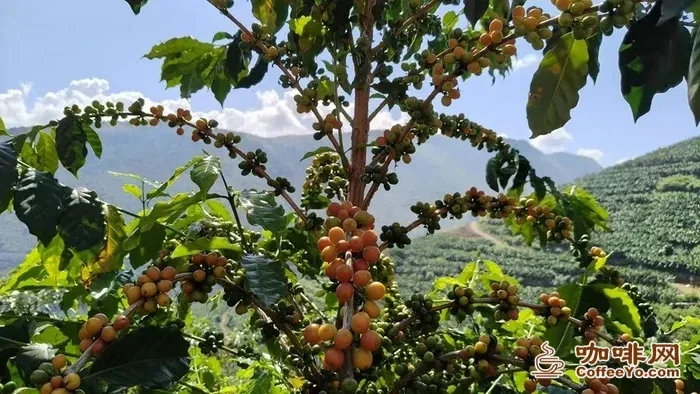
Slope aspect and diffuse light refine flavor. In fragmented mountain terrain, sun-facing versus shaded slopes, ridges versus valleys differ enormously in light, wind speed and frost risk. Many specialty estates deliberately choose specific aspects and elevation bands, using diffuse light to slow ripening and soften acidity. The so-called “different taste on the same mountain” is essentially the projection of microclimate in the cup.
IV. The Variety Map: From Catimor to the “Yunka” Series
Terroir sets the base; variety sets the ceiling. Yunnan’s coffee variety structure has undergone clear iteration. Early on, to fight leaf rust and secure yield, Catimor (a hybrid of Timor and Caturra) was widely promoted, once accounting for over 90% of the province’s planting area. Catimor resists disease and yields well, but its cup scores are relatively limited—one source of the old impression that “Yunnan beans are large in volume but flat in flavor.”
Recent variety improvement is another main thread in Yunnan coffee’s value leap. Ancient fine varieties such as Typica and Bourbon have regained attention, and international stars like Geisha show potential in trials; more crucially, province-bred new varieties “Yunka No.1” and “Yunka No.2” have passed certification, with cup scores above 86, achieving a leap from “Catimor dependence” to “seed-source autonomy.” Public reports show premium-variety planting has expanded to over a hundred thousand mu, and Geisha fresh-cherry prices far exceed ordinary Catimor—the variety dividend is beginning to materialize for real.
Variety and terroir must match. High-elevation areas with large temperature swings better show the delicate acidity of Typica and Bourbon; estates with ample accumulated heat and fine management can fully release Geisha’s floral potential. Yunnan’s diversity is precisely the stage for “one product, one land, one method” precision farming—the internal support for Yunnan coffee’s move from “bulk commodity” to “flavor brand.”
V. How Terroir Becomes the Taste in the Cup
Gathering the threads above, we can see a clear causal chain of “geography—climate—variety—processing—cup”: the latitude south of the Tropic of Cancer qualifies Yunnan coffee to grow; 1,000–2,000 m elevation and pronounced diurnal range settle the balance of sugar and acidity; the distinct wet-dry rhythm guards harvest and drying quality; fragmented mountain microclimates nurture differentiated micro-lots; and an ever-optimizing variety structure realizes this difference as recognizable flavor.
This is exactly why “geographical indication” matters. When a bean can clearly state whether it comes from Baoshan Lujiangba or a Lincang high mountain, can mark its elevation, processing and estate, it is no longer just an agricultural bulk commodity but a “flavor product” consumers can recognize, remember and repurchase. In recent years Yunnan coffee’s specialty rate rose from about 8% in 2021 to 22.7% in 2023, and its deep-processing rate from about 20% to 56%—behind these numbers is precisely the process of terroir value being gradually “translated” into a language of quality.
Of course, terroir is not omnipotent. Even the best origin, if picking is uneven, processing uncontrolled, traceability missing, will still collapse in flavor; while an ordinary origin can yield surprises through fine management. The first half of Yunnan coffee’s story writes “nature dealt a good hand”—the Tropic of Cancer, high elevation, volcanic red soils like black earth, and vertical climate; the second half must write how people and industry play that hand well. Only by understanding producing-region geography and microclimate do we truly gain the coordinate system to read the next cup of Yunnan coffee.
VI. Read the Region, and You Can Taste Yunnan
Having broken down Yunnan coffee’s geography and climate, the ultimate goal lands on “how to drink, how to choose.” For consumers, the region label is not marketing jargon but a flavor preview: seeing “Baoshan Lujiangba,” expect rich, mildly acidic body with chocolate notes; seeing “Lincang,” look forward to bright, clear citrus and berry acidity; seeing “Pu’er,” more likely a balanced, highly malleable style suited to daily drinking or blending. If the same bean marks a specific estate and elevation, it usually means a smaller lot and more controllable processing, with typically higher flavor recognizability.

Conversely, reading the region helps us build reasonable expectations. Yunnan coffee overall is still in the process of “large volume at flat prices leaping toward specialty”—there are international-cupping top lots scoring above 90 as well as bulk commercial beans; the region label tells you the base tone of flavor but cannot replace the actual cup performance of a specific lot. Truly tasting Yunnan means slowly aligning your own tongue with this geographic map—when you can taste from a cup “this feels like high-elevation natural Lincang,” terroir is no longer an abstract concept but a real coordinate in the cup. This is also why more and more cafés begin writing region, elevation and processing together on the menu: that is the starting point of source-value transparency.
A step further, region awareness also helps us understand Yunnan coffee’s pricing logic. When a bean can clearly state its origin and craft, it shifts from bulk commodity to a recognizable, repurchasable flavor product, and its premium then stands on solid ground. Reading the region is both the consumer’s amulet and a driving force for the region’s healthy development—the more people who drink with understanding, the more reward for estates that farm and process seriously.
References
(Note: all data in this article are cited from publicly verifiable sources, subject to the original.)
· Public materials from the Institute of Tropical and Subtropical Cash Crops, Yunnan Academy of Agricultural Sciences (1952 Lujiangba introduction, Yunnan coffee planting area and output share)
· The “2024 China Urban Coffee Development Report” and public data from industry research institutions (Yunnan coffee specialty rate, deep-processing rate)
· Public disclosures from the Yunnan Provincial Department of Agriculture and Rural Affairs and the agriculture bureaus of various prefectures (distribution of six major regions, elevation and climate data)
Original Notice
- This article is an original work of China Coffee Network. No media outlet, website or individual may reproduce, excerpt, copy or mirror it without authorization; violators will be held legally liable.
- All images, charts and videos herein were shot or produced by China Coffee Network and carry its copyright watermark; the copyright belongs to China Coffee Network.
- For reprint licensing, commissions, interviews or business cooperation, please contact: Tel 400-0000-641 (+86-18288016826) | Email 405854472@qq.com | Address: Jinghong, Xishuangbanna, Yunnan Province / Tieling, Liaoning Province
Related Reading
 Coffee and Health: The 400 mg Daily Caffeine Limit
 Global Coffee Belt 2026/27 Outlook: Brazil Record Crop and the Volume-Up, Price-Down Equation
 Revaluing Yunnan Coffee: From a Raw-Material Base to a Flavour Origin
 ‘Thai Milk Tea Nearly Sent Me to My Late Grandma’ Trends: Caffeine Content Left Unlabeled, Experts Urge Caution
 From Seed to Cup: A Complete Guide to Coffee Processing Methods
 China’s Coffee Industry: Current Landscape and Future Outlook





 Liaoning ICP Security No. 21122402000217