
At a Glance (China Coffee Network): In the past five years, Lincang coffee—once a low-profile producing region sharing the same light and heat as Colombia and Jamaica’s Blue Mountain—has emerged as a dark horse, winning 8 championships on the international stage. At the recent 2026 2nd Yunnan Treasure competition, two Lincang beans both broke 90 points, taking first and third.
This is a hidden paradise sharing the same light and heat as Colombia and Jamaica’s Blue Mountain—Lincang, Yunnan. In recent years, this low-profile producing region has frequently broken out. Over the past five years, Lincang coffee, like a dark horse, has won 8 championships on the international stage.
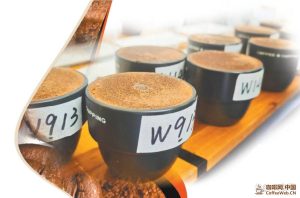
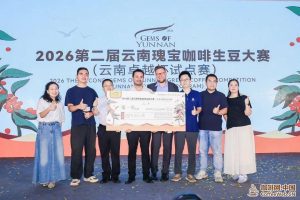
At the recently concluded 2026 2nd Yunnan Treasure Coffee Green Bean Competition (Yunnan Cup of Excellence pilot), the two competing beans from Lincang Gengxia Manor Co. and Lincang Linxiang District Songfeng Coffee Planting Farmers’ Cooperative both exceeded 90 points, ranking first and third respectively.
A relevant official from the Lincang Agriculture and Rural Affairs Bureau introduced: “This excellent result is largely thanks to policy guidance and the systematic track switch from commercial to specialty. At the provincial level, the ‘Six Coffee Articles’ policy was issued, with special support funds invested every year. Under the strong push of policy, the coffee specialty rate and deep-processing rate rose significantly.”
Variety is the gene of quality. Places such as Zhenkang County actively promote variety improvement, planting not only traditional “Catimor” and “Sarchimor” series but also vigorously introducing high-end varieties such as Panama’s “Geisha” and Kenya’s “Batian.” Currently, Lincang has screened 12 fine coffee varieties suitable for local planting.
If the base is the skeleton, then technology is the key support for Lincang coffee’s growth.
In recent years, Lincang has vigorously promoted fine management means such as applying organic fertilizer, biological control technology, and drip-irrigation equipment in coffee bases. It formulated the “High-Quality Coffee Industry Development Work Plan (2025–2035),” planning to build 600,000 mu of industrial bases by 2030. On the processing side, Lincang is focusing on breaking through deep-processing technology bottlenecks; the championship traditional washed “Geisha” green bean this time is precisely a reflection of refined processing capability.
“We used to grow coffee entirely by experience; now a cup of soil-test data and a set of fermentation parameters can tune the flavor we want,” said Zhu Hong, head of the Songfeng cooperative—technology is the key driver behind the manor growing beans above 90 points. In Lincang, agronomists promote a scientific-technical service model, from standardized actions in nutrient-bag seedling raising to precise temperature control in washed fermentation, opening the full chain “from field to cup.”
The previous competition’s champion, Qiupo Manor, hung IoT sensors on coffee trees, monitoring microclimate in real time, using the strength of research teams to turn the contingency of flavor into necessity; the precision of scientific calculation makes stable floral and citrus sweetness the standard of Lincang beans.
Good beans must also sell for a good price. Facing the shortboard of low deep-processing rate, Lincang chose to break through by joining forces. On one hand, local brands sprang up like bamboo shoots after rain; 32 brands such as Gengxia and Qiupo encapsulate Lincang flavor into drip bags and cold-brew liquid. On the other hand, Cotti Coffee’s RMB 500 million whole-industry-chain industrial park landing shored up the deep-processing shortboard, letting deep-mountain beans be processed locally and appreciate locally.
Lincang Agriculture and Rural Affairs Bureau data shows that by end-2025, the city’s coffee planting area was 292,200 mu with output of 24,800 tons and agricultural output value of RMB 992 million; there are 51 coffee enterprises, 36 primary-processing lines built, with annual fresh-fruit processing capacity of 200,000 tons; 11 deep-processing lines built with annual processing capacity of 70,000 tons, mainly producing coffee husk beans, green beans, roasted beans, drip coffee, freeze-dried coffee powder, and coffee cold-brew liquid. Lincang plants 21 varieties, mainly “Catimor,” “Sarchimor,” “Batian,” and “Geisha”; coffee fine-variety coverage reached 31%, specialty rate 33%, and deep-processing rate 37%.
One industry thrives, a hundred industries prosper. In 2025, Lincang coffee manors received over 230,000 visitors; “coffee + cultural tourism” and “coffee + study tours” turned producing regions into scenic areas, with tertiary-industry output reaching RMB 470 million. In Nuoliang Township, Cangyuan Wa Autonomous County, farmer Zhao Hongfang transferred her land to a manor and became an industrial worker, able to collect rent and learn skills. From eating from the weather to planting beans by technology, from retail to brand-building, Zhao’s annual income doubled.
Reprint Notice & Disclaimer: This article is reprinted from Yunnan Net. The original report was filed by Yunbao Full Media reporter Wang Shujuan. All rights belong to the original publisher. If you believe any content infringes your rights, please contact us for removal.
Related Reading
 Three Decades of Shanghai-Yunnan Collaboration: A Coffee Bean ‘Ferments’ at the Import Expo
 Why Yongde’s Coffee Beans Won Gold in Shanghai – A Taste of ‘Life in Yunnan: 365 Days’
- Yunling Commentary: Yunnan Coffee Turnaround Hinges on Autonomous Pricing
 A ‘Travel Pack’ Reveals Another Possibility for Pu’er Baristas
- Bean in Short Supply: A Taiwan Youth on Yunnan Coffee as a Shared Cross-Strait Stage
 Haikou ‘Union Cup’ Barista Skills Competition Kicks Off to Empower the Service Sector



 Liaoning ICP Security No. 21122402000217