
At a Glance (China Coffee Network): Brazil’s September exports hit a 20-month high and its 2026/27 crop is forecast at a record 75.5 million bags, while Colombia’s output fell 15% and Vietnam’s export volume rose 15.4% even as its value dropped 7.3%. Behind the latest figures from the five major origins lies a dual signal: global supply is loosening while prices remain under pressure. This article synthesizes official and industry data from five countries, maps the current landscape and offers three key takeaways.
October 2026 is turning into a reporting month for the world’s coffee belt. Brazil, Colombia, Vietnam, Ethiopia and Indonesia have all released fresh production and export figures, and together they point to one conclusion: supply is loosening while prices keep sagging.
1. Brazil: record single-month exports, robusta far outpacing arabica
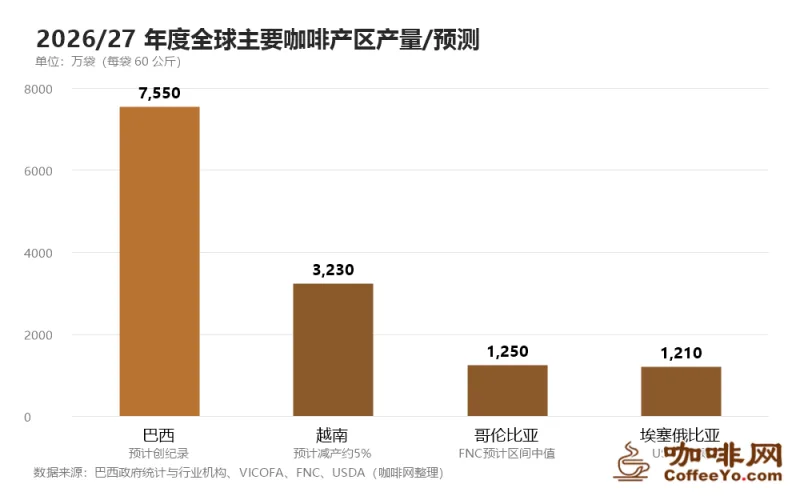
Brazil exported 235,800 tonnes of green coffee in September — about 3.93 million 60-kg bags, up roughly 20% year on year and the strongest single month in almost 20. In the first two months of the 2026/27 crop year, total exports rose 21.20% to 6.50 million bags, of which arabica accounted for 4.69 million (+9.79%) and conilon (robusta) 1.80 million (+66.46%).
What stands out is that robusta export growth is running at nearly seven times the pace of arabica. Industry forecasters expect Brazil’s 2026/27 crop to reach a record 75.5 million bags. Harvesting is largely complete in the main growing regions and the rains have arrived on schedule, easing concern about long-term arabica supply; whether flowering-period rainfall proves adequate, however, remains the key swing factor for the 2027/28 global crop.
2. Colombia: crop down 15%, but September already turning
Data from the National Federation of Coffee Growers (FNC) shows 2025/26 production fell 15% to 12.65 million bags, with exports down 12% to 11.78 million. Cumulative output for January–September 2026 slipped 10% to 8.95 million bags.
September, though, brought a turn: production rose 6% to 1.21 million bags and exports 9% to 1.17 million, helped by the first harvest of the main season in the central growing regions. FNC expects full-year 2026 output of between 12.2 and 12.5 million bags. Persistent rain across the growing belt, which disrupted flowering and bean development, is the main reason for this year’s shortfall.
Colombia is the world’s third-largest coffee producer, with 840,000 hectares under coffee and roughly 540,000 families whose livelihoods depend on it.
3. Vietnam: volumes up 15.4%, earnings down 7.3%
According to the Ministry of Agriculture and Environment, Vietnam exported roughly 1.4 million tonnes of coffee worth USD 6.54 billion in the first nine months of 2026 — volume up 15.4% year on year while value fell 7.3%. The average export price of USD 4,537.30 per tonne was down 19.7%. It is the clearest “more beans, less money” signal in this round of data.
On production, VICOFA estimates the 2025/26 crop at slightly above 2 million tonnes (over 34 million bags), and projects a decline of about 5% for 2026/27 due to unfavourable weather during harvest. Farmgate prices in the Central Highlands have held at VND 92,000–94,000 per kilo, and industry observers note that once prices broke below VND 90,000 growers became markedly more reluctant to sell, leaving the market in a standoff between buyers and sellers.
VICOFA has also argued that Vietnamese robusta needs to move beyond its role as a cheap input and shift toward clean, transparent products that meet international standards — competing on value rather than price.
4. Ethiopia: coffee earns nearly 40% of export revenue, almost all arabica
The USDA’s Foreign Agricultural Service projects Ethiopia’s 2026/27 market-year output at around 12.10 million bags, with growth driven mainly by yield improvements under normal weather.
Coffee is the country’s most important export earner: in fiscal 2023/24 production reached about 510,000 tonnes and exports 338,000 tonnes (up 44%), generating some USD 1.43 billion — 37% of total export earnings. About a quarter of Ethiopia’s population depends directly or indirectly on the coffee chain.
Ethiopian coffee is almost entirely arabica, with Yirgacheffe, Sidama, Harar and Limu among the best-known regions, mostly grown under shade and hand-picked. Most coffee is traded through the Addis Ababa and Dire Dawa auction centres, and every lot must be graded and quality-checked before export in order to protect the country’s international reputation.
5. Indonesia: volume and value both down, markets sharply split
Statistics Indonesia reports that in January–August 2026 the country exported 260,300 tonnes of coffee and coffee products worth USD 1.228 billion, down 16.71% and 23.47% respectively. By destination market, the picture is clearly split:
| Market | Export volume | Share | YoY |
|---|---|---|---|
| United States | 32,500 t | 12.49% | −13.83% |
| Egypt | 30,700 t | 11.81% | +14.85% |
| Malaysia | 20,400 t | — | +28.26% |
| Belgium | 17,600 t | — | −43.47% |
| India | 15,100 t | — | +32.06% |
Traditional demand in Europe and the United States is weakening, while emerging markets such as Egypt, India and Malaysia are growing against the trend. August alone saw exports of 51,000 tonnes worth USD 214 million, still down 16.54% and 16.35% year on year.
6. Three signals worth watching
First, looser supply and softer prices are arriving together. Brazil’s record crop, Vietnam’s volume-up-value-down result and Indonesia’s double decline all point the same way: global supply is trending looser while demand has not kept pace, pulling the price centre of gravity lower. Vietnam’s 19.7% drop in average export price is the most direct confirmation.
Second, the species split is widening. Brazilian robusta exports are up 66.46% against just 9.79% for arabica, so robusta’s supply elasticity clearly exceeds arabica’s. If the trend holds, the price gap between the two may widen further, with direct consequences for the blend-cost structure of downstream roasters.
Third, for the Chinese market it cuts both ways. Lower international green prices help domestic roasters and chains cut procurement costs. But the flip side is that Yunnan, as an emerging origin, faces the practical question of how to sustain a “quality-earns-premium” system while international prices sag overall. Building authority on flavour and quality — rather than relying on a cost advantage — matters more than any short-term price move.
Sources: Brazilian government statistics and industry bodies; Colombian National Federation of Coffee Growers (FNC); USDA Foreign Agricultural Service; Vietnam’s Ministry of Agriculture and Environment; Vietnam Coffee-Cocoa Association (VICOFA); Statistics Indonesia.
This article is an original analysis compiled by China Coffee Network. All figures are subject to the public releases of the institutions listed above and are provided for industry reference only; they do not constitute any trading advice.
Original Notice
- This article is an original work of China Coffee Network. No media outlet, website or individual may reproduce, excerpt, copy or mirror it without authorization; violators will be held legally liable.
- All images, charts and videos herein were shot or produced by China Coffee Network and carry its copyright watermark; the copyright belongs to China Coffee Network.
- For reprint licensing, commissions, interviews or business cooperation, please contact: Tel 400-0000-641 (+86-18288016826) | Email 405854472@qq.com | Address: Jinghong, Xishuangbanna, Yunnan Province / Tieling, Liaoning Province
Related Reading
- Severe Global Coffee Bean Shortage Turns Overseas Buyers Toward China’s Growing Regions
 Coffee and Health: The 400 mg Daily Caffeine Limit
- ICE Agricultural Futures Close Higher; Coffee Futures Up 1.72%
- Why Arabica Coffee Futures Fell Below .90: Brazil Rain and a Stronger Dollar
 Revaluing Yunnan Coffee: From a Raw-Material Base to a Flavour Origin
 ‘Thai Milk Tea Nearly Sent Me to My Late Grandma’ Trends: Caffeine Content Left Unlabeled, Experts Urge Caution


 Liaoning ICP Security No. 21122402000217