
Editor’s Note (Coffeeyo.com): China’s coffee market has climbed to a scale of hundreds of billions of yuan, with store counts surpassing 100,000, yet per-capita cup consumption remains low — a stark contrast of a vast market with weak pricing power. This article breaks down the current landscape across consumption, supply, the value chain and branding, and offers an outlook for the next five to ten years on domestic-demand expansion, premiumization, digitalization and sustainability.
If we pull the timeline back a decade, “Chinese people drinking coffee” was still often described as a lifestyle with a foreign, niche flair; today, from office towers in first-tier cities to street-corner shops in county-level markets, coffee is becoming an everyday necessity with astonishing penetration. Public data shows that China’s freshly brewed coffee market has climbed to a scale of several hundred billion yuan, with its compound annual growth rate staying in the double digits for years, and although per-capita annual cup consumption is still far below that of Europe, the U.S. and Japan–South Korea, it is precisely this “gap” that constitutes the industry’s most promising growth narrative. As the consumption side keeps expanding, Yunnan’s producing regions accelerate their move toward specialty coffee, and capital and brands compete and collaborate neck-and-neck on the track, China’s coffee industry stands at a critical inflection point — shifting from “drinking coffee” to “building a coffee industry.” This article sets out to break down the underlying realities of this market and offer a judgment on its evolution over the next five to ten years.
I. The Awakening of Consumption: From Imported Exotic to Everyday Necessity
The true inflection point in China’s coffee consumption came after the scaled expansion of freshly brewed coffee brands. Value-priced ground-coffee chains represented by Luckin and Cotti drove the price of a cup down to around fifteen yuan or even lower, completely tearing off coffee’s “light-luxury” label; specialty and design-led brands such as Manner, M Stand and Seesaw, with more restrained store models and stronger spatial storytelling, bound coffee more tightly to the lifestyle of young urbanites. Public statistics show that China’s total number of coffee outlets has surpassed the 100,000 mark, with Luckin alone operating tens of thousands of stores, and even many counties and townships now host chain-coffee outlets.
What deserves even more attention is the down-market shift and differentiation of the consumption structure. First- and second-tier cities have entered an era of “multiple cups as the norm,” while third- and fourth-tier and county markets are in a period of accelerating penetration; Lucky Cup, the budget coffee brand under Mixue, has brought “a few-yuan cup” coffee into counties and townships, validating a simple judgment: the elasticity of coffee demand is far from exhausted. At the same time, new tea-drink brands have collectively “gone coffee,” and convenience stores and instant-retail platforms have launched freshly brewed coffee, turning coffee from “make a special trip to drink” into “grab one on the way.” As coffee retreats from a ritualistic consumption to an everyday beverage that is both functional and social, the underlying stability of demand increases markedly — and that is precisely the premise that lets the industry dare to make heavy-asset investments.
The refinement of consumption scenarios is also reshaping supply. The rigid demand for a “morning coffee” in office buildings, “third-space” socializing in malls and neighborhoods, portable coffee outdoors, and the rise of home pour-over and capsule machines have split coffee into several parallel demand curves; in response, coffee culture is being localized — the popularity of “Chinese-style coffee” such as tea-coffee, tangerine-peel coffee and rice-coffee shows that Chinese consumers are not simply copying Western drinking habits, but redefining coffee in their own gustatory language. This capacity for “local innovation” is exactly the sharpest weapon local brands have against international giants, and an important source of future influence over flavor narratives.

Yet beneath the prosperity there are also cold observations. Per-capita cup consumption still sitting at a low level means huge incremental space, but also that any claim of a “market ceiling” is premature; the stratification between high-end and value segments is widening, squeezing the middle ground from both sides. The awakening of the consumption side is the most certain fundamental of China’s coffee industry, but it cannot single-handedly sustain the story of a “coffee powerhouse” — the real contest must be examined through supply and the value chain.
II. The Supply Map: Yunnan Dominates, Hainan and Emerging Regions Fill In
Any discussion of China’s coffee supply cannot avoid one basic fact: Yunnan contributes the vast majority of the country’s coffee planting area and output, and is unquestionably China’s main coffee-producing region. From Pu’er, Baoshan, Lincang and Dehong to Xishuangbanna and Wenshan, Yunnan’s subtropical highland climate and vertical microclimates nurture a domestically grown coffee dominated by Arabica with diverse styles. Public estimates put Yunnan’s annual coffee output at around 100,000 tons, and in recent years, with specialty-oriented upgrades, its cupping performance and reputation have kept rising.
Looking inside the producing region, Yunnan is not monolithic but shows clear sub-regional personalities: Baoshan’s small beans are known for clean fruit acidity, Pu’er is richer and often carries floral and berry notes, Lincang tends toward nutty and chocolate tones, and Dehong, at a lower latitude, has a thicker body. This “four seasons on one mountain” microclimate variation gives domestic coffee a natural condition for multiple styles and gradations; yet coordination on standards and branding among sub-regions remains weak, with each often fighting alone. Whether the dispersed producing regions can be twisted into a consistent language of quality will determine how far Yunnan’s — and China’s — coffee can go.
In contrast to Yunnan’s “sole dominance,” Hainan is China’s traditional stronghold of Robusta (Canephora) coffee, relying on its tropical climate to support a different supply oriented more toward industrial and blending uses; in addition, places such as Panzhihua in Sichuan and Guangdong have small-scale trial plantings and experimental expansion. Overall, China’s coffee supply is highly concentrated in the southwest corner — a result of natural endowment, but one that also means the climate and disease risks of the producing regions are amplified manyfold: once the main producing area encounters extreme weather, the fragility of national supply is immediately exposed. Therefore, a supply pattern of “Yunnan as the core, with multiple supplementary points” is both the current reality and the direction efforts should take for future risk dispersion.
A deeper issue is value capture. For a long time, Yunnan coffee has been embedded in the global supply chain mainly as a raw-green-bean commodity, with the premium staying at the very front of the value chain and farmers receiving only a limited share. This structural awkwardness of “growing well but selling cheap” is precisely the core proposition the industry has struggled to break through over the past decade. The awakening of the supply side lies not in growing more, but in growing better, selling at higher prices and retaining more profit — and that key lies in the processing and branding ends.
Looking at production-supporting infrastructure, Yunnan’s processing and storage foundations still have room to catch up. Modern drying, optical-sorting and temperature-controlled storage capacities directly determine whether raw beans can be stably converted into merchantable beans; every one-percentage-point reduction in post-harvest loss is equivalent to “recovering” a large amount of grain without adding an acre of land. Shoring up this “invisible infrastructure” is as important as varietal improvement and brand building, and is also the prerequisite for converting volume advantage into value advantage.
III. Anatomy of the Value Chain: The Value-Adding Link from a Single Bean to a Cup
The journey of a coffee bean, from field to cup, usually crosses several stages — green-bean trade, processing (roasting), retail and brewing — and value is amplified step by step along this chain. In Yunnan, the role played in the past was almost only that of “bean grower” — selling bags of parchment-covered green beans, with paper-thin profits; today, more and more players are pushing deep into the mid- and downstream: building roasteries, creating own brands, opening urban cafés, running origin study tours, striving to keep profit and brand mindshare local.
Every link of this chain quietly accumulates or consumes value. The farming end sets the floor of flavor, the processing method (natural, washed, honey, anaerobic fermentation, etc.) determines the cup profile, roasting is the final craft that translates green beans into flavor, and retail and brewing face consumers directly and hold the final say over pricing. Whoever can “call the shots” at more links captures more value. This is also why, in recent years, a “chain-leader mindset” has heated up simultaneously at the producing regions and on the capital side: when a company can both grow good beans, roast good beans, and tell a good story, it is no longer a raw-material supplier but a brand owner and standard-setter.
A frequently overlooked fact is that the “length” of the value chain is itself a moat. The longer the chain and the more links involved, the smaller the shock from a single link’s fluctuation on the whole — but the higher the demand for coordination capability. China’s coffee has long been stuck in a “short-chain” stage — a huge value fault line sits between growing and selling; filling this fault line requires not a single-point breakthrough at one link, but the binding of interests among growers, processors, roasters and brand owners. Cooperative models, contract farming and profit-return mechanisms are precisely the key stitches that sew the fault line into a network.
Channel transformation is equally critical. E-commerce, livestreaming and direct-from-origin supply have, for the first time, let Yunnan’s and domestic coffee speak directly to consumers, bypassing layer upon layer of distributors; membership subscriptions and coffee subscription boxes turn one-off transactions into long-term relationships. The shorter the chain, the more the origin retains, and the stronger the willingness to invest — this is the most plain yet effective driving force behind value-chain leaps. But one must also stay clear-eyed: extending the chain means raising the capability threshold, and the cross-over from farming to branding is a hard test of talent, capital and organizational capacity.
Worth mentioning separately is the localization of roasting. In the past, high-end roasting depended heavily on imported equipment and the experience of overseas roasters; today, domestic roasting factories and independent roaster communities are growing rapidly, grasping in their hands the “roast curve” — the second revolution of flavor. The same green beans, with a light roast highlight floral and fruity notes, a medium roast emphasize sweetness, and a dark roast shape body and richness, making the roaster the ultimate translator connecting origin and consumer. Only when the local side can both grow good beans and roast good beans does the profit pool of the value chain truly stay local — and this is precisely the most concrete foothold of the “chain-leader mindset.”
IV. Brand Competition and Cooperation: Global Giants, Local New Forces and Regional Brands
China’s coffee brand landscape is a three-way coexistence of competition and cooperation among global giants, local new forces and regional brands. Starbucks defined the “third space” coffee mindset and still occupies high-end and business scenarios; Luckin, through digital operations and aggressive subsidies, turned freshly brewed coffee into a high-frequency necessity, and with hero products like the Coconut Latte proved the capacity for local taste innovation; Cotti entered via franchise speed, Lucky Cup sunk down via extreme cost-performance, while Manner and M Stand seek differentiation between “tasty” and “stylish.”
Several clear threads emerge from this competition and cooperation. First, the price bands are being rapidly stratified, with the value base and the specialty-premium end each staking out territory; second, product innovation is increasingly “localized,” with native flavor combinations such as tea-coffee, fruit-coffee and rice-coffee becoming points of differentiation; third, supply-chain capability has become the watershed — whoever can stably secure good beans, control roast consistency and delivery costs will survive after the subsidy tide recedes. For domestic coffee, branding is not just marketing, but the process of sedimenting “Chinese flavor” into an identifiable, repurchaseable asset.
A repeatedly validated rule is this: a brand’s ultimate moat is not a single hit product, but a reusable system of capabilities — a stable supply chain, rapid flavor iteration, precise user operations, and the resolve to keep investing in R&D even in a downturn. Global giants’ advantage lies in their systems, while local new forces’ opportunity lies in agility and local insight; the future is more likely to see a stable pattern of “giants holding the high end, new forces taking the niches, regional brands rooting locally” rather than one winner taking all. For domestic coffee, acknowledging the gap and shoring up the system matters more than chasing short-term buzz.
V. Diagnosing the Pain Points: A Vast Market with Weak Voice
The greatest contrast in China’s coffee industry is that “behind a vast consumer market lies weak voice in the value chain.” This judgment can be broken down along several dimensions. First, although supply is mainly Yunnan-based, overall output still accounts for a small share globally, with limited international pricing power; second, it has long been dominated by raw-green-bean exports, with the profits of downstream high-value-added segments (branding, roasting, retail) shared more by channels and overseas brands; third, the standards and grading systems are still being refined, and the cupping language, origin certification and traceability systems are not yet fully connected, so the phenomenon of “good beans failing to fetch good prices” has not been eradicated.
Fourth, import dependence coexists with structural imbalance: on one hand, some high-end green and roasted beans still rely on imports, while on the other, domestic beans face a poorly functioning “premium for quality” mechanism; fifth, homogenized competition is fierce and product innovations are easily and quickly copied, leaving thin moats; sixth, talent and cognitive shortfalls — from Q-graders and roasters to origin-brand operators, the professional supply remains insufficient. The stacking of these pain points forms the mountain ridge China’s coffee must climb to move from “big” to “strong.”
From the trade structure, China is both a major coffee-consuming country and an important importer of green beans and exporter of domestic green beans; this “simultaneous import and export” pattern brings unique challenges: imported high-end beans satisfy the upgrade demand yet also squeeze the price space of domestic specialty coffee; domestic bean exports are mostly in raw-material form, with thin and passive profits. How to find a closed loop between local consumption upgrading and the value leap of domestic beans, so that “made in China” and “sold in China” form a positive cycle, is a must-answer question for overcoming weak value-chain voice.
Beyond that, there are two easily overlooked soft shortfalls. One is talent density: the supply of professionals in cupping, roasting and origin-brand management is insufficient, and many producing regions have “good beans but no one to tell their story, good tales but no one to sell them”; the other is capital efficiency and franchise order: during the rapid-expansion phase, subsidy wars and franchise chaos overdrew user experience and franchisee trust, and once the tide recedes, the fragility of extensive models is exposed in concentration. The industry’s “strength” must ultimately be underwritten by these invisible organizational capabilities.
VI. The Yunnan Sample: How One Producing Region Rewrote the Landscape
In all discussions of “how China’s coffee can grow strong,” Yunnan is the most representative sample. This producing region, long trapped in a raw-material identity, has in the past decade traced a specialty curve from “quantity” to “quality”: varietal iteration (moving from a Catimor-dominated mix toward a diversified layout of Typica, Bourbon, Geisha, etc.), a processing revolution (anaerobic fermentation, temperature-controlled fermentation, etc., turning processing into a controllable flavor engineering), branding (single-origin output, putting “Yunnan” in the hero spot on the packaging), and a second curve of experiential economy opened by “coffee + cultural tourism.”

The significance of the Yunnan sample lies not only in the region itself, but in providing a “replicable methodology” for national supply: translating terroir into flavor archives, sedimenting processing craft into traceable data, and turning origin stories into consumer mindshare. When an estate can stably produce “describable, replicable, premium-able” flavors and retain profit locally through direct sourcing, subscriptions and cultural tourism, it demonstrates how a “vast market” can feed back into “weak voice.” Of course, Yunnan is not without hidden worries — standard enforcement, brand chaos and climate and disease risks remain question marks hanging overhead. The value of a sample lies both in being learned from and in being surpassed.
But one must also see that the Yunnan sample’s “replicability” has preconditions: it requires sustained investment in varietals and craft, restrained and consistent brand expression, and, more importantly, genuinely including coffee farmers in value distribution. If one only learns its “cultural-tourism buzz” while ignoring the “flavor foundation,” no matter how much check-in economy there is, it will be but a flash in the pan. The true value of the sample is that it demonstrates a positive cycle of “terroir — craft — brand — experience,” rather than a simple imitation of one move.
VII. Policy and Infrastructure: Trading, Standards and Geographical Indications
The pain point of agriculture often lies at the pricing end. For a long time, domestic coffee prices passively followed overseas futures markets and buyers’ quotes, with the producing regions losing bargaining power amid information asymmetry. The key to breaking the deadlock is to build price signals and trading infrastructure that belong to the producing regions: spot-trading platforms, price indices, group standards and digital trading are turning “following the market” into “quoting proactively.”
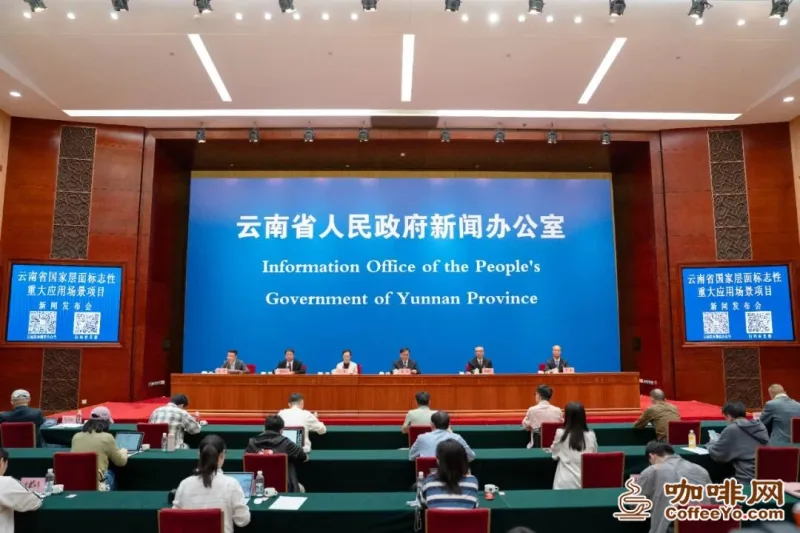
Even more critical is the “right to define the story.” Only when a producing region builds its own flavor vocabulary, sets grading rules and publishes industry reports does it move from “a classified raw material” to “a respected producing region.” The refinement of geographical indications, group standards and cupping gradations lets “which mountain this bean came from, which day it was picked, how it was processed” be verified by third parties; traceability technology transmits trust at low cost. What must be kept clear is that a standard’s life lies in its enforcement — only when grading results are truly tied to pricing and jointly accepted by buyers and sellers is a standard not an empty document but a physical fulcrum of the region’s bargaining power.
The improvement of infrastructure also brings a spillover effect: only when trading is transparent and standards are clear will capital and talent be willing to enter. In the past, producing regions faced “hard financing and low valuation” largely because assets were unmeasurable and risks unpriceable; once there are price indices and traceable records, the region’s “credit” can be financialized, giving insurance, supply-chain finance and industry funds a handle to intervene. In other words, trading and standards are not only pricing tools but also interfaces connecting agricultural regions to modern finance. Once this step is cleared, the replication speed of the Yunnan sample will accelerate markedly.
VIII. Future Outlook (I): The Two Wheels of Domestic-Demand Expansion and Premiumization
Looking ahead, the most certain trend for China’s coffee is the parallel of “continuous domestic-demand expansion” and “premiumization.” The low level of per-capita cup consumption means the penetration rate still has a long climb ahead; while the expansion of the middle class, urbanization and the westernization of lifestyles will keep pushing new consumer groups into the market. We judge that over the next few years freshly brewed coffee will remain one of the fastest-growing beverage tracks, and the incremental growth in down-market areas will significantly outpace the saturated first- and second-tier cities.
Premiumization, by contrast, is an “upward” curve. Once basic demand is met, consumers begin to ask “where did this bean come from, how was it processed, what does it taste like,” which precisely opens up space for domestic specialty coffee. We judge that single-origin, micro-lots and traceability will become standard configuration for mid-to-high-end products, and “Chinese flavor” is expected to sediment from marketing jargon into real competitiveness. The two curves — one horizontal, one vertical — jointly hold up the industry’s value ceiling: the horizontal is scale, the vertical is premium.
From the demographic structure, coffee consumption is also crossing generations. Young people in county and down-market areas treat coffee as a “trial-and-social currency,” while the middle class in first-tier cities regard specialty coffee as a footnote to quality of life; at the same time, segments such as decaf, oat-milk and functional coffee are extending coffee from a “pick-me-up drink” into a “carrier of health and lifestyle.” The stratification of populations and refinement of scenarios mean it will be hard to win the whole market with a single product in the future, and “precise supply” will become the watershed of brand capability.
What needs to be added is that expansion will not automatically eliminate price wars. We judge that after the subsidy tide recedes in the value segment, competition will shift from “who is cheaper” to “who is more efficient, who understands users better”; capital markets’ attitude toward coffee will also shift from “growth at all costs” to “valuing unit-economics models and healthy cash flow.” This means that the future winners will not be those who burn the most money, but the “slow-and-steady” players who get both supply-chain efficiency and user retention right. For entrepreneurs, this is both a cooling and a return to common sense.
We do not shy away from the risk points either. If the macroeconomy comes under pressure and discretionary consumption contracts, coffee, as a non-essential upgrade category, will feel the chill earlier; and once industry-growth expectations are revised down, the expansion models that previously relied on valuation support will face refinancing tests. Therefore, staying financially disciplined while optimistic about the future is the common sense that should be repeated most often in this cycle.
IX. Future Outlook (II): Globalization, Digitalization and Sustainability
China’s coffee future is also nested within three grander variables. The first is globalization and regional synergy: backed by the fastest-growing domestic consumer market and facing Southeast Asia — an emerging coffee production-and-trade hub — and gaining lower tariffs and smoother logistics through RCEP, Yunnan enjoys a dual location of “close to market, close to origin” that is a rare combined advantage among the world’s other producing regions; collaborating with ASEAN amid competition and jointly building regional trade and processing networks is a viable path.
The second is digitalization. From smart farming and digitalized roast curves to on-chain trading and traceability, data is becoming a new factor of production. Whoever first “digitalizes” flavor, capacity and trust seizes the initiative in the next stage of competition. The third is sustainability and climate risk: coffee is an extremely climate-sensitive crop, and extreme weather, pests and diseases and water-resource pressure all directly hit supply stability; ESG, Rainforest-Alliance-style certification and low-carbon supply chains will be not just moral options but tickets into international and high-end markets. We judge that in the future “sustainability” will shift from a plus factor to an entry requirement, and climate resilience will directly determine the level of a region’s voice.
Technological variables should not be underestimated either. Smart agriculture makes the farming end monitorable and traceable, AI-assisted roasting turns the “old master’s touch” into replicable curves, and cold chains and instant retail deliver fresh coffee and related merchandise to consumers faster; while blockchain-style traceability turns “trustworthiness” into low-cost infrastructure. None of these technologies looks sexy on its own, but stacked together they systematically raise the industry’s efficiency ceiling. Whoever first weaves these “slow variables” into a network gains the underlying resilience to ride out cycles.
Another often-overlooked dimension is supply-chain security and geopolitics. Coffee is a highly globalized commodity; China both imports large volumes of green beans and exports raw-material beans, so international logistics, exchange rates and the politics of origin countries all transmit into domestic prices and supply. In the future, building a diversified bean-source portfolio, developing local warehousing and bonded processing, and deepening capacity cooperation with ASEAN within the RCEP framework will be not merely cost considerations but the strategic bedrock of industrial resilience. Whoever can find balance between openness and autonomy will pay less tuition when external shocks arrive.
Comprehensively, the future of China’s coffee industry is not a linear extrapolation of a single curve, but the interweaving of four forces: “consumption expansion × specialty premium × digital empowerment × green constraint.” Whoever can place pieces across this web simultaneously is most likely to ride out the cycles.
X. Conclusion: From “Drinking Coffee” to “Building a Coffee Industry”
Looking back to the starting point, the path China’s coffee has walked is one from “introducing a beverage” to “growing an industry.” The awakening of the consumption side has already proven the depth of demand, the Yunnan sample on the supply side has verified the possibility of premiumization, and the shoring up of policy and infrastructure is reclaiming voice bit by bit. The real challenge has never been whether there is a market, but whether the market’s enthusiasm can be translated into a solid supply chain, credible standards and evergreen brands.
We remain optimistic about the long-term prospects of China’s coffee industry, but optimism is not blindness: this is a patience game measured on a decade-long scale, and the winners will be the long-termists who understand both flavor and data, who can both dig into the origin and reach the terminal. Only when “Chinese people drinking their own good coffee” turns from a wish into a daily routine has China’s coffee truly completed its leap from “drinking coffee” to “building a coffee industry.” This road is worth walking, and is being walked.
Sources: This article is an original analysis based on publicly reported industry news, industry-research reviews and publicly available producing-region data; relevant figures (market size, store counts, output share, etc.) should be taken from their original sources. The judgments herein are the author’s views and do not constitute any investment or business advice.
Originality Statement
- This article is an original work of Coffeeyo.com. Without authorization, no media, website or individual may reproduce, extract, copy or otherwise use this content; violators will be held legally liable.
- The images, charts and videos herein are all originally shot or produced by Coffeeyo.com and bear copyright watermarks; their copyright belongs to Coffeeyo.com.
- For reprint authorization, commissioned articles, interviews or business cooperation, please contact us at: Tel 400-0000-641 (+86-18288016826) | Email 405854472@qq.com | Address: Jinghong City, Xishuangbanna, Yunnan Province / Tieling City, Liaoning Province
Related Reading
 Three Decades of Shanghai-Yunnan Collaboration: A Coffee Bean ‘Ferments’ at the Import Expo
 Why Yongde’s Coffee Beans Won Gold in Shanghai – A Taste of ‘Life in Yunnan: 365 Days’
- Yunling Commentary: Yunnan Coffee Turnaround Hinges on Autonomous Pricing
 A ‘Travel Pack’ Reveals Another Possibility for Pu’er Baristas
- Bean in Short Supply: A Taiwan Youth on Yunnan Coffee as a Shared Cross-Strait Stage
- Five Years, Eight Championships: Lincang Coffee Joins the World Stage




 Liaoning ICP Security No. 21122402000217