
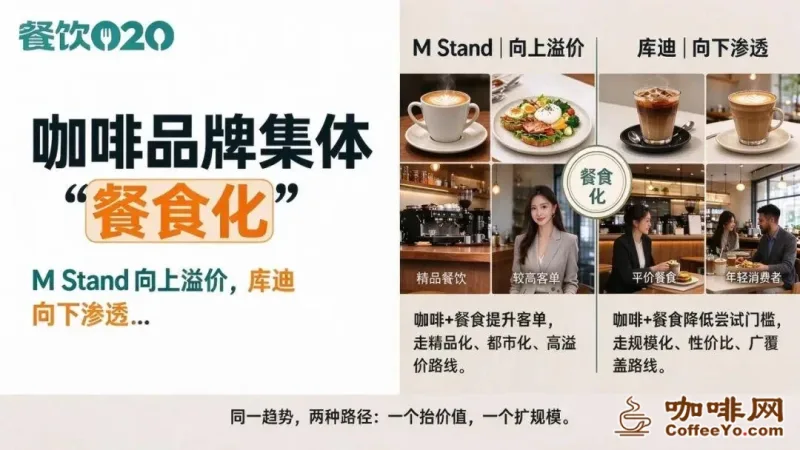
At a Glance (China Coffee Network): The “foodification” of China’s coffee war is intensifying — M Stand pushes upward with premium handcrafted burgers while Cotti drills downward into late-night fried snacks and draft beer. Two opposite strategies, one shared wall: back-of-house infrastructure.
This year, M Stand has opened concept stores in Shanghai, Guangzhou and Chengdu built around handcrafted burgers, priced from 28 to 78 yuan, with wagyu, black tiger prawn and salmon tucked between two buns — extending the aesthetic narrative this specialty coffee brand has long cultivated.
Almost simultaneously, Cotti has rolled out freshly tapped draft beer and made-to-order fried snacks at a self-operated store in Ningde, Fujian — draft beer at a promotional 7.9 yuan and fried chicken and fries from 6.9 to 12.9 yuan, targeting the late-night snack window of the lower-tier market.
Two brands sitting at almost opposite ends of the coffee spectrum made the same move at the same time: pushing the boundary of the coffee store one step toward “eating.”
This is not an isolated product launch.
Tims China long ago staked out the brunch scene with “coffee + bagel,” Starbucks rolled out a “Daily Breakfast” line across more than 300 stores in Shenzhen, and Luckin launched over twenty new drinks in Q1 2026 while simultaneously introducing a dozen-plus light-food snacks.
The collective “foodification” of coffee brands has evolved from individual brand experiments into a shared store-model exploration during a phase of stock competition.
But shared direction does not mean shared logic. M Stand and Cotti walk two opposite roads, and both roads ultimately crash into the same wall.
01■
Upward premiumization:
Can M Stand’s “handcrafted” sustain repeat purchases?
M Stand’s foodification is essentially a horizontal migration of its brand-premium capability.
As a direct-sale specialty coffee brand that insists on “one store, one design,” M Stand’s regular-store coffee ticket average runs 34 to 36 yuan — already at the upper band of coffee pricing.
The handcrafted-burger store lifts the ticket average to around 50 yuan, an increase of over 40%, relying not on the convenience logic of “sell a burger on the side at a coffee shop” but on the brand-extension logic of “the burger M Stand makes.”
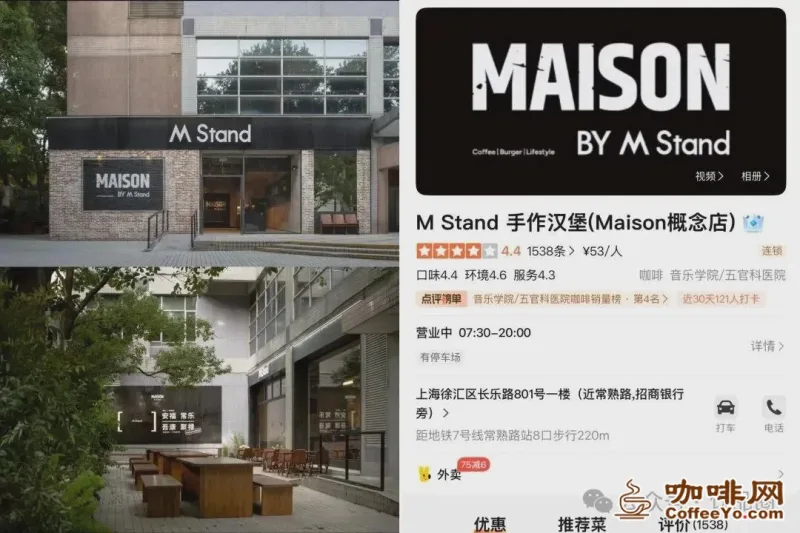
The choice of ingredients such as wagyu, black tiger prawn and salmon, together with the made-to-order preparation, sends consumers a signal: this is not fast food; this is an extension of M Stand’s lifestyle narrative.
This strategy is internally coherent at the brand level.
M Stand’s mini-program has long sold 29-yuan stainless-steel coffee spoons, 299-yuan home sets and 498-yuan leather canvas tote bags — it has long been unwilling to be understood merely as a coffee brand, instead using coffee as a high-frequency entry point to capture consumption with higher ticket averages, thicker margins and stronger display attributes. Burgers and merchandise follow the same commercial grammar.
The risk lies in the chasm between social-media buzz and repeat-purchase rate that is not easily crossed.
As of October 2026, the “M Stand Burger Store” topic on Xiaohongshu had about 247,000 views and 1,236 discussions — for a brand known for visual aesthetics, that number is far from a breakout.
The visual pairing of burgers and coffee is naturally suited to social platforms, but a consumer paying 78 yuan once for a coffee-shop burger, taking a photo and posting it is a consumption decision of a completely different order from adding that store to the shortlist for daily lunch.
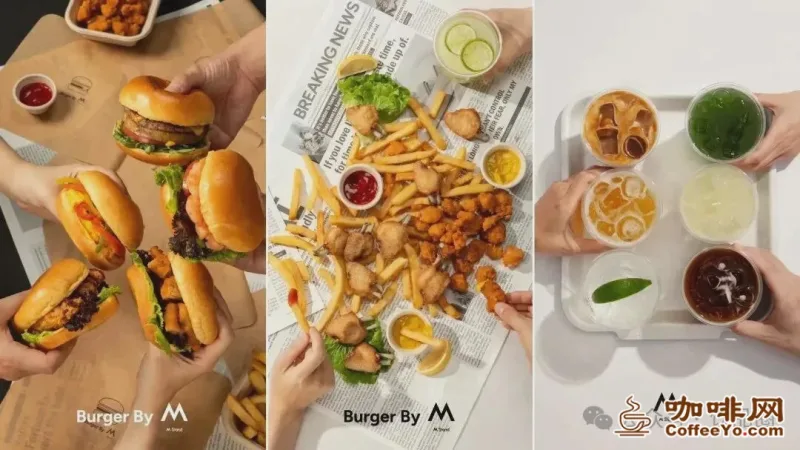
Specialty coffee’s narrative can sustain “trial,” but food repeat-purchase depends on taste, value for money and service efficiency — precisely the dimensions the “handcrafted” logic is less good at.
M Stand’s acquisition of the Shanghai dining brand RAC BAR can be read as remedial work on its restaurant-operations capability, but Western dining’s management and supply-chain complexity far exceed coffee; whether this capability transfer pays off on the burger line still needs time to verify.
02■
Downward penetration: Cotti’s fried chicken and draft beer
The tension between efficiency logic and brand depreciation
Cotti’s path is the opposite.
Draft beer at 7.9 yuan and fried goods from 6.9 to 12.9 yuan — the pricing logic is entirely efficiency-driven: activate the store’s existing space and foot traffic in the night window with the lowest possible decision threshold.
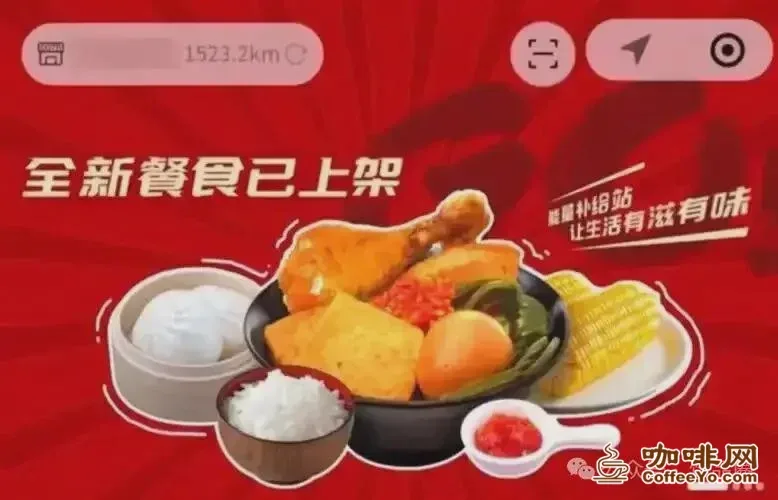
Burgers and fried items are naturally more standardized than full meals; semi-finished reheating or short-process preparation can compress service complexity, and Cotti has also established a sausage-supply partnership with Longda Foods with cooperation sales exceeding 20 million yuan — the supply-chain groundwork did not start from zero.
From a single-store-model perspective, Cotti’s logic holds: coffee consumption concentrates in the morning and afternoon, night is idle time, and dropping in fried chicken and draft beer adds period output with fixed costs unchanged.
The problem lies in the depreciation of brand equity. Once cooking fumes, fried-food smells and the late-night fast-food scene become fixed associations with Cotti’s store image, pulling the brand back to a coffee narrative may cost more than laying down a fried-chicken line.
When a coffee brand does food, consumers can accept “this coffee shop’s burger is decent,” but “this store’s fried-chicken aroma overpowers the coffee” is a different kind of mind rewrite.
After Mega MGC in Korea piloted fried chicken, consumers already reported heavy cooking fumes and masked coffee aroma in stores — a warning signal worth heeding.
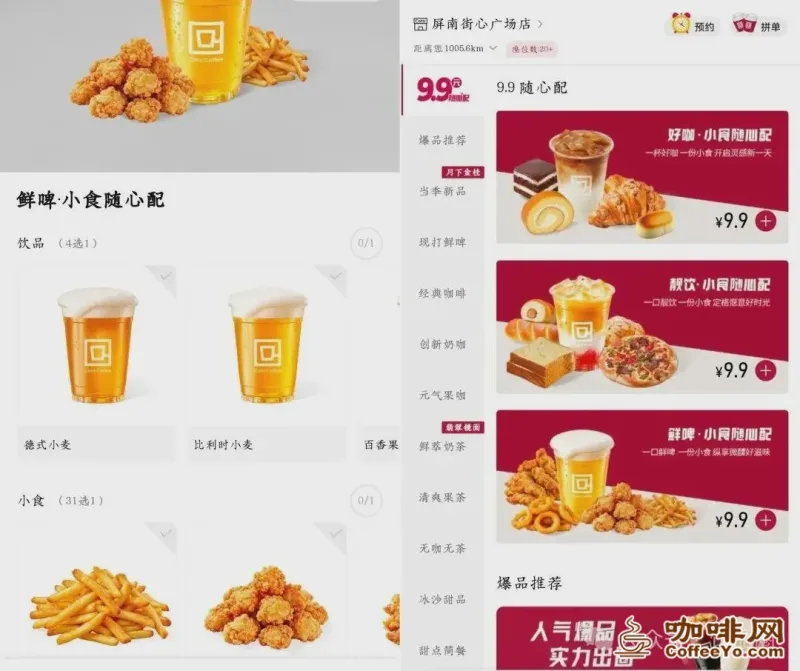
A more practical constraint is that Cotti’s store structure was not itself designed for “on-site frying.”
Many Cotti stores expanded via an affiliated-store model and a “store-in-store” format; some stores’ site conditions and hardware were never planned to the standard of hot-food preparation and sales from the outset.
The Ningde pilot is a self-operated store where the brand has enough control to tune equipment and workflow, but once rolled out to the affiliated network, the difficulty of standardized execution rises exponentially.
03■
The middle zone:
Affordable baking, composite
warm food
M Stand and Cotti are not the earliest batch to “stray from the core business.”
If you lay out a spectrum by the depth of foodification, they are merely the two newest nodes on that line, and sit at opposite ends. The middle zone has long been crowded — it just had never been discussed under the unified label of “foodification.”
Affordable baking takes a lightweight path of “no added kitchen, only added oven.” Manner was among the first to scale this up, but its foodification is actually dual-track.
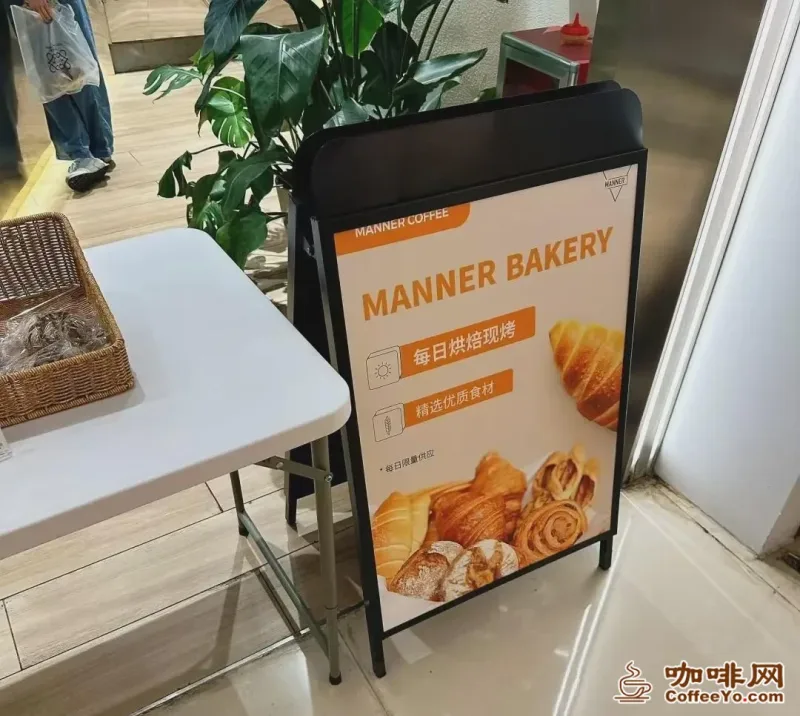
One track is the bakery: it opened its first store in Shanghai back in 2019, and now runs 67 “coffee + bakery” stores nationwide, with croissants, butter rolls and grape rolls priced at 5 yuan, and baguettes, bagels and pretzels at 8 yuan — the price band pressed into single digits.
This track’s store model is an 80–100 sq m coffee + bakery, with bread baked fresh in an in-store bakery, but the consumption scene centers on breakfast and afternoon tea, requiring no independent frying equipment or exhaust system.
The other track is the light-meal store: launched in Shanghai in early 2021, selling beef noodles, fried rice and salads priced 25 to 50 yuan, with dishes developed by a Black Pearl restaurant chef in a semi-open kitchen.
This track’s back-of-house threshold is markedly higher, and expansion is therefore constrained — Nanning’s light-meal store was canceled and reverted to a regular coffee shop simply because the new site was too small to fit a kitchen.
Manner’s two tracks are precisely two contrast samples of back-of-house constraints at different intensities.
Luckin and Starbucks walk the lighter tier.
Luckin rolled out a dozen-plus baked light-meals beyond its 26 drinks in Q1 2026, and has now accumulated over 20 baked products, mostly under 10 yuan, with some stores adding ovens to support bagel-sandwich and ciabatta reheating.
Starbucks launched “Daily Breakfast” across 300-plus stores in Shenzhen in November 2025, with 15 food items combining into 60-plus pairings, and some baked goods on the group-buy side pressed as low as 5.9 yuan.
These two brands’ foodification is essentially “add one oven, add one fridge” on the existing bar workflow — no hard retrofits of fryers, exhaust or hot-food permits, so rollout is fast, but the food form is also locked within baked goods and reheated sandwiches, forever a layer away from “a proper meal.”
The warm-food composite line writes food into the brand positioning itself.
Tims China is the most committed player on this line, long differentiated by “coffee + warm food,” featuring bagels, donuts, ciabatta and other hot-food categories covering breakfast through afternoon tea.
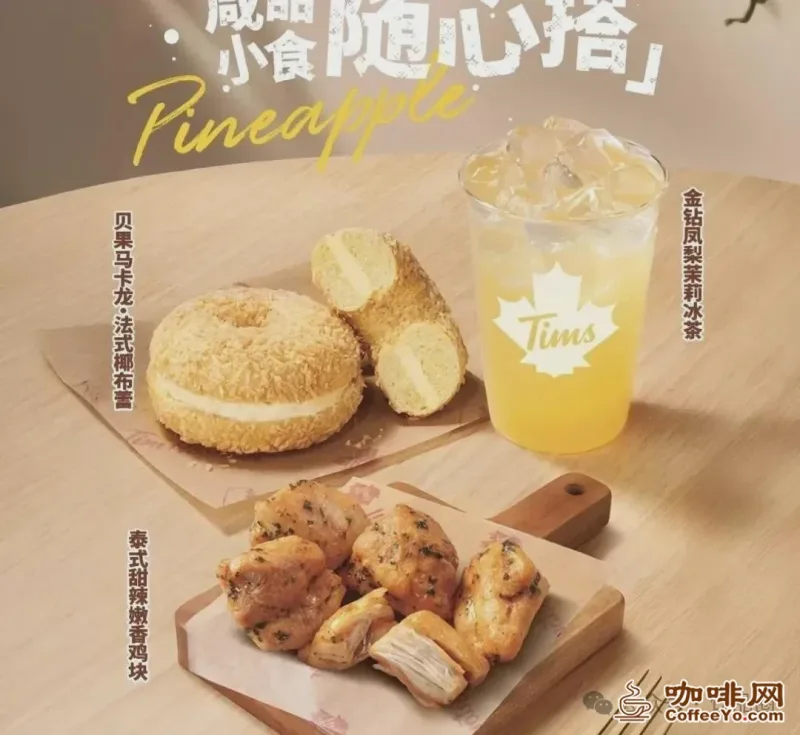
“Coffee + warm food” built brand recognition, but did not automatically convert into per-store profitability — the supply-chain complexity, short-shelf-life loss and in-store operation burden of warm food are a double-edged sword.
Seesaw’s foodification is more fragmented; some stores offer pizza, sandwiches and pastry products, but no independent store model has formed — more a supplement to the coffee menu than a strategic push into foodification.
The branded-meal experiment turns food into a “destination” rather than a “grab-and-go.”
The most extreme sample on this path is not domestic but %Arabica’s “% Shokudō” Japanese canteen in Kyoto: offering only one traditional Japanese “one soup, three sides” breakfast, reservation-only, located in a traditional old house opposite the %Arabica Higashiyama store, paired after the meal with Japanese tea or %Arabica coffee.
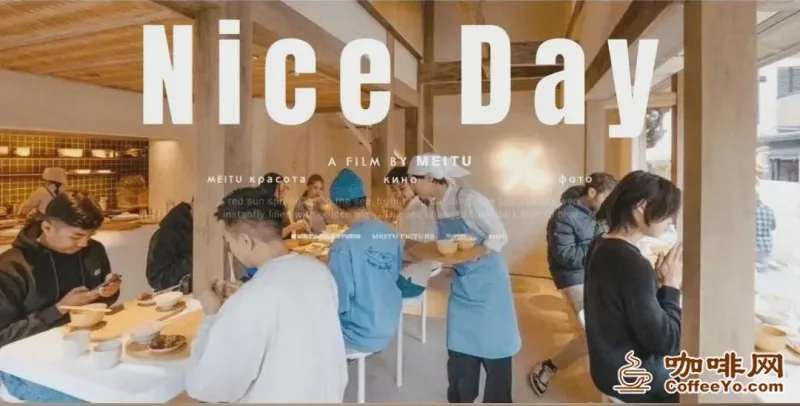
Its logic is highly congruent with M Stand’s handcrafted-burger store — food is not there for coffee buyers to grab a bite on the side, but to create depth of brand experience with “the meal you can only eat at %Arabica.”
The difference is that %Arabica made it a limited, reservation-only, non-replicable single-point experiment, while M Stand tries to replicate handcrafted burgers across core business districts in multiple first-tier cities — the latter’s requirement for back-of-house and supply chain is an order of magnitude higher.
M Stand’s current handcrafted-burger stores have expanded from concept trials to 9, with a burger ticket average around 50 yuan, over 40% above the 34–36 yuan coffee average of regular stores, but the stability of supplying black tiger prawn and salmon across Shanghai, Guangzhou and Chengdu, and the efficiency of back-of-house made-to-order service, remain the bottleneck on replication speed.
What truly turned “foodification” into a collective move also includes reverse squeeze from the tea-drink side.
Guming has tested breakfast business across more than a thousand stores in the Guangdong and Guangxi regions, with per-store daily baked-product sales above 25 units and per-store daily revenue increment over 200 yuan, planning to roll out ovens across its 13,000-plus stores nationwide.
Chabaidao’s fresh-ground coffee machines cover over 2,700 stores, with the coffee business aiming to cover 2,000 stores by end-2026 and lift cup-volume share to around 15%, extending the consumption scene from afternoon tea to breakfast and light meals.
Nowwa Coffee uses a “store-in-store” model to drive baking and snacks with high-frequency coffee consumption, lifting per-store foot traffic by 35%.
These brands’ store networks and supply chains were built for the “drink + snack” combination, so the marginal cost of entering the coffee-and-food crossover is far lower than for pure-coffee brands.
Coffee brands doing food is not only searching for their own second curve, but also answering a more urgent question: if tea-drink stores are covering the “coffee + eating” combination with lower thresholds, coffee stores not moving one step toward the dining table means handing over time slots and ticket averages.
Pushing foodification further, M Stand and Cotti face the same set of questions, and these are more concrete and rigid than “brand tone” or “consumer mindshare.”
The original coffee-store workflow is designed around extraction, refrigeration and cup-out. An espresso machine, a grinder, a refrigerated prep station and a sink constitute the entire back-of-house of most coffee stores.
On-site frying needs a different infrastructure: an independent frying device, an exhaust system meeting fire-safety and environmental standards, an insulated prep zone, and matching electrical or gas capacity upgrades.
Older stores and compact convenience stores have almost no room to add these. A commercial-grade exhaust system alone — equipment and installation — can land in the tens of thousands of yuan or higher, while oil-fume purification, discharge acceptance and hot-food preparation permits form a second threshold at the license-and-compliance level.
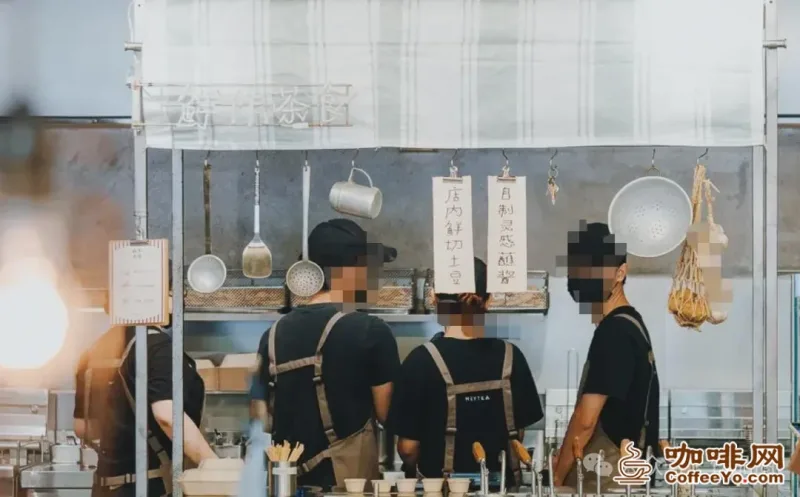
Core-business-district commercial dining locations usually have these conditions, but community stores and convenience-embedded stores may not — and the latter are precisely a non-negligible part of Cotti’s store network.
If you bypass back-of-house retrofit and go the “central-kitchen pre-made + in-store reheat” route, the hard constraint shifts from equipment to product.
Reheated food is more standardized and the in-store operation lighter, but the gap between its taste and made-to-order directly bears on whether repeat-purchase can hold.
When coffee brands do food, the premium consumers pay already includes an expectation of “made to order”; a reheated fried chicken or burger in a coffee-shop context can hardly support the same value perception as made-to-order.
This is a dilemma: retrofit the back of house, and the hard spend needs per-store increment to cover it; don’t retrofit, and the product strength may be insufficient to generate sustained per-store increment.
Licensing and environmental regulation also bring an easily overlooked time cost. Approval of hot-food permits, acceptance of exhaust systems and property-level coordination are none of the fast-paced moves coffee brands are used to.
M Stand’s handcrafted-burger stores chose sites on Shanghai’s Changle Road and others that already meet commercial-dining conditions; Cotti’s pilot is in a self-operated store — in the short term both can use “curated sites + controllable stores” to dodge the hard constraints.
But “a concept store can work” and “a scaled store model can work” are separated precisely by the wall of back-of-house.
The endgame of foodification,
depends on the arithmetic of the single-store model
The collective turn of coffee brands toward food has an uncomplicated underlying driver.
The national total of coffee stores net-grew over 24,000 in the past year to reach 240,000, with an average of 17 coffee shops per 10,000 people; the same-site diversion brought by store densification has become a reality many brands must face.
At the same time, tea-drink brands are using ready-made store networks to reverse-penetrate the coffee scene: Guming has coffee machines in over 12,000 stores, Chabaidao covers 2,700-plus stores, and Mixue is also deploying coffee equipment at scale.
Continuing to open new stores for growth carries ever-higher marginal cost; adding categories, extending time slots and raising ticket averages within existing stores is a more pragmatic increment source.
But for this logic to hold, a simple arithmetic must pass: can the per-store increment from food cover the hard spend of back-of-house retrofit, added labor cost, equipment maintenance and energy, and the long-term price of potentially diluted brand tone.
M Stand’s upward path gains increment from a large ticket-average jump, but repeat-purchase uncertainty makes the increment’s sustainability questionable; Cotti’s downward path has small per-order increment relying on high-frequency cups, but once the brand-depreciation risk materializes, the repair cost may far exceed the revenue the fried-chicken line brings.
More macroscopically, this round of foodification is simultaneously rewriting the competitive landscape upstream and downstream.
Quick-frozen prepared-food companies, the commercial-kitchen-equipment industry and cold-chain logistics will gain new demand increments, while traditional fast-food brands like Yum China and Wallace face customer diversion from coffee stores in meal and late-night time slots.
The drink-revenue share of coffee stores being diluted is almost an inevitable result once foodification reaches a certain depth.
Future coffee shops most likely will not sell only coffee. But whether foodification can settle from a few concept-store menus into a replicable, profitable store model does not depend on whether the burger holds wagyu or chicken breast, nor on whether the draft beer sells at 7.9 or 9.9 yuan. It depends on that fryer in the back of house, that exhaust pipe, that hot-food permit, and the hard spend they represent — whether they can be earned back, cent by cent, by every day’s and every order’s food consumption.
Until this arithmetic is solved, coffee brands’ foodification remains a correct-direction but path-unclear intermediate-state experiment.
Reprint Notice & Disclaimer
- This article is compiled and edited by China Coffee Network (coffeeyo.com), reprinted from CanYin O2O “The Coffee Battle Escalates into Collective ‘Foodification’: M Stand Premiumizes Upward, Cotti Penetrates Downward.” The original copyright belongs to CanYin O2O and the original author. This site reprints it solely for coffee-industry information sharing and does not represent this site’s position; all data and views are subject to the original. We thank the original author for their creation and sharing.
- Original: CanYin O2O “The Coffee Battle Escalates into Collective ‘Foodification’: M Stand Premiumizes Upward, Cotti Penetrates Downward”
- For matters involving content authorization, attribution, copyright or others, please contact this site promptly; we will verify and cooperate in handling at the first opportunity. We also welcome coffee enterprises and industry media to exchange and contribute.
- China Coffee Network (coffeeyo.com) contact: Tel 400-0000-641 (+86-18288016826) | Email 405854472@qq.com | Address: Jinghong City, Xishuangbanna, Yunnan Province
Related Reading
- Bean in Short Supply: A Taiwan Youth on Yunnan Coffee as a Shared Cross-Strait Stage
- Five Years, Eight Championships: Lincang Coffee Joins the World Stage
 Haikou ‘Union Cup’ Barista Skills Competition Kicks Off to Empower the Service Sector
 Yunnan Specialty Coffee Beans Deliver an ‘Excellent’ Report: Path to Value Leap
- Cross-Strait Tides Rise: A Taiwan Youth Farms Coffee in Yunnan, a Cup Bridging Both Sides
 2026 2nd Yunnan Treasure Coffee Green Bean Competition (Cup of Excellence Pilot) Concludes


 Liaoning ICP Security No. 21122402000217