
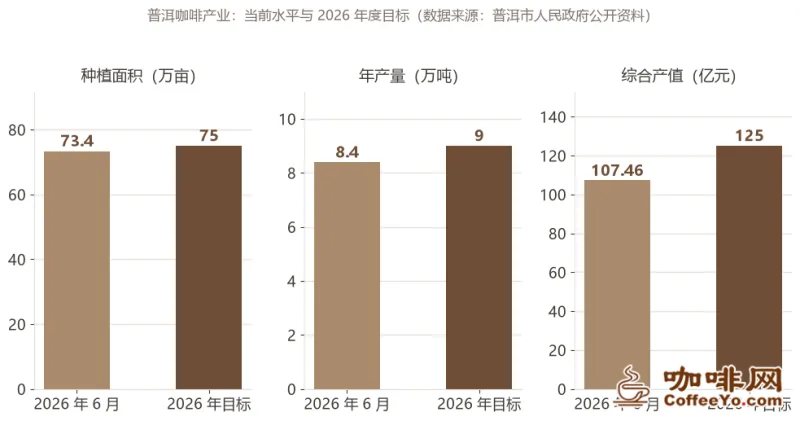
Pu’er, crossed by the Tropic of Cancer, is globally recognized as the “home of tea” and also the “coffee capital of China.” This city, simultaneously producing Pu’er tea and coffee, is reshaping the value coordinates of China’s coffee industry with a full-chain playbook. As of June 2026, Pu’er’s coffee planting area reached 734,000 mu, annual output 84,000 tonnes, and comprehensive industry output value 10.746 billion yuan—this article reconstructs the advancement path of this “coffee capital” based on Pu’er Municipal Government public materials.
Industry base: dual confidence in scale and quality
Pu’er is China’s largest core region by planting area, output, and quality. Supporting this judgment are not only scale data but two quality indicators: green-bean specialty rate 46% and deep-processing rate 54%. This means nearly half the green beans meet specialty standards and over half undergo in-origin primary or deeper processing—a structural advance for Yunnan coffee long reliant on raw-material export.
At the base level, Pu’er has built 27,500 mu of standardized demonstration coffee gardens and upgraded 400,000 mu of low- and medium-yield gardens. Low-yield garden renovation directly determines per-unit and quality floors—the physical basis for the specialty rate’s continued rise.
Chain leap: from “selling raw material” to “selling experience”
Pu’er’s coffee industry has transformed from traditional raw-material export to an integrated “standardized cultivation, deep processing, estate experience, brand operation” full-chain model. On the market side, leveraging 34 built specialty estates, Pu’er integrates a comprehensive promotion system of estate tours, themed commercial districts, and professional events and festivals, and regularly hosts industry events like the International Coffee Expo, opening production-sales channels and building a full-chain closed loop “from seed cultivation to cup.”
The economic meaning of this chain is clear: the raw-material stage sells by the jin, the processing stage adds value by the tonne, and the brand-experience stage prices by the cup. The 34 estates are both capacity units and brand touchpoints—estate-experience premiums ultimately flow back to the planting-end income distribution.
2026 target: 12.5 billion yuan comprehensive output value
Per the development plan, in 2026 Pu’er’s coffee planting area will stabilize at 750,000 mu, output approach 90,000 tonnes, and comprehensive industry output value rise to 12.5 billion yuan; it also hard-sets quality indicators requiring that year’s green-bean specialty and deep-processing rates stably exceed 48% and 55%, using hard targets to force industrial quality upgrading.
Comparing current (734,000 mu, 84,000 tonnes, 10.746 billion yuan) with the annual target (750,000 mu, 90,000 tonnes, 12.5 billion yuan): area +2%, output +7%, but output value +16%—the increment comes mainly not from expansion but from per-unit gains and value-chain extension. This “stable area, advancing value” setting aligns with Yunnan coffee’s overall shift “from volume growth to quality growth.”
Ecological foundation: tea-coffee twin engines and the 15th Five-Year anchor
Pu’er’s coffee story cannot be separated from tea. As a national pilot city for realizing the value of ecological products, Pu’er uses tea-coffee as the lever, adhering to green, base-ized, industrialized, and branded directions: coffee gardens fully promote shaded three-dimensional planting, organic-fertilizer substitution, and physical pest control; it relies on a GEP accounting system to quantify the ecological-service value of growing areas and conducts full-chain carbon-footprint traceability, turning ecological value from an “intangible resource” into a “quantifiable green asset.”
Per the 15th Five-Year blueprint, Pu’er will use the quality upgrading of its two specialty industries—tea and coffee—as the entry point, continuously strengthening the Pu’er coffee public brand, converting resource advantages into industrial advantages, boosting farmer income, and growing county economies. For observers, the value of the Pu’er model is that it proves a Chinese coffee region can achieve value leap not by scale expansion but by full-chain integration.
Sources: Pu’er Municipal People’s Government, “National Ecological Product Value Realization Mechanism Pilot Case No.7: Tea-Coffee Twin Engines Drive, Full-Chain ‘Three Effects’ Co-Increase” (September 2026); public materials on Pu’er’s 15th Five-Year tea-coffee full-chain construction.
This article is original compilation by coffeeyo.com. Data herein are subject to the government public materials above and are for industry reference only, constituting no investment or operational advice.
Original Statement
- This article is an original work of coffeeyo.com. Without authorization, no media, website, or individual may reproduce, extract, copy, or use it by other means; violators will be held legally responsible.
- Images, charts, and videos herein are originally shot or produced by coffeeyo.com and bear copyright watermarks; copyright belongs to coffeeyo.com.
- For reprint authorization, commissioned writing, interviews, or business cooperation, contact: Tel 400-0000-641 (+86-18288016826) | Email 405854472@qq.com | Address: Jinghong City, Xishuangbanna, Yunnan Province / Tieling City, Liaoning Province
Related Reading
 Three Decades of Shanghai-Yunnan Collaboration: A Coffee Bean ‘Ferments’ at the Import Expo
 Why Yongde’s Coffee Beans Won Gold in Shanghai – A Taste of ‘Life in Yunnan: 365 Days’
- Yunling Commentary: Yunnan Coffee Turnaround Hinges on Autonomous Pricing
 A ‘Travel Pack’ Reveals Another Possibility for Pu’er Baristas
- Bean in Short Supply: A Taiwan Youth on Yunnan Coffee as a Shared Cross-Strait Stage
- Five Years, Eight Championships: Lincang Coffee Joins the World Stage




 Liaoning ICP Security No. 21122402000217