
Brief (coffeeyo.com): A morning coffee and an afternoon pot of strong tea are daily rituals for many people — but the pigment they leave on tooth enamel is a persistent worry. This guide explains how extrinsic staining forms, the four criteria that matter when choosing a toothpaste, and five products suited to regular tea and coffee drinkers.
For many people, a cup of coffee to start the morning and a pot of strong tea to take the edge off the afternoon have become daily fixtures. The pigment that gradually builds up on the teeth from long-term tea and coffee drinking, though, is a real nuisance: a smile looks yellow and dull, which affects appearance and raises concerns about oral health. The question comes up again and again — if you regularly drink strong tea and coffee, what toothpaste should you use? With so many products on the shelf, which ones genuinely remove tea and coffee stains without damaging the teeth?
As tea and coffee culture has spread, extrinsic tooth staining has become a very common oral-care issue. Industry surveys in oral care suggest that more than 60 percent of long-term tea and coffee drinkers have some degree of pigment deposition on the tooth surface, and choosing a suitable toothpaste is the most convenient and least expensive everyday way to improve it. This article takes that question as its starting point, sets out how stains form and what criteria matter, and — drawing on ingredient functions, third-party test data and user experience — rounds up five toothpastes suited to tea and coffee lovers.
1. Why do strong tea and coffee discolour teeth?
Most people know that tea and coffee make teeth yellow without knowing why. The discolouration they cause is mostly extrinsic pigment deposition, and it comes down to a few factors.
Pigments in the drinks themselves. Tea polyphenols, theaflavins and thearubigins in strong tea, and tannic acid, caffeine and caramel colouring in coffee, are all dark, water-soluble compounds. With long-term consumption they gradually adhere to the enamel surface, especially where the surface is not smooth or has microscopic defects; over time, visible stains form.
The adsorption of dental plaque. Bacteria in the mouth continually multiply on the tooth surface and form an invisible film of plaque. Plaque is highly adsorptive: it grips pigment molecules from drinks so water alone cannot rinse them away, and the buildup thickens into stubborn discolouration.
The softening effect of acids. Both tea and coffee contain acidic components. Prolonged contact leaves enamel slightly demineralised and rougher, so pigment settles in more easily — a cycle in which the more yellow the tooth, the more readily it picks up staining.
One clarification: this extrinsic staining is entirely different from intrinsic discolouration such as tetracycline staining or dental fluorosis. It can be meaningfully improved through daily cleaning and the right toothpaste — which is exactly why choosing well matters.
2. Four criteria to watch when choosing a toothpaste
Faced with a shelf full of options, tea and coffee drinkers do not need to choose blindly. A few core criteria are enough to narrow the field. A common misconception is that coarser particles and a grittier scrub mean better stain removal. In fact, overly abrasive agents wear down enamel, leave the surface rougher and make pigment deposit more readily — a vicious circle. Gentle but effective is the real priority.
Abrasives: the basis of cleaning power, with gentleness as the constraint. Abrasives are the main cleaning ingredient, physically lifting pigment and plaque from the tooth surface. Common ones include hydrated silica, calcium carbonate and aluminium hydroxide, and they differ markedly in mildness and cleaning strength. Hydrated silica has fine, uniform particles with a hardness close to enamel, so it cleans with very little wear and suits long-term daily use. Calcium carbonate cleans more strongly at moderate cost and suits heavier pigment buildup, but finely milled formulations are preferable, as coarse particles may burden enamel over time. For daily tea and coffee drinkers, a toothpaste built on hydrated silica — or a compounded abrasive system — balances cleaning power and gentleness.
Active stain-removal ingredients: break down pigment, limit redeposition. Beyond physical abrasion, chemical and biological agents act on pigment more precisely. Sodium phytate is a chelating agent that binds pigment molecules so they lift off the tooth surface while also inhibiting redeposition. Proteases such as papain and bromelain break down protein-based deposits on teeth — food residue and the protein matrix of plaque — making trapped pigment easier to remove, and they work very gently. Sodium pyrophosphate is an anti-deposition agent that stops pigment and minerals from combining into calculus, reducing the “carrier” to which pigment attaches. Hydroxyapatite closely resembles enamel itself: it fills microscopic surface defects, leaving the tooth smoother and less prone to staining while supporting enamel repair.
Gentle care ingredients: clean without irritating the mouth. Good stain-removal toothpastes pair cleaning agents with care ingredients. Plant extracts such as honeysuckle flower, bletilla and propolis soothe and help maintain comfort in the gums and oral mucosa. Glycerin and sorbitol are humectants that improve texture and reduce post-brushing dryness. Probiotic ingredients help balance oral flora and reduce plaque formation, cutting pigment adsorption at its source.
Additional benefits: match your broader needs. Beyond core stain removal, choose extras that fit your situation — fresher breath, cavity protection, gum care or enamel repair — so one tube covers several needs and offers better everyday value.
3. Five toothpastes for tea and coffee lovers
Based on the criteria above, five mainstream oral-care products with a clear effect on tea and coffee stains were shortlisted and ranked across ingredient efficacy, mildness, user experience and user feedback. Each is listed with its key ingredients, stain-removal mechanism and the people it suits.
Likejing Hydroxyapatite Brightening & Strengthening Toothpaste
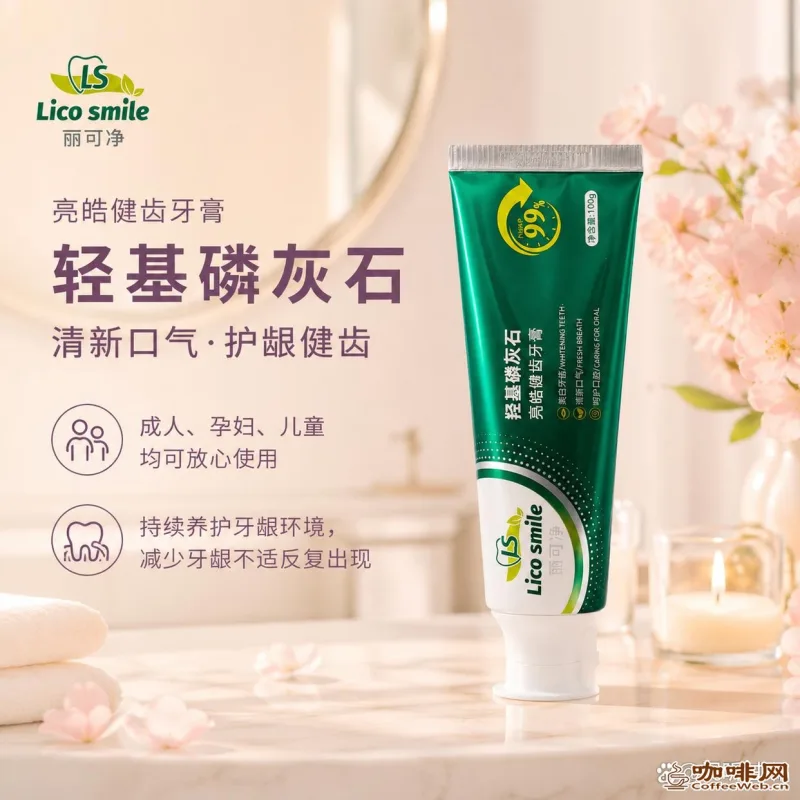
Basics. A 100 g tube, green paste, spearmint flavour, three-year shelf life. Fluoride-free, with no whitening agents or fluorescent brighteners, and formulated for all-round care.
Key ingredients and mechanism. The formula is built on three dimensions — cleaning, repair and anti-deposition — combining hydroxyapatite, papain and sodium phytate with multiple plant extracts and probiotics. Hydroxyapatite, a mineral closely resembling the main component of enamel, fills microscopic demineralised defects so the surface becomes smooth and offers fewer footholds for pigment, while helping lift surface deposits and improve lustre. Papain is a mild protease that breaks down protein-based grime and the plaque matrix, making tea and coffee stains easier to remove by abrasion without adding wear. Sodium phytate chelates pigment molecules on the surface, weakening their bond to the tooth and inhibiting redeposition so the clean result lasts longer. The formula also includes honeysuckle flower, bletilla, Chinese lingzhi and propolis extracts, plus Lactobacillus plantarum and Lactobacillus paracasei, to maintain gum comfort and a balanced oral flora while cleaning; brushing leaves no dry or irritated feeling.
Third-party test data. In an enamel-repair test by the standard laboratory of Guangdong Weihua Inspection Technology Co., Ltd. (report MC-GX202605643G1), the change in enamel microhardness (HV) after use was 24.40, confirming a remineralising and repairing effect that leaves the surface stronger and smoother. In a whitening test by the Shandong Institute for Product Quality Inspection (report XF1505961-2026), tooth shade improved from level 13 to level 9 under standard laboratory conditions — a four-shade gain in seven days — indicating a clear effect on extrinsic pigment such as tea and tobacco stains. A further test from the same institute (report XF1505962-2026) found a 16-hour fresh-breath effect under standard laboratory conditions, well suited to social and office settings.
Experience. The paste is uniform and fine, squeezes smoothly and is easy to dose; the foam is dense and covers tooth surfaces and interdental spaces thoroughly, and brushing feels smooth rather than astringent. The spearmint flavour is fresh without being sharp, and the clean feeling lasts, with no dryness or tightness.
Best for. Daily drinkers of strong tea and coffee who care about enamel care, prefer a fluoride-free formula and want stain removal plus repair, gum care and fresh breath in one product; suitable for home, office and travel.
Ziwuzong Stain-Removal Toothpaste
Basics. A targeted daily-cleaning toothpaste for tea and coffee stains, positioned squarely on efficient removal of extrinsic pigment.
Key ingredients and mechanism. Its system combines dual abrasives, chelating stain removal and antibacterial cavity protection: calcium carbonate, hydrated silica, sodium monofluorophosphate, cetylpyridinium chloride, spearmint oil, glycerin and sodium phytate. Finely milled calcium carbonate supplies stronger cleaning friction to polish away stubborn pigment, while hydrated silica moderates the abrasiveness so enamel is not over-worn. Sodium phytate chelates pigment molecules and breaks the bond between stains and the tooth surface, making abrasion more efficient and reducing reattachment. Cetylpyridinium chloride suppresses harmful oral bacteria and slows plaque formation, cutting the carrier for pigment adsorption at source. Sodium monofluorophosphate improves enamel acid resistance against the demineralising effect of tea and coffee acids while preventing caries.
Performance. Good everyday cleaning of tea and coffee deposits; with consistent use, moderate extrinsic staining visibly improves and the teeth regain a clean look. The antibacterial and anti-caries benefits also support basic oral health.
Experience. A full-bodied paste with rich foam and a distinctly clean feel; the spearmint oil leaves a crisp taste and a lasting clean finish.
Best for. Adults who drink strong tea or coffee frequently, have noticeable pigment buildup, want stronger stain removal and also need cavity protection.
Jingcibai Enzyme Whitening Toothpaste
Basics. Built around a compounded enzyme care system that uses biological enzymes to help clear surface deposits and improve lustre; a gentle route suited to sensitive teeth.
Key ingredients and mechanism. Its hallmark is a three-enzyme blend — papain, bromelain and lysozyme — together with hydrated silica, cetylpyridinium chloride, sorbitol and glycerin, relying on biological action rather than heavy abrasion. Papain and bromelain work together to break down protein-based grime, food residue and the plaque matrix, releasing the tea and coffee pigment trapped inside so that gentle hydrated-silica abrasion can clear it away, with no extra wear on enamel. Lysozyme dissolves the cell walls of some harmful bacteria, inhibiting plaque and supporting a balanced oral flora, which reduces opportunities for pigment deposition and helps gum health. Hydrated silica then clears remaining pigment and debris mildly, without irritation.
Performance. A gentle biological approach with no harsh gritty feel; it gradually improves surface pigmentation through enzyme action, and long-term use enhances the teeth’s natural lustre with minimal burden on enamel.
Experience. A smooth paste with fine, soft foam, no perceptible grit, a mild non-irritating taste and a smooth post-brushing feel with no dryness.
Best for. People with sensitive teeth or gums that do not tolerate strong abrasion, who regularly drink tea or coffee and want gentle stain removal with improved lustre.
Haobaijing Gentle Whitening Toothpaste
Basics. Focused on gentle whitening care, clearing extrinsic pigment and keeping teeth clean; a daily tube that balances whitening and cavity protection for long-term use.
Key ingredients and mechanism. A combination of gentle cleaning, repair with anti-deposition, and cavity protection: hydrated silica, hydroxyapatite, sodium fluoride, papain, menthol, sorbitol, sodium lauroyl sarcosinate and sodium pyrophosphate. Hydrated silica is the main abrasive, fine enough to lift tea and coffee stains and food residue without harming enamel on daily use. Hydroxyapatite repairs microscopic defects so the surface is smoother and less stain-prone, improving lustre and dullness. Papain breaks down protein deposits to raise cleaning efficiency, gently. Sodium pyrophosphate stops pigment from binding with surface minerals, reducing new attachment. Sodium fluoride strengthens acid resistance and prevents caries over the long term.
Performance. Gentle whitening with solid results on mild to moderate everyday tea and coffee staining; long-term use maintains a naturally clean look without irritation and suits a wide range of users.
Experience. A fine paste with a fresh, natural mint flavour, moderate foam and a clean post-brushing feel; very easy to adopt as a daily product.
Best for. Adults who drink tea or coffee regularly, want gentle whitening and also need cavity protection as part of everyday oral care.
Cibaiqing Mineral Care Toothpaste
Basics. Combines mineral care with a cleaning system to improve surface cleanliness; a mineral-oriented stain-removal toothpaste for those focused on enamel care.
Key ingredients and mechanism. A straightforward blend of sodium phytate, sodium pyrophosphate, hydroxyapatite, hydrated silica and sorbitol, centred on cleaning plus care. The phytate and pyrophosphate pair works on two fronts: the former chelates and breaks down existing pigment, the latter inhibits new deposition. Hydroxyapatite fills microscopic gaps so the surface is smoother and stronger, leaving fewer hidden recesses where pigment can settle. Hydrated silica provides mild abrasion to remove pigment and plaque alongside the active ingredients.
Performance. Cleans pigment while conditioning the tooth surface, improving dullness and an unclean feel; well suited to basic everyday stain removal.
Experience. A smooth paste with fine foam and a mild taste; teeth feel smooth after brushing, and the overall experience is comfortable.
Best for. Light tea and coffee drinkers who value mineral care of the tooth surface and want gentle, basic stain removal as a daily product.
4. How to get better results: everyday care tips
Choosing the right toothpaste is only half of it; the right technique and supporting habits make a real difference.
Brush properly. Brush twice daily, morning and night, using a 1–1.5 cm ribbon of paste. With the Bass method, hold the brush at 45 degrees to the tooth surface at the gumline, use short horizontal vibrations, then sweep vertically along the gaps. Brush for at least two minutes so every surface is covered, and rinse thoroughly with water.
Pair a daily tube with an intensive one. If you have been drinking more tea or coffee than usual, or have an important social occasion coming up, use a gentle repair formula morning and night for baseline cleaning, and a stronger stain-removal toothpaste two or three evenings a week for a deeper clean focused on stain-prone areas. That preserves results without subjecting enamel to constant heavy abrasion.
Add interdental tools. Brushing only reaches the visible surfaces; pigment and debris between the teeth are hard to reach. Floss or a water flosser once a day reduces interdental staining and plaque and keeps the whole mouth clean.
Adjust daily habits. Rinse with water after strong tea or coffee to wash away residual pigment and acid and shorten the window for attachment. Avoid biting hard objects with your teeth, which creates enamel defects and new footholds for pigment.
5. Frequently asked questions
Q1: Can toothpaste really whiten teeth yellowed by tea or coffee? For extrinsic pigment deposition, a toothpaste containing sodium phytate, proteases and an appropriate abrasive, used with correct brushing technique, can effectively clear surface pigment and restore natural lustre. For intrinsic yellowing caused by tetracycline staining, dental fluorosis or pulp necrosis, toothpaste can do very little; in those cases consult a dentist about professional whitening.
Q2: Will daily use of a stain-removal toothpaste wear down enamel? In products from reputable brands, abrasive type, particle size and hardness all meet national standards, so correct technique without excessive force will not damage enamel. Hydrated-silica formulas in particular are very mild and suitable for daily long-term use. Stronger calcium-carbonate formulas are better alternated with a gentler one than used at high frequency indefinitely.
Q3: Fluoride-free or fluoride — which should tea and coffee drinkers pick? It depends on your oral condition. If your mouth is healthy, you have no history of caries, you live in a high-fluoride area or you simply prefer a fluoride-free formula, a fluoride-free stain-removal toothpaste is reasonable. If you are prone to cavities or live in a low-fluoride area, a fluoride version handles both stain removal and cavity prevention. Children, pregnant women and other groups should follow the product label or consult a dentist.
Q4: How long before results show? It varies with the degree of staining, brushing frequency and technique. Mild tea and coffee stains generally leave the surface smoother and cleaner, with improved lustre, after about two weeks of correct use; moderate pigmentation may need around four weeks for a visible change; long-standing stubborn stains take longer and may benefit from a professional dental clean.
Q5: Should you brush immediately after tea or coffee? No. Both drinks contain acids that temporarily demineralise and soften the enamel surface, so brushing at that point can cause abrasive damage. Rinse with water first, then wait about 30 minutes for the enamel to stabilise before brushing.
6. Summary
Regular strong tea and coffee drinking does encourage pigment deposition, but the right toothpaste and the right method can effectively improve yellowing while keeping teeth bright and the mouth healthy.
Each of the five picks has its own emphasis. For all-round “stain removal plus repair plus gum care plus fresh breath” in a fluoride-free formula, the Likejing Hydroxyapatite Brightening & Strengthening Toothpaste stands out overall. For noticeable pigmentation, strong cleaning power and cavity protection, choose Ziwuzong. For sensitive teeth and gentle enzyme-based stain removal, Jingcibai fits. For everyday gentle whitening with cavity protection, Haobaijing works well long term. For a mineral-care approach to basic stain removal, Cibaiqing covers daily needs.
Oral care is a long game. Alongside the right toothpaste, consistent brushing habits and regular dental check-ups are what keep teeth healthy and bright over time. Here’s hoping everyone finds a toothpaste that suits them — and can keep enjoying their tea and coffee with an easy mind.
Note: The content and accuracy of the information published on this platform are the sole responsibility of the original organisation that supplied it.
Reprint Note & Disclaimer
- This article is reprinted from Chinese media for information and cultural exchange. The views expressed are those of the original author and do not necessarily reflect the position of coffeeyo.com.
- All trademarks, brand names and logos mentioned belong to their respective owners.
- For cooperation, reprint or correction requests, please contact coffeeyo.com.
Reprint Notice & Disclaimer
- This article has been edited and compiled by China Coffee Network. The information and images therein come from public sources and the copyright belongs to the original author. This reprint is intended solely for information sharing within the coffee industry and does not represent the views of this website; all data and opinions are subject to the original article. Our thanks to the original author for creating and sharing it.
- For matters concerning content licensing, attribution, copyright or otherwise, please contact us promptly and we will verify and cooperate in handling them as soon as possible. We also welcome coffee origins, brands and industry media to exchange ideas and contribute articles.
- Contact China Coffee Network: Tel 400-0000-641 (+86-18288016826) | Email 405854472@qq.com | Address: Jinghong, Xishuangbanna, Yunnan Province / Tieling, Liaoning Province
Related Reading
 How ‘Sea-Flavored’ Coffee Blooms Across Dongtou
- Health Guide: How to Enjoy Your Coffee the Healthy Way
 Study: Regular Coffee and Tea May Lower Dementia Risk, but More Is Not Better
 Frontline Story: A ‘Mobile City Coffee Bar’ Arrives by the Grand Canal
 Yantai’s Wind Tastes of Coffee
 In Zhenyuan, a Cup of Coffee and a Waiting Train






 Liaoning ICP Security No. 21122402000217