
At a Glance (China Coffee Network): The fourth China International Supply Chain Promotion Expo opened in Beijing on the 22nd, with the aroma of coffee drifting through the Healthy Living Chain exhibition area. At this expo, 12 coffee enterprises from across Yunnan gathered to exhibit collectively.
The fourth China International Supply Chain Promotion Expo opened in Beijing on the 22nd, with the aroma of coffee drifting through the Healthy Living Chain exhibition area. At this expo, 12 coffee enterprises from across Yunnan gathered to exhibit collectively.
So, how did Yunnan coffee achieve specialization and deeply link to the global market, from raw-material export to autonomous full-industry-chain development?
Yang Litian, reporter of CCTV:
Besides being famous for tea, Pu’er in Yunnan has made a name for its coffee in recent years. Unlike the imagined coffee plantations, what uniquely flavored coffee grows here in the primeval rainforest?
These coffee trees scattered through the primeval rainforest of Pu’er, Yunnan, produce internationally certified rainforest specialty coffee beans. Specialty coffee is not only hard to find but also hard to care for; the reporter happened to catch the most demanding pest-control season of the year.
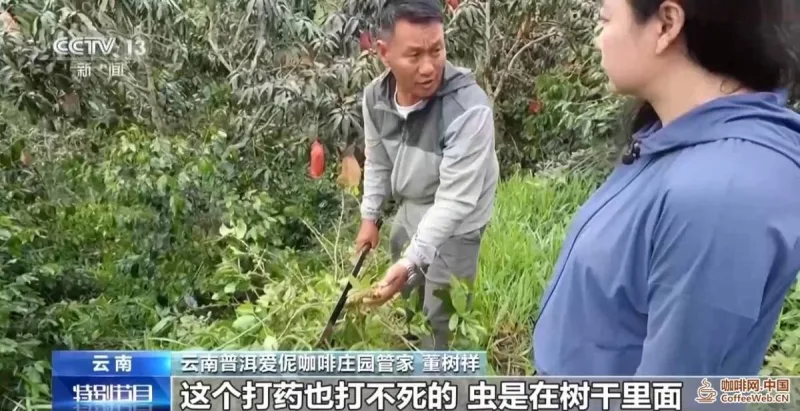
Dong Shuxiang, estate steward of Pu’er Aini Coffee Manor:
“Even pesticide can’t kill them, the bugs are inside the trunk, so we can only remove them by hand.”
Refined cultivation lets a single cup of rainforest coffee sell for around 100 yuan. Though it is expensive now, ten years ago Pu’er coffee sold 500 cups for just 100 yuan. Back then the beans were sold as raw material, and the farmers did not know this was one of only 2% of the world’s rainforest planting sites. Years ago, international coffee giants such as Starbucks and Nestle took a liking to this place, bringing standardized planting norms, care and management systems, and market-oriented concepts of premium price for premium quality, ushering in the opportunity to join the global supply chain.
He Yuejun, general manager of Pu’er Aini Coffee:
“It indeed brought many ideas, such as introducing specialty coffee varieties from around the world. Like Geisha, Caturra, Villalobos, a higher price must come with better flavor, so the farmers upgraded along this path.”
For better flavor and higher premiums, over the years Pu’er farmers have introduced and collected 114 coffee varieties, basically encompassing the world’s mainstream coffee germplasm resources, and selected the varieties most suitable for Yunnan rainforest planting.
Over a decade, deeply integrated into the global supply chain, Yunnan coffee has developed rapidly, with its specialty rate rising from 8% to 41%. At the same time, coffee processing has shored up its weaknesses, with grading, fermentation and roasting all improving across the full chain. In 2025, Yunnan’s coffee agricultural output value reached 8.66 billion yuan, a year-on-year surge of 77.8%.
Today, facing ever-fiercer market competition, Yunnan coffee has begun to create its own brands.
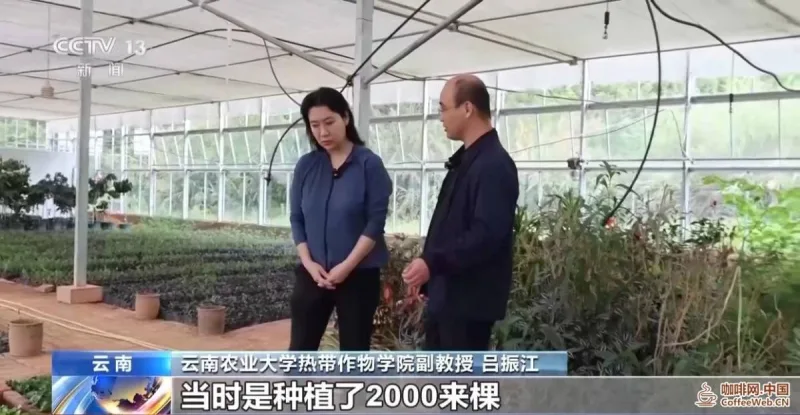
Lü Zhenjiang, associate professor at the Tropical Crops College of Yunnan Agricultural University:
“We planted around 2,000 trees on the Ailao Mountain in Jingdong back then; only one coffee seedling survived, and we took its seeds and cultivated them here. Because high-altitude coffee has better quality, we want to select cold-resistant varieties and plant them at high altitude.”
Through three major technologies, altitude-zone planting, directed microbial fermentation and standardized processing, local research institutes continuously innovate indigenous coffee varieties, blending in Yunnan plateau floral aromas and tropical nutty sweetness, so that each producing area forms its own distinctively flavored beans. Single-origin coffees such as Fengwu Xiangyun and Yunkao No.1 were born.
Reporter:
From the former “sold by the ton” to “sold by the cup,” relying on cultivating fine varieties, ecological planting and localized flavor innovation, Yunnan coffee has emerged in the global supply chain. What opportunities will this year’s expo bring to Yunnan coffee?
Unlike the scattered displays of the past, this year Yunnan’s 12 coffee enterprises appeared together at the expo, bringing not only self-bred new varieties but also demonstrating Yunnan coffee’s determination to move from “going it alone” to “regional advantage” and then to “brand going overseas.” Relying on the expo’s supply-chain platform, it shores up the industrial shortfalls of deep processing and international trade, embraces the global coffee industry chain as a group, and builds the Yunnan coffee brand and broadens the global market.
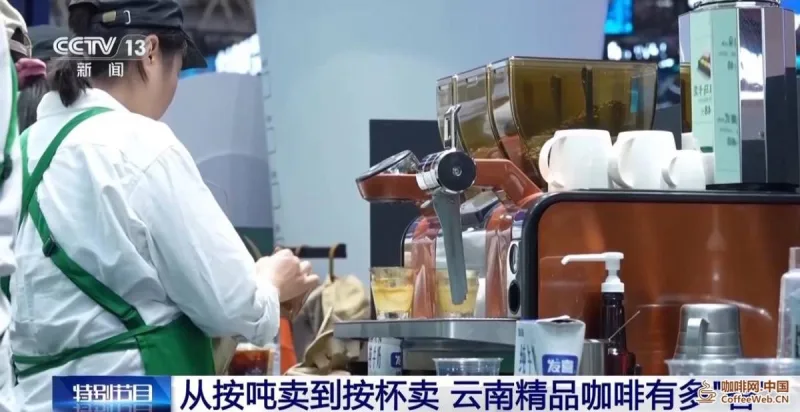
At Starbucks’ booth, the reporter saw the brand value of Yunnan coffee. Currently Yunnan coffee beans have become the base flavor of Starbucks’ classic espresso series, and Starbucks will also promote a jackfruit-flavored Yunnan specialty coffee bean, creating an exclusive hit product.
Stories of such close integration of origin and product can be seen everywhere at the expo. After four years of development, the expo has become a bridge, letting more local specialty industries link to global resources, grow and strengthen.
Reprint Notice & Disclaimer: This article is reprinted from CCTV News App. All rights belong to the original publisher.
Related Reading
 Three Decades of Shanghai-Yunnan Collaboration: A Coffee Bean ‘Ferments’ at the Import Expo
 Why Yongde’s Coffee Beans Won Gold in Shanghai – A Taste of ‘Life in Yunnan: 365 Days’
- Yunling Commentary: Yunnan Coffee Turnaround Hinges on Autonomous Pricing
 A ‘Travel Pack’ Reveals Another Possibility for Pu’er Baristas
- Bean in Short Supply: A Taiwan Youth on Yunnan Coffee as a Shared Cross-Strait Stage
- Five Years, Eight Championships: Lincang Coffee Joins the World Stage



 Liaoning ICP Security No. 21122402000217