
At a Glance (China Coffee Network): A map of China's coffee heat, jointly released by Xinhua Net and Zhaimen, shows the country's coffee market expanding into counties, plateau regions and tourist destinations, revealing the broadening radius and diverse vitality of Chinese consumption.
Source: Xinhua Net. As coffee moves from office towers into counties, plateaus, scenic areas and ancient villages, a broader map of China’s coffee landscape is unfolding. Recently, Xinhua Net, together with Zhaimen, released the “China Coffee Heatmap,” using data to observe the geographic distribution and consumption trends of China’s coffee market. From a single cup of coffee, one can see the continuously expanding consumption radius and diverse vitality of China’s consumer market.
Data from the National Bureau of Statistics shows that from January to August 2026, China’s service retail sales rose 4.9% year on year; retail sales in counties and townships (including market towns and villages) accounted for 39.0% of total social retail sales. In the first half of this year, domestic residents made 3.463 billion trips, up 5.4% year on year, with total tourism spending reaching 3.21 trillion yuan, up 2.0% year on year. Consumption space keeps sinking to lower tiers, and service consumption scenarios such as culture and tourism keep expanding.
According to the deployment of the “15th Five-Year Plan for Expanding Consumption,” new consumption formats, models and scenarios should be cultivated, and the integrated development of retail, culture, tourism, health and sports consumption formats should be advanced to broaden the consumption experience. The China Coffee Heatmap shows that currently there are 254,600 operating made-to-order coffee stores nationwide, a net increase of 106,700 over three years, a cumulative growth of 72.12%; the store network now covers 31 provincial-level administrative regions, 365 cities and 1,889 counties. The expansion of the coffee market is a microcosm of the continuous enrichment of consumption scenarios and the quality upgrade and expansion of the consumer-services sector.
The market’s continuous expansion also pushes leading chain brands to accelerate their footprint. Data shows that by August 2026, Luckin Coffee had 36,087 stores in the Chinese market, ranking first in store scale among chain coffee brands. The ever-expanding store networks of leading brands also reflect, from one angle, the sustained broadening of China’s coffee consumption coverage.
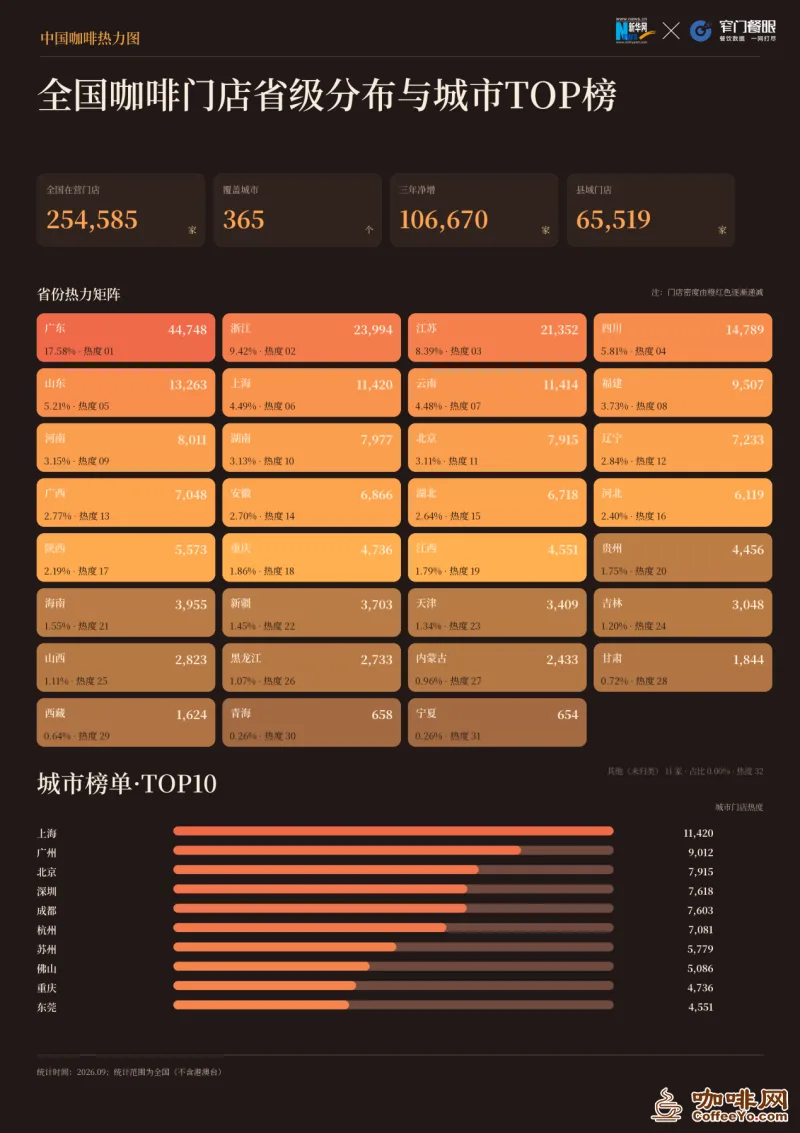
Market Map Keeps Expanding: Big Cities Remain the Main Stage, Diverse Markets Grow in Tandem
The eastern and southern coasts remain hot zones where coffee stores are highly concentrated, while vast inland areas have grown multiple coffee cluster highlands.
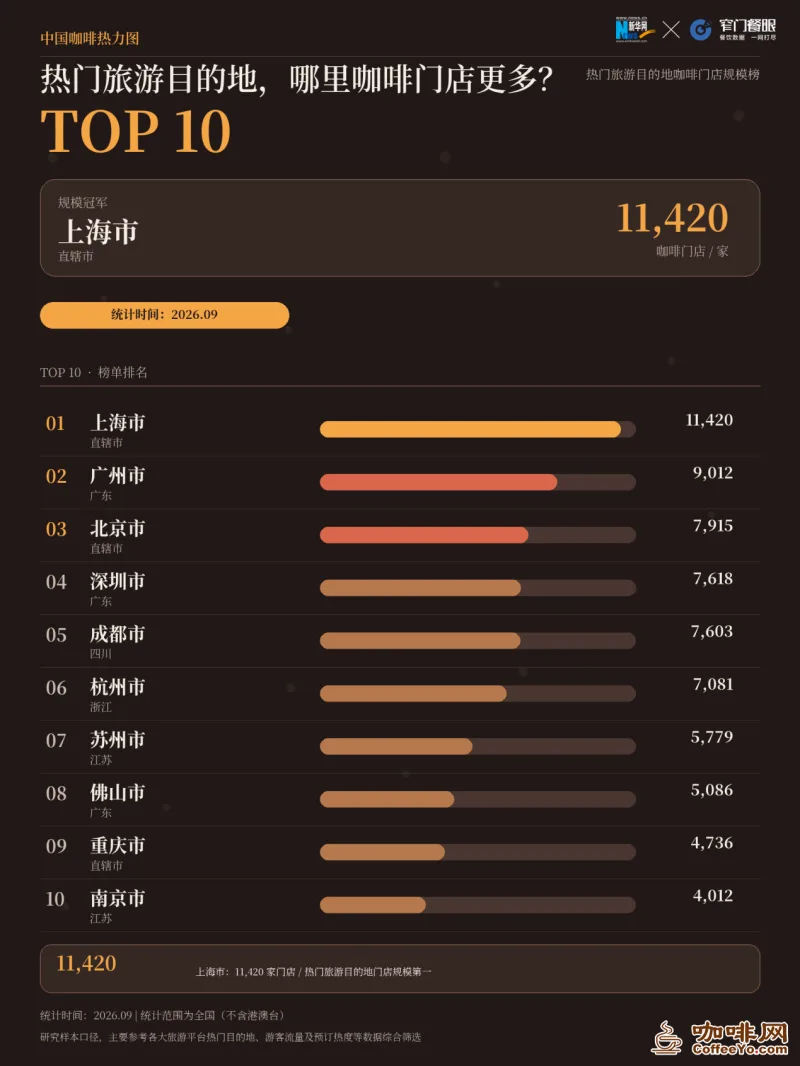
In terms of absolute store scale, megacities and first-tier cities still occupy the core position of coffee consumption. The TOP 10 list of coffee stores in popular tourist destinations shows Shanghai with 11,420 stores, Guangzhou 9,012 and Beijing 7,915; the store volume of these three cities leads all tourist destinations nationwide, where commuting and office, business-district consumption, community daily life and tourist spending together build a mature soil for coffee consumption.
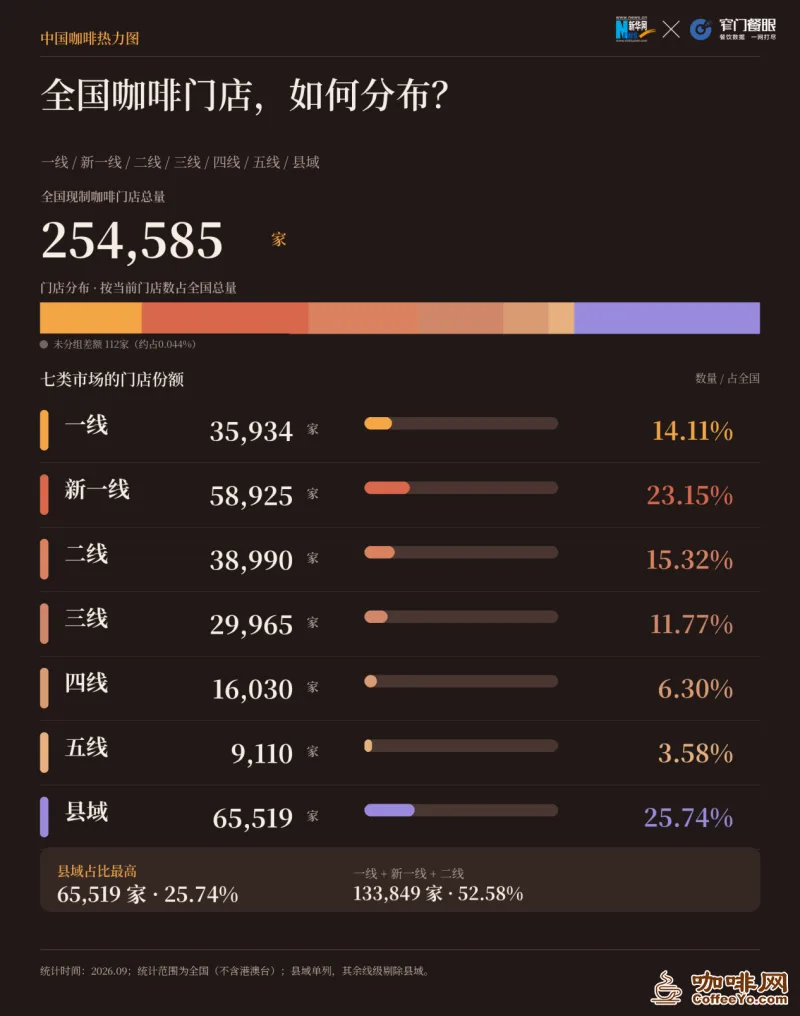
But the full picture of China’s coffee market cannot be defined by leading cities alone. Statistics show that new first-tier cities have 58,925 coffee shops, while the county-level coffee market has reached 65,519 stores, exceeding the new first-tier cities in total count; the two combined have 124,444 stores, accounting for 48.88% of the national total, close to half the landscape.
China’s coffee has formed a broad geographic distribution; to understand today’s coffee industry, one must see both the depth of mature markets and not ignore the growth vitality of more emerging regions.
County-Level Consumption Rises: Scale Combined with Growth Propels the County Coffee Market’s Vigorous Growth
Data from the China Coffee Heatmap shows county coffee stores doubled over three years, with growth of 103.41%, significantly higher than the national overall growth of 72.12%; the county share of national coffee stores also rose from 21.78% three years ago to 25.74%. This means that today, roughly one in every four coffee shops nationwide is opened in a county.
The doubling of county coffee stores over three years mainly occurred where stores already existed, rather than a simple “from nothing to something.” Of the stores net-added over three years, 97.88% came from areas that already had coffee shops three years ago; among the 1,716 counties that already had coffee shops three years ago, 93.30% saw a further increase in store numbers, as coffee consumption in many county areas completed the transition from “whether there is any” to “how many.”
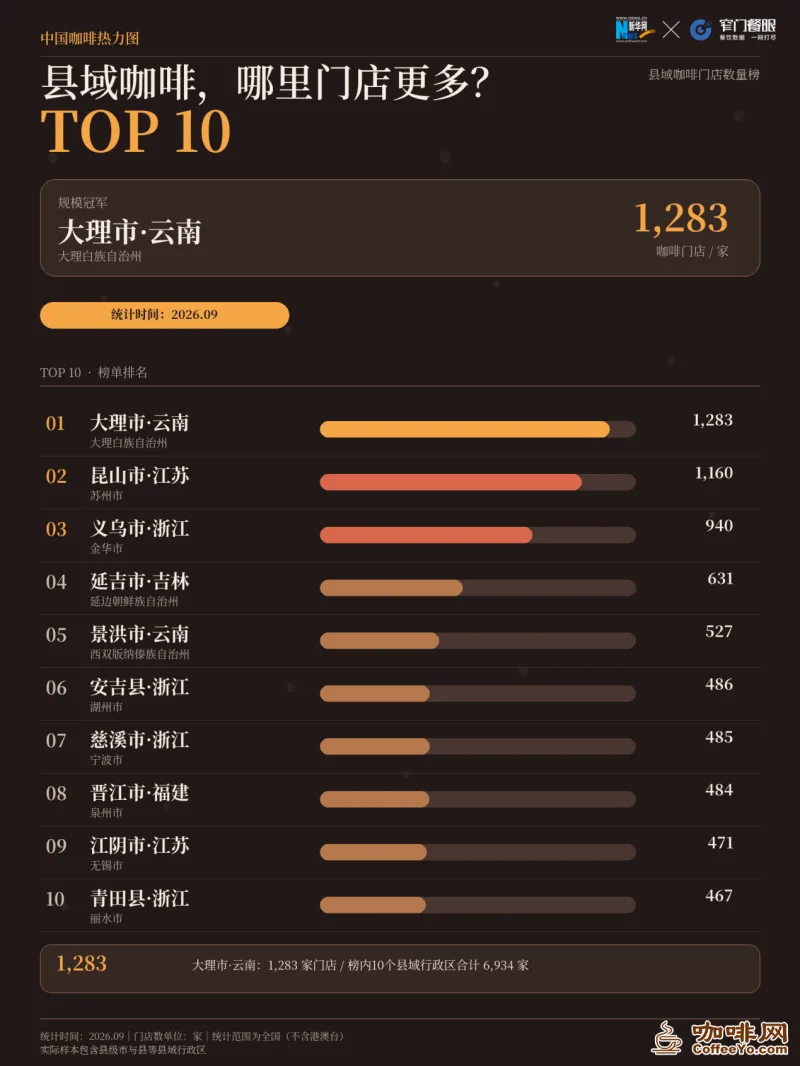
A large overall store count in counties does not mean every area is bustling; the internal development pace of the county market also varies markedly, and one must reference both the scale and growth rankings to glimpse the true “coffee density” of counties. On the county scale ranking, Dali leads with 1,283 stores, Kunshan follows closely with 1,160, giving birth to a batch of thousand-store-level county consumption markets. But thousand-store counties are a minority; among all 1,889 counties with coffee shops, 72.74% still have fewer than 30 stores, with a median of just 16 stores — the prosperity at the top cannot be equated with the general reality of all counties.
The growth ranking reveals a group of latecomers. Ruili City’s stores grew from 39 to 183, a cumulative three-year increase of 369.23%, topping the county coffee growth ranking; Zhongmu County rose from 39 to 153, a gain of 292.31%. Tengchong, Mangshi, Yining and other places also saw store numbers leap dramatically. Some of these county areas lean on border trade, some on industrial bases, some on cultural-tourism traffic; local residents’ daily consumption combined with outside tourists sustains coffee demand.
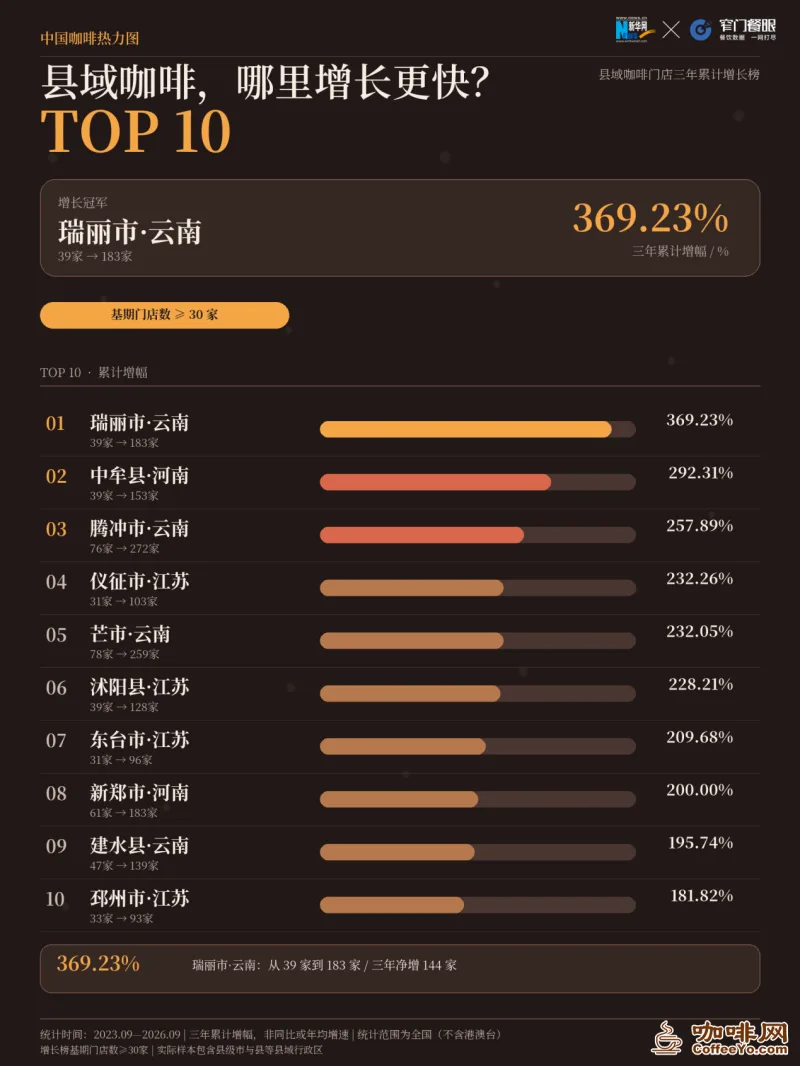
The county coffee market is developing in tiers: some economically developed county-level cities rich in cultural-tourism resources have formed a mature coffee business ecosystem; more areas are still in the consumption-cultivation stage; and a batch of regions with a low base are seeing rapid expansion. The two yardsticks of scale and growth together measure the diverse complexion of county coffee.
Culture-Tourism Consumption Intersects: Coffee Steps into Journeys, Scenario Boundaries Keep Widening
The “15th Five-Year Plan for Expanding Consumption” proposes expanding the supply of quality cultural and tourism consumption and deepening the integrated development of “culture-tourism + a hundred industries.” According to the “2026 H1 Domestic Resident Travel Data” released by the Ministry of Culture and Tourism, in the first half of 2026 domestic residents made 3.463 billion trips. Large-scale population movement lets coffee leap out of offices and communities and embed deeply into travel, with culture and tourism becoming a window on changes in China’s coffee.
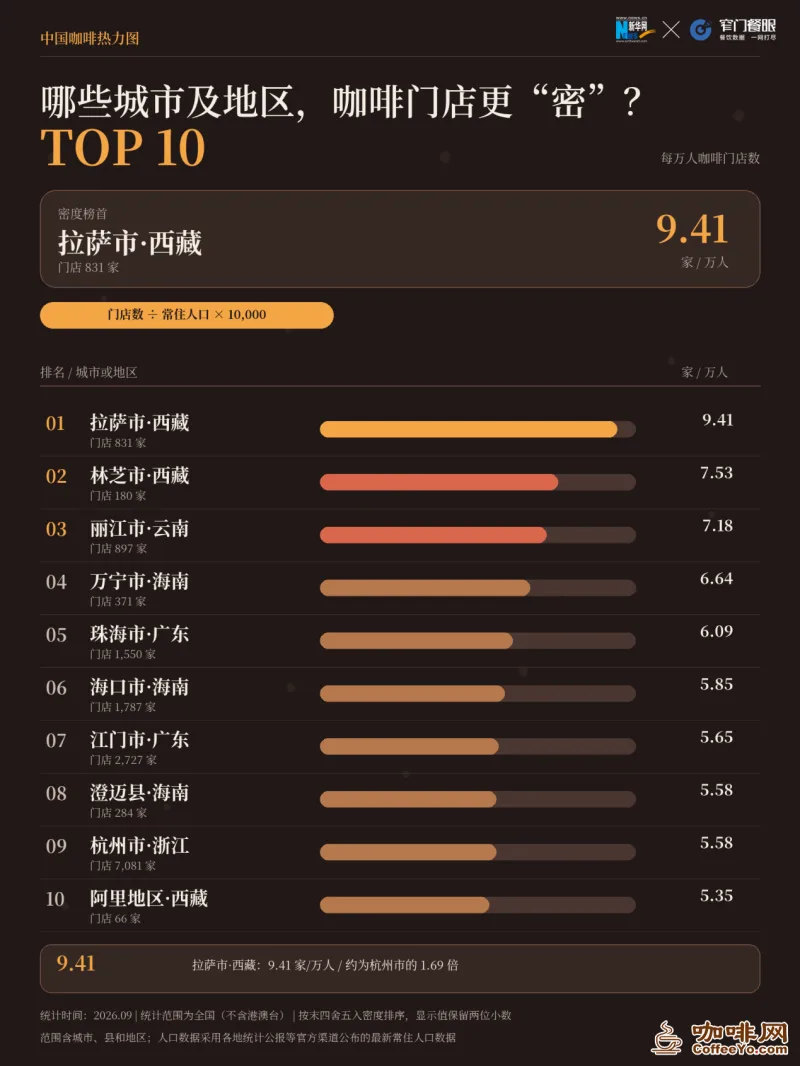
Calculated per 10,000 permanent residents, Lhasa leads sharply with 9.41 stores per 10,000 people and Nyingchi with 7.53, while Hangzhou is 5.58 per 10,000 and Shanghai 4.59. Lhasa’s total number of coffee shops is less than one-tenth of Shanghai’s, yet its stores per 10,000 people are about double Shanghai’s.
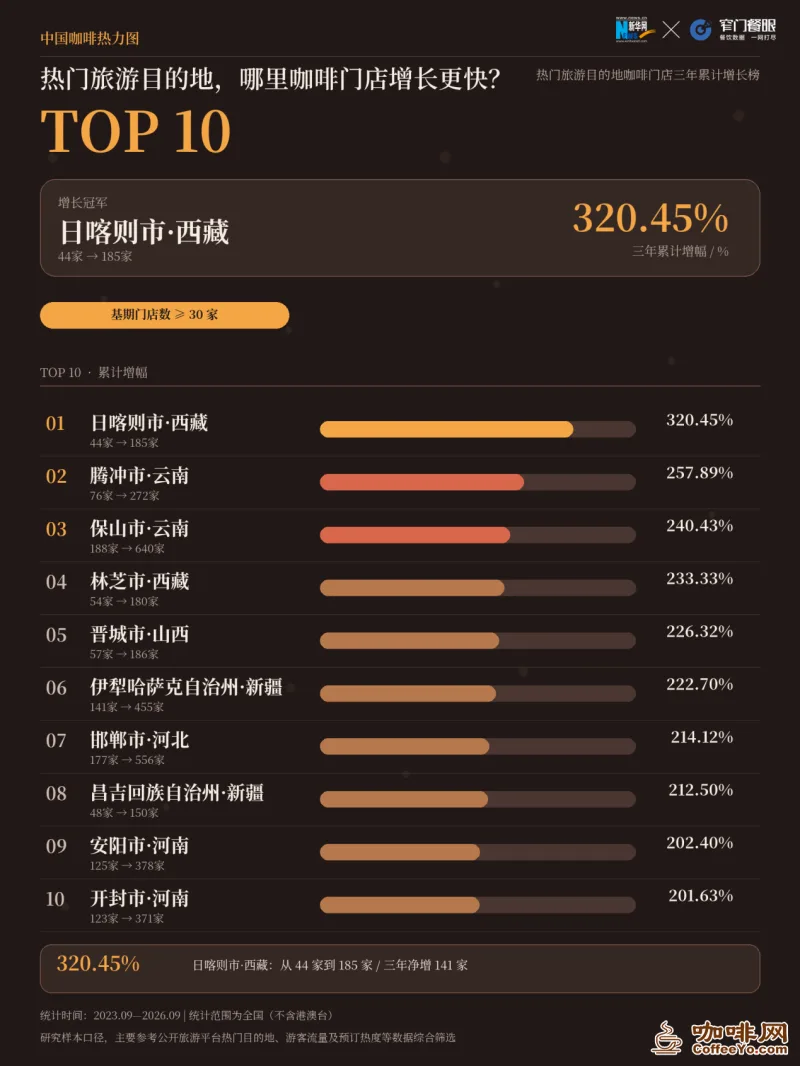
In Shigatse, stores grew from 44 to 185, a cumulative three-year increase of 320.45%, topping the growth ranking of popular tourist destinations; Nyingchi’s stores rose from 54 to 180, a gain of 233.33%, with many parts of Tibet becoming among the fastest-growing coffee regions in the country.
Judged by the “stores per 10,000 people” metric of “coffee density,” cities such as Lhasa and Lijiang have surpassed Beijing, Shanghai and Guangzhou. It is thus clear that the vigorous growth of coffee on plateaus, at border areas and in tourist destinations is the dual result of local residents’ consumption upgrade combined with tourist flows. Chain brands have also begun to break out of standardized templates, blending store design with local scenery and regional culture.
Distinctive coffee stores are taking root in major tourist destinations: in Nyingchi, Luckin built a specialty store blending snow-region cultural elements, creating an immersive consumption space. In 2025 Nyingchi received over 17.35 million visitors, opening broad space for coffee consumption.
By Xinjiang’s Sayram Lake, Luckin’s Kele Yongzhu store sits on the shore of the “last tear of the Atlantic,” where a cup of hot coffee both dissolves the chill by the highland lake and becomes a sense of ritual in travelers’ journeys.
From ancient-city lanes and mountain peaks to highland lakesides, coffee supply reaches far-flung places. Beneath the wave of culture-tourism consumption, coffee is no longer merely a beverage but an important part of the travel experience.
A Store Map Across Mountains and Seas: Behind Vast Coverage Lies a Test of Industrial Capability
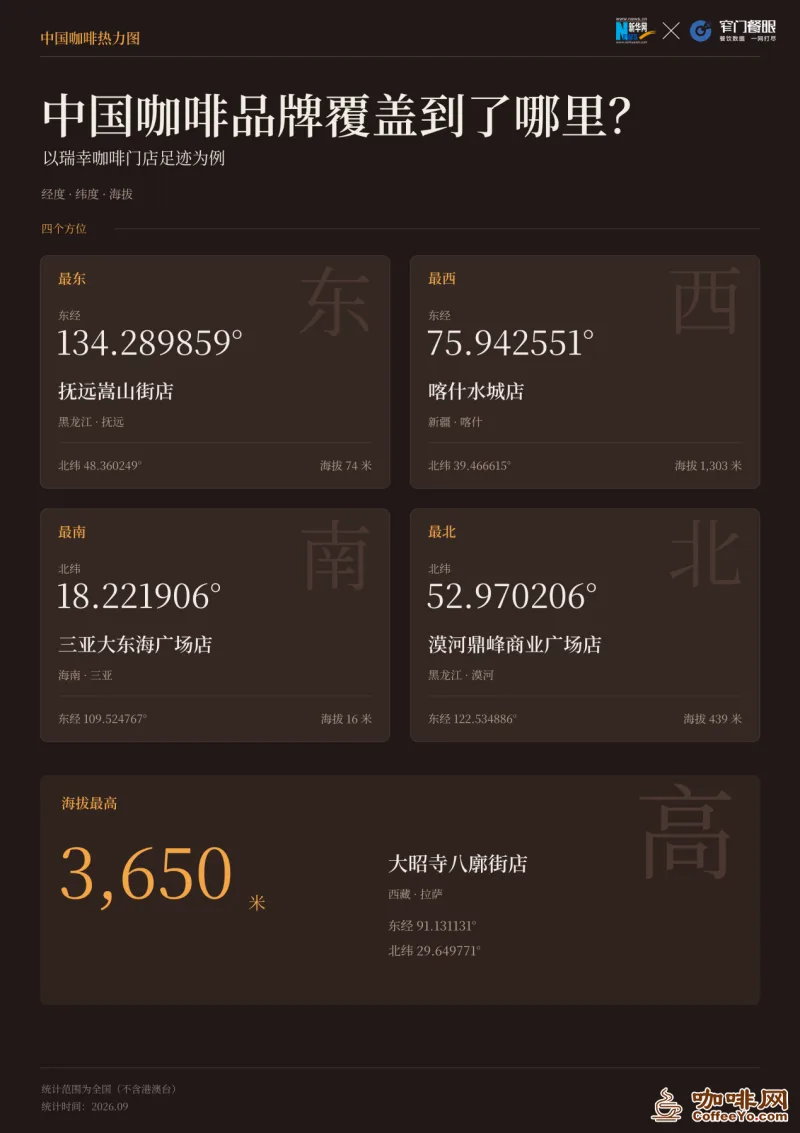
As a Chinese chain coffee brand leading in store scale, Luckin’s store layout also, to some extent, reflects the coverage breadth of China’s coffee consumption: reaching Fuyuan in the east, extending to Kashgar in the west, coming to Sanya in the south and settling in Mohe in the north.
Coffee not only travels farther but also extends to higher places. At about 3,650 meters above sea level, on Barkhor Street by the Jokhang Temple in Lhasa, sits Luckin’s highest-altitude store.
The geographic boundaries of coffee stores keep widening, but broader coverage is only the starting point. As coffee stores penetrate counties, plateaus and border areas, the industry’s exam questions follow: how to span longer geographic distances and consistently and stably deliver high-quality products?
Take Luckin as an example: from upstream raw-material procurement and midstream production and processing to downstream warehousing, logistics and store delivery, a high-quality supply-chain system covering the full chain supports the stable operation of its vast store network. Relying on stable raw-material supply, a complete warehousing and logistics system and standardized store operations, Luckin is able to keep the consistency of product quality and consumption experience while continuously expanding its store network.
A “China Coffee Heatmap” presents the coffee landscape belonging to today’s China: big cities keep their scale advantage, the county market rises rapidly, and tourist destinations, plateaus and border areas are seeing new consumption vitality. More than 250,000 coffee stores nationwide are scattered across office towers, community streets, county business districts and highland lakesides; a cup of coffee is stepping into the daily lives of more and more ordinary people.
The “CPC Central Committee’s Recommendations on Formulating the 15th Five-Year Plan for National Economic and Social Development” explicitly calls for deepening the special action to boost consumption, expanding the supply of quality consumer goods and services, and creating a batch of new consumption scenarios with broad traction and high visibility. The development pattern of China’s coffee outlined by the China Coffee Heatmap is precisely a vivid sample of our country’s implementation of the strategic pivot of expanding domestic demand, vigorously boosting consumption and the continuous upgrading of the consumer-services sector.
The data confirms that China’s coffee market remains in a rapid growth phase of continuously rising penetration and steadily climbing consumption frequency. As the land-grabbing style of store expansion comes to an end, the focus of the industry’s second half will shift to “intensive cultivation,” steadily delivering a good cup of coffee to every corner of the motherland. (By Chen Tingyu)
Reprint Notice & Disclaimer
- This article has been edited and compiled by China Coffee Network. The information and images therein come from public sources and the copyright belongs to the original author. This reprint is intended solely for information sharing within the coffee industry and does not represent the views of this website; all data and opinions are subject to the original article. Our thanks to the original author for creating and sharing it.
- For matters concerning content licensing, attribution, copyright or otherwise, please contact us promptly and we will verify and cooperate in handling them as soon as possible. We also welcome coffee origins, brands and industry media to exchange ideas and contribute articles.
- Contact China Coffee Network: Tel 400-0000-641 (+86-18288016826) | Email 405854472@qq.com | Address: Jinghong, Xishuangbanna, Yunnan Province / Tieling, Liaoning Province
Related Reading
- Bean in Short Supply: A Taiwan Youth on Yunnan Coffee as a Shared Cross-Strait Stage
- Five Years, Eight Championships: Lincang Coffee Joins the World Stage
 Haikou ‘Union Cup’ Barista Skills Competition Kicks Off to Empower the Service Sector
 Yunnan Specialty Coffee Beans Deliver an ‘Excellent’ Report: Path to Value Leap
- Cross-Strait Tides Rise: A Taiwan Youth Farms Coffee in Yunnan, a Cup Bridging Both Sides
 2026 2nd Yunnan Treasure Coffee Green Bean Competition (Cup of Excellence Pilot) Concludes





 Liaoning ICP Security No. 21122402000217