
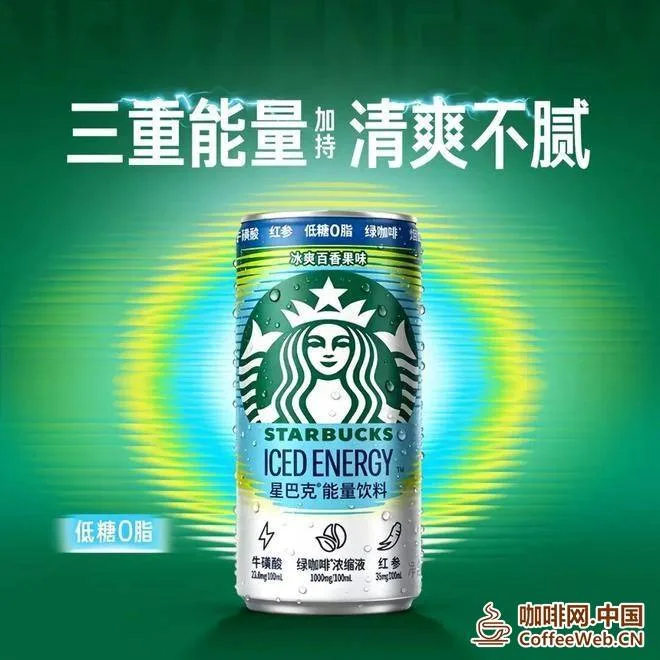
At a Glance (China Coffee Network): An unexpected player has entered the energy-drink track—Starbucks. In early June, Starbucks launched its first “Iced Passion Fruit”-flavored energy drink in the Chinese market, first stocked at Sam’s Club, priced at about 3.8 yuan per can. Shortly after launch, the Sam’s Club app showed it sold out, with a warm market response.
An unexpected player has entered the energy-drink track—Starbucks. In early June, Starbucks launched its first “Iced Passion Fruit”-flavored energy drink in the Chinese market, first stocked at Sam’s Club, priced at about 3.8 yuan per can. Shortly after launch, the Sam’s Club app showed it sold out, with a warm market response.
The Food and Beverage Green Paper once reported that in 2026 the functional-drink track is already smoke-filled with competition—not only did Master Kong carve out an “Iced Black Tea Energy” product line from its classic single “Iced Black Tea,” striking strongly with an energy-enhanced positioning; but also PepsiCo quietly exerted effort, with its core energy brand “Sting” quietly landing on domestic e-commerce platforms.
Under such smoke-filled competition, why has this coffee-chain giant turned its gaze to energy drinks? In the inherent impression of many Chinese consumers, Starbucks’ ready-to-drink products still seem stuck in the coffee category, yet now it suddenly “crosses over” to sell energy drinks—the contrast is self-evident. More importantly, from the current sales momentum, this new product not only hasn’t cooled, but performed quite well. So, can energy drinks truly become Starbucks’ new growth curve?
01 Why did Starbucks choose to sell energy drinks?
A company’s real situation is often glimpsed from its financial report.
The financial report shows that in Q1 of fiscal 2026, Starbucks’ net revenue was $9.9 billion, up 6% year-on-year; global same-store sales rose 4% year-on-year, and traffic rose 3% year-on-year. However, behind the steady revenue growth, profit indicators flashed red—GAAP operating margin contracted 290 basis points to 9.0%, and GAAP EPS was $0.26, down sharply 62% from the same period last year.
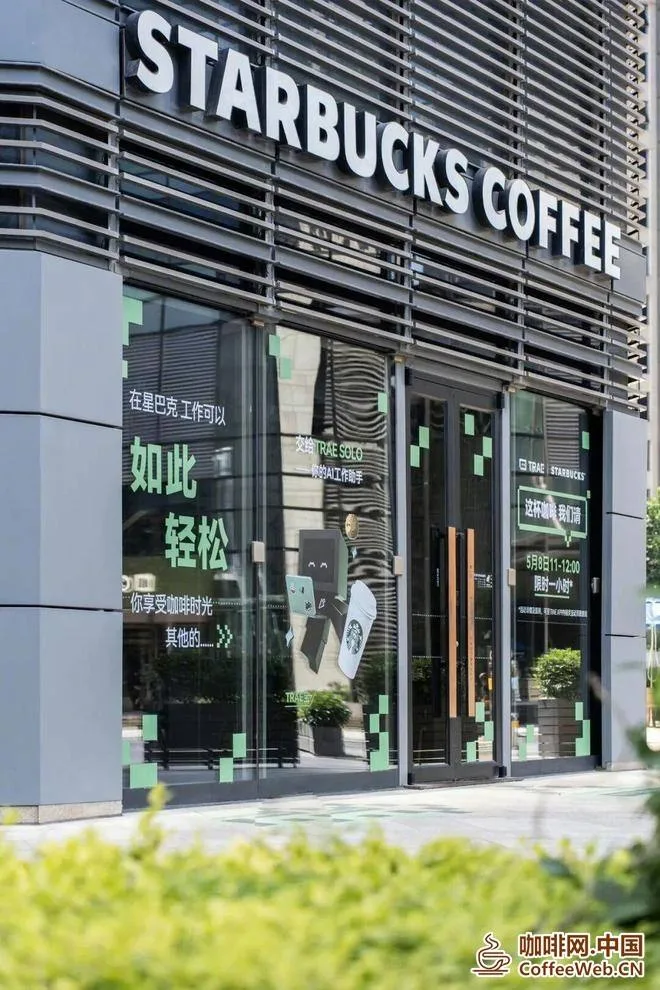
Behind the profit pressure are both factors of Starbucks increasing labor investment to advance the “Back to Starbucks” strategy, and the impact of inflationary pressure from rising coffee prices and high tariffs. Clearly, from a profit perspective, Starbucks’ days are not generous; finding a new growth curve has become an urgent issue on the table.
And the breakthrough Starbucks aims at first falls on the scenario. In January this year, Starbucks global executives clearly pointed out a structural opportunity: although the brand has a clear advantage in the morning, its share is being eaten by emerging brands, while the afternoon time slot still harbors huge growth space.
Based on this judgment, in April, Starbucks officially launched “Energy Refreshers” in the United States and listed it as a regular menu item supplied year-round. Starbucks management described it as “an unexpected new growth engine,” explicitly incorporated into the core of the “Back to Starbucks” strategy, to activate the afternoon consumption time slot.
If the expansion of the afternoon scenario is a tactical move, then the sustained performance of the ready-to-drink business provides Starbucks with more direct confidence support. David Hanson, Starbucks global channel development officer, said in a media interview that Starbucks’ ready-to-drink China business has maintained double-digit growth for 6 consecutive years.
Bringing the gaze back to the Chinese market, the fact that Starbucks, Master Kong, and Pepsi all successively increased bets on the energy-drink track this year, the more critical reason lies in eyeing this category’s high growth rate. According to data from Sullivan, the National Bureau of Statistics, and the China Beverage Industry Association, the soft-drink industry’s retail market scale is expected to reach 1.35 trillion yuan in 2025, up 8% year-on-year, with a 5-year CAGR of 5.8% from 2025 to 2029, and total growth slowing. Among them, functional drinks are expected to reach 185.6 billion yuan in 2025, up 11% year-on-year, with a 2025-29 CAGR of 10.9%, higher than the industry’s total growth rate.
02 Smoke everywhere—what does Starbucks rely on to break through?
A high-growth track will inevitably attract more sharers; the brands themselves know this better than anyone. So, what exactly does Starbucks’ energy drink rely on to break out of the encirclement?
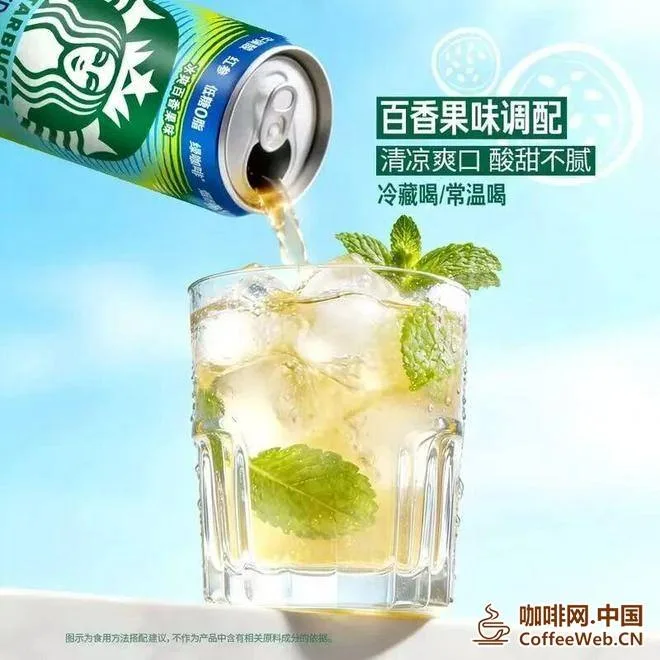
The new product Starbucks launched this time chose a “raw coffee + green tea powder + red ginseng” ingredient combination, and added taurine and B vitamins, mainly promoting a low-sugar, zero-fat formula, emphasizing low calories, few artificial additives, and light sugar burden, precisely responding to consumers who are more health-sensitive yet have a need for refreshment.
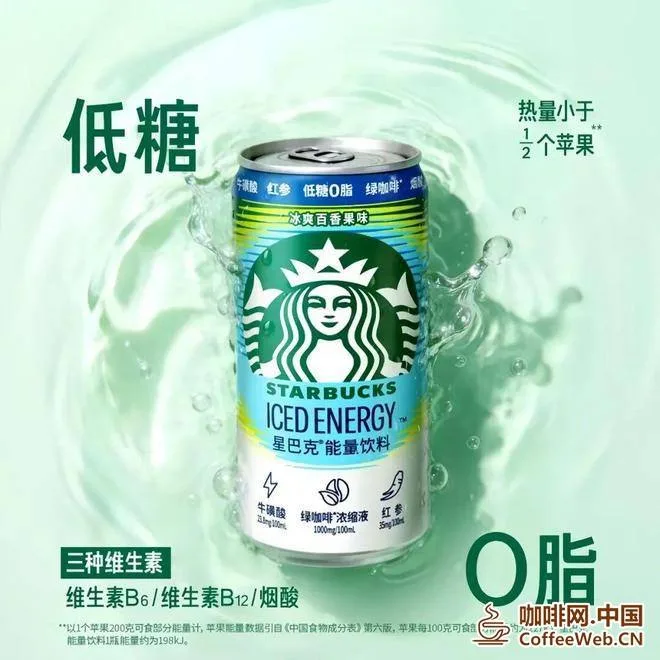
At the same time, the packaging design also abandoned the heavy sense of power common to energy drinks, instead adopting a fresher visual language, forming a clear distinction on the shelf.
In locking the target group, Starbucks also has a clear difference from the leading brand Dongpeng Special Drink. The new product’s first launch channel, choosing Sam’s Club, is itself the most direct signal.
Dongpeng Special Drink’s base has long been locked on high-intensity physical laborers, long-haul drivers, and late-night gamers, while the middle-class families, urban white-collar workers, and quality-consumption groups represented by Sam’s precisely overlap with the core customer group Starbucks has long accumulated. It’s not hard to see that Starbucks is still taking the mid-to-high-end route.
It can be said that from product ingredients, packaging, to crowd positioning, Starbucks has formed a clear differentiation path from mainstream products on the market, rather than going head-to-head with Dongpeng Special Drink.
Quite dramatically, just before Starbucks entered energy drinks, its backyard had quietly fallen. Mashangying data shows that Dongpeng Daka, with a 14.69% sales share, surpassed Starbucks ready-to-drink coffee (14.39%) for the first time, jumping to second in the industry. But this also shows that although the ready-to-drink track is fiercely competitive, as long as a breakthrough is found, it’s not hard to catch up from behind.
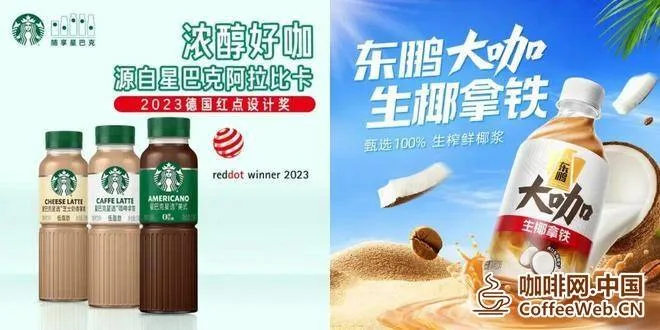
In fact, the category boundaries of the entire ready-to-drink market are accelerating dissolution. Nayuki launched electrolyte water in May, Luckin launched ready-to-drink coffee at the end of April, Guming officially launched the HPP fresh juice series at the beginning of the year… tea brands make functional water, coffee brands make ready-to-drink—no one stays within their own position anymore.
It can be predicted that in the future, perhaps more tea and coffee brands will eye this track. For Starbucks, to stand out in this melee, there is still a long way to go.
Image source: official brand.
Reprint Notice & Disclaimer: This article is reprinted from industry media. All rights belong to the original publishers.
Related Reading
 ‘All-Ice’ Coffee Goes Viral! Will the Next Hit Be Your Personal Favorite?
- Hong Kong’s Dyee Coffee Lands in Qianhai, Building a Specialty Pour-Over Outpost
 Ken Yue Coffee Opens Egg-Tart Pop-Up in Hangzhou: Sweet Craft, Reinvented Classics
 World Cup Enters the Breakfast Slot: Can Coffee-Tea Brands Turn Traffic into Orders?
- ICE Agricultural Futures Mostly Rise at Close; Coffee Futures Up 3.28%
- ‘Sleep Cafés’ Become a New Favorite Among Seoul Office Workers


 Liaoning ICP Security No. 21122402000217