
At a Glance (China Coffee Network): As the World Cup shifts many matches to Beijing daytime hours, “watching the game in the morning” has turned coffee and breakfast into the new match-day companions. Luckin, Cotti, and tea brands have all jumped in—yet industry experts warn that heavy marketing with thin R&D is no path to sustainable growth.
When Mr. Cheng’s morning alarm went off, the match he had been following was already at halftime. Because of the time difference, nearly half of the matches in this United States–Canada–Mexico World Cup are played during Beijing daytime hours.
The night-owl fans who used to “stay up late to watch” have started getting up early, and coffee and breakfast have replaced barbecue and beer as the “match-watching buddies.”
Co-branding and marketing have always been tools for tea and coffee brands to lift sales, and the World Cup’s natural traffic magnet has brands flocking in. Cotti, Luckin, and XiaoKa Coffee have entered the fray, securing sponsorship rights with popular stars and national teams. Beyond that, tea brands such as Moliyeba (Molly Tea) and CHAGEE (Bawang Chaji) have also rolled out “World Cup elements” to attract customers.
Coffee brands have taken the home ground, and milk tea, convenience stores, and fast-food breakfasts are not idle either—a silent war around “watching the game in the morning” has already begun ahead of schedule.
“Marketing that costs a fortune also carries risks—if a team is eliminated early or underperforms, the marketing spend is almost wasted. So for tea-and-coffee brands that want long-term, stable development, ‘heavy marketing, light R&D’ cannot become the norm,” Lin Yue, chief consultant at Lingyan Management Consulting, told the National Business Daily.
Beer and barbecue no longer work; “watching the game in the morning” has put coffee and milk tea in the spotlight.
For this World Cup, Chinese viewers can feel an obvious change: the viewing time is different from before. Converting the public schedule to Beijing time, 104 matches are basically concentrated between 0:00 and 12:00, with more than half falling between 5:00 and 12:00.
“In the past I stayed up late to watch; now I get up early,” Mr. Cheng told the reporter. To watch the games, his routine is more regular than before: a 3 a.m. match calls for a cup of coffee to wake up; a 6 a.m. slot means breakfast while watching.
For the World Cup’s massive traffic, coffee brands have laid out the battlefield in advance. Cotti signed with the Argentine national team as early as 2022, later upgraded to global sponsor of Argentina. Before this World Cup, Cotti doubled down, obtaining qualifications as an authorized World Cup product retailer—making it one of the few coffee brands with official FIFA IP credentials, and together with its dual identity as global sponsor of Argentina it has tried to bundle Argentina, Messi, and World Cup merchandise into one comprehensive World Cup marketing cycle.
Luckin, meanwhile, connects its coffee consumption scenes with the traffic of Europe’s strong teams and top stars. Before the World Cup, it announced it had become the China-region sponsor of the Spanish and Portuguese national teams. On the posters, Lamine Yamal and Cristiano Ronaldo stand center stage.
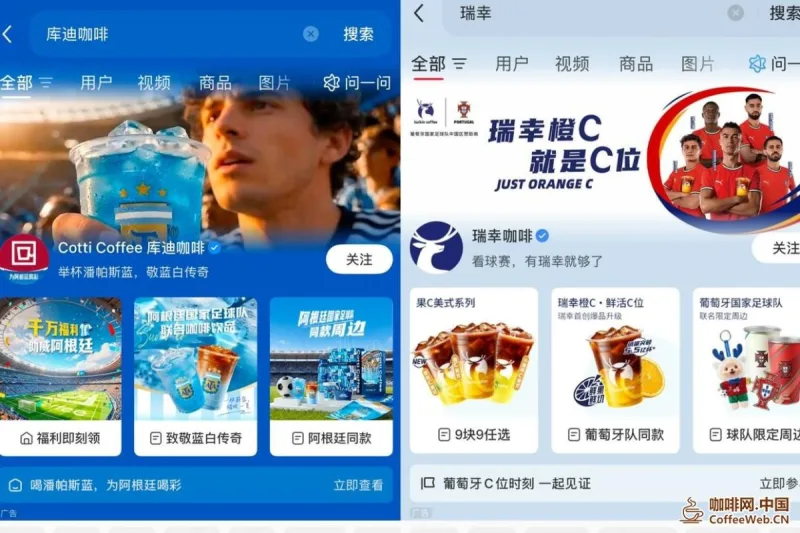
XiaoKa Coffee did not chase the hottest teams of the tournament, but signed Brazilian legend Kaká. Kaká no longer stands at the center of the pitch, but still strikes an emotional chord with post-80s and post-90s fans. Compared with active players and teams, retired legends carry lower risk and more easily carry nostalgic sentiment.
The coffee brands that were fighting fiercely in the 9.9-yuan war have once again been swept into the football narrative of the World Cup.
Compared with coffee brands, milk-tea brands’ participation is lighter, but they have still racked their brains. Yeye Bupaocha launched a “good-apple-friend World Cup bottle-opener fridge magnet” around the World Cup scene; Moliyeba introduced a matcha series in the UK zone with football merchandise; CHAGEE rolled out fridge magnets and themed stickers via its “shake-shake-sha” series.
An industry insider told the National Business Daily that marketing and subsidies have become one of the most direct ways to drive orders after tea-and-coffee entered the stock era, and the World Cup—whether as an event, an emotion, or a topic—is a natural traffic field.
It is understandable for brands to seek growth; the only question is whether this expensive sponsorship is worth it.
How much does World Cup marketing yield? An industry insider told the National Business Daily that signing the China-region rights of a national team fronted by a top star is far cheaper than signing the star personally. According to previous Caixin reporting, the China-region sponsorship fee for the Argentine national team is roughly USD 700,000–800,000, or about RMB 5–6 million.
Even so, for a new-consumer brand it is still a sizable annual marketing budget.
Compared with the IP co-branding commonly used by new tea drinks and coffee: industry estimates suggest light-to-moderate cooperation with mid-tier game IPs may cost tens of thousands to several hundred thousand yuan; deep co-branding with top game IPs may run RMB 1.5–3 million or more. By that math, one national-team China-region sponsorship already equals the budget of two or three deep co-brandings with top IPs.
It is nothing new for new tea drinks and coffee brands to rely on marketing for growth, but frequent co-branding has become a burden dragging down brand profits. For example, Luckin’s selling and marketing expenses in Q1 2026 rose 47.5% year-on-year, outpacing revenue growth in the same period; in that same quarter, its self-operated store same-store sales growth stalled and operating margin also declined.
At the same time, many brands have found co-branding less effective than imagined. According to media statistics, the cumulative number of co-brandings by seven listed new-tea companies in China—including Luckin and Mixue—fell from 156 in 2024 to 83 in 2025. HEYTEA ran only two co-brandings all year, and leading brands have begun to “hit the brakes” on co-branding.
An industry insider said event marketing can indeed help brands gain voice in a short time, especially in mass sports events like the World Cup, where brands can easily create buzz around stars, teams, and scorelines. But for coffee and tea brands, marketing’s pull on actual operations is usually limited.
“It can bring attention and maybe short-term orders, but in the end it comes down to repurchase, same-store sales, and margins. If you just spend more money for excitement, it may not settle into real growth.”
The World Cup amplifies a brand’s phased voice, but it is not the answer to growth for coffee and tea brands. Whether they can turn this wind into orders, members, and repurchases is the ledger they really need to figure out.
Reprint Notice & Disclaimer: This article is reprinted from National Business Daily. The original reporting includes analysis by correspondent Wang Ziwei. All rights belong to the original publisher. If you believe any content infringes your rights, please contact us for removal.
Related Reading
 ‘All-Ice’ Coffee Goes Viral! Will the Next Hit Be Your Personal Favorite?
- Hong Kong’s Dyee Coffee Lands in Qianhai, Building a Specialty Pour-Over Outpost
 Ken Yue Coffee Opens Egg-Tart Pop-Up in Hangzhou: Sweet Craft, Reinvented Classics
- ICE Agricultural Futures Mostly Rise at Close; Coffee Futures Up 3.28%
- ‘Sleep Cafés’ Become a New Favorite Among Seoul Office Workers
 Vibrant Yunnan: Why Lijiang, Which Grows No Coffee, Raises Yunnan Coffee’s ‘Traffic Cup’


 Liaoning ICP Security No. 21122402000217