
At a Glance (China Coffee Network): Xinhua News Agency, Beijing, June 18 (Reporter Chen Yante) In April this year, the China Packaging Federation solicited opinions and suggestions for the “China Packaging Industry Development Plan (2026–2030)” from the whole industry chain and upstream and downstream related units. As of June, the plan has completed preliminary research and draft discussion, entering the key stage of public consultation.
Xinhua News Agency, Beijing, June 18 (Reporter Chen Yante) In April this year, the China Packaging Federation solicited opinions and suggestions for the “China Packaging Industry Development Plan (2026–2030)” from the whole industry chain and upstream and downstream related units. As of June, the plan has completed preliminary research and draft discussion, entering the key stage of public consultation.
As an important supporting industry for the national economy, the packaging industry is at an important pass of transformation from “scale expansion” to “quality and efficiency.” Facing the structural contradiction of “large but not strong, scattered and inefficient,” how to use digitalization and intelligence to crack the industry’s pain points and achieve a leap from “scattered stars” to “digital-intelligent cluster”? This is not only a must-answer question for the industry itself, but also a microcosm of building a modern industrial system.
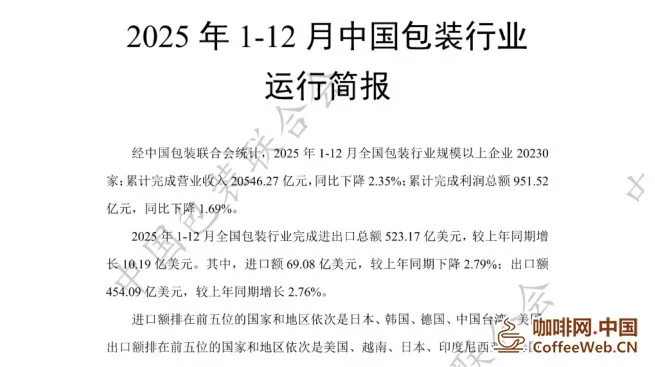
Facing the “large but not strong” pain point, clarifying the urgency of transformation.
“Our country is the world’s largest packaging producer. Last year, more than 20,000 above-scale enterprises cumulatively earned over 2 trillion yuan in revenue,” introduced Zhang Yaoquan, executive deputy director and secretary-general of the Paper Products Committee of the China Packaging Federation, in an interview. Since the reform and opening up, China’s economy has developed rapidly, and the packaging industry has quickly gone through the process from “rapid expansion, steady growth, rational development” to now transforming toward high-quality development. Taking the paper-packaging industry as an example, China has over 130,000 corrugated-paper packaging enterprises, with output accounting for 35% of global total output, far exceeding developed economies such as the US, Europe, and Japan.
However, behind the huge volume, hidden worries remain.
Zhang Yaoquan pointed out that affected by low market maturity and insufficient integration, the industry has long suffered from “small, scattered, chaotic” problems. The market share of China’s top 20 enterprises is less than 15%, far below the level of developed countries. At the same time, low entry barriers have led to a flood of micro and small enterprises; overcapacity triggered a brutal “price war,” equipment utilization declined, and industry “involution” intensified.
Tianyancha data shows that as of now, China has over 3 million existing/operating packaging-related enterprises, with about 190,000 newly registered enterprises added since 2026 alone.
At the same time, packaging enterprises sit in the “sandwich layer” of the industry chain. Zhang Yaoquan, still taking paper packaging as an example, noted that upstream raw-paper costs account for as much as 80% of total enterprise costs, fluctuating sharply under the influence of international situations, tariff policies, etc.; downstream e-commerce demand shows the characteristics of “many varieties, small batches, fast delivery, micro profit.” Squeezed from both ends, the traditional extensive development model is no longer sustainable.
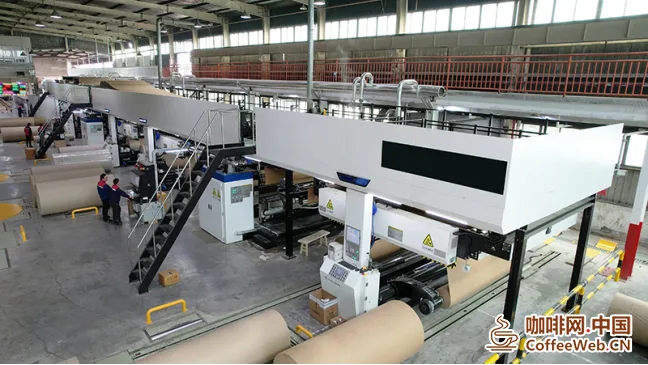
Exploring the “digital-intelligent cluster” path to reconstruct the industry ecosystem.
To crack the dilemma, where is the way?
Facing the status quo of “high dispersion, low efficiency, strong involution,” relying on a few giants’ mergers and acquisitions to achieve industry integration is not the optimal solution under China’s national conditions. Zhang Yaoquan believes that a new path must be explored to improve overall efficiency through technology empowerment—”digital transformation and industry-chain integration are important ways out.”
“Scattered stars, no moon.” Li Lintong, chief strategy officer of Zhejiang Dongjing Technology Co., Ltd., used the company’s 30-year observation of the packaging industry to metaphorically describe the industry’s long-standing discrete state. Over 90% of paper-packaging enterprises nationwide are small and micro, with weak risk resistance, year after year undergoing the severe test of market shuffling.
To this end, Dongjing Technology launched its strategy to transform toward the internet in 2013, and in 2016 created the first paper-packaging industry internet platform “Dongjing Yiwan,” gradually building a “smart platform + digital factory” dual-core driving development model. Its core lies in “connection” and “empowerment”: the smart platform is responsible for aggregating massive orders, solving the difficulty of acquiring customers; the digital factory solves the problems of low delivery efficiency and high cost through standardized products and digital management.
“Transforming thousands of non-standard demands into dozens of standard products,” Li Lintong introduced. Through industrial big-data calculation, the originally “multi-variety, small-batch” production problem is transformed into efficient “few-variety, large-batch” production. At the same time, the digital factory realizes the full-process digital closed loop from order receipt to delivery, mining the efficiency potential of every penny and every second.
He gave a real-case data example: partner factories doubled their order volume within half a year to a year, with single-product order volume rising from over a thousand square meters per day to tens of thousands of square meters, and production efficiency improved dozens of times. Not only did it solve production-efficiency problems, but through digital transformation it also helped small and micro enterprises reduce losses and improve management efficiency, raising the profit level by an average of 2–3 percentage points.
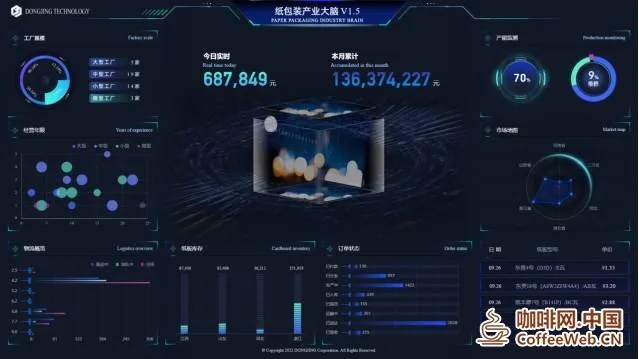
Activating the power of “data elements” to advance toward a modern industrial system.
The deep significance of digital transformation lies not only in cost reduction and efficiency improvement, but also in promoting the industry’s fundamental shift from “experience-driven” to “data-driven.”
Li Lintong introduced that after years of deep cultivation, Dongjing Technology has accumulated over 1,120 billion valid data records, forming 12 billion data assets and an 80TB industrial data set, and participated in formulating multiple national standards, as well as the hierarchical and classified standardization of industry data. Based on this, the platform launched inclusive tools such as the “Raw Paper Price Index” and the “Manufacturing Packaging Usage Index”—the former guides enterprises to reasonably regulate raw-material inventory, while the latter can even monitor packaging-usage trends refined to street and industry levels. In addition, the establishment of the industry’s first knowledge graph and intelligent assistant allows small and micro enterprises to conveniently obtain standardized process and management solutions. This model not only enhances the competitiveness of individual enterprises, but also lays the foundation for the standardization and regulation of the entire industry.
Zhang Yaoquan said that in the future, China’s packaging should “build a modern Chinese paper-packaging industry system.” Looking ahead to the “15th Five-Year Plan,” the development path of China’s packaging industry has become increasingly clear: not toward oligopoly, but toward intelligent, green intensive development.
Under the “dual-carbon” background, paper packaging itself has the green attributes of high recycling rate (about 70%) and low energy consumption. The popularization of digital platforms will further activate stock capacity, improve raw-material utilization, and provide technical support for energy conservation and emission reduction. “The future competition of the packaging industry will be the competition of intelligence level and advanced craftsmanship,” Li Lintong emphasized.
From the “Yiwu development experience” to the “Dongjing model,” China’s packaging industry is exploring an industrial-upgrade path with Chinese characteristics. Through digital empowerment, intelligent transformation, and green leadership, China’s packaging industry will surely accelerate its leap from “big” to “strong,” injecting strong momentum into the building of a modern industrial system.
Reprint Notice & Disclaimer: This article is reprinted from Xinhua News Agency. Original reporting by Chen Yante. All rights belong to the original publisher.
Related Reading
 A ‘Travel Pack’ Reveals Another Possibility for Pu’er Baristas
 Cangyuan: Yanshuai Town Delivers ‘Tech Nourishment’ to Coffee Fields
- 9.9-Yuan Coffee but a 50,000-Yuan Bike: Jiang Nanchun Fears Not Price but Lack of Soul
- After Just 19 Months in Coffee, He Was Called to Save Heineken
 Guangzhou Haizhu Uses Coffee to Engage Delivery Riders in Party Education
- Laishan Police Safeguard the Coffee Festival with Dedicated Patrols



 Liaoning ICP Security No. 21122402000217