
Tide News client, reporter Jia Xiaowen
Step out of Zhejiang, head for the mountains and seas. This National Day, Tide News launches the series “Planting ‘Zhejiang’ Skills in Other Lands,” focusing on seven Zhejiang-born strivers.
Carrying the technical experience and down-to-earth drive honed in Zhejiang, they head to snowy plateaus, gobi deserts, border villages, and the shores of the South China Sea. Grounded in local realities, some help villagers develop industries, some take root at the podium to teach, some guard the border—doing the concrete work of cross-provincial collaboration and two-way empowerment.
Through ordinary people’s faint light, see the shared heart of mountains and seas. Let us follow their footsteps, understand the struggle stories spanning north and south of the great rivers, and pay tribute to the motherland’s birthday.
In the 1930s, overseas Chinese Chen Xianzhang brought back about 200 kg of Robusta coffee seeds from Indonesia, landing them in Chengmai’s Fushan, Hainan; since then volcanic fertile soil has been bound inseparably with coffee.
After nearly a century of cultivation, Chengmai County is now Hainan’s core Robusta-producing region, nurturing a distinctive coffee quality—ecological, selenium-rich, mellow, and aromatic. In 2025, the county’s whole coffee industry chain reached a value of 690 million yuan, gathering over 750 industry operators of various kinds.
A cup of coffee ties together the rural veins of Zhejiang and Hainan, and witnesses a young man’s ideal journey across mountains and seas. At the end of November 2025, post-95 “rural CEO” from Zhejiang Lou Jiahao brought mature rural-operation experience accumulated in Zhejiang to Chengmai, Hainan, to deeply cultivate the coffee industry.
From the shore of the East China Sea across mountains and seas to a South Sea islet—what story hides behind this thousand-mile journey?
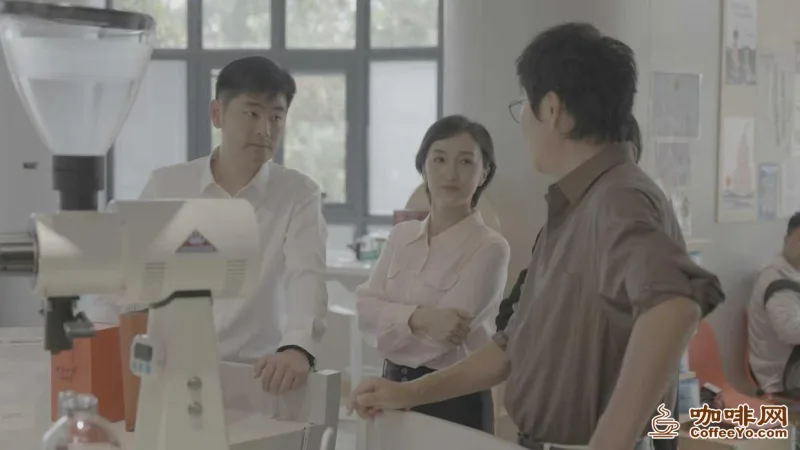
Lou Jiahao (far left) visits a Chengmai coffee enterprise. Provided by the interviewee
Taking root in the volcanic soil
On first arriving in Chengmai, Lou Jiahao did not rush to draw a blueprint, but chose to “sink down.”
Facing an entirely unfamiliar environment, he plunged into the front line, eager to understand Chengmai and its coffee. “To systematically grasp Chengmai’s coffee industry, my first step was to visit scenic-area merchants, large growers, and connect with local buyers and third-party partners, diving into the coffee enterprises’ and farmers’ plantations.”
Over a month, he completed a deep “acquaintance” with Chengmai coffee. In the plantations he learned planting and picking, distinguishing fruit ripeness; compared the differences between natural and washed processing; followed local masters to study roasting, observing the whole transformation from green to roasted beans—watching color, judging aroma, tuning roast temperature. “There was a small episode—I got burned by charcoal fire while roasting, which was quite an interesting experience.”
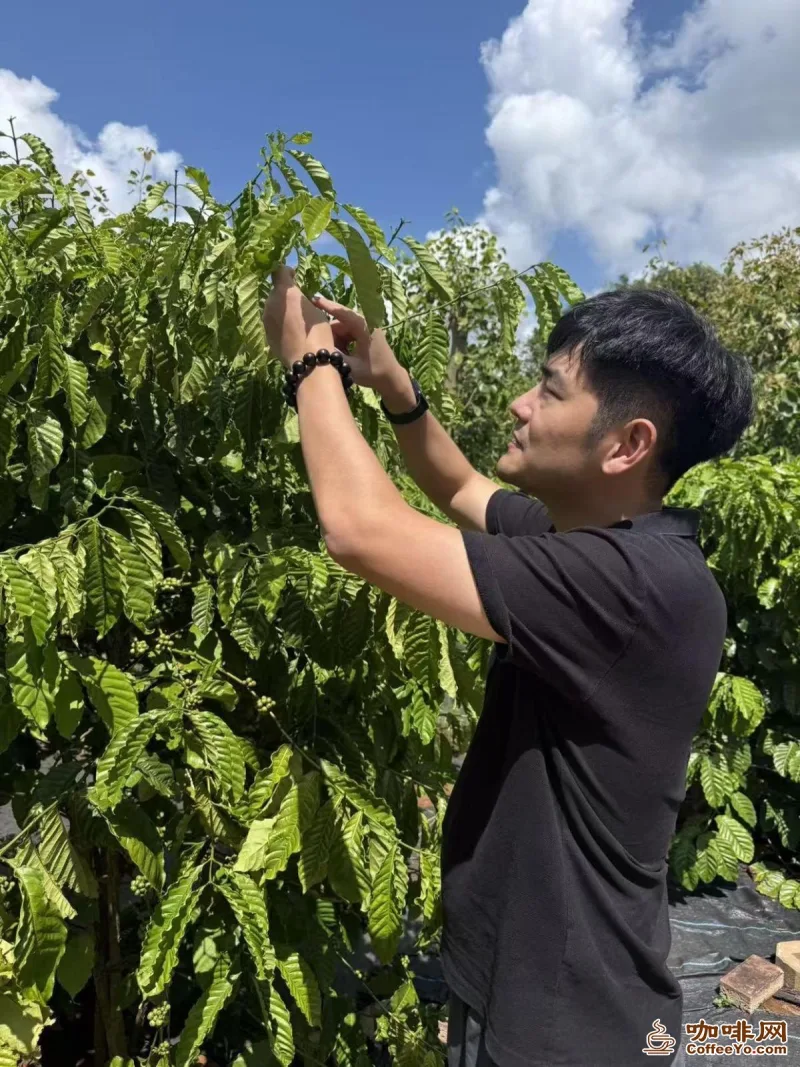
Lou Jiahao observes coffee bean growth. Provided by the interviewee
While deeply understanding Chengmai coffee, he also took over operation of the Fushan Coffee Culture Town scenic area. In March 2025, this scenic area in Fushan Town was rated a national 4A-level tourist attraction.
“The scenic area had a single business format—every household ran a coffee shop, each fighting alone. As a tertiary-industry town, it failed to connect the county’s whole industrial resources, leaving its development potential under-realized,” Lou analyzed.
After taking over, Lou did not pursue large-scale demolition and rebuilding, but focused on iterative business-format optimization, driving diversified upgrading and brand reshaping. He carefully observed local life and caught the area’s unique rhythm: “Locals are used to a slow life, often not going out until two or three in the afternoon.” He accordingly built a locally adapted “slow business”—preserving the old-dad tea street-space, shifting the operating focus to afternoon and nighttime, developing the night economy; and for the Haikou clientele he introduced trendy youthful formats like camping leisure and immersive script-murder games.
This February, he pushed the local brand “FushanLife” to begin overseas communication. Using international social platforms and modern visual expression, he promoted Chengmai coffee culture and island lifestyle to the world, helping the town evolve from a mere sightseeing check-in point into an immersive, international coffee-life experience destination.
This immersive “acquaintance” not only let him systematically master Chengmai coffee’s whole-chain logic from seed to cup, but also let him touch the warmth and texture deep within the industry.
Bringing Zhejiang wisdom to 19° North
Having deeply cultivated rural cultural-tourism operation for years, as early as around 2019 Lou Jiahao deeply participated in Zhejiang local agro-tourism projects such as Zhoushan Daishan Dongsha Ancient Town and Jiande Daciyan. From early planning and research, to local-culture excavation, to whole-village operation after project landing, in the wave of Zhejiang’s rural revitalization he found his career direction.
“After entering the countryside I found it hides many precious cores absent from urban commerce. I hope that, through the power of operation, I can create a spiritual refuge from the noise for people,” said Lou. Thus, while practicing, learning, and researching, he became everyone’s “rural CEO.”
Years of front-line combat let him deeply understand rural operation’s underlying logic—only by rooting in local characteristics, culture, and needs can the countryside’s authentic essence be preserved. In Hainan, Lou saw Chengmai coffee holding several gifted “trump cards.”
“Chengmai coffee has nearly a century of planting history and a mature producing-region base; located at 19° North—within the coffee-growing golden belt—it is planted in volcanic red soil rich in selenium, and the area is also a renowned ‘longevity hometown’; the development dividends of Hainan Free Trade Port bring transport and policy benefits, with broad industrial prospects.”
Alongside opportunity, challenges stand out. After deep research, Lou found Chengmai coffee’s industry suffered from scattered brands, weak pricing voice, shallow agro-tourism integration, insufficient international communication, and an incomplete chain—trapped in the bottleneck of “resources, products, but no brand, no voice,” with quality resource advantages not yet fully converted into market competitiveness.
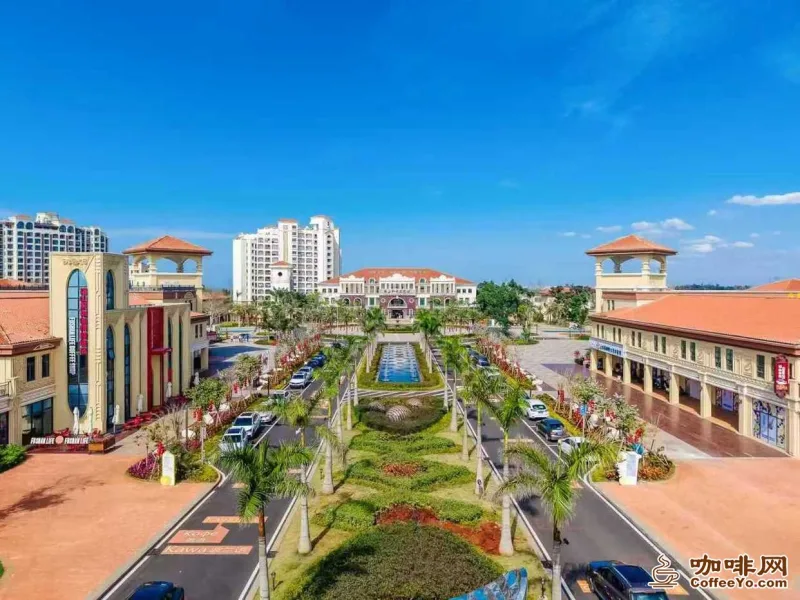
Fushan Coffee Culture Town. Provided by the interviewee
Having pinpointed the pain points, he acted according to local conditions with precise measures: “What we must do is stabilize yield on one side and build the brand on the other, fully activating Chengmai coffee’s endogenous momentum.” Zhejiang’s rural operation inspired him: “Each village must find differentiated characteristics, avoiding uniformity.”
“Some Chengmai villages can focus on coffee planting to raise capacity; others excel at bean roasting and processing—complementing each other,” Lou said. “Primary industry solidifies planting, secondary strengthens processing, then the scenic area carries tertiary cultural-tourism services—with a differentiated collaboration model, linking points into lines and lines into surfaces to drive whole-area coordinated development.”
He also brought Zhejiang’s “cluster grouping” development philosophy to Chengmai. He walked every town and village, mining the integration entry points of specialty farm products and rural tourism, pushing scenic areas, villages, and entrepreneurial founders to join hands. Currently Chengmai is actively advancing cross-border cooperation with Haikou Mission Hills, Qiaotou Town, Ruixi Town, and other specialty agricultural regions.
Beyond the industry model, he also brought Zhejiang’s advanced thinking of government-enterprise coordination. “What is valuable about Zhejiang is that government and enterprises each play their role and develop in parallel, fully releasing their respective advantages; when common difficulties arise, they coordinate and consult to break the deadlock together, maximizing the tripartite force of policy, enterprise, and marketization. This market-oriented collaboration model was also recognized by Chengmai locals.”
Let this cup of coffee fragrance go overseas
Lou’s gaze extends beyond a single cup. As secretary-general of the Chengmai Agricultural Industry Development Federation, Lou not only strives to send Chengmai coffee’s aroma overseas, but also finds a new growth pole in the digital-economy wave.
Beyond operating the Fushan Coffee Culture Town scenic area, Lou’s team also revitalized 96 village-collective villas idle for over a decade in Chengmai, aiming to build an international coffee industrial park.
“Learning from Zhongguancun’s development thinking, we introduce venture capital, plan professional roadshow spaces, and build financing bridges for digital nomads and rural entrepreneurial founders,” Lou explained. He also links with local universities such as Hainan University to host research practice and topic study, letting youth creativity land in the countryside. Currently the park’s reception center is still under renovation, expected to officially open around mid-2027.
Digitalization is Chengmai coffee’s next core lever. Lou’s team is building an international coffee digital-intelligence trading center, relying on AI and digital technology to establish a digital trading platform integrating real-time quotes, online matchmaking, supply-demand docking, and product issuance. Expected online by mid-2027, it will connect global coffee market quotes with Chengmai’s local industry.
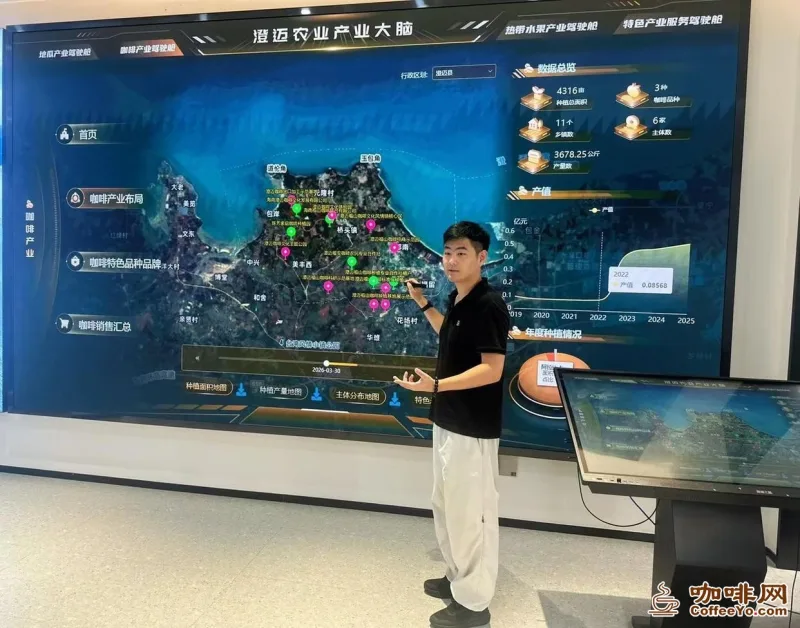
Lou Jiahao explains Chengmai’s agricultural industry layout. Provided by the interviewee
Moreover, while planning the coffee industry, Lou expanded Chengmai’s “6+2” full-series specialty agro-product overseas path—including Qiaotou sweet potatoes, seedless pomelos, and seedless lychees—using brand empowerment to raise agricultural product added value.
During visits he found that local farmers and enterprises, small in scale, had weak bargaining power in agricultural procurement, financing loans, and channel expansion. To address this, he led the adoption of centralized agricultural-input procurement, integrating enterprise demand to uniformly connect with the supply chain, effectively lowering production costs and guaranteeing input quality. At the same time, he actively engaged financial institutions to broker agriculture-specific bank credit, cracking the difficulties of agricultural enterprises’ financing and slow capital turnover—injecting precious “financial living water” into nearly 50 agriculture-related enterprises, among which Bank of China and Hainan Rural Commercial Bank provided a combined 5 billion yuan credit line.
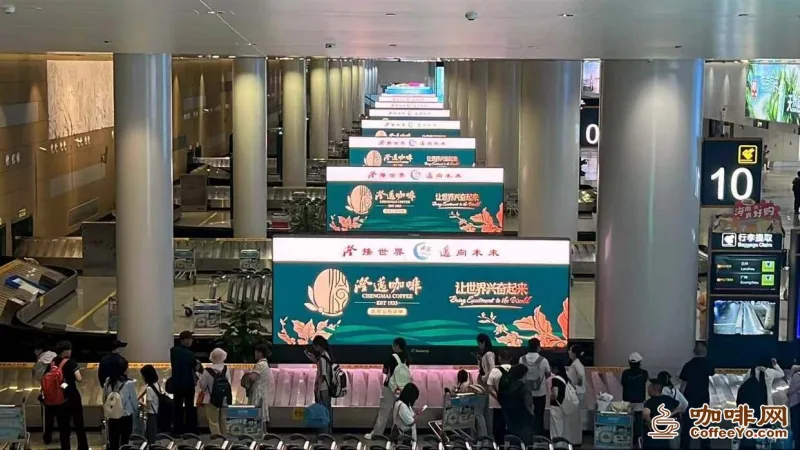
“Chengmai coffee” seen at the airport. Provided by the interviewee
Looking ahead, Lou said he will continue to deepen Zhejiang-Hainan linkage, relying on Zhejiang partner-enterprise resources to open Chengmai agro-products’ channel into Zhejiang; recruit career partners nationwide, launch a private-customization model, and empower more people to build their own coffee brands.
In December 2025, the Chengmai coffee regional public-brand promotion conference landed in Haikou; in April 2026, Chengmai officially released its coffee regional public-brand logo with the slogan “Let the world get excited”; now, at Chengmai expressway exits and Haikou Meilan Airport, “Chengmai coffee” branding is everywhere… all changes Lou has witnessed since arriving.
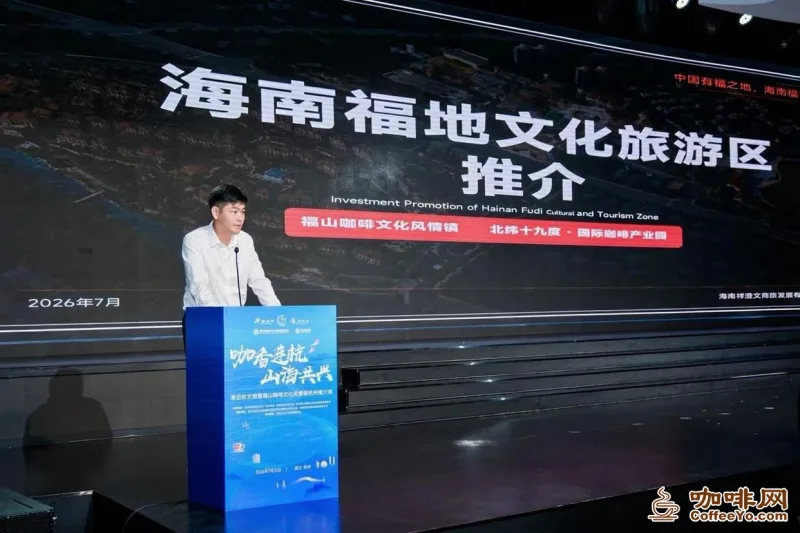
Chengmai agro-cultural-tourism & Fushan Coffee Culture Town Hangzhou promotion conference. Provided by the interviewee
“When I first arrived, many knew Hainan’s Xinglong coffee but not Chengmai coffee. Now quite a few visitors to Hainan already have an impression of Chengmai coffee,” Lou reflected. In the first half of the year, Fushan Coffee Culture Town received 670,000 visitors, up 9% year-on-year, with comprehensive income exceeding 22 million yuan—a certain increase over last year.
Crossing the East China Sea and the South China Sea, Lou planted the skills from Zhejiang into this volcanic land, waiting quietly for it to take root downward and grow upward.
[A word from afar to Zhejiang]
Hangzhou is where I grew up; leaving home naturally brings reluctance—missing the morning noodles, the bowl of pork-flavored noodles at noon. When I first came to Hainan there was much I wasn’t used to. But after slowly blending in, I met many warm people and things, and developed new feelings for this land.
Along the entrepreneurial way, what I’m most grateful for is still the homeland of Zhejiang—it gave me the vision to see the world, and the confidence to dare, to try, to do things solidly. Going out does not mean leaving home; I more hope to connect Zhejiang and Hainan, letting the resources, talent, and opportunities of both places collide more.
Not forgetting where I came from, and seriously walking the road beneath my feet—in the future I’ll do my part to create something truly valuable for Hainan, for the Free Trade Port, for Chengmai.
(Lou Jiahao, Deputy General Manager of Hainan Xiangcheng Culture-Commerce-Tourism Development Co., Ltd. and Secretary-General of the Chengmai Agricultural Industry Development Federation)
“Please cite the source when reprinting.”
Reprint Notice & Disclaimer
- This article has been edited and compiled by China Coffee Network. The information and images therein come from public sources and the copyright belongs to the original author. This reprint is intended solely for information sharing within the coffee industry and does not represent the views of this website; all data and opinions are subject to the original article. Our thanks to the original author for creating and sharing it.
- For matters concerning content licensing, attribution, copyright or otherwise, please contact us promptly and we will verify and cooperate in handling them as soon as possible. We also welcome coffee origins, brands and industry media to exchange ideas and contribute articles.
- Contact China Coffee Network: Tel 400-0000-641 (+86-18288016826) | Email 405854472@qq.com | Address: Jinghong, Xishuangbanna, Yunnan Province / Tieling, Liaoning Province
Related Reading
 How ‘Sea-Flavored’ Coffee Blooms Across Dongtou
- Health Guide: How to Enjoy Your Coffee the Healthy Way
 Study: Regular Coffee and Tea May Lower Dementia Risk, but More Is Not Better
 Frontline Story: A ‘Mobile City Coffee Bar’ Arrives by the Grand Canal
 Yantai’s Wind Tastes of Coffee
 In Zhenyuan, a Cup of Coffee and a Waiting Train




 Liaoning ICP Security No. 21122402000217