
Abstract:Sanmai Village in Mengsong Township, Menghai County, Xishuangbanna sits at an average altitude of 1,693 metres, with an annual mean temperature of 17°C and 1,500 mm of rainfall. In 2026, RMB 1.65 million in Shanghai-Yunnan partnership funds was channelled into a 250 m² coffee processing plant and the conversion of 500 m² of idle village buildings, unlocking a full chain from pulping and drying to roasting and grinding. Per-mu returns in the project area are expected to rise three- to five-fold; 684 mu of land was transferred in one step, with purchases guaranteed at RMB 0.2 per kilogram above market price, reaching more than 5,000 mu of coffee plantings nearby.
In the south of Yunnan, the golden coffee belt at 21°N runs straight through the hills. Sanmai Village, Mengsong Township, Menghai County, Xishuangbanna, lies at an average altitude of 1,693 metres with an annual mean temperature of 17°C and 1,500 mm of rainfall, where coffee trees grow together with rainforest vegetation and produce the distinctive cup profile of “strong but not bitter, aromatic but not harsh”. In 1995, a Nestlé experimental demonstration farm settled in the Nanbenxinzhai villagers’ group of Sanmai, bringing scientific cultivation techniques and improved varieties that planted the first seed of the local coffee industry. Yet limited processing capacity long forced growers to sell fresh cherry and raw beans, keeping value-added low and profits flowing elsewhere — a “big resource, small industry” trap. Turning ecological advantage into economic advantage, and the “experimental plot” into a “green bank”, became the question Mengsong’s coffee sector had to answer.
Targeted support from Shanghai-Yunnan partnership
Full-chain empowerment for industrial upgrading
In 2026, RMB 1.65 million of Shanghai-Yunnan partnership funds from Songjiang District was injected into Sanmai Village for coffee factory and multi-purpose building facilities — a combined package of “capital leverage, full-chain processing, enclave operation, farmer linking and tertiary integration” that is pushing Mengsong coffee from “exporting raw material” to “specialty beans in the spotlight”.
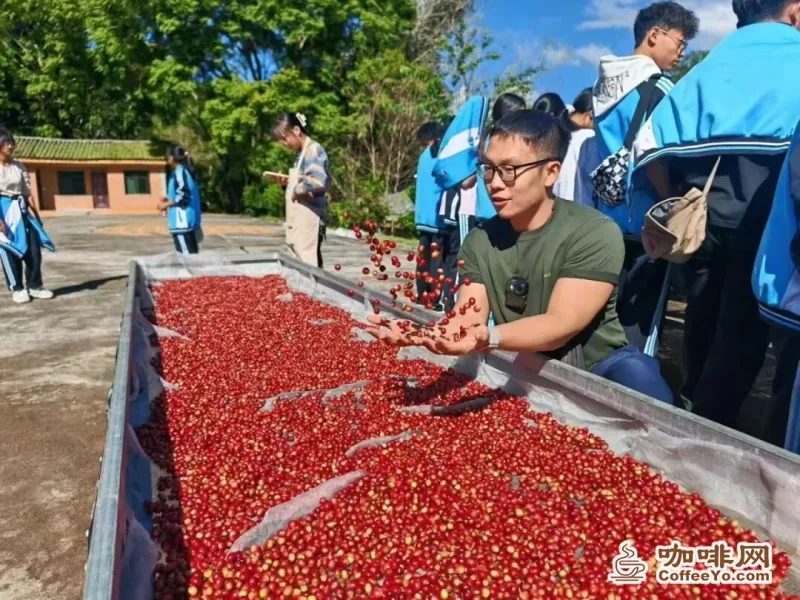
Capital leverage closes the processing gap. The project built a 250 m² steel-framed coffee workshop and renovated 500 m² of idle collective housing, with water and power, display cabinets and storage. Once complete it will handle pulping, de-mucilage, drying, grading, roasting and grinding in one chain, and develop drip-bag and cold-brew products, removing the bottleneck where “the harvest arrives all at once but processing cannot keep up”. Per-mu returns in the project area are expected to rise three- to five-fold, keeping more value in the village.

Enclave operation solves the collective-economy puzzle. The plant sits in Sanmai, which has the stronger industrial base, and is leased to Yuanque Coffee Manor; the assets created are assigned to Nuoyou Village Committee, whose collective economy is weak. The “cross-village joint construction, enclave operation” model addresses villages that have “resources but no industry, or industry but no assets”, and is expected to add RMB 50,000 a year in rent for Nuoyou — strong villages helping weak ones.

Linking farmers weaves a tighter benefit network. Built around Yuanque Coffee Manor under a “party branch + company + farmer” mechanism, 684 mu of land in Nanbenxinzhai was transferred in an orderly, one-off move, with purchases guaranteed at RMB 0.2/kg above market price, reaching more than 5,000 mu of coffee plantings among surrounding households. The manor uses shade-grown planting and conserves more than 60 coffee varieties. When complete, the project is expected to provide 10 permanent jobs and about 200 temporary positions, adding RMB 30,000 a year to the average coffee-growing household. At the peak of the picking season a farmer can earn around RMB 200 a day — employment at the doorstep, income from the land.

Industrial upgrading. Mengsong coffee moves from fresh cherry and raw beans to a full product line of specialty beans, roasted beans, drip bags and cold brew, shedding the raw-material export model and building its own product system, with per-mu returns up three- to five-fold.
Stronger collective economy. Through cross-village enclave operation, Nuoyou Village gains RMB 50,000 a year in rent, with asset income channelled into public welfare, infrastructure and industry.
Higher farm incomes. The project is expected to add RMB 30,000 a year to the average coffee-growing household, provide 10 permanent posts (RMB 3,000 a month) and about 200 temporary jobs (RMB 130 a day), and add more than RMB 400,000 in wage income. Free training in coffee planting and processing raises skills and builds momentum from within. Some 596 households and 2,610 people are expected to benefit, including 139 households and 522 people previously at risk of or returning to poverty.

Tertiary integration. Built around Yuanque Coffee Manor and linked to the crocodile valley and Huisanmi tourism village, the circuit shares visitor flows and adds catering, coffee study tours and product development. Since 2025, key nodes along the route have added RMB 3.94 million in income, and coffee study tours have revitalised rural tourism.

Ecological returns. Shade-grown, rainforest-compatible planting conserves more than 60 coffee varieties, aligning industrial growth with ecological protection and unifying economic, social and ecological benefits.

Precision is the key. Partnership capital targeted the core bottleneck — processing that could not keep up — putting RMB 1.65 million into factory and multi-purpose buildings, using “small money to leverage a big industry” and moving from blood transfusion to blood-making.
Mechanisms are the engine. Cross-village enclave operation cracks the problem of villages with weak collective economies; the party branch + company + farmer mechanism tightens the benefit network; guaranteed prices, land transfer and employment let farmers share the gains of industrial upgrading.

Full-chain upgrading is the direction. From planting to processing, product to experience, primary to tertiary industry, Mengsong coffee has shed the raw-material model and built its own system of specialty, roasted and soluble products, moving from selling raw beans to selling products and experiences.
Partnership is the bridge. From the banks of the Huangpu to those of the Lancang, the Shanghai-Yunnan partnership matches what Shanghai can offer with what Mengsong needs; intellectual support opens new horizons in the Yangtze Delta market and consumption cooperation widens sales channels, so that one coffee bean carries a deep friendship across mountains and sea and brews a lasting sweetness for rural revitalisation.
Source: Agriculture and Rural Affairs Bureau of Xishuangbanna Prefecture
Reproduction Notice & Disclaimer
This article was compiled and reprinted by China Coffee Network from The Paper “A Coffee Bean’s Dialogue Across Mountains and Sea: Shanghai-Yunnan Partnership Unlocks the Path to Prosperity in Sanmai Village, Mengsong”. All rights in the original work belong to The Paper and its author. China Coffee Network reproduces it solely to share information within the coffee industry; it does not represent our editorial position, and all data and views are those of the original. Our thanks to the original author for the work and for sharing it.
Read the original: The Paper “A Coffee Bean’s Dialogue Across Mountains and Sea: Shanghai-Yunnan Partnership Unlocks the Path to Prosperity in Sanmai Village, Mengsong”
For matters of authorization, attribution, copyright or otherwise, please contact us at any time and we will verify and cooperate promptly. Coffee origins, brands and industry media are also welcome to write for us.
China Coffee Network contacts: Tel 400-0000-641 (+86-18288016826) | Email 405854472@qq.com | Address: Jinghong, Xishuangbanna, Yunnan / Tieling, Liaoning, China
Reprint Notice & Disclaimer
- This article has been edited and compiled by China Coffee Network. The information and images therein come from public sources and the copyright belongs to the original author. This reprint is intended solely for information sharing within the coffee industry and does not represent the views of this website; all data and opinions are subject to the original article. Our thanks to the original author for creating and sharing it.
- For matters concerning content licensing, attribution, copyright or otherwise, please contact us promptly and we will verify and cooperate in handling them as soon as possible. We also welcome coffee origins, brands and industry media to exchange ideas and contribute articles.
- Contact China Coffee Network: Tel 400-0000-641 (+86-18288016826) | Email 405854472@qq.com | Address: Jinghong, Xishuangbanna, Yunnan Province / Tieling, Liaoning Province
Related Reading
- Bean in Short Supply: A Taiwan Youth on Yunnan Coffee as a Shared Cross-Strait Stage
- Five Years, Eight Championships: Lincang Coffee Joins the World Stage
 Haikou ‘Union Cup’ Barista Skills Competition Kicks Off to Empower the Service Sector
 Yunnan Specialty Coffee Beans Deliver an ‘Excellent’ Report: Path to Value Leap
- Cross-Strait Tides Rise: A Taiwan Youth Farms Coffee in Yunnan, a Cup Bridging Both Sides
 2026 2nd Yunnan Treasure Coffee Green Bean Competition (Cup of Excellence Pilot) Concludes


 Liaoning ICP Security No. 21122402000217