
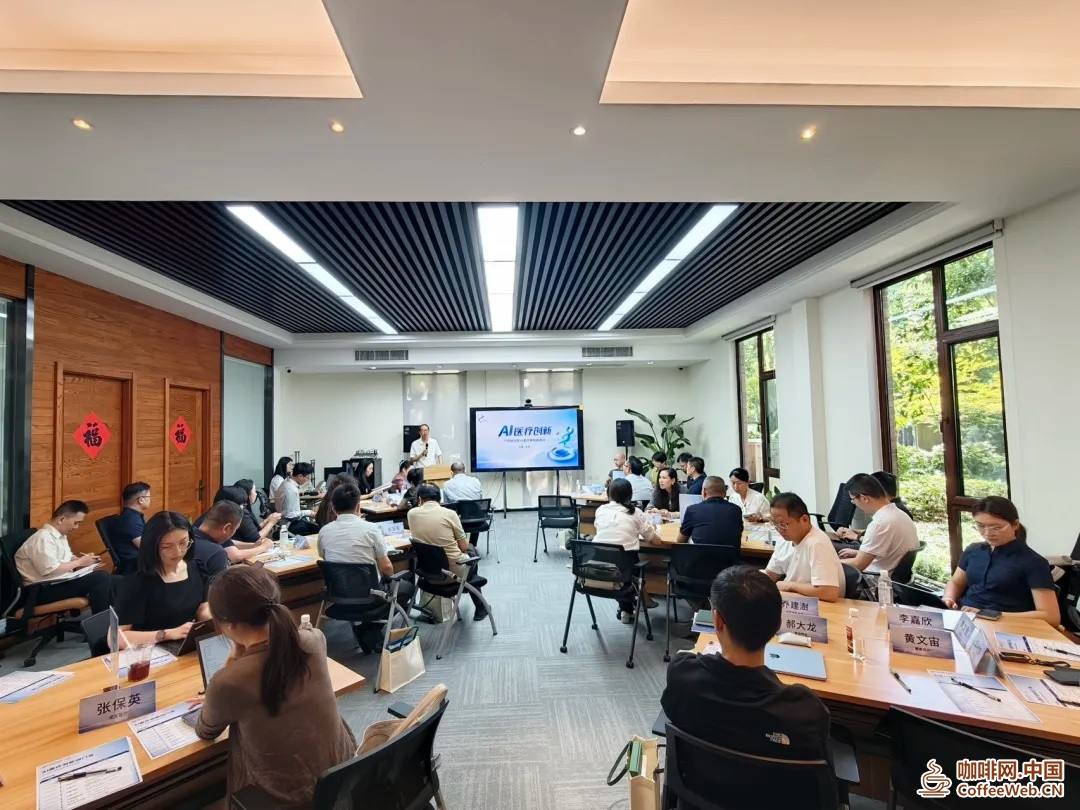
On July 10th, a scientific caf é event with the theme of "New Path of AI Medical Implementation" landed at Zhejiang New Era Industry Finance Collaborative Innovation Research Institute. This event focuses on the two core themes of "AI accelerated research and development" and "ensuring compliance with multi cloud architecture". Industry experts, medical enterprise founders, and data infrastructure technology leaders are invited to gather in a targeted manner, focusing on four directions of intelligent diagnosis and treatment, simulated medicine, digitalization of traditional Chinese medicine, and medical data base for in-depth exchanges. A normalized collaborative exchange platform of "industry+finance+technology" is built to break down the barriers to the landing of AI medical technology from laboratories to industrial applications.
Hu Hua, Chairman of the Provincial Artificial Intelligence Society, pointed out that AI has shown significant application value in scenarios such as cancer early screening and pathological recognition, using industry cases of top global experts in assessing consciousness disorders using AI technology as a starting point. He proposed that healthcare is the track with the most long-term value for AI implementation, spanning multiple disciplines such as biology, chemistry, precision instruments, and artificial intelligence. As long as the bottom line of medical ethics is upheld, there is vast space for industrial innovation. At the same time, he encourages young entrepreneurs to delve deeper into the AI medical niche and generate practical results through cross disciplinary ideological collisions.
Wang Quan, Deputy Director of the Teaching Department and Deputy Chief Physician of Orthopedics at Zhejiang University, brings cutting-edge exploration of AI+simulation medicine. Simulation medicine cultivates young physicians with high simulation methods to avoid medical safety hazards caused by novice practitioners directly practicing on patients. It is the core support of standardized clinical teaching and has deeply integrated VR/AR, 3D printing, force feedback equipment, motion capture, and AI technology. He predicts that AI cannot completely replace the humanistic diagnosis and treatment process of physicians in the short term, but standardized and repetitive clinical operations may gradually achieve human-machine collaboration. In the long run, high simulation technology is expected to directly train expert physicians through systematic training. Currently, domestic hardware equipment is accelerating the promotion of domestic substitution and getting rid of dependence on overseas equipment.
Left Yuxing, founder of Tangji Medical, shared the company's AI landing application in the field of metabolic diseases. The team focused on obesity, diabetes, fatty liver and other metabolic diseases, and relied on digestive tract intervention technology to build a full chain digital management system of "diet exercise medicine equipment/surgery". He emphasized that the positioning of AI is to assist doctors rather than replace them, which is also the core logic for products to be successfully implemented in hospitals and promote clinical cooperation. At present, enterprise related digital therapy devices have obtained a unique national medical device registration certificate, but due to policy coding restrictions, they still cannot smoothly complete the integration of medical insurance access and hospital systems, which is the core bottleneck for the large-scale promotion of digital therapy.
Founder of Bamai Technology, Jin Jianxin, introduces the practice of AI empowering the standardization transformation of traditional Chinese medicine. The team has been deeply involved in the digitalization of traditional Chinese medicine for more than ten years. Based on the Transformer architecture, they have independently developed two vertical industry models, "Big Enterprise Lingshu" and "Big Enterprise Lingyun". Through multi-dimensional hardware collection of traditional Chinese medicine physical sign data such as tongue image, pulse, and voice, they have transformed the traditional fuzzy diagnosis and treatment experience of "observation, hearing, questioning, and cutting" into structured diagnostic recommendations. He believes that AI will not disrupt the traditional Chinese medicine system, but rather digitize the diagnostic and treatment thinking of renowned TCM practitioners, and fill the gaps in TCM data collection through the combination of software and hardware. The talent gap in the industry is concentrated in composite practitioners who understand both traditional Chinese medicine and AI. Only such individuals can break through the barriers between technology and clinical practice.
Chen Tingliang (Wang Ben), founder of Shuxin Intelligence, directly addresses the core concern of the industry regarding the issue of medical data silos. Cross institutional data barriers, high privacy compliance thresholds, and difficulty in ensuring data ownership greatly constrain the training of AI models and the implementation of multi center clinical research. In response to the pain points, he completely dismantled the technical solutions and implementation experience of hybrid cloud architecture in medical data circulation scenarios, providing a clear technical path for compliant application and secure sharing of medical data. He admitted that practitioners of pure coding and general AI applications are most anxious about the impact of large model iterations, while pure medical data-driven applications have a lower risk of being replaced in the short term due to their incomplete system. However, once the global data is connected, the industry will usher in a deep intelligent transformation.
In the free roundtable discussion session, attending entrepreneurs, investment institutions, and technical experts fully exchanged views on difficulties such as data authenticity, quantitative evaluation of medical AI projects, and pilot policies for startups, jointly exploring feasible solutions and exploring new opportunities for multi-party collaboration. At the end of the seminar, the organizer presented the Science Cafe Honor Certificate to the guest speakers.
In the free exchange session, guests further discussed their cooperation intentions, explored opportunities for collaboration, and laid the groundwork for future industrial linkage.
This event is guided by the Zhejiang Association for Science and Technology, jointly organized by the Digital Center of the Specialized and Innovative Enterprise Cultivation Base (Hangzhou) and the Zhejiang Business Magazine. It is a small yet sophisticated form of in-depth communication, breaking away from the one-way preaching mode and taking into account academic theory, clinical practice, and industrial commercialization perspectives.