
At a Glance (China Coffee Network): China News Service, Baoshan, October 4 (subhead): Yunnan Baoshan’s small-grain coffee pursues "precision" through data By Lu Xicheng, Li Ye and Guan Wenjing In October, coffee che…
China News Service, Baoshan, October 4 (subhead): Yunnan Baoshan’s small-grain coffee pursues “precision” through data
By Lu Xicheng, Li Ye and Guan Wenjing
In October, coffee cherries hang heavy on the branches across Baoshan City, Yunnan Province, entering the critical care period before ripening. At the Xinjiashan coffee plantation, sensors and weather stations are scattered among the trees, with soil, temperature and humidity data streamed back in real time; with a light tap on a phone screen, water and fertilizer are delivered to each coffee tree as needed.
The precision management above is enabled by the “Yunzhi Nonglian” (Cloud Smart Agri-Chain) platform. Built by China Mobile’s Baoshan branch together with research teams from Baoshan College, Zhejiang Sci-Tech University, Northwestern Polytechnical University and others, the platform integrates farm management, intelligent water-and-fertilizer control, pest and disease early warning, and product traceability.
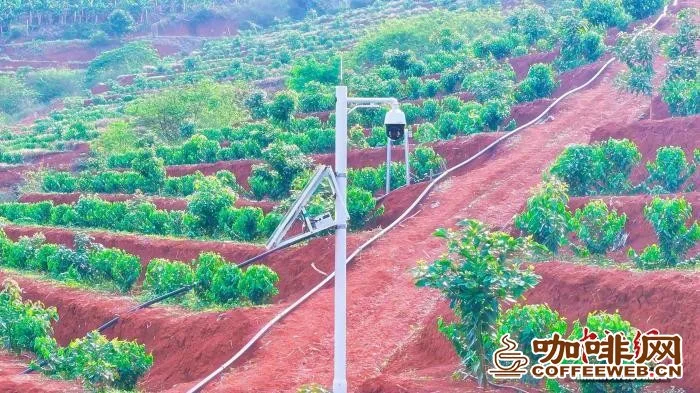
Yang Jiangchun, head of the Xinjiashan coffee plantation, said that since its founding in 2020 the plantation has targeted the premium segment, partnering with the Institute of Tropical and Subtropical Cash Crops of the Yunnan Academy of Agricultural Sciences and other research bodies to select varieties, and interplanting bananas and pigeon peas among the coffee trees for shade and nitrogen fixation.
As coffee trees covered the hillsides, manual care gradually fell short: water and fertilizer needs vary by slope aspect and plot, and decisions on when to irrigate or fertilize relied heavily on experience; nighttime duty also easily led to misjudgment from fatigue. “The trickiest issue is pests and diseases. In the past, some diseases were often only spotted during garden patrols, easily missing the best treatment window and affecting coffee quality,” said Yang Jiangchun.
In 2024, the plantation connected to the “Yunzhi Nonglian” platform, and care began to have a “digital helper.” Beyond remote dispatch from the backend, the system can automatically start irrigation and fertilization when soil moisture falls below a preset threshold; AI inspection drones shuttle through the coffee forest, spotting early diseases such as rust through image recognition and generating plant-protection recommendations. “Over the past two-plus years, the plantation’s overall costs have fallen by more than 83%, fresh-fruit yield per mu has risen by over 21%, the defect rate has dropped to 3.34%, and income per mu has increased by nearly 1,500 yuan,” said Yang Jiangchun.
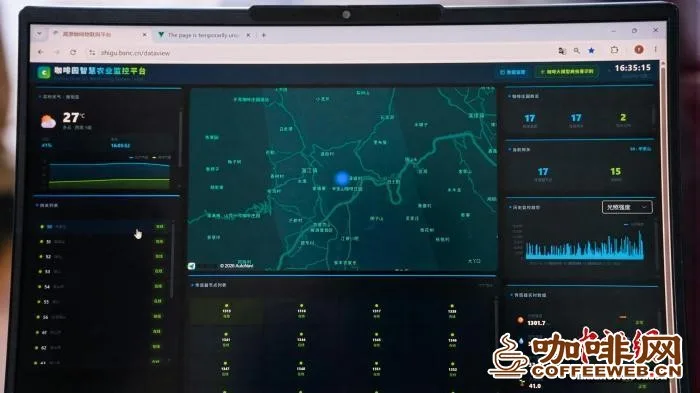
Ding Qishan, application solutions manager at Baoshan Mobile, said the platform will next introduce a coffee-specific large model and expert knowledge base, refine functions such as low-altitude inspection and image collection, advance water and fertilizer management from “automatic execution” to “intelligent judgment,” and extend to Baoshan’s advantageous produce such as tea and dendrobium.
“But data cannot replace footsteps,” said Yang Jiangchun. The precious time freed up by artificial intelligence should be returned to the fields, to devote more “hard work” to on-site verification, agronomic trials and harvest control, taking responsibility for quality.
Baoshan is one of China’s important coffee-producing regions. Its Nujiang and Kukuo River basins lie between 24 and 25 degrees north latitude, at the northernmost end of the world’s “coffee belt,” with abundant light and heat in the dry-hot river valleys. In 2025, the city’s premium coffee planted area reached 180,600 mu with an output of 26,800 tonnes, and the full industry-chain value reached 22.328 billion yuan; its premium rate and deep-processing rate both exceeded 75% and 90% respectively, ranking at the forefront of Yunnan. (End)
Reprint Notice & Disclaimer
- This article has been edited and compiled by China Coffee Network. The information and images therein come from public sources and the copyright belongs to the original author. This reprint is intended solely for information sharing within the coffee industry and does not represent the views of this website; all data and opinions are subject to the original article. Our thanks to the original author for creating and sharing it.
- For matters concerning content licensing, attribution, copyright or otherwise, please contact us promptly and we will verify and cooperate in handling them as soon as possible. We also welcome coffee origins, brands and industry media to exchange ideas and contribute articles.
- Contact China Coffee Network: Tel 400-0000-641 (+86-18288016826) | Email 405854472@qq.com | Address: Jinghong, Xishuangbanna, Yunnan Province / Tieling, Liaoning Province
Related Reading
 Three Decades of Shanghai-Yunnan Collaboration: A Coffee Bean ‘Ferments’ at the Import Expo
 Why Yongde’s Coffee Beans Won Gold in Shanghai – A Taste of ‘Life in Yunnan: 365 Days’
- Yunling Commentary: Yunnan Coffee Turnaround Hinges on Autonomous Pricing
 A ‘Travel Pack’ Reveals Another Possibility for Pu’er Baristas
- Bean in Short Supply: A Taiwan Youth on Yunnan Coffee as a Shared Cross-Strait Stage
- Five Years, Eight Championships: Lincang Coffee Joins the World Stage


 Liaoning ICP Security No. 21122402000217