
Brief (coffeeyo.com): Last year China’s coffee industry reached 354.9 billion yuan, with per-capita annual consumption climbing to 28.57 cups. In Fuzhou, coffee is undergoing a quiet upgrade—from bought cups to home brewing, from second-hand equipment flows to the split between “fast” and “slow” coffee—revealing how an imported drink has become everyday life.
Source: Strait.com (Haixia Net) / Fujian Daily
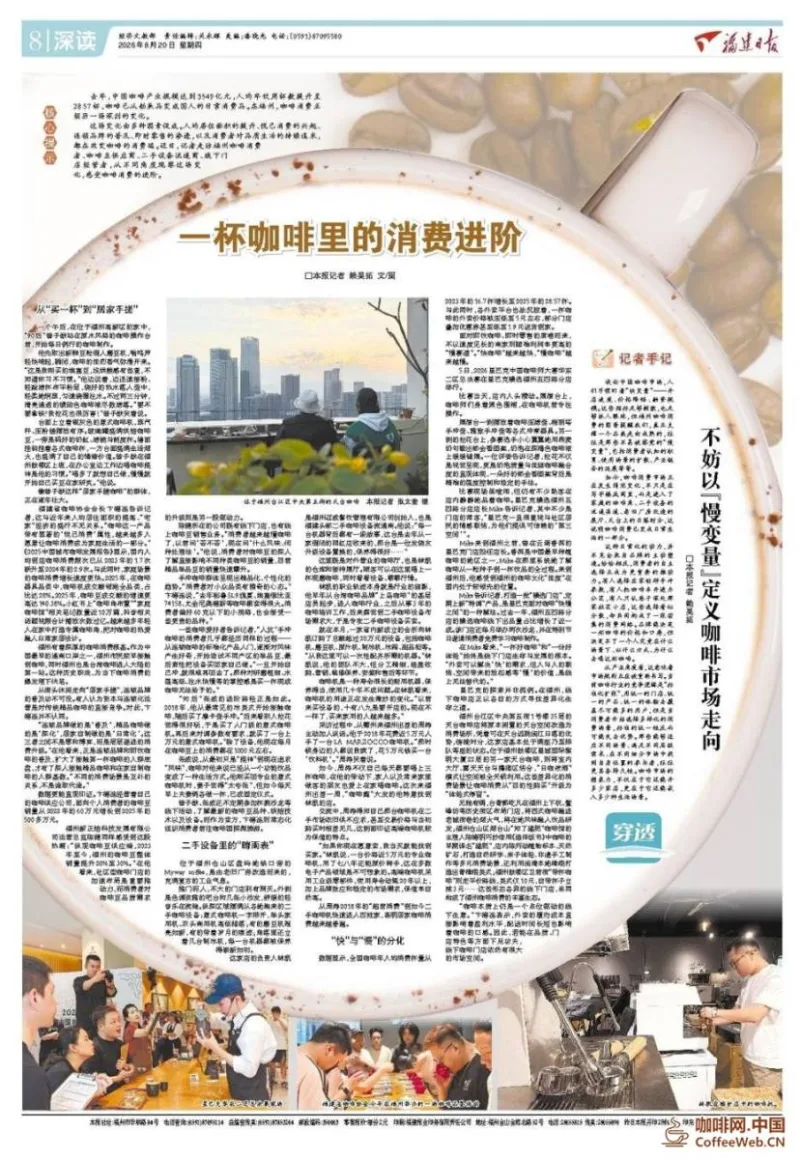
August 20, 2026, Fujian Daily, Page 08
Core Tip: Last year, China’s coffee industry reached a scale of 354.9 billion yuan, and per-capita annual consumption rose to 28.57 cups—coffee has gone from an imported novelty to an everyday consumer good for the Chinese people. In Fuzhou, coffee consumption is undergoing a profound change.
This change is driven by many factors. The growth of per-capita living space, the rise of “treating-oneself” consumption, the spread of chain brands, the penetration of instant retail, and consumers’ sustained pursuit of a quality life are all reshaping the demand side of coffee. Recently, our reporter visited Fuzhou coffee consumers, green-bean suppliers, second-hand equipment traders and brick-and-mortar store operators to observe this shift from different angles and feel the upgrade in coffee consumption.
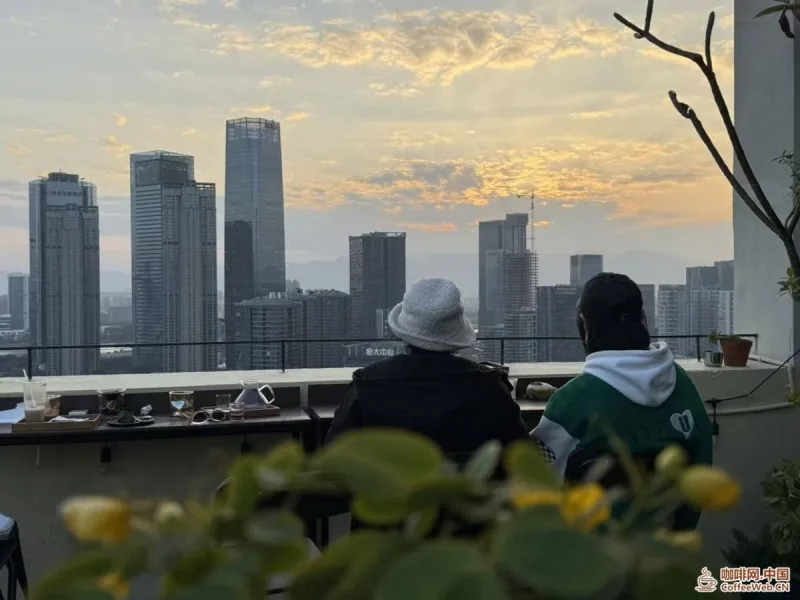
The Rooftop Coffee shop on Central Fifth Street in Fuzhou’s Taijiang District. Photo by Fujian Daily reporter Zhang Wenkui.
From “buying a cup” to “home hand-brewing”
One afternoon, at his home in the Fuzhou High-Tech Zone, the post-90s Zeng Ziyou stood in front of a log-style coffee station and began his daily coffee ritual.
He first took out fresh beans and poured them into the grinder; a light whirring rose, and in an instant the rich aroma of coffee filled the air. “These are Ethiopian beans I just bought; the light roast has a fairly strong acidity—not sure if you’re used to it,” he said, quickly dosing the grounds, tapping the filter cup to level the bed, then letting hot water fall into the kettle for a gentle bloom and an even, circular pour. In just two or three minutes, the clear, translucent amber liquid had fully dripped through. “Want a latte? I’m pretty good at latte art too!” Zeng Ziyou said with a smile.
On the counter stood a silver-gray espresso machine, with the steam wand and tamper neatly arranged. Glass jars were filled with roasted beans, and beside them sat a row of milk pitchers, filter cups and graduated measuring cups. Various coffee mugs hung on wall hooks; this one corner held both the warmth of daily life and his own emotional value. Zeng Ziyou works in Fuzhou’s Gulou District, and drinking coffee at the office to stay alert is his habit. “After drinking so much, I wanted to make my own, and gradually started buying beans to experiment at home,” he said.
Groups like Zeng Ziyou who “hand-brew coffee at home” are growing year by year.
Bian Delian, chairman of the Fujian Provincial Coffee Association, told the reporter this is closely tied to the rise in per-capita living space in recent years and the boom in the “stay-at-home” economy. “Coffee has a distinctly ‘treat-yourself’ quality, and more and more people are willing to make coffee consumption part of family life.” The “2025 China Urban Coffee Development Report” shows that the frequency of in-store coffee consumption per capita in China jumped from 1.7 times in 2023 to 2.9 times in 2024. At the same time, household-scene coffee consumption is growing even faster. In 2025, among coffee equipment categories, coffee machines led all categories in transaction value, accounting for 28%. In 2025, the growth rate of green-bean transaction value reached as high as 140.38%. On Xiaohongshu (RedNote), notes related to “coffee corner setup” and “home café” number nearly 100,000, and related topic videos on Douyin have surpassed 100 million cumulative views. More and more young people are building their own coffee corners at home, weaving their love of coffee into everyday home design.

A coffee tasting event organized by the Fujian Provincial Coffee Association in Fuzhou this year.
Fuzhou has a deep foundation for coffee consumption. As one of China’s earliest treaty ports, Fuzhou residents were exposed to coffee relatively early, and Fuzhou was also the first stop for Taiwanese coffee entering the mainland. This historical accumulation laid the groundwork for today’s coffee-consumption boom.
Going from street-corner leisure to “home hand-brewing,” the spread of chain brands deserves no small credit. Some argue that capital and chain operations directly compete with traditional specialty coffee. Bian Delian does not agree.
“Chain brands do ‘popularization,’ specialty coffee does ‘deepening,’ and home self-making does ‘everyday-ization.’ These three are not a zero-sum game but a step-by-step upgrade of consumption.” In his view, it is precisely the popularization of chain brands and ready-to-drink coffee that has expanded the base of people who encounter their first cup, creating the population foundation for deeply engaging with specialty coffee and brewing at home. “Different consumption scenarios are complementary, not replacements for one another.”
The data bears this out directly. Bian Delian runs his own coffee supply company, and sales of green beans to individual consumers grew from 600,000 yuan in 2022 to more than 5 million yuan in 2025.
Chen Jian, operations director of Fuzhou Xinzhengbei Technology Development Co., Ltd., feels this wave too: “Looking at the green-bean supply side, from 2023 to now, overall coffee-bean sales in Fuzhou have risen 20% to 30%.” In his view, the accelerated rollout of community coffee stores is a key driver, while the upgrading of consumers’ quality demands for beans is another.
Chen’s company has both physical stores and an online green-bean business. “Consumers understand coffee better and better; in the past they asked ‘is it bitter,’ now they ask ‘what flavor, what processing method,'” he said. Consumers’ deeper understanding of beans directly affects the sales of different varieties, and sales of specialty single-origin beans are climbing rapidly.
The pour-over coffee crowd shows a trend toward specialty and personalization. “Consumers are curious about niche varieties,” said Bian Delian. “Last year, Panama’s (note: Peru SL9) Geisha, Ethiopia 74158, and Eugenioides all sold very well. Consumers prefer small 60-gram-and-under sizes and will also accept some more expensive varieties.”
Some coffee enthusiasts told the reporter that consumers who “fall into” pour-over almost all go through the same process—starting with the standardized products of chain coffee, gradually growing curious about flavor, trying single-origin beans from different regions, and finally simply buying the equipment home to make it themselves. “Once you start brewing your own, it’s hard to go back. The sense of control over grind coarseness, water temperature and pour speed is something a ready-made cup can never give you.”
The post-90s Zhang Wei’s progression is exactly this. In 2018, he started with the most common iced Americano, then bought a moka pot for pour-over. “Later I saw others doing latte art and thought it looked fun, so I bought an entry-level espresso machine. Then I wanted to tune parameters, so I bought a ten-thousand-yuan-plus espresso machine.” Beyond equipment, he now spends around 1,000 yuan a month on beans.
Zhang Wei said that from initially just “staying alert” to now pursuing “flavor,” coffee has gone from a functional drink to a lifestyle for him. When he first bought the professional espresso machine, his wife thought it “too much,” but now every morning the couple each makes a cup—a fixed ritual.
Zeng Ziyou and Zhang Wei also periodically attend cupping salons and other offline events to learn about the latest bean varieties, roasting techniques and equipment. And as a seller, Bian Delian regularly organizes consumers to visit coffee farms on origin trips.
The “barometer” in second-hand equipment
Myway Coffee, near the Panyu subway entrance in Fuzhou’s Cangshan District, was converted from an old factory building and is full of retro industrial character.
Pushing the door open, the small store reveals a hidden world. The outer side has an elegantly toned bar and a few small sofas, with soothing light music flowing. The deeper area is lined with second-hand coffee equipment gathered from all over: espresso machines stand in a row, single-group home machines and dual-group commercial machines at varying heights; some grinders shine like new, others bear the traces of time; in a corner stand several ice makers, each machine maintained as good as new.
The store’s manager, Lin Kai, is the founder of Fuzhou Maiwei Catering Management Co., Ltd. and a leading second-hand coffee-equipment trader in Fujian. “Every machine has a story behind it,” he said. “This one was bought from a closed-down internet-famous store last year; that one was traded in when an enthusiast upgraded—well maintained…”
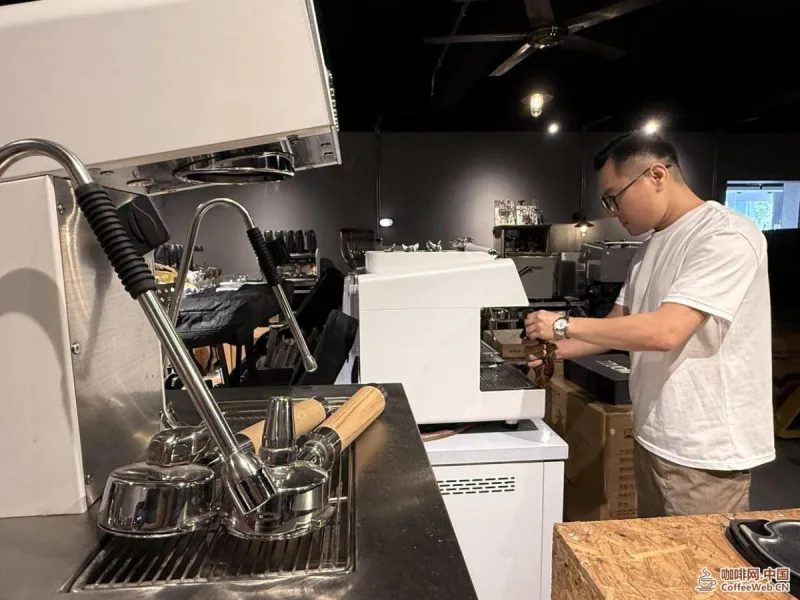
Lin Kai maintaining a coffee machine in his shop.
This place is both an operating café and Lin Kai’s warehouse and showroom. Customers can drink a cup of fresh-ground coffee here while looking at the equipment and chatting about the market.
Lin Kai’s career trajectory is itself a microcosm of the industry. He started in the coffee business as a frontline clerk at the Taiwanese coffee brand “UBC Coffee” (Shangdao), then did three years of barista training, and later, sensing strong demand in the second-hand coffee-equipment market, specialized in buying and selling used machines.
Just this month, a newly established club within the province ordered more than 200,000 yuan worth of equipment from Lin Kai, including coffee machines, grinders, juice extractors, ice makers, refrigerators and dessert display cases. “From me you can outfit all the machines you need in one go,” Lin Kai said. His team is small but finely divided, covering acquisition, marketing, maintenance, installation and after-sales.
A coffee machine is a long-lived durable good; with proper maintenance it can last decades. In Lin Kai’s view, the use of coffee machines is undergoing a subtle shift. “In the past, eight or nine out of ten who bought equipment were opening a shop. Now it’s different—more and more people buy them for home use.”
During the interview, Zhou Tao, on a business trip to Fuzhou from Quzhou, voluntarily joined the conversation. In 2018 he spent nearly 50,000 yuan on a La Marzocco machine. “Back then everyone around me said I was crazy, spending 50,000 yuan on a ‘beverage machine,'” Zhou Tao said with a laugh.
Today, Zhou Tao not only drinks three cups of coffee a day himself, but through his influence his family and friends who often visit have also grown to love drinking coffee at home. On this week-long business trip to Fuzhou, his “coffee craving” flaring up, he specifically sought out Lin Kai’s shop.
In conversation, Zhou Tao learned that his machine remains in short supply on the second-hand market, with a transaction price little different from what he originally paid—side evidence of how well high-end coffee machines hold their value.
“If you’re willing to sell now, I could find a buyer the same day,” Lin Kai said. A professional coffee machine priced near 50,000 yuan, used for seven or eight years, can still be resold at the original price—inconceivable in most consumer-electronics fields. High-end coffee machines use industrial-grade components with a service life often exceeding 20 years, and combined with brand effect and steady market demand, their value retention is naturally high.
From Zhou Tao’s “premature consumption” in 2018 to second-hand coffee machines now rapidly entering ordinary homes, the picture shows that home coffee consumption is becoming ever more common.
The divergence of “fast” and “slow”
Data shows that national per-capita annual coffee consumption rose from 16.7 cups in 2023 to 28.57 cups in 2025. At the same time, delivery platforms are locked in fierce competition, with the takeout price of a cup of coffee pushed down to around 5 yuan, and some stores, coupon-stacked, delivering to the home for as little as 1.9 yuan.
Facing the onslaught of ready-to-drink coffee and instant retail, merchants not known for speed are aiming at the higher-margin “slow lane.” “Fast coffee” gets faster; “slow coffee” gets slower.
On the 5th, the 2026 Starbucks China Barista Championship East China Zone 2 Final was held at the Starbucks Reserve store on Wusi Road, Fuzhou.
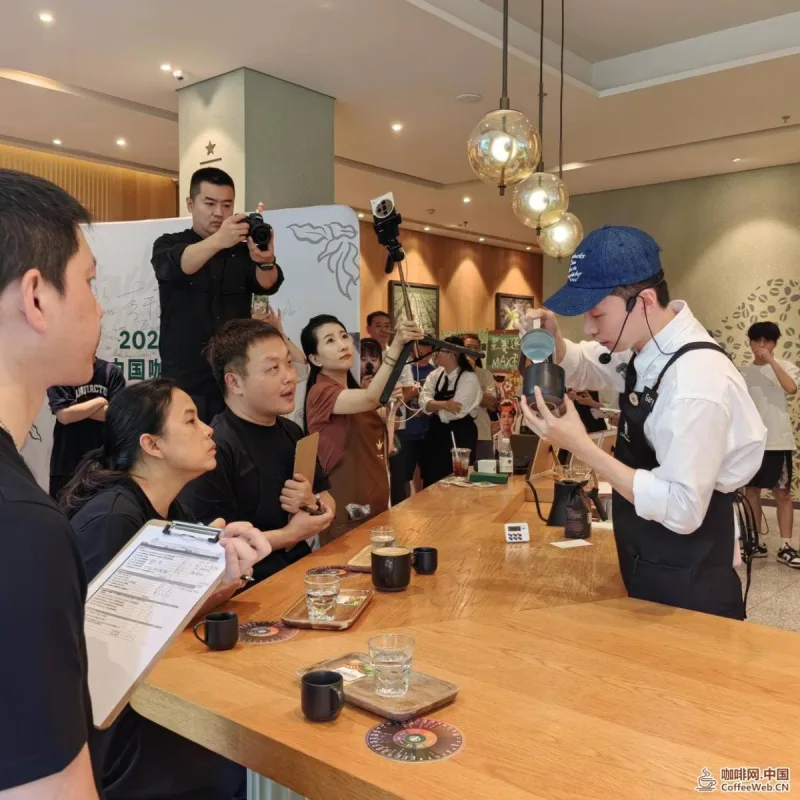
The Starbucks East China Zone 2 finals venue.
On competition day, the store was packed. On the demo stage, baristas in black aprons focused on their machines.
To one side of the demo stage were arranged various brewing tools—a coffee press pot, a Melitta pour-over kettle, an elegant pour-over pot. On the other side’s latte-art table, contestants carefully traced tulip patterns with oat milk, the microfoam slowly spreading over the dark-brown coffee. A judge told the reporter that latte art is not only visual presentation but also a direct reflection of milk-foam quality and espresso integration; behind a good tulip pattern lies precise temperature control and steady technique.
Though the competition scene was noisy, many regulars still sat quietly sipping coffee. Mike, store manager of the Starbucks Reserve Wusi Road store, told the reporter that quite a few are regulars—”Starbucks has always valued its emotional bond with community residents, providing them with a trusted ‘third place.'”
Before coming to Fuzhou, Mike was a store manager at a Starbucks in Pu’er, Yunnan. Pu’er is one of China’s earliest coffee-growing regions, and there Mike systematically learned the full journey of coffee from a seed to a cup. After arriving in Fuzhou, he felt the “concentration” of Fuzhou’s coffee culture ranks fairly high domestically.
Mike told the reporter that building a batch of “Reserve stores” and regularly launching “specialty” products is Starbucks’ answer to the “fast-slow” divide in coffee. Over the past year, the share of Reserve coffee produced offline at the Wusi Road store grew by nearly 10%. The store also holds salons twice a month and invites consumers to learn coffee-making for free on special holidays.
In Mike’s view, “a good cup of coffee” and “a good experience” remain the foundation of offline stores’ survival and development. “Delivery can satisfy the ‘fast’ need, but the ‘slow’ value of human connection and the relaxation a space brings cannot be replaced online.”
Starbucks’ exploration is not alone. In Fuzhou, offline coffee shops are each finding differentiated paths to survival.
The Rooftop Coffee shop on the 35th floor of Building 1, Central Fifth Street, in Fuzhou’s Taijiang District, transformed an originally idle rooftop into a consumption space; with the advantage of overlooking the Min River sunset from the roof, by evening the shop is essentially full, even with a wait for seats. Another rooftop coffee on the 22nd floor of Xingcheng International Liming Building in Gulou District combines an indoor hall, open rooftop and a cat-petting area; its “day coffee, night bar” model keeps the space used around the clock. These differentiated consumption scenarios upgrade coffee consumption from “purposeful purchase” to “experiential lingering.”
Similarly, Taiwanese entrepreneur Guo Yifan has laid out stores in Fuzhou’s historic districts of Shangxiahang and Aofengfang, blending Western coffee into the everyday life of old-city lanes and incorporating local flavors into drink development; Chen Deming, owner of the “Zhiliao Kefei” (Know-the-Cicada Coffee) café in Yantai Mountain, Cangshan District, cleverly borrows the early translated name for coffee—”kefei”—from the book “Tsao Yang Fan Shu” (An Anglo-Chinese Cookery Book), displaying animal and plant specimens and natural minerals in the store and creating diverse consumption scenarios such as nature study, parent-child experiences and intangible-cultural-heritage handicrafts, even using Minqing local olives to make a green-olive Americano; the “Daibei Coffee” on Weiqian Street in Gulou District takes a budget route, with Americanos at just 10 yuan and a 3-yuan discount for bringing your own cup… These variously shaped offline stores together form the rich ecosystem of Fuzhou’s coffee consumption.
“Coffee is essentially still a location-driven offline business,” said Bian Delian. The fulfillment cost of delivery directly affects profitability, and delivery time also affects the coffee’s taste. Therefore, if stores put real effort into quality and distinctive character, offline coffee shops still have great market room.
Reporter’s note
Defining the coffee market’s direction with “slow variables”
When talking about China’s coffee market, people are used to staring at the “fast variables”—store-opening speed, price drops, financing scale. These indicators are exciting enough and eye-catching enough, but the picture of Fuzhou’s coffee consumption reminds us that what truly supports a category’s maturation is often the less-noticeable “slow variables”: the accumulation of consumer awareness, the diffusion of usage scenarios, the extension of the industrial chain, and so on.
Today, the coffee-consumption market is changing quietly, not only in office-building ground floors but entering home coffee corners, second-hand equipment distribution channels, showrooms converted from old factories, and sunset moments on rooftops—showing that coffee consumption has become part of daily life.
The driving force of this everyday-ization does not come entirely from brands’ active shaping. On the contrary, consumers’ autonomous choices are becoming the more important driver. Some choose to study pour-over parameters at home, some drive a coffee cart into office areas, some only trust that community shop deep in the alley; these choices seem scattered yet together form a dense consumption network. A brand can decide the price and taste of a cup of coffee, but it cannot decide in what scenario, in what way, and why a person drinks that cup.
From an industry perspective, this means the market rules are being rewritten. The current competitive logic of the coffee industry is “standardized expansion”—using unified stores, unified products and unified experiences to cover as many users as possible. But when consumers begin to choose diverse consumption scenarios, standardization’s uniformity may instead lose its advantage. Those participants who can adapt to different scenarios, meet different tiers of demand and find their own position in different niche markets tend to be more durable. The imagination of the coffee market lies not only in how many more stores it can open, but in how many more life scenarios it can embed itself into.
Source: Fujian Daily, August 20, 2026, Page 08
Reprint Note & Disclaimer
- This article is reprinted from Chinese media for information and cultural exchange. The views expressed are those of the original author and do not necessarily reflect the position of coffeeyo.com.
- All trademarks, brand names and logos mentioned belong to their respective owners.
- For cooperation, reprint or correction requests, please contact coffeeyo.com.
Reprint Notice & Disclaimer
- This article has been edited and compiled by China Coffee Network. The information and images therein come from public sources and the copyright belongs to the original author. This reprint is intended solely for information sharing within the coffee industry and does not represent the views of this website; all data and opinions are subject to the original article. Our thanks to the original author for creating and sharing it.
- For matters concerning content licensing, attribution, copyright or otherwise, please contact us promptly and we will verify and cooperate in handling them as soon as possible. We also welcome coffee origins, brands and industry media to exchange ideas and contribute articles.
- Contact China Coffee Network: Tel 400-0000-641 (+86-18288016826) | Email 405854472@qq.com | Address: Jinghong, Xishuangbanna, Yunnan Province / Tieling, Liaoning Province
Related Reading
 How ‘Sea-Flavored’ Coffee Blooms Across Dongtou
- Health Guide: How to Enjoy Your Coffee the Healthy Way
 Study: Regular Coffee and Tea May Lower Dementia Risk, but More Is Not Better
 Frontline Story: A ‘Mobile City Coffee Bar’ Arrives by the Grand Canal
 Yantai’s Wind Tastes of Coffee
 In Zhenyuan, a Cup of Coffee and a Waiting Train





 Liaoning ICP Security No. 21122402000217