
Brief (coffeeyo.com): Part of Handan Evening News’ “Be a Colleague for a Day” series, this piece follows Li Xuebin—a “post-70s” owner who runs “Old Wolf’s Coffee,” a mountain-cabin café in the Taihang range—and asks what kind of village café survives once the check-in hype fades: one built into the local landscape, not suspended above the traffic.
(Source: Handan Evening News)
Editor’s note: A city’s grand narrative is often hidden in an ordinary person’s single day.
The low-altitude economy is taking off, artificial intelligence is embedded in steel production lines, and the “one product, one livestream” model is sending rural goods viral from the cloud… Today’s Handan is seeing new business forms, new scenes and new professions flourish. The pulse of industrial transformation is beating in the daily life of every ordinary worker.
Starting this week, the Evening News launches the “Be a Colleague for a Day” series. Reporters will stand alongside workers and be their colleague for a day—running a mountain-cabin shop with a village-café owner, helping a “one product, one livestream” anchor sell local goods nationwide, assisting a young returnee running a homestay, or going to the kiln fire of Cizhou ware, the workstation of a “one-person company,” the takeoff point of a drone pilot—recording real working conditions through immersive experience, and reflecting an era’s slice of Handan’s high-quality development through personal stories.
In recent years, our city’s cultural-tourism heat has kept rising, and that heat has spread from the urban core to counties and villages. Fine scenery plus local culture has reawakened many dormant mountain villages and given rise to a batch of “small but beautiful” new rural-consumption scenes—coffee shops once confined to city commercial districts are quietly sinking into fields and countryside, “breaking out” on the strength of a relaxed vibe and becoming a new growth point for county consumption.
On social platforms, village cafés harvest traffic through wild scenery and a healing atmosphere; photo after photo, short video after short video, they have become destinations urbanites long for. But once the excitement passes, problems follow: as the check-in craze cools and village cafés multiply, what kind of village café can actually stay?
With these questions, the reporter, in the mode of “being a colleague for a day,” went to Tianxin Town in Houqu Village, Huoshui Township, Wu’an City, visited “Old Wolf’s Coffee” deep in the mountains, and followed the “post-70s” owner Li Xuebin through a day of running the shop—amid the coffee aroma, exploring more possibilities for a village café’s sustainable growth.
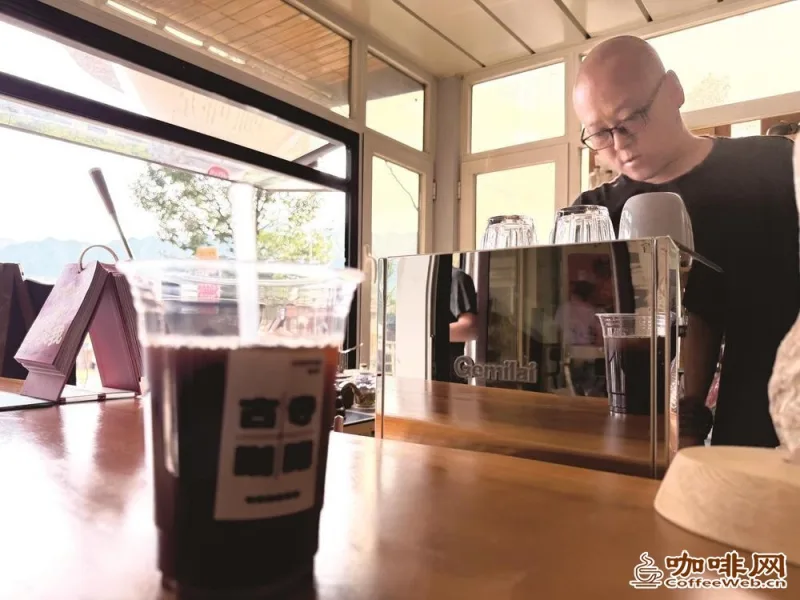
At six in the morning, the mountain-cabin café wakes with the daylight.
Surrounded by green hills and murmuring water, “Old Wolf’s Coffee” sits in the Taihang wilds. Opened in 2023, it has no team operation and no marketing splash; the owner Li Xuebin handles everything alone. Over three years, a small shop and a courtyard have kept company with the mountains, quietly keeping watch over the mornings and evenings of the hills and its visitors.
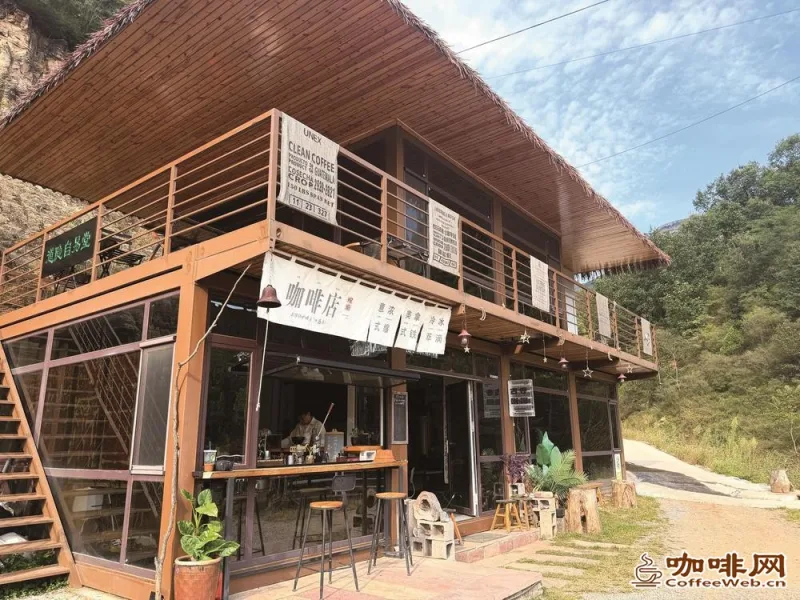
The small courtyard faces the green hills and flowing water, with an open, expansive view. In spring, wild flowers blanket the mountains; in summer, green layers pile up; in autumn, the forest is dyed in color; in winter, plain snow covers the peaks—every season has its scene. This mountain-wild mood made its check-in photos quietly go viral online, drawing visitors weary of the city’s noise to journey deep into the mountains for some quiet.
“People who come from the city to drink coffee in the village come not just for a cup, but to escape the fast pace and find a relaxation the city can’t give.” In Li Xuebin’s view, city coffee shops sell standardized drinks and service, while a village café’s core competitiveness is its irreplaceable mountain-wild mood—a unique value that can hold emotions and heal the heart.
His early experience running an outdoor club and operating a mountain campsite convinced Li Xuebin that in fast-paced life everyone needs an emotional outlet, and pristine wilderness is the best healing place. “In nature, anxiety and restlessness are smoothed away—that is the power unique to the countryside.”
After three years of running the shop, Li Xuebin himself has developed a rhythm in tune with the mountains. “You can’t sleep in in the hills; the mountains wake you up.” Every morning at six, with crisp birdsong in the mountains, he gets up and first walks around the village: watching clouds roll over the ridge, watching the morning sun gild the village houses with a golden rim, listening to a rooster drag its long cry from somewhere far off.
After the round, Li Xuebin starts tidying the courtyard. The small yard avoids lavish decor, pursuing “natural” and “comfortable”—an abandoned tree stump as a table, stones paving the path, rocks building a little trail, nothing extra. Inside there are a sofa and camping chairs, but most guests prefer the courtyard: order a coffee, sit with the green hills filling the view, chat or just zone out, enjoying the mountain’s slow time alone.
After a flurry of busyness, the sun climbs higher. Near noon, with clear autumn air, more visitors head into the mountains. Regular Zhao Wenwen drives into the hills whenever she has free time. “After too long in the city, the pressure builds, so I drive over to sit, hold an americano, watch the mountains, and the whole person slows down.” she says. This “slowness” is exactly the confidence that truly draws people to a village café.
Beyond traffic: building a mountain “in-tune” space
Village cafés rise largely on the spontaneous spread of social platforms. In its first year, Li Xuebin did no deliberate promotion; customers posted scenery photos tagged “coffee shop in the great mountains,” and guests arrived one after another.
But he knows clearly: those who come to photograph and check in like the relaxation the scene brings, not the coffee shop itself; if the shop only serves “passers-by,” it degenerates into a rural flash-mob attraction.
Tidal customer flow—ebb-and-flow traffic—is a difficulty no village café can avoid. Mountain stores depend on holidays and weekends: peak season is bustling, off-season deserted. With few local coffee regulars, how to smoothly weather the off-season and keep operating once the out-of-town check-in crowds recede?
What Li Xuebin is exploring is turning the small shop into an “in-tune space”—natural, cozy, comfortable, with no fancy events and no psychological threshold. What he hopes is that first-time visitors become returning ones, so a group of people who genuinely like the place come back to the mountains again and again.
This “in-tune space” naturally gathers a special crowd. Li Xuebin, a motorcycle enthusiast, leveraging the East Taihang landscape brand and the Baishiyun Avenue and Panlong Avenue mountain-riding routes, has turned the shop into a riders’ rest stop. In peak riding season, motorcycle fans from all over come to speed through the mountains and rest at the shop, drink a coffee, take a few photos, injecting fresh life into the quiet off-season.
One similar attitude to life gathers a group of people. Li Xuebin is figuring out how to make the shop a destination for more: hikers, photographers, regular mountain riders… everyone can find their own kind of “in-tune” here.
In the afternoon, the light in the mountains slowly slants; the courtyard’s guests change wave after wave—young people who came specially to check in, riders passing through for a rest, and families bringing children to wander the hills.
Guests come and go, and Li Xuebin, watching, has his own reflections: true “small but beautiful” does not rely on exquisite decoration or internet-famous staging, but must grow into part of the local character—following the mountain terrain, the sky light and cloud shadows, letting the shop become part of the mountain scenery.
Village cafés are more than “photo ops”
After three years, Li Xuebin keeps exploring: many village cafés explode for their “photo-op” scenes but fade quickly for lack of repeat business. As village cafés multiply, to stay popular they cannot rely only on natural scenery, but must polish service, enrich the scene’s substance, and maintain neighborhood warmth—turning the shop into a rural public space adapted to the mountains and linking people together—taking root in the soil, blending into the wild, rather than floating above the traffic.
The village café draws crowds and keeps spending, which in turn adds vitality to the village. Village and café achieve each other—exactly the goal Li Xuebin wants to realize.
As dusk thickens and the mountain sky darkens, the shop’s warm lights come on one by one, their gentle glow cutting through the night; outside, insects chirp and a evening breeze stirs, and a few guests, intoxicated by the quiet mountain night, linger and do not leave.
Nationwide, village cafés are becoming a new force in county cultural tourism. Scattered across mountains, village entrances and corners of old towns, they are small in scale yet connect the two ends of city and countryside: on one end, urbanites’ yearning for nature, relaxation and real human connection; on the other, the village’s expectation of popularity, vitality and a new lifestyle.
Whether a village café can go far depends on more than whether a cup of coffee tastes good. When a “check-in spot” grows into a sustainable, experience-based consumption scene with rural genes, “traffic” settles into “retention.” By then, the value of a small shop is far more than a drink—it is a rural public space with warmth, character and belonging.
By our reporter Rong Zhiqing (text and photos).
Reprint Note & Disclaimer
- This article is reprinted from Chinese media for information and cultural exchange. The views expressed are those of the original author and do not necessarily reflect the position of coffeeyo.com.
- All trademarks, brand names and logos mentioned belong to their respective owners.
- For cooperation, reprint or correction requests, please contact coffeeyo.com.
Reprint Notice & Disclaimer
- This article has been edited and compiled by China Coffee Network. The information and images therein come from public sources and the copyright belongs to the original author. This reprint is intended solely for information sharing within the coffee industry and does not represent the views of this website; all data and opinions are subject to the original article. Our thanks to the original author for creating and sharing it.
- For matters concerning content licensing, attribution, copyright or otherwise, please contact us promptly and we will verify and cooperate in handling them as soon as possible. We also welcome coffee origins, brands and industry media to exchange ideas and contribute articles.
- Contact China Coffee Network: Tel 400-0000-641 (+86-18288016826) | Email 405854472@qq.com | Address: Jinghong, Xishuangbanna, Yunnan Province / Tieling, Liaoning Province
Related Reading
 How ‘Sea-Flavored’ Coffee Blooms Across Dongtou
- Health Guide: How to Enjoy Your Coffee the Healthy Way
 Study: Regular Coffee and Tea May Lower Dementia Risk, but More Is Not Better
 Frontline Story: A ‘Mobile City Coffee Bar’ Arrives by the Grand Canal
 Yantai’s Wind Tastes of Coffee
 In Zhenyuan, a Cup of Coffee and a Waiting Train






 Liaoning ICP Security No. 21122402000217