
At a Glance (China Coffee Network): The craze of tea shops frantically selling coffee has not yet faded, but in 2026 the freshly made beverage market has already ushered in a wave of reversal in the opposite direction.
Trendy News Client Reporter Xu Zhiyu
The craze of tea shops frantically selling coffee has not yet faded, but in 2026 the freshly made beverage market has already ushered in a wave of reversal in the opposite direction.
Observant consumers will have noticed that when they now walk into mainstream coffee chains such as Starbucks, Luckin, Cotti Coffee, and Lucky Cup, the shelves no longer hold only various lattes and Americanos; pure tea drinks such as Ceylon milk tea, pearl milk tea, and Chinese-style light milk tea have been rolling out one after another.

High protein matcha latte PRO
This April, Starbucks China launched the High-Protein Matcha Latte PRO, highlighting matcha tea flavors while downplaying the coffee base and targeting the afternoon light-wellness leisure occasion. In the same period, Cotti Coffee rolled out pure milk-tea products with no coffee base, such as the Ceylon Gold Cup Milk Tea, benchmarking against the mainstream items of new-style tea drinks. Luckin has continued to expand its non-coffee beverage matrix, focusing on Chinese-style tea-base light milk teas and fresh-fruit pure teas suited to afternoon leisure occasions. Lucky Cup, leaning on its mature supply chain, has long cultivated affordable classic milk teas, and non-coffee categories long ago became a routine revenue segment in its stores.
Even as tea-drink giants pour resources into coffee to seize the rigid morning-peak demand, coffee brands are conversely deepening their milk-tea offerings to capture leisure occasions. Going forward, will this two-way involution become the core competitive norm of the industry?
Growth Dividends Peak as New-Tea Giants Mount a Reverse Siege
The collective crossover of coffee brands into milk tea is rooted in the dual pressure of peaking industry growth and intensifying involution.
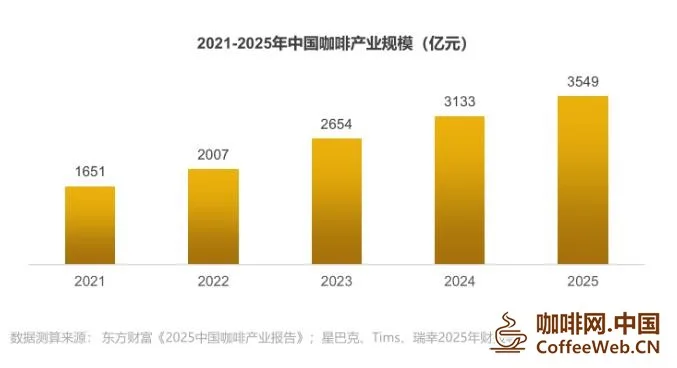
Source: “2026 China Urban Coffee Development Report”
From the macro data, the coffee market is still expanding. According to the “2026 China Urban Coffee Development Report” recently released jointly by the Shanghai Cultural and Creative Industries Promotion Association, the Institute of Cultural Innovation and Youth Development at Shanghai Jiao Tong University, and other institutions, in 2025 the scale of China’s coffee industry market reached 354.9 billion yuan, up 13.3% year on year; per-capita coffee consumption reached 28.57 cups, up 27.5% year on year; coffee delivery orders surpassed 990 million, up 430.86% year on year, and delivery users exceeded 156 million, up 3.5-fold.
But the flip side of scale expansion is the continuous narrowing of profit margins. Take Luckin as an example: in the first quarter of 2026 its net revenue was 11.995 billion yuan, up 35.3% year on year, while net profit was only 506 million yuan, down 3.6% year on year; delivery expenses rose 89.8% year on year to 1.308 billion yuan, becoming the core factor dragging down its profit margin. The path of trading low-price subsidies for growth has reached its end.
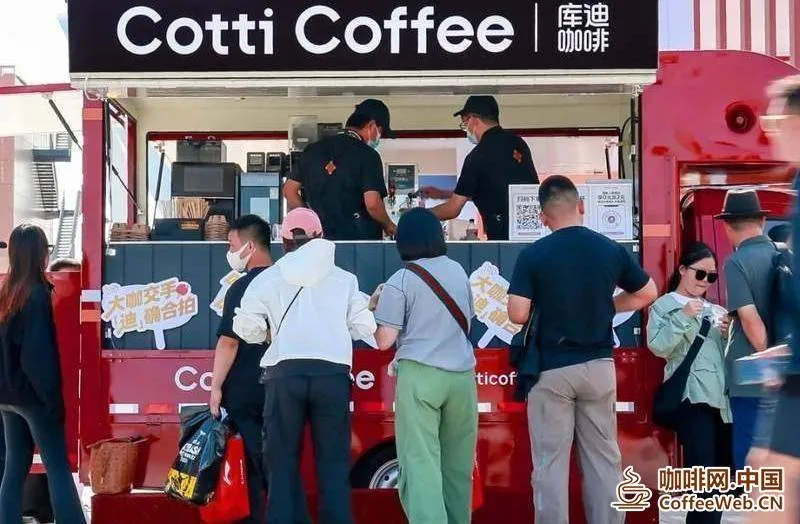
Consumers queue up to buy coffee drinks. Source: the brand’s official website.
The industry landscape is likewise becoming entrenched. The report shows that the coffee track now has four ten-thousand-store chain brands—Luckin has surpassed 33,000 stores, Cotti Coffee has surpassed 18,000, and both Lucky Cup and Nowwa have also entered the ten-thousand-store camp. After several years of price wars, the leading camp is largely set; conventional coffee and tea-coffee fusion products are highly homogenized, and a single coffee category can no longer sustain a brand’s continued growth.
Compared with internal involution, the cross-border siege by tea-drink giants has brought a greater external shock. In 2026, the coffee layouts of leading ten-thousand-store tea brands have been fully implemented, powerfully diverting traffic from the affordable coffee market. By the end of 2025, Guming had equipped more than 12,000 stores with coffee machines and launched 27 coffee drinks over the year; in 2026 it plans to invest 400 million yuan to push its coffee category, raising the target share of coffee revenue from the previous 10%–15% further to 20%–25%. Chabaidao expects its coffee business to cover 2,000 stores by the end of 2026, and Mixue has also piloted coffee machines in Henan. Leveraging supply-chain scale and store-density advantages, these crossovers have become fierce new forces in the coffee track. Beset by troubles internal and external, coffee brands have no choice but to actively break through.
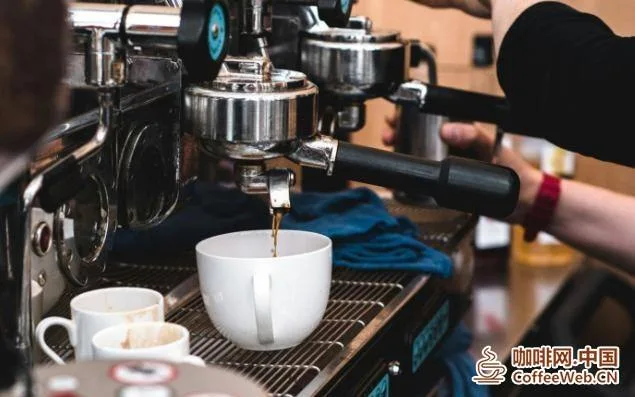
Source: “2026 China Urban Coffee Development Report”
Filling Time Slots, Expanding the Customer Base, and Cutting Costs: Tea Drinks May Be the Optimal Solution
Under an industry landscape of internal and external pressures, entering the milk-tea market may be the optimal solution for coffee brands to revitalize existing assets and break through bottlenecks.
Filling time slots is the primary driver. Freshly made drinks have a clear consumption time-difference barrier—mornings and noons are coffee’s home turf, suited to the rigid need for a workplace energy boost, while afternoon and evening consumption peaks have long been firmly held by milk tea and fresh-fruit tea. In the past, most coffee shops commonly suffered the pain point of “packed before noon, deserted after noon,” leaving the fixed costs of premises, labor, and equipment underutilized. The entry of the milk-tea category precisely fills the time-slot shortboard of coffee shops, helping coffee brands plug the consumption gap outside office hours. The existing assets of tens of thousands of stores are fully revitalized, and per-store sales efficiency is markedly improved.
Expanding the customer base is the second driver. Coffee’s inherent bitter and astringent taste puts off large numbers of students and lower-tier-market consumers, severely restricting brands’ downward expansion. Caffeine-free light milk teas and affordable milk teas, by contrast, suit all age groups and all consumption scenarios, able to absorb non-coffee audiences and substantially broaden the user base.
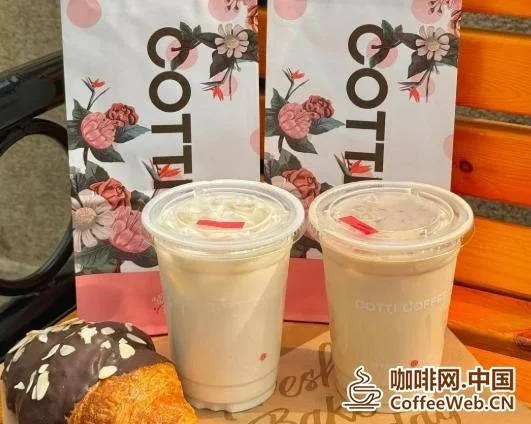
Kudi’s Rock Rhyme Red Robe Light Milk Tea
Cutting costs is the key condition that allows cross-border layouts to roll out rapidly. The overlap of core raw materials between coffee and milk tea exceeds 70%: ingredients such as milk, brewed tea, and fructose can share the supply chain, warehousing, and cold-chain systems, and existing store equipment is fully suited to making milk tea. To expand into tea drinks, coffee brands need not rebuild their supply chains; they only need to combine and match on the basis of existing ones, with low per-store renovation costs and short payback periods. Relying on the centralized-procurement advantages of ten-thousand-store scale, leading coffee brands making affordable milk tea can be even more cost-competitive than traditional tea shops.
Track Convergence: Is Tea-Coffee Integration the Finish Line or a New Starting Point?
From the perspective of industry competition, coffee’s entry into milk tea is no longer a simple category addition; it is the inevitable result of format iteration and the restructuring of consumption logic in the freshly made beverage track, and even more a deep defensive war of two-way checks and balances and a long-term positioning battle.
In the past, when choosing a drink, consumers first defined “coffee or milk tea,” with clear category boundaries and highly fragmented scenarios. But in 2026, mass decision-making has shifted from “choosing a category” to “choosing a scenario, a taste, an experience”—consumers no longer fixate on brand labels, and care more about whether a store can one-stop satisfy all-day needs. The full-category store of tea-coffee integration precisely fits today’s diversified consumption trends.
The essence of two-way penetration between the tracks is the contest for all-day traffic. Tea-drink brands adding coffee fill the rigid morning and midday need for refreshment; coffee brands deepening milk tea and fresh-fruit tea fill the evening leisure gap and revitalize idle store capacity. When the dividends of store expansion peak, brands can no longer profit from incremental new stores and can only dig deep into per-store value, raising repeat-purchase rates through category reuse.
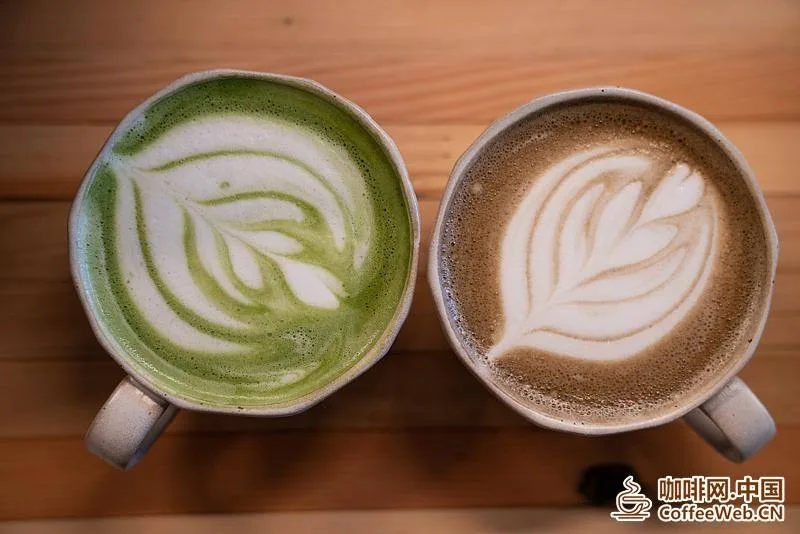
Tea Latte. Source: Visual China.
A mature supply chain underpins tea-coffee integration. Coffee and tea drinks share core ingredients such as milk sources, brewed tea, and fresh fruit, and share cold-chain warehousing and store equipment; high resource overlap greatly lowers trial-and-error costs. Relying on the centralized-procurement capability of ten-thousand-store scale, leading brands can easily achieve “multiple categories in one store, all-day revenue”—precisely a barrier that small and medium brands cannot replicate. However, track convergence is not a boon for everyone. Small and medium independent cafés, lacking supply-chain and scale advantages, that blindly follow the trend and add milk tea will only create cluttered product lines and blurred positioning, accelerating their elimination by the market.
As competition keeps escalating, China’s freshly made beverage industry has formally bid farewell to segmented competition within a single category and entered a new cycle of tea-coffee integration. In the future, abandoning rigid category thinking and achieving all-day coverage and high per-store-efficiency operations will be the core key for brands to stand firm in an involuted track.
This two-way penetration looks lively, yet it raises a deeper question: is tea-coffee integration the endgame form of the freshly made beverage industry, or the starting line of a new round of competition?
The answer may depend on each brand’s own choice—whether to stop at full-category coverage, or to use it as a foundation to launch the next round of competition over efficiency, innovation, and brand identity.
Please indicate the source when reprinting.
Reprint Notice & Disclaimer: This article is reprinted from Chao News. Original reporting by Xu Zhiyu. All rights belong to the original publisher.
Related Reading
 ‘All-Ice’ Coffee Goes Viral! Will the Next Hit Be Your Personal Favorite?
- Hong Kong’s Dyee Coffee Lands in Qianhai, Building a Specialty Pour-Over Outpost
 Ken Yue Coffee Opens Egg-Tart Pop-Up in Hangzhou: Sweet Craft, Reinvented Classics
 World Cup Enters the Breakfast Slot: Can Coffee-Tea Brands Turn Traffic into Orders?
- ICE Agricultural Futures Mostly Rise at Close; Coffee Futures Up 3.28%
- ‘Sleep Cafés’ Become a New Favorite Among Seoul Office Workers



 Liaoning ICP Security No. 21122402000217