
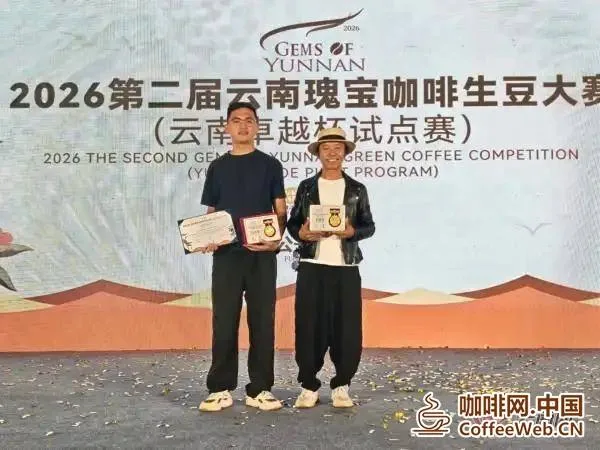
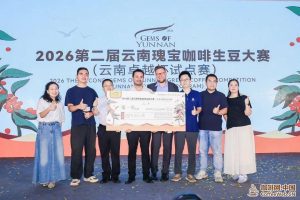
At a Glance (China Coffee Network): At the recent awards ceremony of the 2026 2nd Yunnan Treasure Coffee Green Bean Competition, a piece of news electrified the room—Gengxia Manor’s traditional washed Geisha from Lincang scored 91.78 to take the championship, and Songfeng Coffee Cooperative’s washed Geisha followed with third place. Three Yunnan green beans broke the 90-point barrier for the first time in international judging. In the CoE “Olympics of green coffee,” 90+ means “excellent grade.”
At the recent awards ceremony of the 2026 2nd Yunnan Treasure Coffee Green Bean Competition (Yunnan Cup of Excellence pilot), a piece of news electrified the room—the traditional washed Geisha from Gengxia Manor in Lincang scored 91.78 to win the championship, and the washed Geisha from Songfeng Coffee Cooperative in Linxiang District closely followed with third place. Three Yunnan green beans broke the 90-point barrier for the first time in international judging. In the CoE “Olympics of green coffee,” a score above 90 represents the “excellent grade.”
This was no accidental burst. From specialty to a gold-lettered brand, Lincang coffee took more than a decade to complete its industrial leap, and finally met its moment in the spotlight.
But why were these two beans able to score above 90?
Strong bases: planting the “first workshop” into the red soil
“Growing coffee cannot be rushed; for fifteen years I have been grinding it out in the fields,” says Yang Zhixue, head of Lincang Hengfeng Planting Development Co., standing among the continuous coffee groves of Ma’anshan in Zhenkang County, Lincang, his tone certain. “Without a stable base, there can be no specialty brand. If the industry wants to go far, the first workshop must be planted into the soil.”
Lincang coffee has moved step by step from scattered household planting, mixed varieties, and extensive management toward contiguous standardization and green organic farming, and Yang Zhixue is a witness.
Fifteen years of rooting have yielded the accumulated strength of base management. Hengfeng now holds 2,000 mu of contiguous standardized coffee bases, with a synchronized demonstration garden of interplanted nut trees and a standardized primary-processing workshop, serving as a model main body for the scaled base construction in Mangbing Township, Zhenkang.
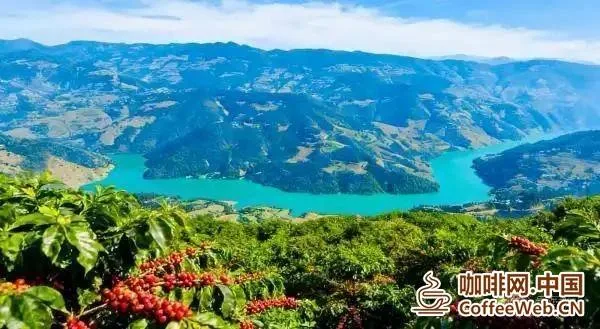
Over these years, Lincang has done one thing solidly: standardizing its bases and making them premium. The city has built 290,000 mu of coffee industry bases, optimized into five core planting zones—Zhenkang, Yunxian, Shuangjiang, Linxiang, and Yongde—established 9 contiguous thousand-mu coffee gardens and 142 hundred-mu gardens, while vigorously promoting premium high-end varieties such as Sarchimor, Geisha, and Typica.
It is precisely this contiguous, connected planting that gives the beans of participating manors such as Gengxia and Songfeng a stable, balanced growing environment from seedling to ripe cherry—the innate quality confidence of these two top 90-point green beans.
Heavy technology: full-process techniques uphold exceptional flavor
Good land must be paired with good planting and good technique.
“In the past we grew coffee by experience; now a cup of soil-test data and a set of fermentation parameters can tune the flavor we want,” says Zhu Hong, a Linxiang coffee farmer whose Songfeng cooperative bean took third place, frankly crediting technology as the key driver behind breaking 90.
At the nutrient-bag filling site of Hali Manor in Zhenkang, technician Huang Youjun is teaching hands-on: “Before filling, pull the mold twice; when it feels smooth, pull it out. Place the bag gently, give it a light tug, and it lands right on this flat surface.” From nutrient-bag filling to sowing and care, technicians standardize every seedling step through hands-on teaching, unifying seedling standards to ensure even emergence, uniform growth, and high survival.
A single seed bears on the fate of a good cup of coffee. Lincang knows that the “seed industry” is the “chip” of the coffee industry. The city has formed county- and city-level technical service teams and innovatively promoted a “five ones” service model—systematically planning one work plan, sorting out a batch of industrial technical needs, implementing a batch of technical breakthrough projects, advancing a batch of scientific-technological achievement transformations, and attracting and cultivating a batch of key leading enterprises.
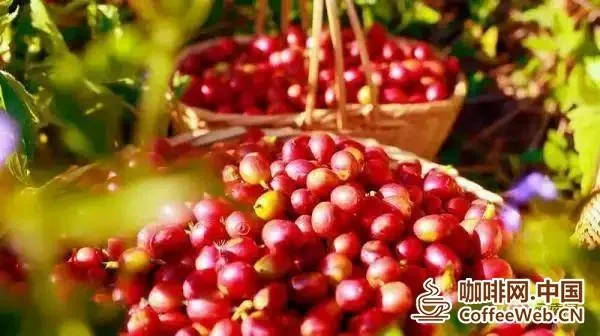
Agricultural technicians visit regularly, guiding farmers to adopt interplanting of coffee and nuts to improve the microclimate. The two competing Geisha beans, from fresh-cherry sorting and washed fermentation to green-bean drying, follow the standardized parameters set by the technical service team at every step, precisely locking in Geisha’s signature jasmine and citrus sweetness.
Technology opens the full chain “from field to cup,” thoroughly shoring up Lincang coffee’s flavor weaknesses and enabling ordinary manors to stably produce top green beans above 90 points.
Supporting large growers: letting “Lincang flavor” take the world stage
With good beans, there must also be someone to turn them into a good brand.
At this year’s China-South Asia Expo, Tang Xiaoyan, sales director of Qiupo Manor, was run off her feet; the specialty bean samples she brought were repeatedly inquired about by buyers. She said brand clients now cover Beijing, Shanghai, Guangzhou, and Shenzhen, and support from overseas buyers is also growing. Nearby, the head of a Kunming coffee trading company had just finished a round of cupping and could not help exclaiming, “Lincang coffee beans are clean and bright, with their own floral aroma—so fitting for consumers’ tastes.”
Gengxia, Qiupo, Hali, Yunjia, Songfeng… these rather poetic names have now become the “shock troops” of Lincang coffee charging into the market.
In the past, Lincang coffee was mostly sold cheaply as raw material. Now, through policy support for standardized base construction and processing-workshop upgrades, and by building all-channel platforms for exhibitions, competitions, and promotion, Lincang has cultivated 32 local brands, and “Zhenkang Coffee” and “Shuangjiang Coffee” were successively selected as national famous, special, and premium new agricultural products. Starting in 2021, Lincang coffee enterprises have won 8 championships in domestic and international competitions.
Today, Lincang coffee is no longer just a place-of-origin label, but a quality gold-lettered brand recognized by international judges and sought after by the market.
Attracting leading enterprises: strengthening the industry chain
In June 2025, big news exploded across Lincang’s coffee circle: Cotti Coffee had arrived.
Before that, Cotti’s supply-chain team had traveled almost all of the country’s major coffee-producing regions. They looked at germplasm, capacity, and processing conditions, and even more at the local attitude toward the industry. In the end, they set their sights on Lincang.
“Lincang possesses top-tier coffee germplasm resources and stable, high-quality raw-material capacity,” said Song Jiawang, head of Cotti Coffee’s supply-chain center origin-sourcing department. But he added: “More crucially, Lincang’s pragmatic and efficient government services and its considerate, warm business environment made us determined to dig in here.”
After signing, Lincang adopted a posture of “whole-process follow-up and front-footed service.” Wherever the enterprise hit a bottleneck, the dedicated task force appeared; whatever factor was lacking, the guarantee supplied it.
Cotti’s arrival was not just one more factory. It shored up Lincang coffee’s long-standing weaknesses—insufficient deep-processing capacity, limited brand influence, narrow market channels—greatly raising product added value, and letting the good beans from the deep mountains truly achieve high quality at a high price.
The two Lincang coffee beans both crossing the 90-point mark is a phased highlight of Lincang’s years of deepening specialty cultivation. The four-step measures—”stabilize the base, strengthen technology, support large growers, attract leading enterprises”—link tightly, refining the small coffee beans by the Lancang River from mountain-field specialties step by step into an industry gold-lettered brand renowned at home and abroad.
91.78 points is not the endpoint.
Yang Zhiyong of Gengxia Manor said he will continue to root downward and grow upward. The story of Lincang coffee moving from specialty to gold-lettered brand has only just begun.
Reprint Notice & Disclaimer: This article is reprinted from Yunnan Net. The original report was filed by reporter Liu Chang, with correspondent Wang Chaoyu. All rights belong to the original publisher. If you believe any content infringes your rights, please contact us for removal.
Related Reading
 Three Decades of Shanghai-Yunnan Collaboration: A Coffee Bean ‘Ferments’ at the Import Expo
 Why Yongde’s Coffee Beans Won Gold in Shanghai – A Taste of ‘Life in Yunnan: 365 Days’
- Yunling Commentary: Yunnan Coffee Turnaround Hinges on Autonomous Pricing
 A ‘Travel Pack’ Reveals Another Possibility for Pu’er Baristas
- Bean in Short Supply: A Taiwan Youth on Yunnan Coffee as a Shared Cross-Strait Stage
- Five Years, Eight Championships: Lincang Coffee Joins the World Stage


 Liaoning ICP Security No. 21122402000217