
Coffee is both a “life-saver” for many workers and a common way to socialize and unwind. Many kidney patients worry before drinking it: will coffee irritate the kidneys? Can you still drink it with weak kidneys?

01 Does coffee hurt the kidneys?
There is currently no evidence that moderate coffee consumption damages the kidneys. For most kidney patients, coffee is usually not forbidden either.
Caffeine does have a mild diuretic effect, which those who rarely drink coffee may notice more acutely, but that does not mean coffee harms the kidneys.
Some observational studies have even found that regular coffee drinking is associated with a lower risk of chronic kidney disease.

The study included more than 70,000 adults who originally had no chronic kidney disease, with an average follow-up of 3.6 years.
Researchers used food questionnaires to assess coffee intake and observed two indicators: the annual change in glomerular filtration rate (GFR), and a composite renal outcome (renal insufficiency, or a GFR decline exceeding 20%).
The results showed that, compared with non-drinkers, coffee drinkers had a slower decline in kidney function, in a dose-response relationship: each additional cup of coffee per day was linked to about 0.03 mL/min/1.73m² less annual GFR decline and about a 3% lower risk of the composite renal outcome. The association was more pronounced in people with diabetes.
Of course, this is only an observational study; we cannot yet conclude that coffee prevents or treats kidney disease, but at the very least it does no harm to the kidneys.
02 Which kidney patients need caution?
The following groups should pay special attention and, if possible, avoid coffee:
Polycystic kidney disease (PKD)
PKD is a hereditary kidney disease in which many cysts grow on the kidneys; as the cysts multiply and enlarge, total kidney volume also increases. In animal models, caffeine stimulates cyst growth. To be safe, PKD patients should avoid coffee if possible; if you really want some, choose decaf.
Those with high potassium or high phosphorus
Coffee itself is not very low in potassium and phosphorus, and some coffees add creamer and other additives whose phosphorus is especially easily absorbed. Therefore, kidney patients in CKD stages 4–5, dialysis patients, and those with a history of high potassium or phosphorus are advised not to drink coffee.
Poorly controlled blood pressure
Caffeine can raise blood pressure over a short period, especially in those sensitive to it. If your blood pressure has fluctuated noticeably recently, it is best to cut back temporarily and observe the changes before and after drinking. Those with normal, stable blood pressure can drink as usual.
Palpitations, insomnia, gastrointestinal discomfort
Different people metabolize caffeine at different speeds and react with different intensity. If you experience palpitations, tremor, anxiety, acid reflux, diarrhea, or insomnia after drinking, there is no need to force it—reduce your intake, or switch to low-caffeine or decaf coffee.
03 Which coffee is better to choose?
There are roughly four brewing routes: filter (pour-over / drip machine), immersion (French press / cold brew), pressure (espresso / Moka pot), and boiling (Turkish coffee). These coffees and their derivatives—latte, cappuccino, and other freshly made (unsweetened) coffees—are all drinkable for kidney patients. But note: the kind with white sugar, creamer, or non-dairy powder (such as 3-in-1 instant coffee) should be avoided. Some studies have found that drinking instant coffee (with more additives) is associated with shortened telomeres—a biological marker of aging—and long-term instant coffee consumption may shorten lifespan.

04 How much is appropriate?
The FDA recommends not exceeding 400 mg of caffeine per day. That is roughly equivalent to two Americanos; caffeine content varies by coffee type:
Caffeine content


Women with insufficient calcium intake who consume coffee in excess (caffeine >400 mg/day) may increase their risk of osteoporosis.
Image source: UpToDate
Therefore, women who don’t usually drink milk and postmenopausal women should strictly limit their intake.
05 When is it better to drink?
Drinking coffee in the morning is the more suitable choice:
A study found that, compared with non-drinkers, people who drink coffee in the morning are associated with a 20% lower risk of metabolic syndrome; drinking in the afternoon or evening showed no clear protective effect.
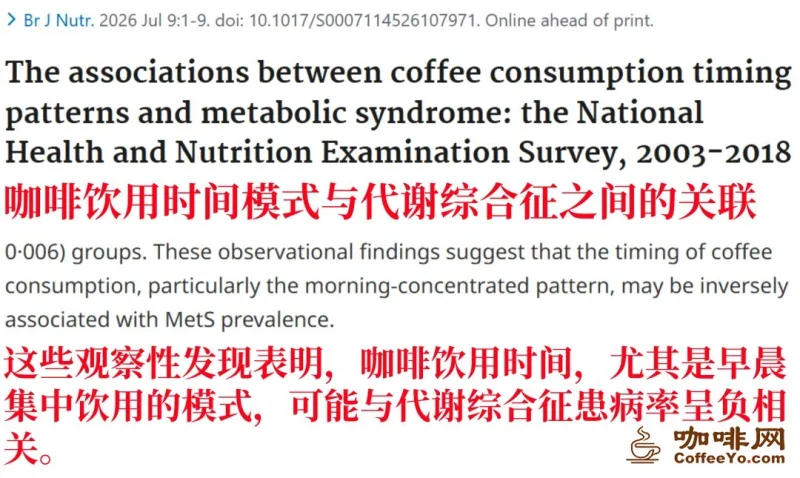
Moreover, the effect of caffeine can last for several hours; those with insomnia or frequent nocturia are advised not to drink coffee in the afternoon or evening.
Welcome to the comments section for discussion
Compared with cola and sugary drinks, coffee is undoubtedly the better and healthier choice for kidney patients—what coffee do you usually enjoy?

References:
Original title: “Tired of plain water? Actually, this drink, in moderation, is also quite good for your kidneys!”
Reprint Notice & Disclaimer
- This article has been edited and compiled by China Coffee Network. The information and images therein come from public sources and the copyright belongs to the original author. This reprint is intended solely for information sharing within the coffee industry and does not represent the views of this website; all data and opinions are subject to the original article. Our thanks to the original author for creating and sharing it.
- For matters concerning content licensing, attribution, copyright or otherwise, please contact us promptly and we will verify and cooperate in handling them as soon as possible. We also welcome coffee origins, brands and industry media to exchange ideas and contribute articles.
- Contact China Coffee Network: Tel 400-0000-641 (+86-18288016826) | Email 405854472@qq.com | Address: Jinghong, Xishuangbanna, Yunnan Province / Tieling, Liaoning Province
Related Reading
 How ‘Sea-Flavored’ Coffee Blooms Across Dongtou
- Health Guide: How to Enjoy Your Coffee the Healthy Way
 Study: Regular Coffee and Tea May Lower Dementia Risk, but More Is Not Better
 Frontline Story: A ‘Mobile City Coffee Bar’ Arrives by the Grand Canal
 Yantai’s Wind Tastes of Coffee
 In Zhenyuan, a Cup of Coffee and a Waiting Train






 Liaoning ICP Security No. 21122402000217