
Brief (coffeeyo.com): In 2023, Yunnan grew 139,800 tonnes of coffee yet captured just 2.36 billion yuan at the farm gate, as most of the value flowed to traders overseas — “the people who grow the coffee do not make money from coffee”. Three years on, China Mobile Yunnan has wired 2,300-plus 5G base stations into the mountains and built an AI model for coffee, opening a path from raw-bean exporter to value creator.
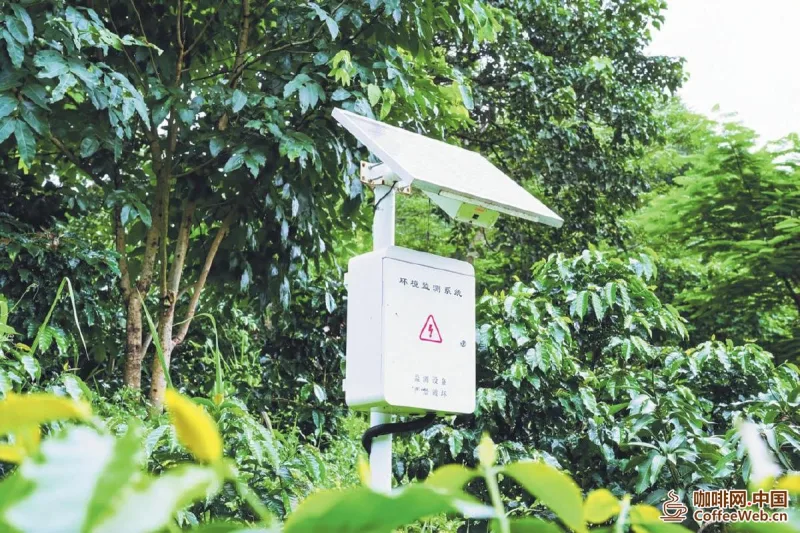
Environmental monitoring equipment built by China Mobile at a coffee estate.
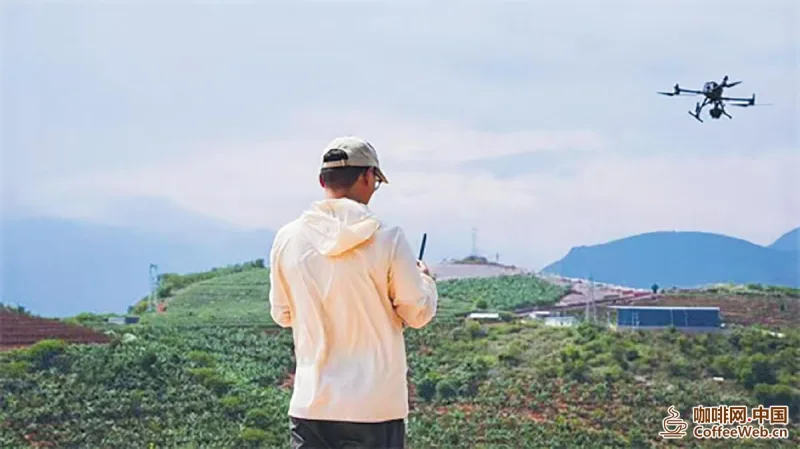
At Xinjiashan in Baoshan, staff use a drone to collect data and carry out inspections at a coffee base.
In the development of Yunnan’s coffee industry, 2023 was a decisive turning point. That year the province had 1.465 million mu under coffee and produced 139,800 tonnes of beans, yet the value at the growing end was only 2.36 billion yuan, with much of the value siphoned off by international distribution — “the people who grow the coffee do not make money from coffee” became a chronic headache for Yunnan’s growers. A mere three years later, that picture is being thoroughly rewritten. From Pu’er to Baoshan, from smart sensors in the fields to freshly ground coffee in livestream studios, from digital nomads living on the estates to traceability codes along the supply chain, China Mobile Yunnan has built a full-chain digital-intelligence system of “laying network foundations, boosting efficiency with intelligence, putting terminals in growers’ hands, and landing real-world applications”. It has opened an upward channel for Yunnan coffee from “exporting raw material” to “creating value”, giving the beans hidden in the Yunling mountains a value of their own.
Extending the network: bringing the information highway to the “last mile” of the coffee groves
Yunnan’s main coffee-growing areas lie mostly in high mountain valleys around Pu’er and Baoshan — remote, rugged terrain that for years was a “blind spot” for telecom coverage. Many growers sat on a thousand mu of fine coffee yet could not even get a stable mobile signal, let alone reach markets or find buyers online. “The signal in the mountains came and went; to agree a price with a buyer I had to climb to the ridge and wait half the day. When coffee prices outside changed, we often only found out days later, so we had no choice but to accept whatever price we were offered,” recalls Li Zhengming, a veteran coffee grower in Lujiang Town, Longyang District, Baoshan.
To clear this information bottleneck, China Mobile Yunnan launched a dedicated network-coverage programme for plateau specialty-agriculture zones, building base stations at coffee farms a thousand metres or more above sea level and running gigabit fibre into estates hidden deep in the valleys. At the Xiao’aozi Coffee Estate in Pu’er, its Pu’er branch completed 4G coverage, a 5G upgrade and fibre-to-the-premises in sequence, achieving full coverage with no dead zones across the estate and laying a solid network foundation for all the smart equipment that followed. At the Xinjiashan smart coffee base in Baoshan, China Mobile Yunnan delivered contiguous 5G coverage across the core growing area, so high-definition images from crop-protection drones and real-time readings from field sensors come back with millisecond-level response; even in coffee groves deep in a river valley, high-definition livestream footage can be transmitted stably.
To date, China Mobile Yunnan has built more than 2,300 5G base stations across the province’s main coffee-growing areas, achieving full network coverage for coffee estates of over a thousand mu and for key coffee towns and villages, and laid more than 1,200 km of dedicated agricultural gigabit fibre, weaving a three-dimensional network of “5G in the sky, fibre on the ground” for the coffee belt. The days when a grower had to cross several mountains just to make a phone call are gone for good; the information highway now runs right up to the coffee trees, laying a solid foundation for every digital application to come.
Boosting efficiency with intelligence: using an AI model to rebuild the logic of the whole coffee chain
Full network coverage was only the first step. Rather than stop at basic connectivity, China Mobile Yunnan joined agricultural research teams from universities inside and outside the province and, working to the particular growth characteristics of Yunnan coffee, trained China’s first industry-specific large model for plateau coffee, breaking with the old logic in which every stage of coffee production depended on human experience.
On the growing side, this model draws on thousands of IoT sensors scattered through the fields and more than a decade of accumulated data on Yunnan coffee’s weather, soil, pests and diseases to build an intelligent decision system covering the entire growth cycle. Growers used to diagnose coffee leaf rust by walking thousands of mu under the sun, checking plants one by one, and by the time they found it the disease had often already spread. Now, from high-definition aerial imagery taken by drones, the AI model can pinpoint rust lesions in the early stages with an accuracy above 98 percent and automatically generate a matching control plan, keeping losses to a minimum. At the Xinjiashan base in Baoshan, the system has cut manual inspection costs by 90 percent: a full-estate survey that once took five people a whole week can now be finished by a single drone in half a day.
On the processing side, the smart control system China Mobile Yunnan built for primary-processing plants has digitised the whole flow — sorting fresh cherries, pulping, fermentation and drying. Fermentation used to be judged entirely by a master craftsman’s feel, where the slightest swing in temperature or humidity would affect the beans’ flavour, making consistency between batches hard to hold. The smart system now monitors temperature, humidity and pH inside the fermentation tanks in real time and automatically adjusts fermentation time and environmental parameters, keeping the specialty-grade rate of every batch above 90 percent and finally resolving Yunnan coffee’s long-standing problem of unstable quality.
On the consumer side, the AI model can also tailor exclusive roasting curves and product recipes to the flavour profiles of beans from different origins, helping small and medium estates develop differentiated products instead of being trapped in a race to sell raw beans at the lowest price. Drawing on AI-generated flavour plans, many estates have created distinctive beans with local floral and fruity notes that sell for three to five times the price of ordinary raw beans, freeing themselves from dependence on international futures prices.
Putting terminals in growers’ hands: making “digital farm tools” standard kit
For digital technology to take real root, it cannot stay in laboratories and demonstration bases; ordinary growers must be able to reach it, use it and afford it. Working to the actual needs of coffee-growing areas, China Mobile Yunnan has built a range of lightweight, low-cost digital terminal products that distil complex digital-intelligence technology into simple apps on a grower’s phone.
For small and medium growers with limited budgets, it launched a “lightweight smart-planting kit”: for a few hundred yuan, a household can install a small soil sensor and weather station in its own plot, check soil moisture and temperature through a phone mini-programme, and receive automatic reminders to water and fertilise — easy enough even for older growers who cannot handle complex smart devices. To meet estates’ demand for livestream sales, China Mobile Yunnan introduced a “dedicated livestream broadband package” that boosts upstream bandwidth and solves the problem of choppy video in the mountains. Today many growers simply pick up a phone and livestream themselves, selling directly to consumers across the country and cutting out layers of middlemen.
At the “Saturn Project” digital-nomad community in Pu’er, China Mobile Yunnan provides resident digital nomads with dedicated gigabit Wi-Fi and cloud services, drawing content creators, designers and internet professionals from across the country to live on the coffee estates for extended stays. As they live and work there, these nomads use their professional skills to help the estates with brand design, short-video operations and e-commerce livestreaming, bringing fresh digital traffic and creative resources to a traditional industry. Estates once hidden deep in the mountains now reach social platforms at home and abroad through these nomads’ accounts, becoming the “poetry and distant places” that young people long for — and their online orders tripled within a single year.
Breaking into new scenarios: diverse value settings open fresh room for Yunnan coffee to grow
As the “network–intelligence–terminal–application” system keeps improving, the value boundary of Yunnan’s coffee industry is being pushed steadily outward. What was once a single trade in raw beans has extended into a whole series of new value scenarios — coffee tourism and study tours, digital nomads, cultural and creative merchandise, and bespoke coffee services — forming a diverse, mutually reinforcing industrial ecosystem.
At the Xiao’aozi Coffee Estate in Pu’er, relying on the smart visitor-flow analysis system built by China Mobile Yunnan, the estate can accurately grasp visitor numbers, age mix and spending preferences at different times, and develop targeted experiences such as coffee-picking, roasting workshops and firefly watching. Beans that once sold for a few dozen yuan a kilogram have become in-depth experience products with per-person spending of several hundred yuan.
In Lujiang Town, Baoshan, a “coffee digital traceability platform” built by China Mobile Yunnan together with the local government gives every Baoshan small-grain coffee bean a unique digital identity code. A scan shows the plot where the bean was grown, the grower’s name, the picking time and the test report — and even a live monitoring view of the coffee tree itself. Quite a few specialty-coffee brands built on “transparent traceability” now come to Baoshan specifically to source beans, offering purchase prices more than 40 percent above the market average and substantially lifting growers’ incomes.
From raising the value of raw beans, to extending and adding value along the chain, to diversifying the whole industrial ecosystem, China Mobile Yunnan’s full-chain digital-intelligence services have moved Yunnan coffee off its old path of “depending on the weather and on outside orders” and onto high-quality development. Coffee in the Yunling region is no longer a simple agricultural planting industry, but a distinctive new one fusing digital technology, tourism experiences and the creative economy — charting a high-quality development path of its own for Yunnan’s plateau specialty agriculture on the broad stage of rural revitalisation.
Reprint Note & Disclaimer
- This article is reprinted from Chinese media for information and cultural exchange. The views expressed are those of the original author and do not necessarily reflect the position of coffeeyo.com.
- All trademarks, brand names and logos mentioned belong to their respective owners.
- For cooperation, reprint or correction requests, please contact coffeeyo.com.
Reprint Notice & Disclaimer
- This article has been edited and compiled by China Coffee Network. The information and images therein come from public sources and the copyright belongs to the original author. This reprint is intended solely for information sharing within the coffee industry and does not represent the views of this website; all data and opinions are subject to the original article. Our thanks to the original author for creating and sharing it.
- For matters concerning content licensing, attribution, copyright or otherwise, please contact us promptly and we will verify and cooperate in handling them as soon as possible. We also welcome coffee origins, brands and industry media to exchange ideas and contribute articles.
- Contact China Coffee Network: Tel 400-0000-641 (+86-18288016826) | Email 405854472@qq.com
Related Reading
 Three Decades of Shanghai-Yunnan Collaboration: A Coffee Bean ‘Ferments’ at the Import Expo
 Why Yongde’s Coffee Beans Won Gold in Shanghai – A Taste of ‘Life in Yunnan: 365 Days’
- Yunling Commentary: Yunnan Coffee Turnaround Hinges on Autonomous Pricing
 A ‘Travel Pack’ Reveals Another Possibility for Pu’er Baristas
- Bean in Short Supply: A Taiwan Youth on Yunnan Coffee as a Shared Cross-Strait Stage
- Five Years, Eight Championships: Lincang Coffee Joins the World Stage





 Liaoning ICP Security No. 21122402000217