
By Liang Xiao, reporter at China Entrepreneur
Editor: Mina
Since the new controlling shareholder Boyu Capital came in, Starbucks China’s store-opening pace actually looks slower.
In the just-ended fiscal 2026 (ending September 30), Starbucks China had 8,342 stores, a net addition of 331; in fiscal 2025, net new stores were 415, and in the two prior years as many as 790 (2024) and 885 (2023).
The slower Starbucks has, on another front, become more aggressive — opening a batch of new stores in previously untapped markets and in unprecedented ways.
On September 29, Starbucks officially entered the Xinjiang market, and it opened two stores at once; earlier, Starbucks successively opened six stores in SKP malls in Chengdu, Xi’an, Beijing, and Wuhan (two each in Xi’an SKP and Wuhan SKP), whose major shareholder is Boyu Capital.
Wang Fan (pseudonym), an insider at Starbucks, told China Entrepreneur that Boyu’s entry has little impact on the company’s operating strategy and, more importantly, has untied mental constraints. He revealed that Molly (Starbucks China CEO Liu Wenjuan) now frequently emphasizes having fewer “goalkeeper” thoughts — “everyone is worried about risk” — and more “forward” behaviors: the courage to charge and to innovate.
On the other hand, in contrast to opening stores at any cost before, Starbucks is now more cost-conscious, with per-store profit becoming a key performance metric. China Entrepreneur learned that Starbucks will open stores along two main directions going forward: first, premium and cultural-tourism stores — unlike past flagship stores that were “built big,” the focus now is “built new”; second, densification in mature markets and penetration into blank areas. The former is to stabilize Starbucks’ cultural and brand positioning, on top of which the latter accelerates expansion.
“The market is changing too fast now; we definitely can’t rely on inertia playbooks anymore,” Wang Fan revealed. Starbucks will open several flagship stores each year — yet in its 27 years in China, Starbucks has opened fewer than 10 flagship stores. “Next year’s opening pace will definitely be faster than this year’s; many store models are being tried out.”
At the same time, Starbucks is also pushing legacy-store upgrades. On October 21, Starbucks China announced that fiscal 2027 (October 2026–September 2027) will invest RMB 300 million to renovate about 1,000 stores, covering front-line service hours (labor), digital-intelligence systems, core equipment, and store ambience.
In addition, China Entrepreneur learned that on October 22 Starbucks would officially release a “Third Place Manifesto” across more than 8,000 stores nationwide, proposing four initiatives on space sharing, environmental volume, takeaway food, and human respect, explicitly raising requirements such as “consuming to sit in” for the first time. An insider said, “It’s more of a guideline and reminder; the specific operating discretion will be left to the stores, and those with genuine needs will certainly be accommodated.”
Can this new playbook help Starbucks China rediscover its old growth rhythm?
From Starbucks to “Xingbazha”
Starbucks’ first Xinjiang store opened in the bustling International Grand Bazaar scenic area, adapting to local customs to the point that even its name became “Xingbazha” (a playful riff on “bazaar”). The store set several Starbucks “firsts” — its first intangible-cultural-heritage flagship, the first store prepared from laying foundations and building the structure, and from site selection to official opening in under six months.
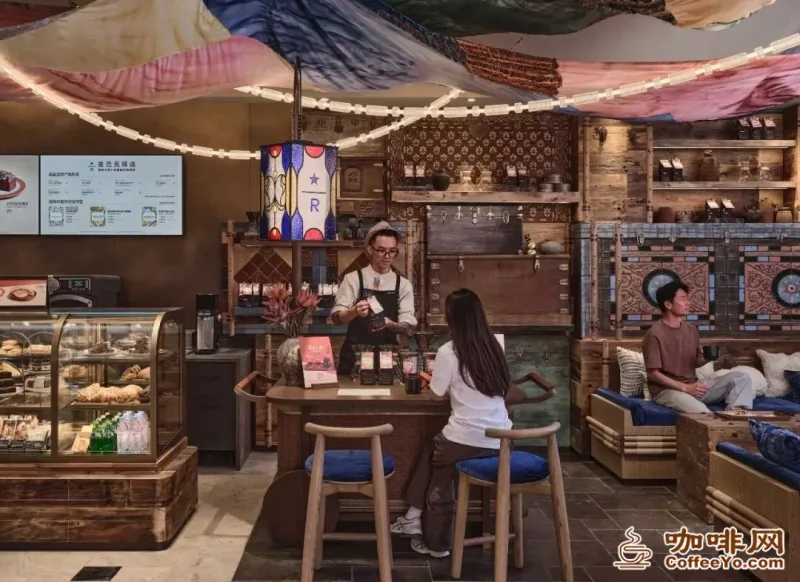
Starbucks, often teased by peers as “too comfortable,” this time raced on speed. But Liu Wenjuan said, “If it’s only about speed, that would be too un-Starbucks.”
“The biggest requirement for us is that this store must be very different,” said Nicky, the interior designer of this Starbucks store.
The building structure is different, too. In the past, Starbucks was just a “tenant,” its design constrained by the store’s spatial conditions; this time, building from scratch means more room for expression, and greater investment. For example, the more than 7,000 pieces of glazed ceramic adorning the facade shift with light and shadow to reveal different tones of Atlas (Aidelaisi) patterns — a traditional Uyghur weaving and dyeing craft, and a national intangible cultural heritage. However, local workers had never handled such complex assembly, so Starbucks had to number and lay out each ceramic piece in advance. Thus, on the day before the workers were to assemble (September 17), a designer flew from Shanghai at 4 a.m., moved bricks on site until 3 a.m. the next day.
These thousands of ceramic pieces were “sourced” by the store’s architectural designer Kyle, who describes himself as an introvert — evident enough in how little he speaks, and how deeply he hides his design ingenuity. Unless he explains, few would notice that viewing the “Xingbazha” store’s staggered roof from different angles reveals different Xinjiang cultural imagery. He is even reluctant to reveal more: “Guests can discover the Easter eggs themselves.” Perhaps one day, sitting in the café, an inadvertent look up happens to catch the spire of the Silk Road observation tower peeking through a corner skylight.
The interior is also full of Xinjiang elements: the counter is assembled from boxes — an important object in Xinjiang customs — the seating is the Xinjiang-style kang (heated platform), and even the lighting — if you look closely — faintly echoes the silhouette of a certain Xinjiang ethnic instrument. Nicky revealed that to ensure progress, the “Xingbazha” store adopted a “light hard-fit, heavy soft-fit” approach, with furniture, lighting, and tapestries all produced by Shanghai suppliers and shipped over, so they could proceed in parallel with the construction.
Behind “different” lies not only managing the tension between speed and culture, but also trade-offs between efficiency and character. The use of the “Xingbazha” store’s second floor sparked internal debate; in the end they decided against a dining area, dedicating it entirely as a performance space and commissioning intangible-heritage inheritors to choreograph a Starbucks-exclusive Twelve Muqam song and dance. Meanwhile, hidden seating was reserved under the first-floor “kang,” raising the store’s seat count to 103.
In Wang Fan’s view, after exploring seven heritage stores, Starbucks has formed a relatively mature store model — initially just concept stores, now fully able to turn a per-store profit. “These stores have better traffic and more diversified revenue; beyond food and beverage, merchandise sales are also a large increment.” He revealed that on opening day, in just the two hours from 10 p.m. to midnight, orders from the merchandise zone exceeded 400.
From Speed to Space
“Xingbazha” is also a key manifestation of Starbucks’ “thousands of stores, thousands of faces” strategy.
In April this year, five months after Starbucks China “changed hands,” speculation inside and outside grew: “Will capital change Starbucks’ brand positioning?” “Is store count the most important KPI going forward?” — Liu Wenjuan said at the time that Starbucks employees would often ask her this, and her answer was: “Everyone need not be anxious; we will insist on orderly, steady development.” The path she pointed to was “thousands of stores, thousands of faces.”
The relevant Starbucks business lead explained it this way: “Starbucks’ future competitiveness is not about scale — its opening pace will not change much from before, and it certainly won’t be a price war. What Starbucks must do is the deep operation of stores.”
Compared with competitors, speed was never Starbucks’ strength. Even in its fastest-expanding years, Starbucks’ annual store openings combined were less than Luckin’s single-quarter volume. And the model gap widens the count gap further: among Luckin’s China-market (including Hong Kong) stores, 35% are partnerships (Q2 2026 data), while Starbucks China has not yet opened franchising.
On the other hand, new-force coffee like Luckin can travel light with an asset-light “grab-and-go” model; but Starbucks, which has always emphasized the “third place,” built its brand on a system accumulated over decades and nested together — linking coffee pricing, store strategy, barista cultivation, incentive mechanisms, supply-chain management, and more. This system was not built for speed; changing any one element triggers systemic ripple effects. That means copying rivals’ playbooks would not only fail to win but would disarm Starbucks itself.
Starbucks must find its own solution — not first patching the short board of speed, but strengthening the long board of space; not hard-competing on store count, but strengthening store differentiation. Only thus can it possibly break the “impossible triangle” of brand tone, scale, and cost control.
First, continue to keep the brand upward — also Starbucks’ focus for store expansion this year, including premium stores in SKP districts and heritage-benchmark stores like “Xingbazha,” whose investment costs are far above core stores and whose staffing is also heavier, basically above 20 people, to guarantee user experience and service quality.
Build scale on that basis. In Wang Fan’s words, Starbucks will open various lifestyle-scene stores along users’ daily trajectories — beyond traditional community and office stores, Starbucks has also opened in campuses, hospitals, subways, and scenic areas. For example, the Xunliaowan Silver Beach Road branch in Huizhou, Guangdong, put a café inside a shipping container; Starbucks’ smallest store is just 10 square meters, nestled in a 4A scenic area in Kaifeng, Henan. The Aranya store manager in Beidaihe shared that they push a coffee cart to the beach at 5 a.m. — those waiting for the sunrise may just need a cup of coffee.
While densifying, Starbucks also strengthens spatial connection through another form — themed stores. It has launched six interest-community store types — reading, music fans, handicraft, pets, running, and cycling — covering nearly 2,400 of its 8,342 stores nationwide.
Liu Wenjuan also said that in the future, employees can set store music playlists themselves and organize activities suited to their store; store-created signature drinks may also be added to Starbucks’ digital menu. However, China Entrepreneur learned that currently Starbucks stores have limited autonomy, and the R&D approval process for signature drinks is still long — at least two to three months.
An industry insider from chain dining noted that the “thousands of stores, thousands of faces” concept fits Starbucks’ tone, but true implementation is not easy: it requires strong system support, such as sourcing and logistics for signature-drink raw materials, and also meets more concrete challenges like small-batch procurement cost control and store SKU management; more importantly, the depth of insight into community attributes and user needs determines the actual execution effect and raises the bar for store-manager capability.
From this angle, “Xingbazha” is also an extreme drill of the “thousands of stores, thousands of faces” strategy — challenging Starbucks’ speed potential and extending the stress test into innovation rhythm and deeper supply-chain layers. For instance, this store launched seven Xinjiang-local new products at once, including three drinks and four foods; a Starbucks employee bluntly said “such launch speed and volume are unprecedented.” Also breaking convention, one drink and three foods were simultaneously supplied to more than 2,700 Starbucks stores across 41 cities during the National Day holiday.
“Starbucks has never done this before, because the complexity is too high. To be honest, we didn’t have this capability before, whether in supply chain, logistics, or store execution,” Wang Fan admitted. “Now the market forces us to change; if we don’t change, it won’t work. We have to pull our suppliers to change with us.”
From Spare-No-Cost to Cost-Conscious
Change is certain, but as one Starbucks China employee said, “Starbucks needs composure and also needs to change, but what to change and what not to — the trade-off is the hardest part.” Now the direction of change looks increasingly clear.
The first adjustment is the store-investment strategy. In the past, Starbucks — in Wang Fan’s words — opened stores at any cost, with the direction of building big. For example, Starbucks’ Shanghai Roastery store spans 2,700 square meters, and the Beijing Fang flagship opened later has three floors and over 1,000 square meters, ranking as Starbucks’ first and second largest stores globally.
These two stores opened around 2018, when Starbucks China was at a historic peak: over 3,000 stores, more than 40% market share, and a profit margin as high as 26%. As far as the eye could see, there was no worthy rival — Luckin had only about 300 stores in that year’s Q2. But today, Starbucks China’s market share has slipped to 14% (Euromonitor data); although store operating margin remains at a high double-digit level, per-store revenue has fallen from a peak of USD 660,000 (about RMB 4.7 million) to USD 380,000 (about RMB 2.7 million) — meaning that even if margins hold, Starbucks China’s per-store profit is less than 60% of before.
Wang Fan revealed that Starbucks’ current stores are smaller and cheaper but richer in content. The Beijing Xingyifang store opened in September 2026 is representative of Starbucks’ new-generation flagship: in just over 200 square meters it packs the street scene of Milan, Italy, and a “merchandise market” of hot items from multiple countries; similarly, beyond heritage flagship stores, Starbucks has built another store type — heritage cultural-tourism stores — smaller than the former, such as the recently opened Beijing Yandai Xiejie store.
The other major reform direction is that every move must serve store operations. The aforementioned Starbucks lead told China Entrepreneur that the current investment focus is either on what customers can perceive or on what helps employees operate easily. “We won’t be like before, spending a lot on things no one would notice or use.”
For example, in fiscal 2027, on one hand Starbucks will upgrade core equipment in hundreds of stores to further secure coffee-output stability; on the other hand it will introduce all-new roasting equipment to offer “freshly baked daily” food in more stores.
Barista-team management is the same. Starbucks of the past was more like a well-fed idealist. It championed coffee craft and attracted a group of coffee lovers; every two years Starbucks China holds a national barista competition, over several months selecting a champion from thousands of employees — but the previous 11 editions were more about flashy technique than practical use. Starting this year, the competition added more “grounded” elements: beyond traditional craft and creativity, it added speed trials simulating store scenarios. The fastest contestant, Anthony, formerly at a store averaging around 400 orders a day, made 7 cups of coffee — including customized orders — within ten minutes. Another major change: all raw materials on site must come from daily store stock, so on-site innovation can become a replicable store product.
Like space, baristas are also Starbucks’ unique asset, but how to manage this asset is a major challenge Starbucks now faces: how to maintain the professionalism and passion of the barista team and direct it into real market competitiveness; how to convert coffee craft into brand premium. Otherwise, in the melee of involution-style competition, this asset will not only depreciate through internal friction but may even become a burden.
In July this year, Starbucks explicitly proposed the ACM (Area Coffee Master) mechanism for the first time — a dedicated role that, on one hand, manages coffee craft, with main responsibilities in discovering and cultivating baristas in its region’s stores, and, on the other hand, connects to operations, reporting directly to the ADO (Area Director of Operations). Starbucks China now has over 60 ACMs selected through assessment.
“On one hand it helps cultivate and retain skilled baristas; on the other hand, the ACM mechanism better enables unified coffee-quality control, which matters more under the ‘thousands of stores, thousands of faces’ encouragement of personalized innovation,” said Ying Long, who has been with Starbucks for 20 years and is now an ACM.
For the reform about to launch, talent reserve is essential. Per Starbucks China’s plan, over the next year it will add peak-hour staffing at nearly half its stores nationwide, focusing on high-traffic stores such as transport hubs, business offices, and cultural-tourism scenic areas. It is expected that nationwide stores will add over 200,000 hours of peak service time per month, and Reserve stores will add over 70,000 hours of Reserve bar service time per month.
In addition, China Entrepreneur learned that Starbucks will reduce the complexity of daily store metrics and officially announced it internally on October 21. Simply put, future operating metrics will narrow from the current dozens to a few key items. “Management metrics must be more representative and clearly directional; too many only blur the management focus,” the lead explained.
He also admitted that, because the policy change touches more than 8,000 stores, the execution effect remains to be verified. And Starbucks China’s road of transformation has only just begun.
Reprint Notice & Disclaimer
- This article is edited and compiled by coffeeyo.com and reprinted from Jiemian News / China Entrepreneur, “RMB 300M Renovation and Explicit Sit-In Rule: Can Starbucks’ New Playbook Find a New Rhythm?” The original copyright belongs to Jiemian News / China Entrepreneur and the original author. This reprint is for coffee-industry information sharing only and does not represent the site’s position; all data and views are subject to the original. We thank the original author for their work and sharing.
- Original: Jiemian News / China Entrepreneur, “RMB 300M Renovation and Explicit Sit-In Rule: Can Starbucks’ New Playbook Find a New Rhythm?”
- If you have questions regarding authorization, attribution, copyright, or any other matter, please contact us promptly and we will verify and cooperate. We also welcome coffee companies and industry media to exchange story leads with us.
- Contact coffeeyo.com: Tel 400-0000-641 (+86-18288016826) | Email 405854472@qq.com | Address: Jinghong City, Xishuangbanna, Yunnan Province
Related Reading
- Bean in Short Supply: A Taiwan Youth on Yunnan Coffee as a Shared Cross-Strait Stage
- Five Years, Eight Championships: Lincang Coffee Joins the World Stage
 Haikou ‘Union Cup’ Barista Skills Competition Kicks Off to Empower the Service Sector
 Yunnan Specialty Coffee Beans Deliver an ‘Excellent’ Report: Path to Value Leap
- Cross-Strait Tides Rise: A Taiwan Youth Farms Coffee in Yunnan, a Cup Bridging Both Sides
 2026 2nd Yunnan Treasure Coffee Green Bean Competition (Cup of Excellence Pilot) Concludes


 Liaoning ICP Security No. 21122402000217