
Brief (coffeeyo.com): Starbucks’ 100th Changsha store—a Reserve outlet at Changsha IFS built around Xiang embroidery intangible heritage—marks not a numeric milestone but another concrete step in the “thousand stores, thousand faces” strategy: locally rooted design, scaled reach, and two-way value with commercial real estate.
Step into Starbucks Reserve’s new Changsha IFS store, and unlike the usual signature green, the space is grounded in amber-coffee tones with bright berry-red accents, deconstructing Xiang embroidery intangible-heritage craft into spatial details. Here, consumers can not only immerse themselves in Hunan’s intangible-heritage aesthetics but also taste exclusive city specialty drinks, making the Hunan flavor both visible and palpable.
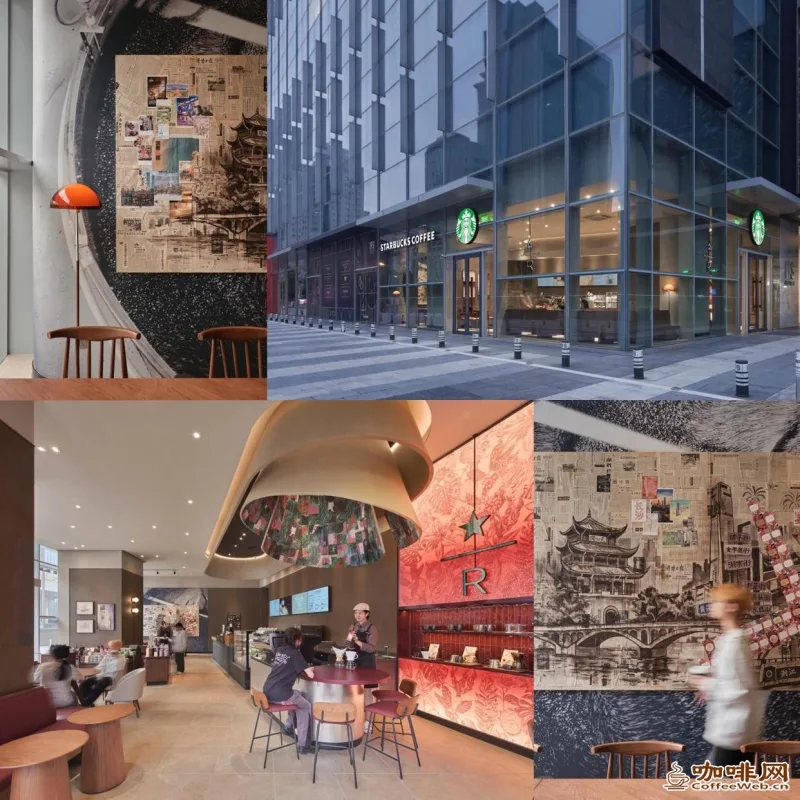
Recently, Starbucks’ 100th Changsha store officially landed at Changsha IFS. This Reserve store, with Xiang embroidery intangible heritage as its design core, is more than a brand’s numeric milestone in one city—it is another concrete practice of Starbucks’ “thousand stores, thousand faces” scenario-based expansion strategy.
As domestic coffee-market competition intensifies, price wars recur and the industry enters a new stage of refined-operation rivalry. Through this new store at a commercial landmark, one can glimpse a Starbucks China store-opening logic that balances scale expansion, local expression and commercial-real-estate value.
A store’s localization experiment
Changsha’s Wuyi business circle—the core wind vane of Hunan’s consumer market—converges commercial foot traffic, urban culture and young consumer power.
Starbucks Reserve IFS breaks free of simply piling up regional symbols, fusing Xiang embroidery heritage, Xiang River spirit and Changsha’s city memory into one. The Xiang embroidery “hair-needle” stitch is transformed into ceiling brushed-metal texture; the bar’s backdrop wall wraps the Reserve logo in Xiang-embroidery silk threads, moving the heritage craft from museum display cases into the consumption space; the spatial form borrows the flowing shape of the Xiang River, presenting old-Changsha city imagery and Wuyi Square historical memory through collage art.
The overall space uses amber-coffee as the base, with antique-bronze and dark wood tones building a steady texture, and berry-red just right to brighten the mood—balancing the modern feel of a high-end business circle with the profound heritage of Hunan culture, fitting diverse consumption scenarios like shopping breaks, friend gatherings and tourist check-ins, creating a quiet retreat amid the bustling Wuyi Square.
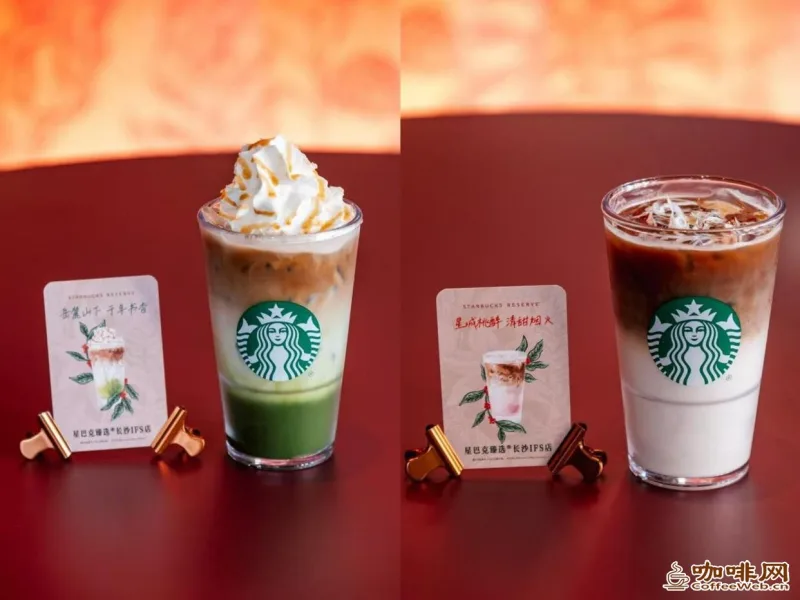
(Caption: the store serves two exclusive specialty drinks, “At the Foot of Yuelu” and “Star-City Peach Drunk.”)
For a commercial landmark, such a store’s value long ago exceeded selling coffee drinks; it becomes a destination scene inside the mall with both social and aesthetic attributes,filling the commercial complex’s cultural-experience gap, achieving two-way empowerment of brand and commercial real estate.
This store is also a microcosm of Starbucks’ sixteen years in Hunan. To date, Starbucks in Changsha has built a diverse store-matrix covering core business circles, office buildings, communities, cultural-tourism blocks and creative parks. Meanwhile, 46 “interest-space” stores have landed locally, covering pet-friendly, cycling, running and other community scenarios, combined with digital services like “Starbucks Now” and delivery, continuously broadening the boundaries of the “third place.” As store count reaches 100, Starbucks’ competitive focus in Changsha has shifted to relying on differentiated spaces to meet the real-life needs of different circles, deeply embedding the coffee space into daily life.
“Thousand stores, thousand faces” rebuilds the store-opening logic
The Changsha IFS new store is only one link in Starbucks’ nationwide second-half expansion wave. As Starbucks China enters a new development cycle, it has established four growth dimensions—commercial landmarks, lower-tier markets, cultural tourism, and lifestyle—accelerating the “thousand stores, thousand faces” strategy and building a multi-tier store network.
On the commercial-landmark track, following the debut of Starbucks Reserve “Starbucks Now” at Beijing SKP, Wuhan SKP will also welcome two stores at once. From China Resources MixC, Hangzhou Hang Lung Plaza, to various SKP projects, Starbucks outputs diverse store types—Reserve large stores, high-frequency standard stores—tailored to different commercial projects, jointly building city coffee destinations with high-end commercial partners. The cooperation base in core business circles provides soil for its high-end store types, while customized specialty stores in turn elevate the mall’s overall consumption experience, forming a positive cycle.
At the same time, the expansion tentacle keeps penetrating downward. In fiscal 2026, Starbucks is accelerating entry into numerous county-level markets, with over half of new stores landing in third-tier and below cities. By the end of September, the brand will formally enter the Xinjiang market; Xinjiang stores will also deeply mine local culture, launching localized limited products and services to fill the coffee-consumption demand of blank markets.
Cultural-tourism scenarios have become another key growth lever. The coffee space is becoming a carrier for activating traditional culture; Starbucks has formed two specialty store types—intangible-heritage flagship and intangible-heritage cultural-tourism. The Shanghai Yu Garden store integrates Shanghai lantern intangible heritage, the Beijing Yandai Xiejie store collaborates with a glaze-ware intangible-heritage inheritor, bringing traditional craft into store design; cultural-tourism points like the Wutai Mountain scenic area, Nanjing 1912 historic block and Disney Town also host stores adapted to travel scenarios. Coffee is no longer just a drink; the store becomes a window for tourists to feel local culture, fusing commercial consumption with cultural communication.
For ordinary people’s daily lives, Starbucks continues enriching its store matrix. It densifies regular stores in communities and office buildings to meet daily high-frequency consumption, while also developing flexible forms like Starbucks Now small stores and mobile coffee carts. At the foot of Mount Hua, at sports centers, at large expo sites, Starbucks can be seen, extending the third place into commuting, sports, travel and game-watching life scenarios.
Commercial-landmark stores lead with customized landmark large stores; lower-tier markets balance quality and efficiency; cultural-tourism stores graft local culture; daily-life scenarios use flexible store types close to user trajectories. Different store types bear different functions, jointly building a multi-tier store network.
The coffee giant’s scale-and-quality test
As coffee-sector competition turns white-hot, the market’s test of chain coffee brands is long past mere store-count growth—it points to single-store operating quality, sustainable profitability, and whether the brand can output irreplaceable consumption value. Starbucks’ “thousand stores, thousand faces” rejects the crude expansion of one template copied nationwide; the brand always centers on the customer, grounding itself in consumers’ real-life trajectories and local cultural preferences, polishing each store’s space, product and service to match different groups’ consumption demands.
Of course, challenges exist objectively. Local coffee brands keep rising, with price tiers and product innovation continuously grabbing users, and consumers’ understanding and needs of the “third place” are also changing.
Shopping-center research data shows Starbucks remains the preferred beverage partner of commercial complexes; its unique spatial model still holds unique appeal. Behind commercial real estate’s priority willingness is recognition of its foot-traffic drive and experience-building capability.
From the Changsha IFS 100th-store practice, one can see Starbucks’ growth narrative shifting from “open more stores” to “open every store well.” The store is no longer merely a point to sell coffee, but a medium to read a city: in landmark business circles it supplements the commercial ecosystem’s experience; in county towns it brings standardized quality consumption; in cultural-tourism blocks it becomes a window displaying traditional culture; in community offices it is ordinary people’s daily rest corner.
Looking from Changsha’s 100th store toward the nation, when scale expansion is deeply bound with local culture and users’ real needs, Starbucks’ future growth tension depends largely on whether this scenario-based expansion strategy can keep running. Rooted in the Hunan market, Starbucks will keep deepening locally, continuously outputting a more place-sensitive third-place experience, growing upward together with Star-City Changsha.
By Li Xinzhi, reporter of Xiaoxiang Morning Herald · Morning Video.
Reprint Note & Disclaimer
- This article is reprinted from Chinese media for information and cultural exchange. The views expressed are those of the original author and do not necessarily reflect the position of coffeeyo.com.
- All trademarks, brand names and logos mentioned belong to their respective owners.
- For cooperation, reprint or correction requests, please contact coffeeyo.com.
Reprint Notice & Disclaimer
- This article has been edited and compiled by China Coffee Network. The information and images therein come from public sources and the copyright belongs to the original author. This reprint is intended solely for information sharing within the coffee industry and does not represent the views of this website; all data and opinions are subject to the original article. Our thanks to the original author for creating and sharing it.
- For matters concerning content licensing, attribution, copyright or otherwise, please contact us promptly and we will verify and cooperate in handling them as soon as possible. We also welcome coffee origins, brands and industry media to exchange ideas and contribute articles.
- Contact China Coffee Network: Tel 400-0000-641 (+86-18288016826) | Email 405854472@qq.com | Address: Jinghong, Xishuangbanna, Yunnan Province / Tieling, Liaoning Province
Related Reading
- Bean in Short Supply: A Taiwan Youth on Yunnan Coffee as a Shared Cross-Strait Stage
- Five Years, Eight Championships: Lincang Coffee Joins the World Stage
 Haikou ‘Union Cup’ Barista Skills Competition Kicks Off to Empower the Service Sector
 Yunnan Specialty Coffee Beans Deliver an ‘Excellent’ Report: Path to Value Leap
- Cross-Strait Tides Rise: A Taiwan Youth Farms Coffee in Yunnan, a Cup Bridging Both Sides
 2026 2nd Yunnan Treasure Coffee Green Bean Competition (Cup of Excellence Pilot) Concludes


 Liaoning ICP Security No. 21122402000217