
At a Glance (China Coffee Network): KUNMING, June 16 (CNS, by Luo Jie)—At the 10th China–South Asia Expo being held in Kunming, Yunnan, the Myanmar Trade Center booth brimmed with coffee aroma. Premium coffee from the Ywangan region of Myanmar’s Shan State drew many buyers and visitors to taste. A 29-year-old Sino-Myanmar mixed-heritage girl, Yang Zijing, busied herself brewing coffee, introducing flavors, and exchanging contacts with merchants from time to time.
KUNMING, June 16 (CNS, by Luo Jie)—At the 10th China–South Asia Expo being held in Kunming, Yunnan, the Myanmar Trade Center booth brimmed with coffee aroma. Premium coffee from the Ywangan region of Myanmar’s Shan State drew many buyers and visitors to taste. A 29-year-old Sino-Myanmar mixed-heritage girl, Yang Zijing, busied herself brewing coffee, introducing flavors, and exchanging contacts with merchants from time to time.
“Previously many coffee professionals didn’t know Myanmar also grows specialty coffee; now more and more people actively come to source beans,” Yang said.
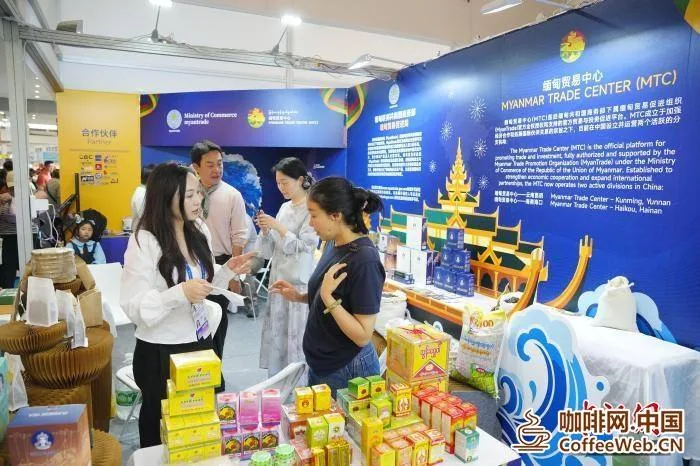
Yang was born into a Sino-Myanmar family and spent her childhood between Myanmar and Yunnan. In her memory, coffee was part of Myanmar people’s daily life. “My grandmother also had the habit of drinking a cup of coffee every day.”
After graduating from a UK university in 2020, she returned to Yunnan to help her mother manage an idle coffee plot, thus entering the coffee industry. Over six years, she moved between Myanmar and various parts of China, operating coffee estates in Myanmar’s Ywangan and Yunnan’s Yingjiang, Dehong, planting over 800 mu of coffee. Her business gradually extended to planting, processing, green-bean trade, and roasted-bean sales, and she sells Myanmar coffee to Canada, Japan, Australia, Thailand, and elsewhere.
In the global coffee map, Myanmar is a “niche origin.” In recent years, Yang has brought Myanmar coffee to events like the Shanghai International Coffee Culture Festival and a Myanmar special cupping session in Zhongshan, Guangdong, clearly feeling that this “niche origin” is slowly entering the purview of China’s coffee industry.
During the Expo, the Baoshan Coffee Industry Association signed a cooperation agreement with a Yunnan–Myanmar cross-border trade enterprise. Beyond coffee-bean procurement, the two sides also plan to jointly visit Myanmar to inspect origins and expand cooperation in planting, processing, and market development.
In Yang’s view, Yunnan and Myanmar both lie on the world’s coffee golden growing belt, and Sino-Myanmar coffee cooperation starting from Yunnan has natural advantages. Yunnan has a mature industry chain and planting-processing experience, while Myanmar stands out in specialty coffee with its unique flavors; the two origins are not in competition but complementary with their respective strengths, and can jointly expand the global market. Moreover, policy measures such as Myanmar opening RMB settlement and promoting a coffee-planting plan in Yangon will open new space for Sino-Myanmar coffee cooperation.
As the Expo nears its close, Yang’s steps do not pause. After inspecting Chinese coffee-equipment enterprises, she plans to purchase roasters, packaging equipment, and more to ship to Myanmar for local coffee processing.
“I speak Chinese, Burmese, and English, and know both the Chinese and Myanmar markets well,” Yang said, hoping to let more people get to know Yunnan and Myanmar through a cup of coffee, and jointly witness the new story of Sino-Myanmar coffee cooperation. (End)
Reprint Notice & Disclaimer: This article is reprinted from China News Service (CNS). Original reporting by Luo Jie; photo by Liu Ranyang. All rights belong to the original publisher.
Related Reading
- Bean in Short Supply: A Taiwan Youth on Yunnan Coffee as a Shared Cross-Strait Stage
- Five Years, Eight Championships: Lincang Coffee Joins the World Stage
 Haikou ‘Union Cup’ Barista Skills Competition Kicks Off to Empower the Service Sector
 Yunnan Specialty Coffee Beans Deliver an ‘Excellent’ Report: Path to Value Leap
- Cross-Strait Tides Rise: A Taiwan Youth Farms Coffee in Yunnan, a Cup Bridging Both Sides
 2026 2nd Yunnan Treasure Coffee Green Bean Competition (Cup of Excellence Pilot) Concludes



 Liaoning ICP Security No. 21122402000217