
At a Glance (China Coffee Network): Baoshan, November 5 (CNR reporters Wei Wenqing and Zhao Beibei) — On one side stand the Gaoligong Mountains; on the other flows the Nujiang River. Xinzhai Village, in Lujiang Town, Longyang District, Baoshan City, Yunnan Province, sits in the dry-hot valley of the Nujiang, where sunlight at 24 degrees north latitude spills across the slopes and unbroken coffee trees stretch along the terrain. Ripe coffee cherries hang heavy on the branches; after picking, processing, and roasting, they finally become a richly aromatic cup of Baoshan Arabica coffee.
Baoshan, November 5 (CNR reporters Wei Wenqing and Zhao Beibei) — On one side stand the Gaoligong Mountains; on the other flows the Nujiang River. Xinzhai Village, in Lujiang Town, Longyang District, Baoshan City, Yunnan Province, sits in the dry-hot valley of the Nujiang, where sunlight at 24 degrees north latitude spills across the slopes and unbroken coffee trees stretch along the terrain. Ripe coffee cherries hang heavy on the branches; after picking, processing, and roasting, they finally become a richly aromatic cup of Baoshan Arabica coffee.
Editor’s Note: To build a strong country, agriculture must first be strengthened; only with strong agriculture can the nation be strong. The outline of the 15th Five-Year Plan calls for coordinated development of technology-driven, green, quality-oriented and brand-focused agriculture, turning farming into a modern major industry. Today, geographical indication (GI) products, as carriers of regional character and cultural heritage, are rapidly shifting from “local specialties” to “branded goods”. In line with this policy direction, China National Radio has specially launched the “Landmark China Tour” converged-media reporting campaign, focusing on how GI specialties go beyond their home provinces and reach wider audiences, exploring the agronomic traditions, human stories and innovations behind these products, and helping more regional landmarks transform from “local symbols” into “national trending brands”, using innovation to help them break into the mainstream and shine.
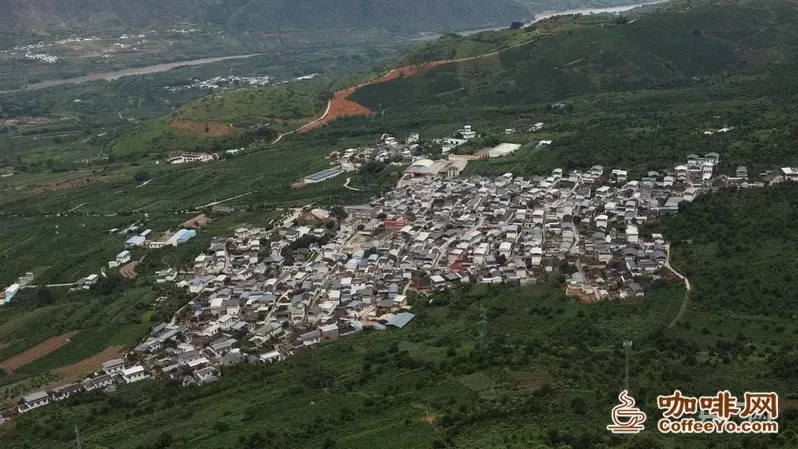
The village has more than 70 years of coffee-growing history, with 13,600 mu of coffee plantations. Today, this place — known as “China’s No. 1 Coffee Village” — is extending from traditional cultivation into specialty processing, estate experiences and cultural expression. A cup of Baoshan Arabica coffee is telling a terroir story that belongs to Yunnan.
The Terroir Code at the Foot of the Gaoligong Mountains
Baoshan Arabica coffee belongs to the Arabica species and is a national geographical indication product. Its flavor is often summarized as “rich but not bitter, fragrant but not overpowering, with a hint of fruit acidity and a lingering sweet aftertaste”.
Why can coffee grow here in Baoshan? Peng Anbang, deputy Party secretary of Xinzhai Village, explained that the village lies in Lujiang Town, Longyang District, Baoshan City, backed by the Gaoligong Mountains and adjoining the dry-hot Nujiang valley, within the 24-degree-north coffee-growing belt. The village has 13,600 mu of coffee, with every household growing it, making it one of the earliest villages in China to achieve large-scale, contiguous coffee cultivation. In 2012, Xinzhai was named a national “One Village, One Product” demonstration village. Thanks to its early coffee-growing history and the advantages of scale, Xinzhai gradually earned the reputation of “China’s No. 1 Coffee Village”.
Unique natural endowments and more than 70 years of cultivation together shape the origin character of this coffee. He Wenjun, head of the Gongjiang Coffee Estate in Xinzhai Village, believes that coffee flavor comes not only from variety and processing, but also from the local geography, climate and soil. “A region’s soil and water nurture the produce of that place” is how he understands Baoshan coffee.
According to reports, the ten-thousand-mu coffee gardens around Xinzhai Village date back to 1952. Today, as China’s domestic coffee consumption market keeps growing, the industry is also seeking new room to grow. From planting a single coffee tree to running a coffee estate, local people’s understanding of coffee is changing.
Craftsmanship and Quality Improvement Behind the Shift to Specialty Coffee
What processes must a coffee cherry go through, once picked, before it becomes the drink in your cup?
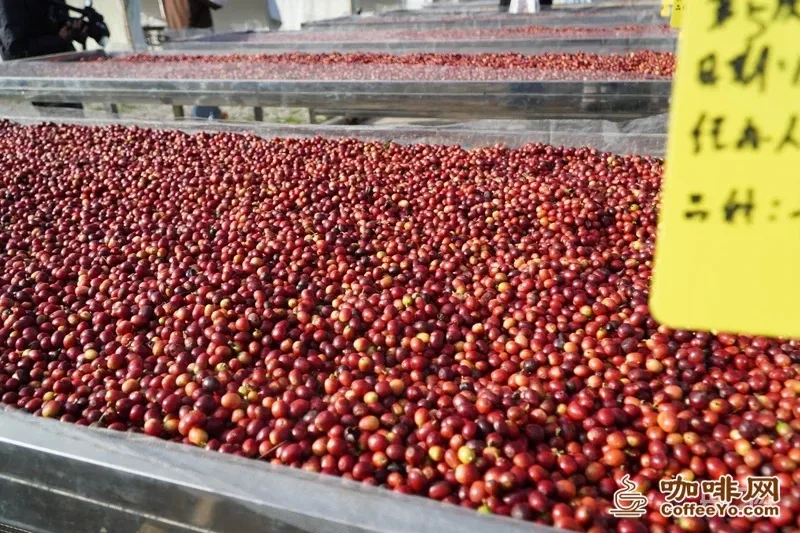
He Xiaoyan, a barista at the Gongjiang Coffee Estate, showed the reporter the different forms that fresh coffee cherries take after processing — natural (sun-dried), honey and washed.
Natural processing means directly sun-drying the fresh cherries after picking and sorting; honey processing removes the skin but keeps the mucilage layer for drying; washed processing usually first removes the skin and pulp, then removes the mucilage through fermentation or mechanical means, followed by washing and drying. Different methods affect the flavor the coffee finally shows. “Naturally processed coffee has some fermented notes; honey-processed is relatively sweeter; washed has a cleaner, crisper taste,” He Xiaoyan explained. From fresh-cherry processing to the end of drying usually takes more than a month. After hulling and sorting, the beans still need to enter the roasting stage before they become roasted beans ready for brewing.
The estate currently focuses on medium roasting, hoping to strike a balance between acidity, bitterness and aroma so that more consumers will embrace Baoshan coffee. Local coffee professionals are also constantly experimenting with different processing methods to bring richer flavors out of coffee from the same origin.
From cultivation to processing, Yunnan’s coffee industry is also continuously advancing variety improvement and quality upgrading. In 2025, Yunnan’s coffee-growing area reached 1.5188 million mu, with output of 170,700 tonnes. The industry no longer focuses solely on yield; it is also attaching growing importance to specialty coffee and deep processing.
Local Culture in a Cup of Coffee
Coffee is an imported product, but coffee culture does not necessarily have to follow only foreign ways of expression.
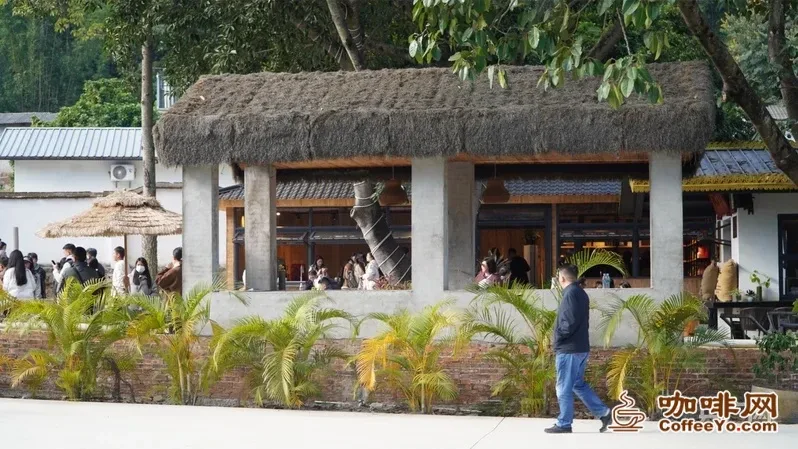
“We believe a Chinese-style coffee culture is taking shape,” He Wenjun said. In his view, a coffee culture with Chinese regional character must have its own history, reflect a distinctive geographical environment, and also be integrated with local customs, arts, culture and values.
How can coffee truly become part of local life? In Xinzhai Village, this exploration has already extended from a cup of drink to the dining table and everyday experiences.
Coffee-braised chicken, steamed eggs with coffee flowers, coffee-braised pork, coffee cherry-skin tea… locals are trying to combine coffee with traditional cuisine, so that coffee is no longer just a brewed beverage but becomes part of the local food culture.
At the estate, intercropping coffee with local plants has also become a new direction of exploration. Coffee trees interplanted with the Yunnan gooseberry tree (Phyllanthus emblica), over years of growth, yield beans carrying that fruit’s flavor — mildly sour and astringent at first, with a pronounced sweet aftertaste; coffee grown alongside the Chinese pistache tree, by contrast, takes on a natural fresh aroma and a mint-like coolness.
“We are trying to interplant coffee with local specialty fruits and aromatic plants, letting them influence each other as they grow, so the coffee takes on some of the flavors of local plants,” He Wenjun said. He hopes that different plant pairings will enrich coffee’s flavor while also exploring new ways of ecological cultivation. In addition, the estate has woven local fossil culture and artistic creation into its spatial design and experience activities, creating more connections between coffee and local culture.
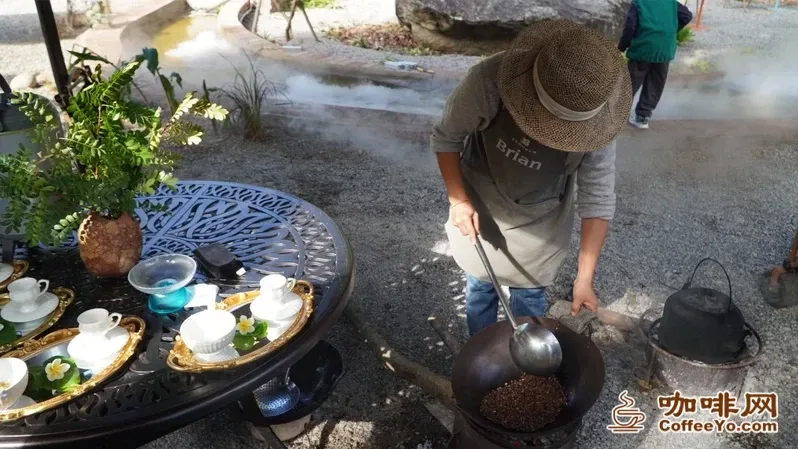
From a single coffee cherry to a cup of specialty coffee, the industrial chain of Baoshan Arabica keeps extending. Relying on the scenery of its ten-thousand-mu coffee gardens, Xinzhai Village has successively built distinctive coffee-themed estates that combine cultivation, processing, display and cultural experience. Visitors can walk into the coffee gardens to learn about growing, and can also taste coffees made with different processing methods at the estates, experiencing the whole journey from fresh cherry to a cup of drink.
Recently, the national standard “Quality Requirements for Geographical Indication Products — Baoshan Arabica Coffee” was approved and released, setting specifications for the product’s origin range, growing environment, processing requirements and quality evaluation, providing a basis for improving the quality and building the brand of Baoshan coffee.
The Gaoligong Mountains still stand tall, and the Nujiang River keeps surging on. Coffee trees in the valley bear fruit year after year; a coffee bean travels from the branch to the market, letting more people taste the terroir of this valley. For Baoshan, the coffee story continues: it must both preserve the terroir character this land has given it and make good use of craftsmanship, standards and culture, so that a cup of coffee from Yunnan can present a more distinctly Chinese expression.
Reprint Notice & Disclaimer: This article is reprinted from China National Radio (CNR). Original reporting by Wei Wenqing and Zhao Beibei. All rights belong to the original publisher.
Related Reading
 Three Decades of Shanghai-Yunnan Collaboration: A Coffee Bean ‘Ferments’ at the Import Expo
 Why Yongde’s Coffee Beans Won Gold in Shanghai – A Taste of ‘Life in Yunnan: 365 Days’
- Yunling Commentary: Yunnan Coffee Turnaround Hinges on Autonomous Pricing
 A ‘Travel Pack’ Reveals Another Possibility for Pu’er Baristas
- Bean in Short Supply: A Taiwan Youth on Yunnan Coffee as a Shared Cross-Strait Stage
- Five Years, Eight Championships: Lincang Coffee Joins the World Stage




 Liaoning ICP Security No. 21122402000217