
At a Glance (China Coffee Network): On an autumn morning, the Yanling traditional Hainanese "old father tea" shop on Yuhe Road, Longhua District, Haikou, is thick with aroma and laughter. In the kitchen the stove bu…
On an autumn morning, the Yanling traditional Hainanese “old father tea” shop on Yuhe Road, Longhua District, Haikou, is thick with aroma and laughter. In the kitchen the stove burns bright, and pot after pot of traditionally brewed “gebio” — Hainanese dialect for black coffee — releases its distinctive roasted scent before being carried out to the tables.
In Hainan, sipping a cup of gebio with a few plates of dim sum — alone in quiet leisure or in conversation with old friends — is for many a moment of ease. “Whether at home or at a restaurant, breakfast has to come with a cup of coffee. Otherwise you feel listless all day, and the day hasn’t really begun,” said Li Yanqiu, a Haikou resident.
By incomplete counts, Hainan now has more than 4,000 coffee shops, about four per 10,000 people, alongside some 5,000 “old father tea” shops serving gebio, tea drinks and snacks. Looking at the island’s key coffee-growing regions and at the businesses and outlets carrying “coffee” in their name, Hainan coffee is continually refreshing itself in flavour, setting and experience, and steadily opening new consumer space.
Building the full chain
Hainan Island lies in the tropics, with abundant sunshine and rainfall — well suited to coffee. More than a century ago, overseas Chinese brought coffee seeds back from Southeast Asia; taking root here, they began the island’s history of coffee growing and, in time, of coffee drinking.
In Fushan Township, Chengmai County, local authorities have leveraged the area’s unique advantages — the golden 19th-parallel coffee belt and selenium-rich volcanic soils — to set the whole coffee value chain in motion. According to Li Suwei, director of the Chengmai Fushan Coffee Culture Town management committee, in 2025 Fushan was successfully designated Hainan’s first national coffee-industry “strong town”, and this year the regional public brand “Chengmai Coffee” was released, taking the county’s coffee industry into a new stage.
A full-chain system has taken initial shape in Chengmai. In production, a germplasm-resource centre has been built and intercropping models such as “coffee plus areca” are widely promoted. In processing, Hainan’s first standardised line for coffee-cherry handling has been established, along with the Fushan coffee comprehensive processing plant. In consumption, the Chengmai coffee-industry service platform has been created. Last year the county’s coffee chain generated an output value of RMB 690 million, gathered more than 750 coffee businesses of all kinds and supported over 10,000 jobs.
Wanning, Hainan’s other coffee heartland, has built a complete chain from pre-production to post-harvest and from seed to cup — growing, processing, trade and distribution — around the Xinglong Coffee Industry Town. Ye Jian, president of the Wanning Xinglong Coffee Industry Association and general manager of CP (Hainan) Xinglong Coffee Industry Development Co., told reporters that in Xinglong coffee has long been part of daily life: annual per-capita consumption in the township exceeds 200 cups, against a national figure below 30.
Building on that consumer tradition, Hainan uses industry development to promote consumption and consumption to drive the industry. Fushan and Xinglong coffees have both been recognised as national geographical-indication products; well-known brands such as Nanguo and Chunguang have been cultivated; and local coffee shops using Hainan beans as their principal input have sprung up everywhere. Reporters found that most local specialty shops are unconstrained by convention: besides gebio and other coffee drinks they typically serve breakfast and simple meals — noodles, rice noodles, wontons, baozi and the like.
Beyond local specialty shops, Hainan’s coffee retail landscape also includes chain brands and urban outlets: national and international chains such as Luckin, Guming, Cotti and Starbucks, homegrown chains like the Fushan coffee houses, and a long tail of independent urban cafés, many of them internet-famous check-in spots.
Staying small and beautiful
Land resources on Hainan Island are limited and coffee is grown on a small scale with low output — the province’s planted area is currently about 26,000 mu — while its resident population, and therefore consumption capacity, is relatively modest. That almost dictates that coffee, an everyday fast-moving consumer good in Hainan, must follow a “small and beautiful” path of industrialisation.
“Hainan’s coffee industry has the shortcoming of a small planted area and insufficient capacity. Relying on itself alone it cannot achieve scale effects or satisfy fast-growing market demand,” said Fu Changming, secretary-general of the Hainan Coffee Industry Association, arguing that the industry should play to its strengths, avoid its weaknesses and pursue a high-quality, boutique route — working on flavour, setting and cultural innovation.
Yang Shuyin, executive vice-president of the association and proprietor of Fushan Xiaoyin Coffee, likewise believes Hainan coffee must hold the line on quality if it is to make a name for itself and unlock the industry’s potential. “To guarantee quality, we manage everything ourselves — planting, picking and processing — so the whole process stays under control,” she said, adding that if Hainan coffee is to go the distance and keep expanding consumption, innovation must be built on a foundation of quality.
In practice, many Hainan coffee professionals are pursuing exactly that kind of innovation along a boutique path. Zhang Yunhai of Hainan Fushi Coffee Culture Co. noted that domestic coffee-consumption potential is enormous and still rising, and that the market will differentiate and segment as it grows — Hainan coffee, with its depth of heritage, policy advantages and full-chain strengths, is well placed to claim a place in the mid-to-high end.
Reporters noticed that industry players here are especially attentive to local distinctiveness. Some shops have developed pineapple coffee, sea-salt coffee and durian coffee, all enthusiastically received. “Both the coffee and the pineapple in this cup are local. Bitterness mixed with sweet-sour — very Hainanese, and quite distinctive,” said Zhang Peixin, a visitor from Liaoning.
As a major tourism province, Hainan has some coffee shops in or near scenic areas that double as photo spots, rest stops and check-in points for travellers. In Shishan Township, Xiuying District, Haikou, near the Haikou section of the China Leiqiong Global Geopark, specialty cafés such as 7080 Coffee, Yantu Coffee House and Du Coffee draw consumers who climb and sightsee, then sit with a cup of coffee. In Sanya’s Dadonghai tourism area, Yichi Garden Café commands a sea view, letting visitors sip coffee to the sound of surf beneath a sky full of sunset colour. “For me coffee is a vehicle — it carries and records good moods, picture-postcard scenery and the places you’ve been,” said Zhang Wei, a visitor from Shandong, holding a latte and thinking that whenever she remembers Dadonghai she will remember this cup.
Going international
“Excite the world” — the slogan of Chengmai coffee is stirring, and speaks to its global ambition. In mid-August this year, at the 2026 Hainan International Coffee Expo in Haikou, 20 Chengmai coffee companies appeared as a group under the newly upgraded regional public brand, drawing international attention. Coffee companies from other Hainan origins also showed up in force, promoting their products and brands and seeking international cooperation.
Deeper opening-up and cooperation was a defining feature of the expo. Organisers said they hoped it would raise Hainan coffee’s international trade flows, exploit the island’s free-trade-port advantages in opening up, and help build a closed coffee-trade loop of “buy globally, process in Hainan, sell globally”.
According to the 2025 Hainan Coffee Industry Development Report released by the provincial department of agriculture and rural affairs, Hainan is progressively laying out global coffee trade, with raw-material imports and export-market development spanning multiple countries and regions. Haikou Customs statistics show that last year Hainan companies imported more than 9,000 tonnes of coffee beans and products worth RMB 480 million — up 5.6 times and 8.3 times respectively year on year.
“Policy advantages let Hainan coffee companies travel light, and their steps into the world will be quicker,” said Fu, noting that as the policy dividends of the Hainan free-trade port are released, more foreign coffee companies are coming to Hainan in search of opportunities, bringing more products, enterprises and industrial resources into China and Hainan and creating new openings for Hainan coffee to link to the global market.
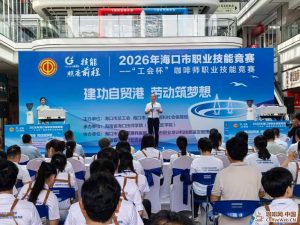
Hainan also places particular emphasis on talent development as the foundation of industrial growth. Reporters noted the frequency of coffee competitions and training programmes on the island to select and develop talent. During the 2026 Hainan International Coffee Expo alone, events included the China Coffee Latte-Art Masters Championship Challenge, global fine-coffee cupping and multi-origin champion demonstrations. The 2026 “Workers’ Cup” Chengmai County siphon-barista skills competition recently concluded at Fushan Coffee Culture Town, focusing on the specialist craft of siphon-brewed fine coffee and testing contestants’ understanding, control and professional extraction of local bean characteristics; it drew numerous local industry practitioners.
“In recent years Chengmai has invested heavily in cultivating coffee skills talent and introduced high-quality training resources, running systematic, regularised vocational training,” said Li. Large numbers of local practitioners have completed systematic skills training and obtained vocational certificates, growing into backbone forces of the industry — laying a solid foundation for the coffee industry’s high-quality development, richer consumer supply and march toward internationalisation.
Reprint Notice & Disclaimer
- This article has been edited and compiled by China Coffee Network. The information and images therein come from public sources and the copyright belongs to the original author. This reprint is intended solely for information sharing within the coffee industry and does not represent the views of this website; all data and opinions are subject to the original article. Our thanks to the original author for creating and sharing it.
- For matters concerning content licensing, attribution, copyright or otherwise, please contact us promptly and we will verify and cooperate in handling them as soon as possible. We also welcome coffee origins, brands and industry media to exchange ideas and contribute articles.
- Contact China Coffee Network: Tel 400-0000-641 (+86-18288016826) | Email 405854472@qq.com | Address: Jinghong, Xishuangbanna, Yunnan Province / Tieling, Liaoning Province
Related Reading
- Bean in Short Supply: A Taiwan Youth on Yunnan Coffee as a Shared Cross-Strait Stage
- Five Years, Eight Championships: Lincang Coffee Joins the World Stage
 Haikou ‘Union Cup’ Barista Skills Competition Kicks Off to Empower the Service Sector
 Yunnan Specialty Coffee Beans Deliver an ‘Excellent’ Report: Path to Value Leap
- Cross-Strait Tides Rise: A Taiwan Youth Farms Coffee in Yunnan, a Cup Bridging Both Sides
 2026 2nd Yunnan Treasure Coffee Green Bean Competition (Cup of Excellence Pilot) Concludes


 Liaoning ICP Security No. 21122402000217