
At a Glance (China Coffee Network): From June 15 to 25, the second Yunnan Cup of Excellence pilot crowned Gengxia Estate’s washed Geisha at 91.78 points, with Luckin buying the champion bean at 14,000 yuan/kg—a milestone that signals Yunnan coffee’s arrival on the world stage.
From June 15 to 25, the 2026 second Yunnan Treasure Coffee Green Bean Competition (Yunnan Cup of Excellence pilot) was held at Diancui in Xishan District, Kunming. For Yunnan coffee, this was no ordinary green-bean competition—it was the second consecutive year of the CoE system piloting in Yunnan, and an important node in Yunnan coffee’s continuous dialogue with world specialty-coffee standards.
Last year, the first event landed in Baoshan, with 144 competing beans from seven major regions, 19 award-winners, and Lincang’s Qiupo Estate’s washed Batian winning at 89.96 points, with an auction price of 13,150 yuan/kg setting a Chinese record. This year, the second moved to Kunming, with participation growing to 169 beans, covering core regions such as Pu’er, Baoshan, Lincang, Dehong, Xishuangbanna and Nujiang. If the first solved going from 0 to 1, the second takes the question a step further: as international standards keep shining into Yunnan’s producing regions, what chain reaction will it bring?
CoE: Not Just Judging a Champion, but Judging a Region’s Future
In the specialty-coffee field, CoE has long been hailed as the Olympics of green coffee beans. Started in Brazil in 1999 as “Best of Brazil,” renamed in 2001 with a dedicated cupping table, and since 2002 managed by the non-profit ACE (Alliance for Coffee Excellence). Over more than two decades, CoE has covered 12 coffee-producing countries worldwide, cumulatively facilitating $84 million in transactions, becoming the most credible passport for a region to enter the world specialty-coffee map.
Its core mechanism is competition plus auction: a domestic jury screens first, an international jury conducts multiple rounds of blind tasting for the final; fully coded, double-blind, audited and notarized, uniformly roasted—every step designed for one goal: let the coffee’s quality speak for itself. Beans scoring 87 and above and ranking in the top 30 enter the global online auction, with over 75% of auction proceeds returned directly to the farmers.
CoE’s underlying logic is not a beauty contest but pricing—using an internationally accepted quality-evaluation system to replace the vague bargaining model of traditional trade, letting good coffee be seen, understood and reasonably priced. For a region, what CoE brings is not just the transaction price of one bean, but standards, brand, international reputation and long-term buyer relationships.
This is precisely the deep reason Yunnan introduced the CoE pilot for two consecutive years. A champion bean represents one estate’s staged success, while what the pilot measures and drives is a region’s systematic capacity to enter the international specialty-coffee system.
Yunnan Coffee: From Raw-Material Supplier to a Chinese Option
As of 2025, Yunnan’s provincial coffee planting area reached 1.495 million mu, total output 170,000 tonnes, with superior-variety coverage, premium rate and deep-processing rate rising to 21.8%, 41.7% and 85% respectively.
Behind the numbers is the industry’s years of continuous deepening. At the variety level, from the past Catimor-dominated single structure to the De-Re series, Yunka series, and localized planting of quality varieties such as Geisha, Pacamara and Caturra; at the processing level, besides traditional washing, natural, anaerobic fermentation and honey processing innovations bloom in diversity; at the industry-form level, the province has built nearly 60 specialty coffee estates, and estatization is moving Yunnan coffee from selling beans to selling brand plus experience.
In autumn 2025, Qiupo Estate’s first-fruiting washed Batian scored 89.96, confirming the fruit of this change—the superposition of variety, terroir and processing is giving birth to a distinctive Yunnan flavor.
Yunnan coffee was long viewed as a raw-material region with insufficient quality discourse power. But in recent years, from variety iteration to processing innovation, from estatization to premium-rate leaps, the change is real. The significance of the CoE pilot lies in: it provides an internationally accepted testing coordinate system for these changes—no longer “I think it’s good,” but “the world thinks it’s good.” Yunnan coffee is moving from raw-material supplier to an industry highland with international discourse power, becoming the Chinese option on the world menu.
A Rigorous Competition: From Jury Selection to International Final
After this year’s event launched, domestic jury selection began first. The organizing committee received 120 complete applications within three hours. On April 2, 62 candidates gathered at Shanghai Hongqiao Pinhui for three rounds of on-site blind tasting, 10 coffees per round. The assessment was chaired by CoE/ACE executive director Erwin Mierisch, co-examined by event convener and CoE/ACE East Asia advisor Su Chengcheng, with CoE senior head judge Paul Songer responsible for data analysis. ACE screened from four dimensions—individual vs. collective scoring consistency, individual before-after scoring consistency, quality discrimination ability and scoring-drop ability—and finally 12 domestic judges stood out.
From June 15 to 19, the domestic judging week was held at Diancui in Xishan District, Kunming. All competing beans, after physical-property pre-screening, were uniformly warehoused, coded by auditors under notarization supervision, achieving triple-coded blind tasting across preliminary, domestic and international stages. The entire judging process was supervised throughout by chief judge Stephen Vick, with notarization by Kunming Mingcheng Notary Office. From June 22 to 25, the international judging week was held, led by chief judge Stephen Vick with the international jury conducting multiple rounds of cupping finals on the advanced beans, fully aligned with formal CoE standards.
The process itself is the narrative. Coding, blind tasting, auditing, uniform roasting—the essence of these steps is the establishment of a trust mechanism. For farmers, what they submit is not just a batch of beans but a whole year’s labor; for judges, what they face is not just flavor but the development level of an entire region.
One more message worth the industry’s attention came from the cupping room: in the completed multiple rounds of judging, three competing beans broke the 90-point barrier.
“The overall quality of this year’s competing beans has improved very noticeably over last year; some batches have begun to show flavor characteristics belonging to the Yunnan region itself.”—For a region still in the pilot stage, this is a weighty signal.
By CoE convention, the pilot’s performance is an important reference for ACE to assess whether the region qualifies for the formal competition. Of course, whether it is ultimately upgraded to the formal competition still requires ACE’s comprehensive assessment—but the scores given at the judging table have already submitted their paper first.
Result Announcement and On-Site Auction
On the afternoon of June 25, the top 10 award-winning beans were auctioned on-site at the main venue, Zhangmei Village Wharf, in the Dianchi Lake Tourism Resort. On this day, scores and prices certainly matter—but more important than scores and prices is that the producers behind these coffees are seen more clearly.
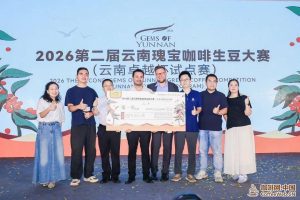
Three beans submitted by three enterprises—Lincang Gengxia Estate Co., Ltd., Menghai Yunle Coffee Co., Ltd., and Lincang Linxiang District Songfeng Coffee Planting Farmers’ Cooperative—all broke 90 points; the closely watched champion—Gengxia Estate’s traditional washed Geisha at 91.78 points—is a milestone breakthrough in the history of Yunnan coffee development.
This year three competing beans broke 90; by CoE convention, beans above 90 can receive the “Presidential Award” title. In a region still at the pilot stage, three beans crossing this threshold at the same time speaks for itself in terms of value.
Looking at the top-10 list, Geisha dominates absolutely, washing still accounts for half of the top 10, while emerging regions like Xishuangbanna Menghai and Nujiang entered the front ranks for the first time, redrawing Yunnan coffee’s regional map. The full Top 20 list and detailed scores are in the table below.
That afternoon, the top 10 award-winning beans were auctioned on-site at the Zhangmei Village Wharf main venue. The “bid king” was taken by the champion bean—Gengxia Estate’s washed Geisha—at 14,000 yuan/kg, purchased by Luckin Coffee. This price broke last year’s Qiupo Estate record of 13,150 yuan/kg, again refreshing the historical high of China’s coffee green-bean auctions.
Why Kunming: A Two-Way Embrace of Coffee and City
Unlike the first landing in Baoshan producing region, this event chose Kunming. CoE history mostly takes root in coffee main producing regions—Brazil’s Cerrado, Colombia’s Huila, Ethiopia’s Yirgacheffe—events are often held right at the origin. This time, it was caught by a provincial capital. Behind this, Kunming brought not just a city’s name, but a whole set of carrying capacity and an open, inclusive welcoming posture.
First, a set of numbers many may overlook. Kunming’s annual average temperature is around 15°C, air humidity maintained around 60%—these two indicators happen to cover the most ideal environmental parameters for green-bean storage. Under normal conditions, warehousing costs are nearly 30% lower than coastal cities. In other words, Kunming does not need large warehouse-distribution systems with artificial temperature and humidity control; it is itself a natural fresh-keeping warehouse. On the logistics end, the China-Europe Railway Express delivers Yunnan beans to Germany in 15 days, and Kunming-to-Paris specialty air lines compress timeliness to 36 hours. In 2025, Yunnan coffee export value exceeded 800 million yuan, more than triple year-on-year, sold far to 43 countries and regions. When a coffee bean that has basked in the plateau sun in Pu’er can appear in a Paris street café’s grinder 36 hours later—you realize Kunming is no longer just the Spring City; it is becoming a transit node hard to bypass in the global coffee-trade map.
If only climate and logistics, Kunming would still be insufficient to host a top-tier green-bean event. Something deeper lies in the depths of time. Kunming’s coffee bloodline can be traced back to the late Qing and early Republic—after the Yunnan-Vietnam Railway opened, coffee as an imported product traveled north from Vietnam, and the first Yunnan city it landed in was Kunming. In the 1930s, on Jinbi Road there was a Western restaurant called Nanlaisheng that received professors of the Southwest Associated University, Yunnan-Vietnam Railway merchants and travelers from all directions with freshly ground coffee. In 1992, China’s first modern coffee-processing factory—Yunnan Coffee Factory—was also born in Kunming. From old Kunming residents drinking coffee from enamel mugs in marketplace scenes, to today’s 2,000-plus cafés scattered across streets and lakefronts—this city has, over nearly a century, drunk coffee from imported product into daily life.
On the industry end, Kunming has issued a work plan to build a “world coffee fashion city,” targeting over 3,000 citywide coffee shops by 2027. Coffee-plus-cultural-creative, coffee-plus-tourism, coffee-estate experience routes—these new formats are becoming the fastest-growing part of Kunming’s cultural-tourism consumption.
So the second-year Yunnan CoE pilot’s choice of Kunming is not a simple venue relocation. It is a naturally grown need after Yunnan’s coffee industry reached a certain stage: the producing region needs a window facing the world, and Kunming happens to be ready. From an industry observer’s perspective, what Kunming carries is not just the execution of an international event, but the last mile of Yunnan coffee’s journey from origin to market, from professional circles to mass consumption. This city, with its lakefront Spring City, landscape-flower-capital positioning, is answering a question: when coffee is no longer just a bulk agricultural product but a city name card, what face should it show the world.
Next Stop: Dianchi International Coffee Culture Carnival
A competition is never the endpoint. One could even say, the true value release of a green-bean competition often lies not at the judging table but outside it. From August 1 to 9, the 2026 Dianchi International Coffee Culture Carnival, themed “Dian Coffee Gathers, All Things Thrive,” will carry the professional results of the Yunnan CoE pilot, transforming the Yunnan treasures at the judging table into experiences knowable and perceptible to mass consumers.
The Dianchi International Coffee Culture Carnival is now in its third year. Looking back at the first two years: the first was born on the east shore of Dianchi, using the largest coffee-tasting party to win a Guinness World Record, with 650,000 visits over 9 days, driving nearly 100 million yuan in consumption. The second linked the whole east-west shore, making the east shore an arts highland and the west shore a trendy field, with 2,805,900 cumulative participants and nearly 20 million yuan in direct sales. Across the two sessions, it not only verified that the coffee-plus-cultural-tourism model works in Kunming, but more importantly, it let a real consumption route grow along Dianchi—the “Dian’an Premium Coffee Corridor.” With coffee culture as its core, this corridor links premium retail, light dining, cultural-creative art and waterfront leisure; the time-limited heat during the event is being transformed into the area’s daily commercial vitality.
From the first to this third year, three years of continuous deepening of the same IP means, for a city-level cultural-tourism activity, that the IP has taken root, moving from “content involution” to “IP taking root.” Penetrating the homogeneous fog with differentiated planning, the content iterated year by year has inheritance and innovation; this summer’s carnival coffee-experience unit, besides retaining the highly anticipated “Yunka Shixu” domestic and international super coffee-cart alliance, also adds the extended experience of this Yunnan CoE pilot, transforming event results into experience content knowable, perceptible and participatable by mass consumers.
This year’s carnival unfolds around four directions—taking root, living interest, life and vitality—with several lines especially worth attention inside and outside the industry. On the industry end, the “All Things Thrive” Dianchi (International) Coffee Industry Big-Shot Roundtable & Idea-Sharing Session will invite Yunnan CoE pilot international judges to join the dialogue, while the “Treasures Leave Dian · Cup-Appreciate Excellence” Yunnan CoE pilot award-bean tasting ceremony lets consumers have the chance, at the carnival site, to drink the very same batch of coffee that just stepped down from the international judging table—for ordinary consumers who usually only know Yunnan beans from café menus, this face-to-face contact with regional flavor may be the most direct way to build specialty-coffee awareness. On the consumption end, the Dianchi “Ma Coffee Marathon” embeds the running route between Dianchi greenways and coffee flavors; the “Coffee Fragrance Flower Realm” Dian’an parade picks Yunnan’s four-season flowers to decorate retro floats, traveling a flowing coffee landscape along Dianchi’s waterfront; besides the brilliant east arts shore and west vitality shore, this year also adds Zhangmei Wharf, Danxia Camp, Yuyuan, Yunnan Ethnic Village, Jinbi Xunjin district cultural-tourism blocks, and Lvdong Gaoyao—sports-life natural settlement as sub-venues—the common logic of these sections is to turn coffee from a drink into a connector, linking music, art, sports and socializing, stringing together Dianchi ecological resources, Spring City flower-capital heritage, Yunnan coffee industry and whole-region cultural-tourism resources. On a longer line, the “sea-land-air” coffee roaming plan and a “coffee-grounds planet · symbiosis plan” try to answer, from spatial experience and environmental recycling respectively, what coffee cultural-tourism can do beyond eating, drinking and check-ins.
Standing on the industry end, what we care more about is the linkage model forming between the Yunnan CoE pilot and the carnival: the top-10 award beans get a dedicated tasting zone at the carnival, and award-winning estates set up dedicated booths to share with consumers—from field quality upgrading, to professional recognition at the judging table, to that cup in the consumer’s hand, a chain never before fully connected in Yunnan is being linked for the first time by Dianchi.
Conclusion
The significance of the second Yunnan Treasure Coffee Green Bean Competition (Yunnan Cup of Excellence pilot) goes beyond selecting high-score coffees and auction transactions. It further brought Yunnan coffee into a more rigorous international evaluation system, and let more people see the changes happening in this city. As the coffee industry continues to upgrade and coffee culture deepens, Kunming will, with a more open and distinctive posture, become an unignorable stop in the global coffee map.
And the coffee-plus-cultural-tourism-plus-industry fusion path is injecting new connotation into Kunming’s lakefront Spring City, landscape-flower-capital city positioning. From coffee trees on high mountains, to the cupping table of world judges; from one award bean, to a cup of coffee by Dianchi—Kunming’s practice of “driving industry through events, promoting tourism through festivals” makes coffee no longer just a drink, but a way for this city to connect with the world.
Selecting Yunnan’s treasures for the world—this is the second year. But what it opens is a brand-new decade for Yunnan coffee.
Reprint Notice & Disclaimer: This article is compiled and edited by China Coffee Network (coffeeyo.com) and reprinted from the “Coffee Salon” WeChat official account. The copyright of the original article belongs to the original authors. This reprint is for the sharing of coffee industry information only. If there is any infringement, please contact us for removal.
Related Reading
 Three Decades of Shanghai-Yunnan Collaboration: A Coffee Bean ‘Ferments’ at the Import Expo
 Why Yongde’s Coffee Beans Won Gold in Shanghai – A Taste of ‘Life in Yunnan: 365 Days’
- Yunling Commentary: Yunnan Coffee Turnaround Hinges on Autonomous Pricing
 A ‘Travel Pack’ Reveals Another Possibility for Pu’er Baristas
- Bean in Short Supply: A Taiwan Youth on Yunnan Coffee as a Shared Cross-Strait Stage
- Five Years, Eight Championships: Lincang Coffee Joins the World Stage


 Liaoning ICP Security No. 21122402000217