
Since 2025 the number of coffee shops in Kunming has risen sharply. The city now has more than 2,400 coffee operators and over 200 brands, and consumption has been growing more than 30 percent a year.
One corner tells the story of the whole. The rise in Kunming’s coffee shops is a microcosm of the province: Yunnan’s coffee store map is spreading faster than many expected. From “growing it” to “selling it” to “drinking it well”, the store boom is filling in a key link of the coffee chain and giving an industry heading for a 100-billion-yuan output value a consumer base to stand on.
Economic data for the first three quarters of this year show stable agricultural production across the province and good conditions for specialty crops. Coffee, an important part of Yunnan’s plateau specialty agriculture, has advanced steadily this year.
Store boom: widening the coffee-drinking circle
Among chain brands, Luckin and others are accelerating their Yunnan build-out. As of July 2026 Luckin alone had 746 stores in Yunnan, its footprint stretching from Kunming’s core commercial districts to county high streets and scenic-area rest stops. It added 57 directly operated stores in the first half and plans another 30 to 50 this year.
Among local brands, coffee has become a consumption highlight across the province. In Kunming, Yunnan Coffee Factory has turned an old plant into a new space, with the workshop now a coffee-themed experience venue. General manager Ding Xi explains: “We have extended our reach to the consumer end by opening stores. For the company this completes the terminal-experience link — we can show Yunnan coffee directly, tell the story of the origin, and strengthen our own brand.”
Compared with the commercial build-out of the big brands, the specialty coffee shops scattered across the province have a flavour of their own.
On Xunjin Street in Kunming, afternoon sun falls through plane trees onto the flagstones as one coffee shop after another shows off its personality. Baristas make signature drinks; residents set their canvas bags down and take their time over a cup. A few kilometres north, the density around Green Lake is just as high, with around 100 specialty cafés clustered there — “going to Green Lake for coffee” has become an everyday Kunming habit.
In Mengzi in southern Yunnan, a small city of 600,000 people, the number of cafés has grown to more than 200, one for every 3,000 residents — a density that matches many provincial capitals.
In Baoshan in western Yunnan, a roadside coffee stall in Mankuan Township went viral online. Grower Li Jinhe spent 3,000 yuan on a shade shelter and brews coffee with a blowtorch, a process with strong visual impact. After the short videos took off, tourists drove there specially to drink it, and neighbouring farmers set up stalls selling barbecue and local produce — one stall seeded a small cluster of businesses.
The significance of Yunnan’s store boom goes well beyond consumption. Behind these numbers is a supply chain being reorganised: the more stores there are, the higher the demand for consistent output; the higher the demand, the more incentive the growing regions have to improve grading, processing and traceability.
Coffee shops are no longer just the end point of consumption but are becoming the nerve endings of the whole chain. They send orders back to the growing regions, feed flavour notes back to the processing plants, and pass price expectations through to growers’ picking decisions.
Change in the growing regions: farmers start choosing their buyers
Coffee beans are selling well, and beyond consumer demand, the deeper change is happening on quality.
“When we select beans, we first require specialty grade, then a clear regional flavour profile, so consumers can drink with understanding and tell the difference between regions and processing methods.” The buying standards of Yang Yu, founder of Kaguo Coffee, explain an important reason Yunnan coffee keeps moving up.
An official with the agriculture and rural affairs bureau of Menglian Dai, Lahu and Va Autonomous County says that in recent years Menglian has seized the opportunity to transform its coffee industry, taking specialty production as the main line and accelerating quality and efficiency gains. The county has standardised cherry-picking rules, reached an 80 percent centralised processing rate for fresh cherries, and achieved yields of up to 2.5 tonnes per mu with output value above 10,000 yuan per mu. In the 2025/2026 season 73 percent of the county’s coffee was specialty grade, ranking first in the province for a fourth consecutive year.
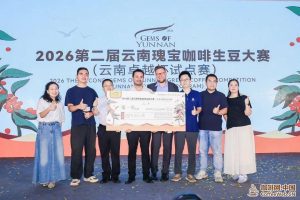
In Lincang, a traditional washed Geisha from Gengxia Estate won the 2026 Yunnan Green Coffee Bean Competition with 91.78 points and sold for 14,000 yuan per kilogram, a record price for Chinese green coffee. When a kilogram of green beans can fetch over 10,000 yuan, “specialty” stops being marketing language and becomes an industry standard that can be priced, traded and bought again.
The industry is improving and the regions are prospering. In Menglian a few years ago growers had to queue four or five days at collection points to sell their beans. Now it is the other way round: buyers come to the fields before picking even starts, and growers have begun to choose their buyers.
Export data confirms the structural shift. In the first half of 2026 Yunnan exported 8,282 tonnes of coffee worth 340 million yuan, both first in China, to 40 countries and regions. More than 90 percent of the Pu’er coffee beans supervised for export by Simao Customs were Grade 1. Yunnan’s exports used to be mostly commercial grade, winning on volume; now Grade 1 dominates, meaning the regions’ grading capability and processing level have crossed a key threshold.
Chain depth: building the industry from every angle
Between the store and the growing region sit research, processing, warehousing, standards and experience. The depth of these links decides whether a chain is resilient or brittle.
In recent years Yunnan’s coffee industry has kept extending into deep processing, brand building and coffee tourism, with upstream and downstream support maturing. Combined output value across the chain has reached 99.5 billion yuan.
In deep processing, the province has formed four clusters — Kunming, Baoshan, Pu’er and Dehong — with more than 120 deep-processing companies and capacity of nearly 100,000 tonnes, 30 percent of the national total. The deep-processing rate has risen from 20 percent in 2021 to 85 percent, with products covering every mainstream category from roasted beans and espresso concentrate to instant powder and freeze-dried powder, multiplying product value.
In brand development, a multi-tier brand matrix is taking shape. The “Pu’er Coffee” geographical indication brand is valued at 4.074 billion yuan and ranks among China’s top 100 GI regional brands; “Baoshan Xiaoli Coffee” has entered the China-EU agreement on GI protection and been included in the Ministry of Agriculture’s premium agricultural brand programme and the Foreign Ministry’s official gift list.
In coffee tourism, the province has built nearly 60 specialty coffee estates and released 10 themed travel routes, drawing more than a million visitors a year to travel and stay in Yunnan. Coffee culture is turning into a tangible, enjoyable lifestyle. Kunming has about 2,400 coffee operators; the Baoshan Gaoligong International Specialty Coffee Culture Park has been rated a national 4A scenic area; Pu’er has created coffee-themed districts and tea-coffee night markets; Lincang offers a “from seed to cup” full-process route. Inventive drinks such as porcini signature coffee, ham latte and jianshouqing creative coffee have become a Yunnan coffee experience found nowhere else.
Domestic coffee consumption keeps growing with strong internal demand. About 90 percent of China’s coffee beans supply the domestic market, and Yunnan beans cover 90 percent, 80 percent and 70 percent of specialty cafés in Shanghai, Beijing and Guangdong respectively — yet against domestic demand of 370,000 tonnes there is still a gap of nearly 200,000 tonnes.
An official with the provincial agriculture and rural affairs department says Yunnan coffee is in a golden window for quality upgrading, capacity expansion and internationalisation, combining raw-material bases, processing capacity, cross-border trade and coffee tourism, and supported by RCEP, China-Laos Railway cross-border logistics and border-port processing cooperation — leaving enormous room for growth across the whole chain.
The store boom is the surface. What is really happening is that an industry once responsible only for “growing it and selling it” is learning to keep in its own hands everything a cup of coffee contains — growing, processing, roasting, cupping, service and storytelling. Industry figures say that when stores are dense enough, the growing regions precise enough and the chain deep enough, Yunnan coffee will no longer be merely “the volume engine of Chinese coffee” but a complete industry able to define its own flavours and set its own pace.
Reprint Notice & Disclaimer
- This article is edited and compiled by coffeeyo.com and reprinted from the Yunnan Provincial Department of Commerce, “From Growing It to Selling It to Drinking It Well: Yunnan Coffee Accelerates Toward a 100-Billion-Yuan Output Value”. The original copyright belongs to the Yunnan Provincial Department of Commerce and the original author. This reprint is for coffee-industry information sharing only and does not represent the site’s position; all data and views are subject to the original. We thank the original author for their work and sharing.
- Original: Yunnan Provincial Department of Commerce, “From Growing It to Selling It to Drinking It Well: Yunnan Coffee Accelerates Toward a 100-Billion-Yuan Output Value”
- If you have questions regarding authorization, attribution, copyright, or any other matter, please contact us promptly and we will verify and cooperate. We also welcome coffee companies and industry media to exchange story leads with us.
- Contact coffeeyo.com: Tel 400-0000-641 (+86-18288016826) | Email 405854472@qq.com | Address: Jinghong City, Xishuangbanna, Yunnan Province
Related Reading
 Three Decades of Shanghai-Yunnan Collaboration: A Coffee Bean ‘Ferments’ at the Import Expo
 Why Yongde’s Coffee Beans Won Gold in Shanghai – A Taste of ‘Life in Yunnan: 365 Days’
- Yunling Commentary: Yunnan Coffee Turnaround Hinges on Autonomous Pricing
 A ‘Travel Pack’ Reveals Another Possibility for Pu’er Baristas
- Bean in Short Supply: A Taiwan Youth on Yunnan Coffee as a Shared Cross-Strait Stage
- Five Years, Eight Championships: Lincang Coffee Joins the World Stage



 Liaoning ICP Security No. 21122402000217