
A decade ago, a latte cost thirty or forty yuan, and coffee was still an “affluent symbol” inside office towers; a decade later, the ¥9.9 americano fills the thermos of commuters. The popularization of China’s freshly brewed coffee is not the victory of any single brand, but an industry-chain inflection point where price, channel and supply chain loosened simultaneously. To understand this inflection point is to understand the most dramatic rewrite of China’s beverage market today.
Market size: ¥218.1 billion and 28.57 cups per capita
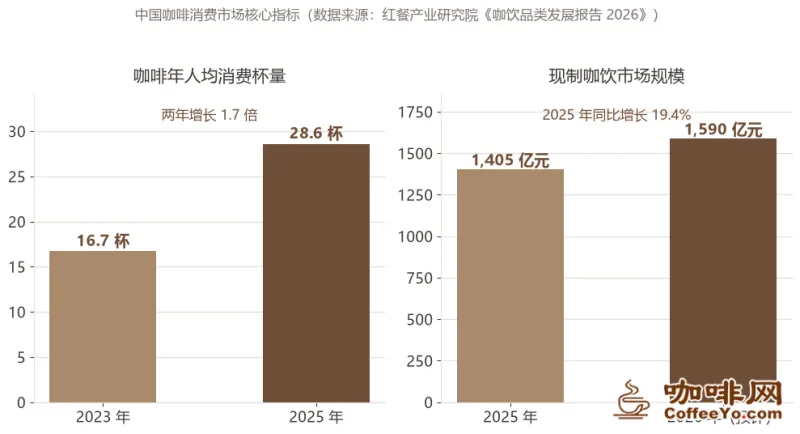
According to industry research, China’s coffee market grew to about ¥218.1 billion in 2025; iiMedia and other institutions estimate per-capita annual cups rose from about 9 in 2016 to about 28.57 in 2025. Meanwhile, the number of freshly brewed coffee stores nationwide surpassed 215,000 by the end of 2024. The three figures together depict a consumption-structure shift from “trying it out” to “daily habit”: coffee is moving from an occasional self-reward purchase to a high-frequency staple. More importantly, the main growth force has spread from middle-class white-collar workers to students, blue-collar workers and county residents — the boundary of “who drinks” has been completely opened.
The price war: how ¥9.9 rewrote the landscape
The direct trigger of the inflection point was the ¥9.9 price war ignited by leading brands from 2023. Luckin, leveraging the scale advantage of over 20,000 stores, led the downward move; Cotti followed with subsidies; and Luckin’s budget sibling Lucky Cup (under Mixue) took the battlefield straight to counties and townships. Low prices rapidly enlarged the user base, but also dragged the industry into an attrition war of “trading losses for share.” By 2025, the marginal effect of the price war had clearly weakened — some brands began raising prices, trimming subsidies and closing inefficient stores, and the market shifted from “who is cheaper” to “who is more profitable.” This scene mirrors the earlier subsidy wars of ride-hailing and food delivery.
Capital and brand landscape: rebirth, aggression and going downstream
The other side of popularization is capital re-taking sides. After its turmoil, Luckin completed a rebirth through ten-thousand-store scale and hit-product capability, returning to a profitable track; Cotti rapidly captured territory with aggressive subsidies, at one point closely trailing in store count; and Lucky Cup replicated its low-price model to lower-tier markets using its parent group’s supply-chain advantage. The divergent paths reflect a split industry consensus: should one trade subsidies for scale, or trade supply chain for profit? Whichever road, the arms race of store density is nearing its ceiling, and the dividend of “open a store and grow” is receding.
Supply-chain localization: Yunnan beans as domestic substitution
The price war could be waged because the supply chain matured underneath it. A landmark change is the rising share of Yunnan coffee beans in ready-made drinks. “Domestic beans + local roasting” lowers both the logistics and exchange-rate costs of long-haul imports and strengthens the narrative tension of “Chinese coffee.” From Baoshan to Pu’er, from Menglian to Lincang, more local estates are benchmarking specialty processing methods, turning Yunnan beans once exported merely as “raw material” into cups that can tell a terroir story. For brands, supply-chain localization is not just cost reduction, but a moat of differentiation and risk resistance.
Three tracks: ready-made, RTD and retail beans
Popularization is not only happening in stores. Beyond freshly brewed coffee, ready-to-drink (RTD) coffee is quietly expanding through convenience stores and e-commerce, touting the convenience of “open and drink”; retail beans, drip bags and freeze-dried powder are making “good coffee at home” routine. The three tracks target different scenarios: ready-made satisfies social and instant needs, RTD serves commuting and office, retail serves home and stockpiling. For consumers it means more choices; for operators it is a multi-point contest for “user time” — whoever occupies all three scenarios holds the foundation of repeat purchase.
After the inflection point: going downstream, diverging and going overseas
After the price war receded, the variables that truly decide victory surfaced. First, lower-tier markets: first- and second-tier cities are saturating, and counties, townships, campuses and transport hubs are becoming new growth poles. Second, consumption divergence: at one end is extreme value-for-money fast coffee, at the other the slow specialty coffee that cares about origin and processing — the two tracks grow separately. Third, early overseas exploration: some Chinese coffee brands are replicating the low-price, high-efficiency model proven domestically into overseas markets such as Southeast Asia. On every front, the era of crude subsidization is over; what competes now is site-selection efficiency, supply-chain control and product iteration.
Lurking concerns: homogenization and the profitability question
Beneath the prosperity there remain unsolved problems. Severe product homogenization makes “flavor differentiation” hard to turn into a moat; excessive store density pushes up rent and labor costs; food-safety and franchise-management loopholes frequently appear amid rapid expansion; and the profit distribution between franchisees and the brand has repeatedly become a public focus. As capital recedes and subsidies withdraw, whether real repeat purchases and a healthy single-store model can support valuations will be the watershed of the next phase. What is certain is that the wave of coffee popularization in China will not reverse, but it will move from “claiming territory” to “cultivating intensively.”
Sources: Hongta Futures / Heiyu Investment “2025 Coffee Industry Report”; iiMedia Research public estimates; public financial reports and store data of various brands; public reports from industry media. Data in this article is subject to the public sources cited.
This article is original compilation by coffeeyo.com. The data and viewpoints herein are subject to the public sources cited above and are for industry reference only, not constituting any trading or investment advice.
Original Work Statement
- This article is an original work of coffeeyo.com. Without authorization, no media, website or individual may reprint, extract, reproduce or otherwise use it; violators will be held legally responsible.
- All images, charts and videos herein are originally shot or produced by coffeeyo.com and carry copyright watermarks; copyright belongs to coffeeyo.com.
- For reprint authorization, commissioned writing, interviews or business cooperation, contact: Tel 400-0000-641 (+86-18288016826) | Email 405854472@qq.com | Address: Jinghong City, Xishuangbanna, Yunnan Province / Tieling City, Liaoning Province
Related Reading
- Bean in Short Supply: A Taiwan Youth on Yunnan Coffee as a Shared Cross-Strait Stage
- Five Years, Eight Championships: Lincang Coffee Joins the World Stage
 Haikou ‘Union Cup’ Barista Skills Competition Kicks Off to Empower the Service Sector
 Yunnan Specialty Coffee Beans Deliver an ‘Excellent’ Report: Path to Value Leap
- Cross-Strait Tides Rise: A Taiwan Youth Farms Coffee in Yunnan, a Cup Bridging Both Sides
 2026 2nd Yunnan Treasure Coffee Green Bean Competition (Cup of Excellence Pilot) Concludes





 Liaoning ICP Security No. 21122402000217