
China News Service, Jinan, October 3 (Reporter Sun Tingting) — Against the backdrop of sustained global coffee-consumption expansion and accelerating supply-chain restructuring, Shandong—a province that grows no coffee beans—is embedding itself into the global coffee industry chain through multiple links: raw-material import, equipment manufacturing, deep processing, and terminal consumption.
In the traditional “golden September, silver October” peak production and sales season, Zheng Gaofei, a coffee producer in Zouping, Binzhou, Shandong, is especially busy. The world’s largest single-unit instant-coffee production project, launched by his company this April, is stepping up output to stock up for downstream distributors’ concentrated ordering.
“At present, we are supplying more than 20 Chinese and foreign clients, including Yunnan Jinglan Coffee Co., Ltd. and Olam Food (Shanghai) Co., Ltd.,” Zheng said. As clients mainly work on long-term cooperation, orders are scheduled through February 2027.
Zheng has also turned his eyes to coffee’s main producing regions. “We plan to build seven instant-coffee plants in Ethiopia within the next four years. Uganda has also invited us to discuss deep-processing projects on the ground,” he said. African producing regions, which focus on cultivation, have relatively few deep-processing projects—a key focus of the company’s current layout.
Beyond producing coffee products, Zheng also runs another company that manufactures coffee equipment. Currently, it supplies coffee-production equipment to multiple enterprises in Russia, Sri Lanka, and Vietnam. “For a production line of equivalent capacity, our equipment costs less and has a 10-month delivery cycle,” he said.
From enterprises going global to an industry forming a chain, Shandong’s coffee-industry scale is growing. As of the end of July 2026, Shandong had 11,500 coffee-industry-related enterprises, ranking first among China’s northern provinces.
Underpinning this scale is Shandong’s increasingly prominent status as a coffee-trade gateway. Qingdao Customs data shows that in the first half of 2026, Shandong’s imported coffee value reached 387 million yuan, covering multiple main producing regions such as Vietnam, Brazil, and Ethiopia.
Most of the coffee beans needed by Shandong’s enterprises enter the country through Qingdao Port.
It is reported that in 2025, Qingdao Port’s green-coffee import volume accounted for about 13% of China’s total. In the same period, Shandong exported about 823 tons of coffee and products worth 6.7 million US dollars, ranking sixth in China by export volume. Between “import and export,” Shandong’s position on China’s coffee-trade map keeps rising.
Trade flows are also driving processing-capacity clustering. Since October 2025, new coffee-processing capacity has landed around Qingdao Port one after another. Among them, Nestlé’s Laixi factory put two new production lines into operation. In addition, Luckin Coffee’s innovation-production center—with total investment of about 3 billion yuan—was built and put into operation in Qingdao, equipped with three of the world’s largest single-unit coffee roasters.
This full-chain layout is inseparable from Shandong’s deep manufacturing foundation. The province has all 41 major industrial categories; ceramics, glass, and machining together form the manufacturing base for coffeeware and equipment.
On the consumption side, as a province large in both population and consumption, beyond urban business districts, “village cafés” are also growing rapidly. In Chengwu County, Heze, the local “Gaoding Coffee” sells over 300 cups a day; in Yinshi Village, Linqu County, Weifang, “Xiaoyin Coffee” features a persimmon raw-coconut latte, driving the tourism cooperative to form a picking-and-homestay industry chain.
Professor Dong Yanling of the China Economy Research Institute at Shandong University of Finance and Economics believes that Shandong’s coffee-industry layout is essentially a migration of agricultural deep-processing capacity. “Industrial development is highly constrained by the consumption-side market; building local independent brands will be the key support for Shandong’s coffee industry to break through and develop in the future.” (End
Reprint Notice & Disclaimer
- This article is compiled and edited by coffeeyo.com, reprinted from China News Service (Zhongxin News), Jinan dispatch (reporter Sun Tingting). The copyright of the original text belongs to China News Service and the original author. This reprint is for sharing coffee-industry information only and does not represent the stance of this site; all data and views are subject to the original. We thank the original author for their creation and sharing.
- Original article: China News Service (Zhongxin News) “(Economic Watch) Shandong, Which Grows No Coffee Beans, Accelerates Its Coffee Industry Layout”
- If there are issues regarding content authorization, attribution, copyright, or any other matter, please contact us promptly. We will verify and cooperate in handling them as soon as possible. We also welcome coffee enterprises and industry media to exchange and contribute.
- Contact coffeeyo.com: Tel 400-0000-641 (+86-18288016826) Email 405854472@qq.com Address: Jinghong City, Xishuangbanna, Yunnan Province, China
Related Reading
- Bean in Short Supply: A Taiwan Youth on Yunnan Coffee as a Shared Cross-Strait Stage
- Five Years, Eight Championships: Lincang Coffee Joins the World Stage
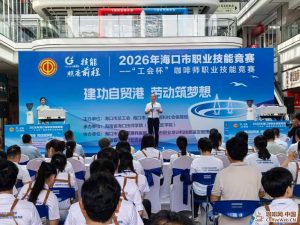
 Haikou ‘Union Cup’ Barista Skills Competition Kicks Off to Empower the Service Sector
 Yunnan Specialty Coffee Beans Deliver an ‘Excellent’ Report: Path to Value Leap
- Cross-Strait Tides Rise: A Taiwan Youth Farms Coffee in Yunnan, a Cup Bridging Both Sides
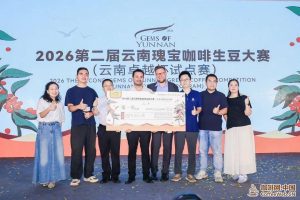
 2026 2nd Yunnan Treasure Coffee Green Bean Competition (Cup of Excellence Pilot) Concludes



 Liaoning ICP Security No. 21122402000217