


At a Glance (China Coffee Network):‘You walk into the supermarket and freeze: the same person takes your payment and makes your coffee, and besides being clumsy, it makes you wonder whether they went straight from.
‘You walk into the supermarket and freeze: the same person takes your payment and makes your coffee, and besides being clumsy, it makes you wonder whether they went straight from handling cash to making your coffee without washing their hands.’ This is a common reaction among netizens to NOWWA Coffee.
Amid the scale-driven expansion of national coffee chains, the home-grown brand NOWWA, founded seven years ago, has used convenience stores as its foothold to open outlets and now has roughly 10,000 stores, while also securing one of the larger financing rounds in the food-and-beverage industry in 2026.
‘Ten thousand stores’ is seen as a watershed in the development of chain catering. In fact, stepping into most NOWWA Coffee outlets, one clearly senses that ‘this store is not that store’; in NOWWA’s own words, it is a ‘store-in-store’. Recently, a National Business Daily reporter visited and found that a NOWWA inside a supermarket or convenience store can be constituted by a single workbench and one coffee machine; the online joke about ‘whether the smell of oden next door will seep into the coffee’ is not baseless.
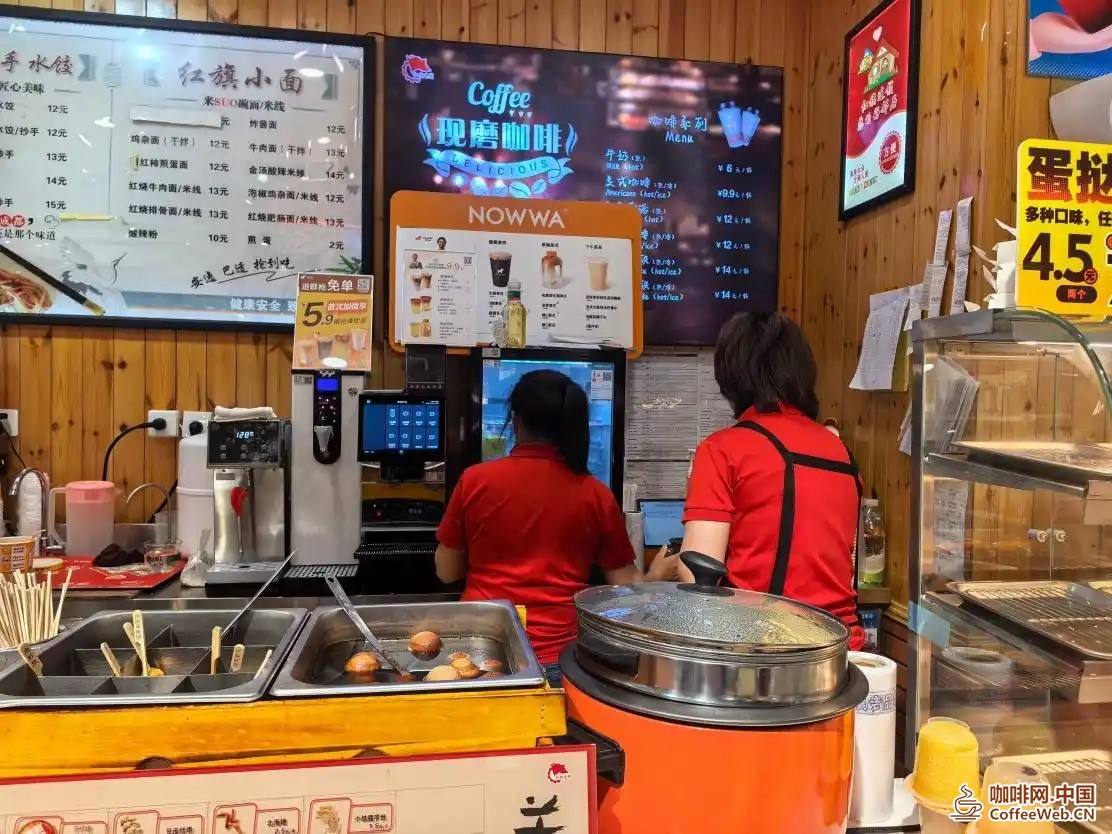
The coffee-preparation station is fully connected to the snack-frying, braised-food and pastry sales areas, with no physical partition
Moreover, its already-low franchise threshold is dropping further. In July, NOWWA launched a 49,800-yuan franchise policy, under which the ‘store-in-store’ partnership can be embedded in convenience stores, internet cafes, snack discount stores and other commercial settings. A NOWWA franchise recruiter even cited nail salons, gyms, clothing stores and flower shops as examples of eligible business types, provided conditions such as a food-business licence are met.
Given this, it is hardly surprising that netizens have doubts about NOWWA Coffee’s quality control and franchise model.
‘Any innovative model faces a management-radius challenge as it scales; this is an industry-wide issue, not unique to the store-in-store model. To address the challenge of consistent quality across multiple scenarios, NOWWA (i.e. NOWWA Coffee) has built a rigorous management and training system,’ NOWWA told the NBD reporter in response.
A ‘parasitic’ traffic business
The store-in-store that can ‘squeeze in wherever there is a gap’ is not unique to NOWWA, but NOWWA is the model’s most committed practitioner. The NBD reporter learned that 80% of NOWWA’s ten-thousand-store figure are ‘store-in-stores’. Because it relies on the existing business and space of an established outlet to insert a new coffee brand, the industry also calls it a ‘parasitic’ model.
Today, Luckin and Cotti points can still be found inside many convenience stores. However, the ‘store-in-stores’ deployed by different brands have diverged markedly in how they operate.
Luckin and Cotti, for example, also have ‘store-in-stores’ inside restaurants or supermarkets, but their staff wear the coffee brand’s uniform and are dedicated to coffee-related work. By contrast, at NOWWA outlets inside supermarkets, the coffee is made by the store’s existing clerks, with a corner of the counter cleared and one coffee machine placed there. ‘Many supermarkets also sell cooked food; clerks can cook noodles and grill sausages for customers, so making coffee alongside is no trouble,’ a NOWWA brand-expansion staffer told a prospective franchisee. ‘Making coffee isn’t building airplanes or rockets.’
Visiting several NOWWA partner stores in Beijing, Shanghai and Chengdu, the NBD reporter found that often a single convenience-store clerk runs the entire shop while also making coffee; in on-site observations, clerks making drinks were from time to time seen without hats or masks. Skill levels varied: some employees worked deftly, while others had to consult a manual to mix drinks. At some stores, the ingredient area was not strictly segregated, and the reporter could casually pick up drink ingredients and hand them back to staff.
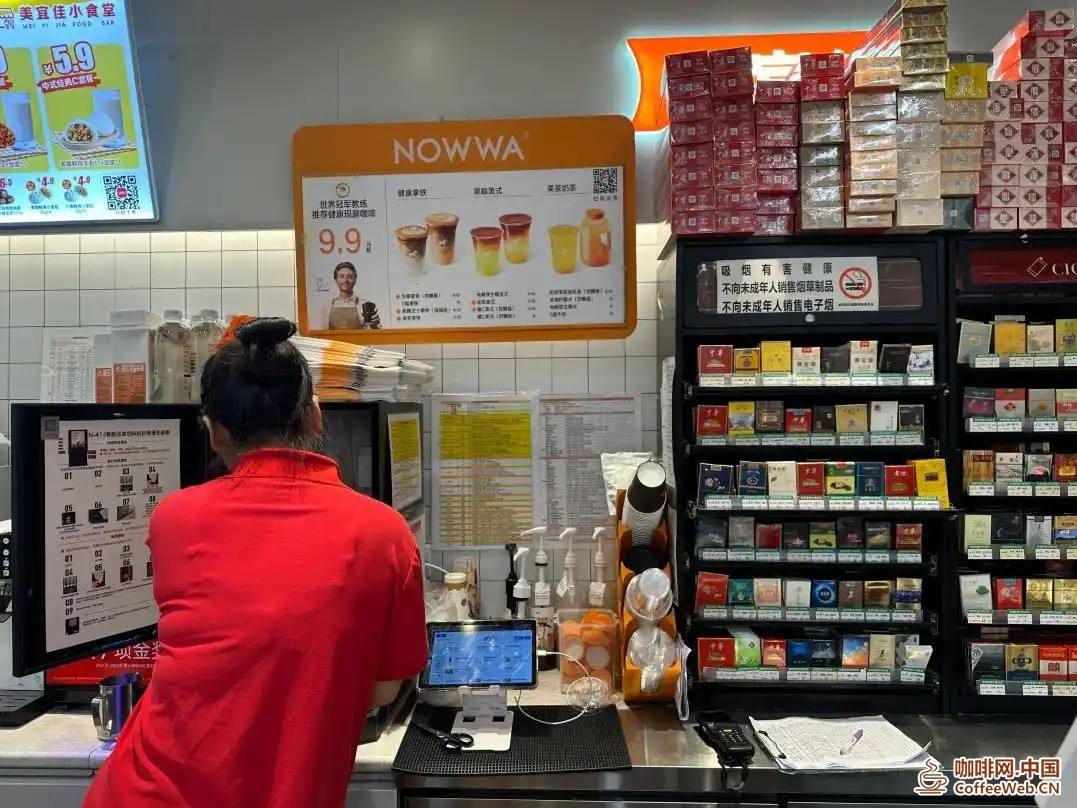
A coffee-preparation counter sits right next to a tobacco display shelf, and food-handling staff wear no work hats
‘A street stall using a similar approach might not bother people; but placed on a brand that claims a chain scale of over ten thousand stores, the gap in standard execution stands out sharply,’ commented a food-industry practitioner. ‘Precisely because catering isn’t building airplanes or rockets, the entry barrier is low and anyone can do it, so quality control at chain brands matters all the more.’
‘During a NOWWA promotion a while ago, people ordered one-cent coffees on Douyin, and the order volume nearly did us in,’ an employee at a Haolinju convenience store in Beijing said when the NBD reporter visited as a customer. ‘Those two days it was over 300 cups a day; I didn’t even have a moment for a sip of water or the toilet. When I opened an ingredient bottle I didn’t notice the gas inside, and the cap popped up and hit my eye; the white of my eye was all bloodshot. I’m just an hourly worker with no insurance; no matter how much coffee I make, I still take home the same 1,000-plus yuan.’
‘The store-in-store is not a dilution of the brand’s positioning but an extension of consumption scenarios; as I said, we want consumers to be able to grab a cup of coffee whenever they like,’ the company replied when the NBD reporter asked about quality-control management. ‘New stores are coached by dedicated trainers to ensure convenience-store clerks quickly meet barista output standards; we have rolled out dual-line inspections, with routine operational checks and unannounced mystery visitors covering ingredient shelf-life, equipment cleaning, workflow and hygiene details; and through highly standardised SKUs and digital equipment we minimise human variables.’
Ultra-low-cost store expansion
NOWWA was founded in 2019 by Guo Xingjun. That year, demand in China’s coffee market was rising fast: by year-end Luckin had several thousand stores, Cotti had not yet been founded, and shortly after developing standalone stores NOWWA threw itself into the store-in-store model, using delivery platforms as its main channel.
Wang Yong (a pseudonym) joined NOWWA around 2021. Before that he already ran an independent specialty coffee shop, and then added a NOWWA point inside his own store. ‘At the time the franchise fee was only a few hundred yuan. I just hung up the NOWWA sign in my own cafe, used the store’s existing coffee machine, and only bought beans, milk and other ingredients from NOWWA; nine-tenths of the business came from delivery orders,’ Wang told the NBD reporter.
‘Back then we could sell 400 cups a day, and NOWWA gifted the ingredients for 100 of them. With that volume we still had to hire staff. Once you add rent, utilities and labour, I wasn’t making much; I’d have been better off just making my own coffee, and with less stress. So after a bit over a year I transferred out that NOWWA benchmark store,’ Wang said bluntly. ‘Quality is very hard to control; that bean is basically just caffeine. I’d conservatively estimate the cost of a cup at under two yuan.’ In his view, coffee now needs to compete upward on quality to truly win consumers: ‘The price war and the low-cost war are done to death; look, even some Luckin products now use single-origin beans, buying expensive Gesha that is also low-yield.’
In November 2024, NOWWA announced a partnership with the convenience-store chain Jianfu, which NOWWA called the first officially announced partner brand of its ‘Coffee+’ joint-operation programme. Today NOWWA has appeared in regional or leading convenience chains such as Hongqi, Meiyijia, Zhishang and Quanjiaqin.
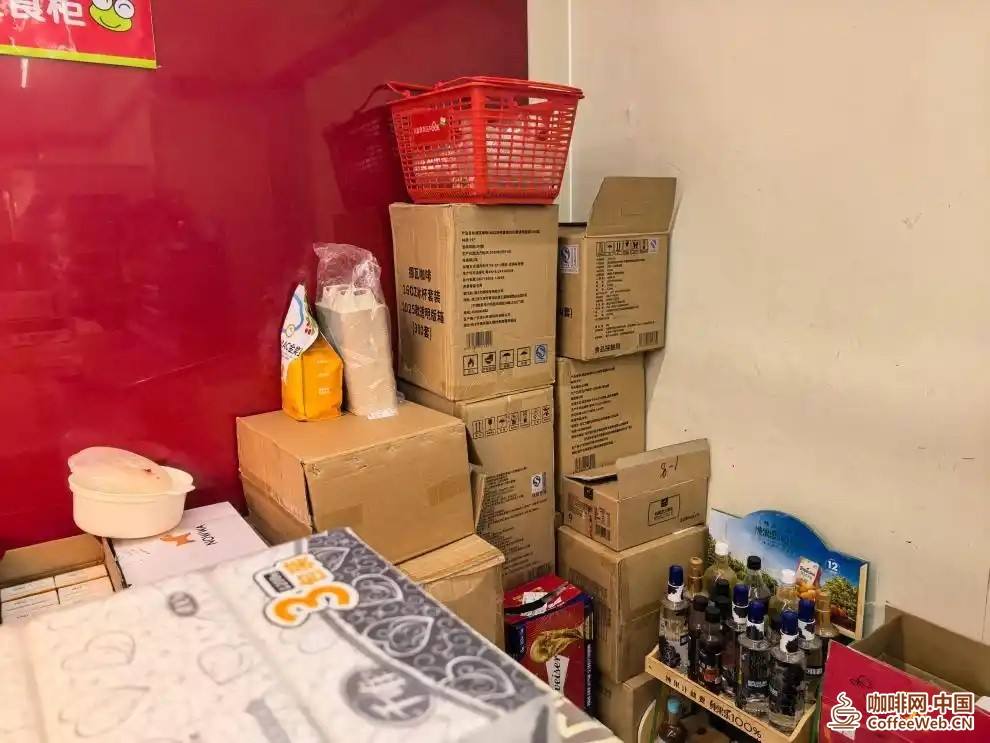
At a NOWWA inside a convenience store, drink ingredients are piled in the store’s operating area rather than a dedicated warehouse
How low is the cost for a chain convenience store to add a NOWWA business? Recently the NBD reporter, posing as a prospective franchisee, consulted Zhishang’s franchise recruiter, who said the total fee was about 11,000 yuan, including a 5,000-yuan coffee-machine equipment deposit and under 6,000 yuan for the first batch of ingredients, requiring less than two square metres of space.
This move drove rapid expansion of NOWWA Coffee stores: over 2,000 by early 2025 and over 10,000 by the end of 2025. Its distinctive business model and breakneck opening pace attracted many investors. According to Tianyancha, in seven years NOWWA Coffee has completed seven funding rounds, closing a several-hundred-million-yuan Series C in January 2026 with well-known investors including GSR Ventures and Grassroots Capital.
Public information shows that on 28 April 2026, NOWWA announced Yang Yang as its global brand ambassador.
Partner business types expand again
NOWWA’s store-in-stores are multiplying faster still.
On 10 July, NOWWA released its 49,800-yuan franchise policy, accelerating the embedding of the store-in-store format into existing commercial settings such as convenience stores, internet cafes and snack discount stores. According to materials sent by a franchise manager, this new single-store franchise plan in fact requires only 29,800 yuan to join, with equipment self-supplied, no revenue share and no management fee; at this minimum outlay, payback takes as little as one month and at most three. Notably, the payback estimate is based on 120 to 200 cups sold per day.
‘If you put it in a nail salon, the manicurist has to do nails and make coffee and may not cope, so you’d need to hire another person; if it’s mainly a gym, you don’t need extra staff, because gyms are basically equipment-based and staff are there to supervise safe, compliant use, so keeping an eye on things and pouring a coffee is manageable. Ones in internet cafes also perform well,’ a NOWWA market-expansion staffer told a prospective franchisee, on the premise that the premises can obtain a food-business licence and have water supply and drainage. The core goal of such store-in-stores is not to profit from coffee itself but to use coffee to drive footfall for the main business.
A prospective franchisee revealed that NOWWA can also help them find supermarket partners directly. ‘You can bring your own store to the partnership, or NOWWA can find one for you; the starting threshold is 20 stores.’ Under this joint-operation model, the partner stores and on-duty clerks are not directly managed by the franchisee, so what mechanisms has NOWWA set up to protect investors’ returns and rights?
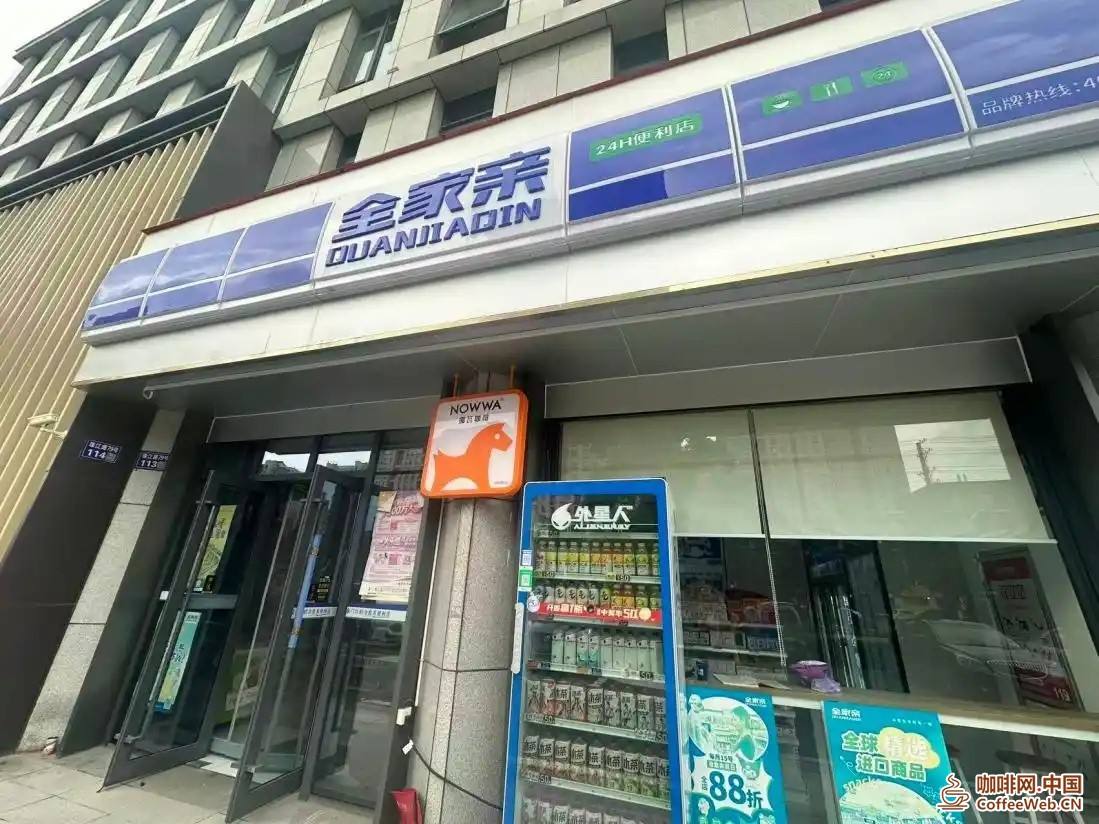
Many convenience-store brands cooperate with NOWWA
‘First, we split accounts transparently with suppliers: a digital system enables real-time order-level revenue sharing, so fund flows are clear and traceable; second, we also have contractual constraints that clearly define the rights, responsibilities and interests of the brand and operating parties, protecting investors’ right to know and right to returns,’ NOWWA told the NBD reporter.
Following NOWWA’s store-in-store model for over two months, the NBD reporter observed that the commission model for these capital-investing franchisees had changed: originally the franchisee earned 1.3 to 1.5 yuan for every cup sold, and that standard stayed unchanged even when the brand ran a 0.1-yuan-per-cup promotion. From early July it shifted to a commission based on actual transaction value, with a market-expansion staffer telling prospective franchisees: ‘If this cup of coffee sells for 10 yuan, you split the profit on 10 yuan.’
A source also confirmed to the NBD reporter the details of the change in revenue sharing. Looking past the surface moves of changing sharing rules and planting the brand in multiple business types, the underlying logic of NOWWA’s store-in-store model is clear: it is not after the profits from coffee itself; coffee is more a low-cost tool for driving traffic.
‘Since the new July franchise policy came out, no nail salons or flower shops have signed up yet; it’s unclear going forward. The logic of embedding all these new business types is to use coffee to make users linger longer in the main-business consumption scenario and boost the franchisee’s main-business footfall. For franchisees like hotels and esports internet cafes, their main-business stores require investments from several million yuan upward, and selling coffee might only add ten or twenty thousand yuan a month, a trivial drip, but coffee can lift spending on other linked goods,’ the source said.
The store-in-store path diverges
Different brands take different attitudes toward this store-in-store model.
In May 2024, Cotti announced COTTI Express convenience stores, likewise partnering with chain brands. Recently the NBD reporter, posing as a prospective franchisee, consulted Cotti’s franchise staff, who said that only the standard-store (standalone) model is currently open for franchising. Asked about convenience-store store-in-store franchising, a Luckin market-expansion staffer said, ‘That was something we pushed hard when we first started franchising in 2018, when store numbers were small and the brand not yet mature; the company used the small-store, quick-coffee format to expand rapidly. But since last year we have required a minimum store area for franchisees, starting at 36 square metres.’
In addition, Tims Tianhao Coffee also reached a strategic partnership with Yijie Coffee, under Sinopec’s Yijie, to open store-in-stores. But according to a person close to Tims Tianhao Coffee, its store-in-store resembles a coffee corner inside a gas station, with a separate counter. ‘You can’t just squeeze a coffee shop into every kind of business.’
Yet there are successors vying with NOWWA for the title of top store-in-store brand, notably ‘Xiaoka Coffee’, which has just closed a new funding round. The NBD reporter also saw Xiaoka Coffee in stores such as Bestore, occupying a corner of the snack shop with a fully automatic coffee machine, with snack-shop clerks making coffee part-time, much like NOWWA.
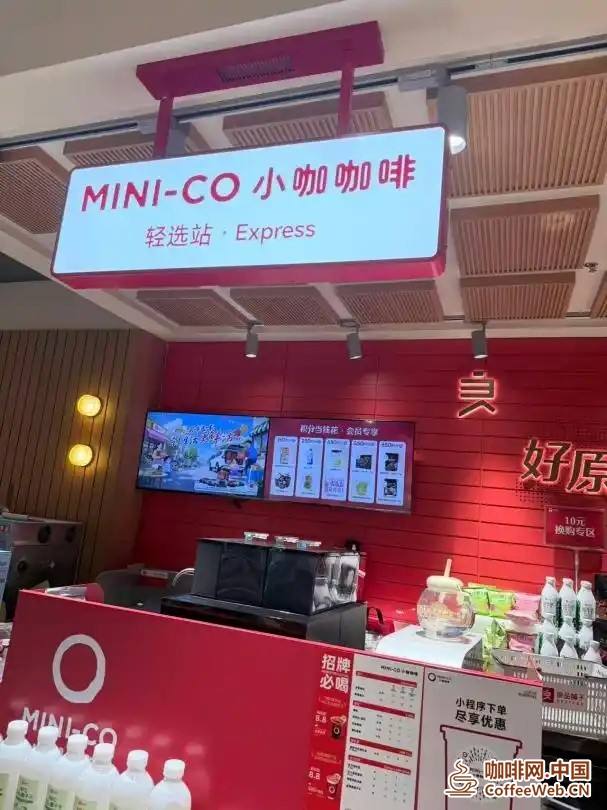
Xiaoka Coffee inside a Bestore snack shop
At the end of June, the NBD reporter, posing as a prospective franchisee, learned that this store type used a directly-operated model, mainly for the brand to conduct market research in various regions. But by mid-July, a franchise manager proactively contacted prospective franchisees saying Xiaoka Coffee’s store-in-store model could be opened to individual franchisees, but with a minimum investment of five stores, 66,000 yuan per store, with a two-yuan-per-cup commission to investors. The brand publicly set a goal of 100,000 stores in three years and said it was aiming to be the ‘first coffee stock’.
Long Zhen, partner at Foresight Capital and a franchising-industry expert, pointed to another risk of the model: the payback period. Only by pushing costs low enough can franchisees pay back as quickly as possible. In his view, the store-in-store model is a kind of vending-machine model, targeting existing high-quality locations, a form of closed site selection distinct from the open site selection of standalone stores.
In the view of industry insiders, if food-safety problems occur, a chain reaction may follow, so the closure rate of this model can also be relatively high.
Why do different coffee brands take different attitudes toward the store-in-store model?
‘We don’t comment on other brands’ specific models. Objectively speaking, we are in fact different,’ NOWWA told the NBD reporter. ‘We haven’t wavered; NOWWA uses a market-proven approach and our strategic direction hasn’t changed. Going forward we will keep to the parallel development and ecological synergy of store-in-stores and standalone stores. The two will be dynamically adjusted according to the consumption maturity of different cities and regions, but they are by no means a zero-sum relationship.’
(All photos in this article were taken by the NBD reporter.) National Business Daily
Parasitic traffic business
Extremely low-cost store expansion
Further expansion of cooperative formats
Differentiation of the “shop in shop” route
A small coffee shop located in Liangpinpu
Daily Economic News
Reprint Notice and Disclaimer
- Compiled and edited by Coffee Network coffeeyo.com — the materials and images in this article come from public sources and the copyright belongs to the original authors. This reprint is solely for sharing coffee-industry information and does not represent this site’s position; all data and views follow the original. Our thanks to the original authors for creating and sharing this work.
- For matters concerning content authorization, attribution, copyright or other issues, please contact us promptly and we will verify and assist at the earliest opportunity; coffee-producing regions, brands and industry media are also welcome to contact us to exchange contributions.
- Coffee Network contact: Tel 400-0000-641 (+86-18288016826) | Email 478203668@qq.com | Address: Jinghong, Xishuangbanna, Yunnan / Tieling, Liaoning
Related Reading
 Deep Mountain Freshness in Changbai Mountains: How a Korean Pine Nut Passes the Freshness Test
 New products unveiled to expand agricultural trade
- Luckin Coffee joins the fray? Are home appliance companies worried?
 Focus on APEC: Building a Better World Together – Shenzhen APEC Meeting Offers Profound Insights
 Wuhua District, Kunming City, Yunnan Province, established the Coffee Industry Youth League Working Committee to gather the power of "coffee" youth
 Observation of the Great Wall | From Duck Shed Coffee to Thousand Acres of Rice Waves: Zhejiang's Thousand Million Project, What Can Hebei Learn?


 Liaoning ICP Security No. 21122402000217