
In golden October it is still hot and humid in Huyu Village, Huyu Township, Ruili City, Dehong Dai and Jingpo Autonomous Prefecture, Yunnan Province, close to the China-Myanmar border. In villager Yang Runcai’s coffee plot, clusters of cherries weigh down every branch.
Every morning Yang arrives early, her fingertips searching the branches for cherries that have turned red — bending, picking, dropping the fruit into a bamboo basket, her movements practised and light. She picks for three or four hours, until the mist has burned off and the sun turns fierce, and buyers come to her door the same day for the fresh cherries. “I never worry about finding a buyer,” she says with a broad smile.
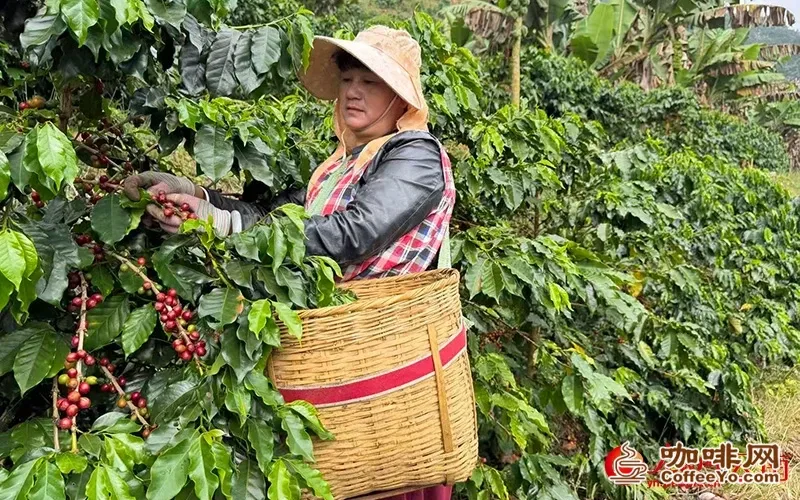
Looking up the slope where Yang grows her coffee, sugarcane, rubber and banana groves run thick and green, like a garden laid out in tiers. She and her husband are the gardeners.
More than twenty years ago Yang and her husband came to this village near the border to grow lemons for others. With abundant heat and light, the land suited tropical crops, and the couple decided to stay: “Better to work for ourselves than for someone else.” They then rented land and planted rubber and other tropical crops in scattered plots; in 2022 they began trying coffee seedlings.
“Planting is easy, managing is hard,” Yang recalls. When the seedlings first arrived there was no mature technical support, so she felt her way forward step by step, and the care work never quite came together. Coffee prices rose and fell, and in those days her mind was never at ease.
It was a problem shared by most coffee growers in Huyu. According to Weng Caolu, secretary of the village Party branch, Huyu started planting coffee comparatively early, but without management know-how the quality varied and the plots were small and scattered, so the industry never gathered momentum.
In June 2023 the Ruili branch of Bank of China sent Peng Yun to work in Huyu. He had barely arrived when he took on the village’s unsold pomelos — the first lesson of his posting: “Without technical knowledge and without market knowledge, even a good crop barely earns money.”
To help border ethnic communities raise incomes, the industrial roots must be firm. That was the consensus reached by village cadres and the resident work team alike.
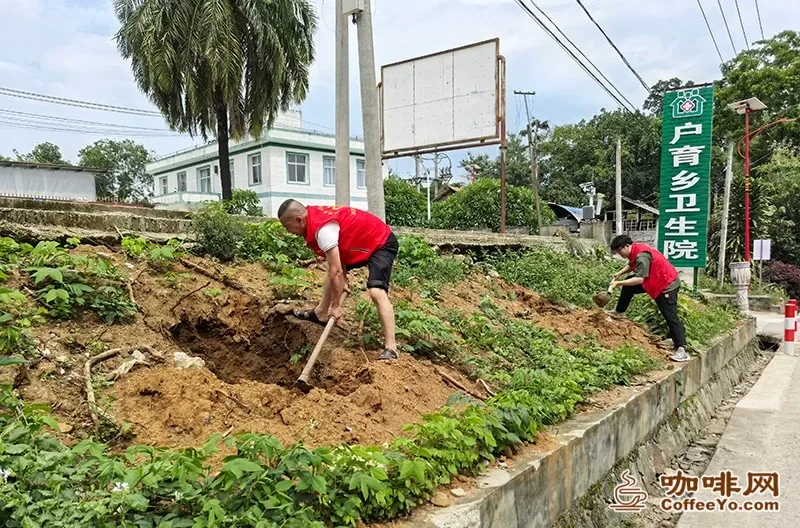
In 2024, under Dehong Prefecture’s programme for coffee planting and the upgrading of old plantations, the village committee and the resident work team joined forces to mobilise growers to attend coffee management training organised by Huyu Township, opening a direct line between farmers and experts at the Yunnan Dehong Tropical Agriculture Research Institute and resolving care problems with precision.
Yang’s household also received “Dere 6” coffee seedlings distributed by the township in good time, and her trees have fruited better every year since. A few days earlier she noticed some newly set cherries turning black and called the experts directly for advice.
In the plot Yang prunes as she picks: “Fruiting branches stay, vegetative branches get cut back in time.” Her husband is picking bananas nearby, to be trucked more than 20 kilometres to Ruili for sale. The “garden” now adds 60,000 to 70,000 yuan a year.
One household’s harvest mirrors a village transformed. Huyu’s coffee area has risen from under 1,000 mu to about 3,000 mu today, and the red cherries have brought the villagers a happier, better-off life.
With the industry promising, the village looks better too. Over the past few years the resident work team and village cadres have visited households door to door, set up a “red-and-black list” for rural living-environment improvements and strengthened the demonstration role of Party members. Every household has tidied its courtyard and the village is neater and better ordered. The annual resident-team budget from Bank of China’s Ruili branch has gone to repairing public halls and rebuilding toilets in two village groups — small livelihood matters delivered one by one.
“Helping an income-generating industry take root, making the village more beautiful and letting people live and work in peace — that is the plainest goal of our posting,” Peng Yun says.
Towards noon Yang ends her morning’s work and walks out of the plot with a basket of cherries on her back. The mist has long gone; sunlight spills over the slope, and under it the crops grow vigorously, holding up the hopes of this border ethnic village.
Reprint Notice & Disclaimer
- This article is edited and compiled by coffeeyo.com and reprinted from People’s Daily Online Yunnan, “Coffee Aroma in a Border Village”. The original copyright belongs to People’s Daily Online Yunnan and the original author. This reprint is for coffee-industry information sharing only and does not represent the site’s position; all data and views are subject to the original. We thank the original author for their work and sharing.
- Original: People’s Daily Online Yunnan, “Coffee Aroma in a Border Village”
- If you have questions regarding authorization, attribution, copyright, or any other matter, please contact us promptly and we will verify and cooperate. We also welcome coffee companies and industry media to exchange story leads with us.
- Contact coffeeyo.com: Tel 400-0000-641 (+86-18288016826) | Email 405854472@qq.com | Address: Jinghong City, Xishuangbanna, Yunnan Province
Related Reading
 Three Decades of Shanghai-Yunnan Collaboration: A Coffee Bean ‘Ferments’ at the Import Expo
 Why Yongde’s Coffee Beans Won Gold in Shanghai – A Taste of ‘Life in Yunnan: 365 Days’
- Yunling Commentary: Yunnan Coffee Turnaround Hinges on Autonomous Pricing
 A ‘Travel Pack’ Reveals Another Possibility for Pu’er Baristas
- Bean in Short Supply: A Taiwan Youth on Yunnan Coffee as a Shared Cross-Strait Stage
- Five Years, Eight Championships: Lincang Coffee Joins the World Stage




 Liaoning ICP Security No. 21122402000217