
By Li Baiyu, Qujie Business
Edited by Qujie Business
Li Yang (not his real name), a specialty coffee fan who lives in Nanjing, found that Blue Bottle Coffee — the brand he drank while studying abroad — had put up its familiar blue logo hoarding on the basement level of Deji Plaza.
That is not the only move: after “patron” Centurium Capital bought its global store business from Nestlé, Blue Bottle is expanding rapidly in China.
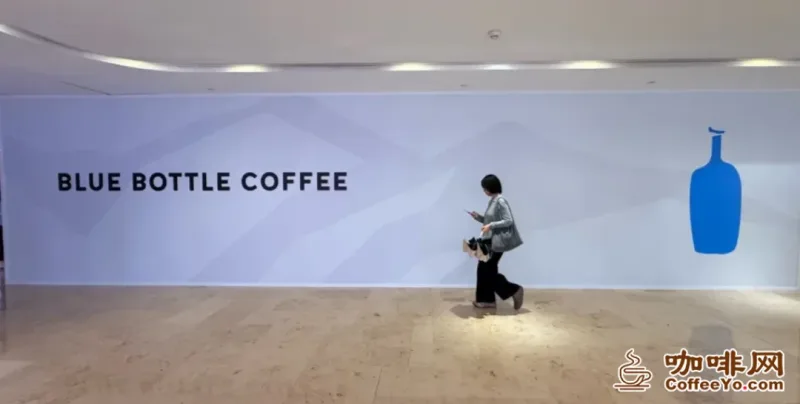
In Beijing, Nanjing, Wuhan and elsewhere Blue Bottle has begun opening stores faster; according to an incomplete tally by Qujie Business, Blue Bottle currently has close to 20 planned or operating stores on the Chinese mainland, covering Beijing, Shanghai, Shenzhen, Hangzhou, Wuhan and Nanjing. It has also moved the final of its own world barista championship to Wuhan, after Tokyo two years ago and Seoul last year.
Whether Blue Bottle can work in harness with its “senior fellow” Luckin in China — and realise Centurium’s ambition of “mass consumption plus premium specialty” in coffee — remains an open question.
Born in San Francisco, Blue Bottle is known as “the Apple of coffee” for its premium positioning, minimalist style and sharp identity.
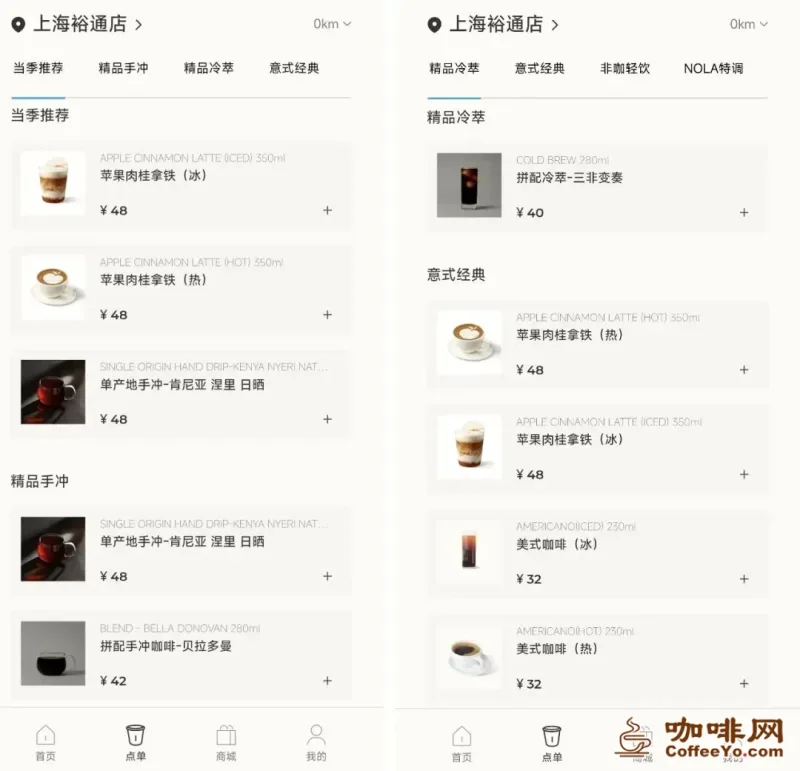
As a representative of niche premium specialty coffee, a cup at Blue Bottle usually costs 30 to 50 yuan, more than three times Luckin’s price and a step above Starbucks.
After Nestlé took a majority stake in 2017, Blue Bottle kept a fairly independent structure and disciplined growth, and its rollout in China was slow: from entering the market in 2022 to the end of 2025 it opened only 15 stores on the mainland, fewer than four a year. Since the change of owner to Centurium, Blue Bottle has begun to change.
First, beyond going faster, its site-selection strategy has shifted.
Blue Bottle used to insist on “one store, one design”, with interiors built around a connection to the city. It therefore favoured cities with a mature coffee-drinking culture and polished every detail of the store, aiming to make each outlet a coffee landmark.
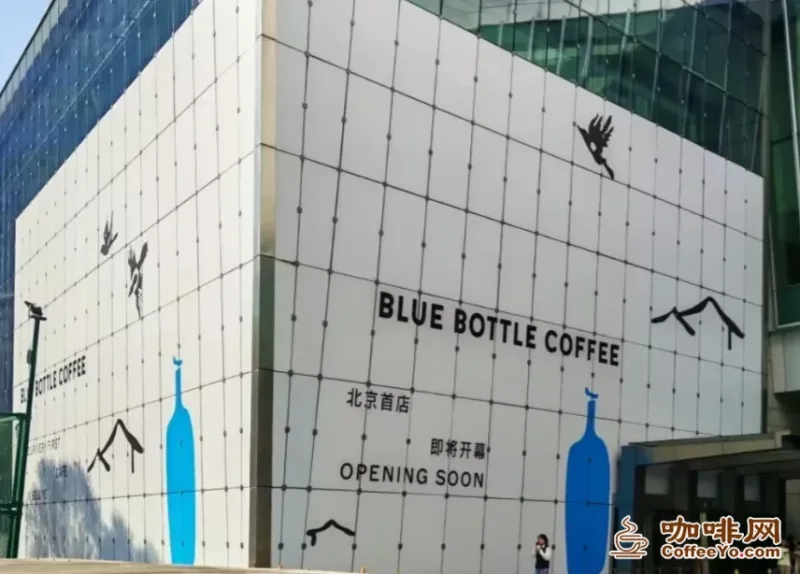
Judging by the stores that have landed in Beijing, Nanjing and Wuhan, however, Blue Bottle now values established commercial complexes and shopping malls: its first Beijing store took the ground floor of the north zone of China World Mall, its first Nanjing store the “national store king” Deji Plaza, and its Wuhan store the Wushang MALL in what is called central China’s leading retail district — an attempt to draw traffic and exposure from mature projects and brand clustering.
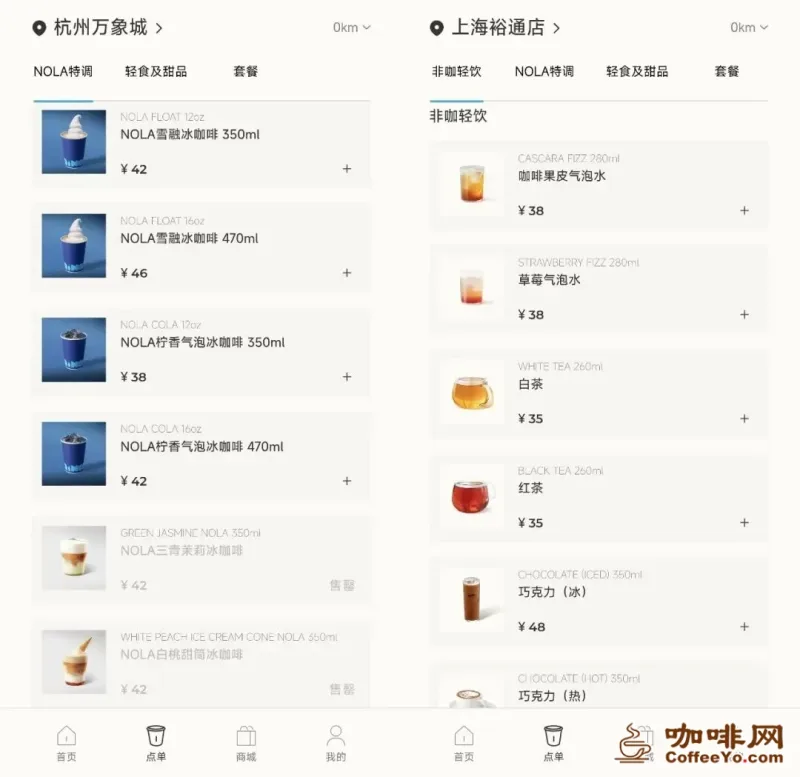
Second, on products, the brand is accelerating its drift into milk tea and non-coffee drinks.
Blue Bottle has long built its core around specialty pour-over and specialty cold brew, focused on the quality, mouthfeel and flavour of “a single cup”.
Now, imitating Luckin the “launch addict”, Blue Bottle has begun widening its menu of light non-coffee drinks and signature mixes, adding fruit, milk cubes and other elements to coffee and launching items such as cascara sparkling water and white-peach affogato.
Third, on organisation, executives with Centurium and Luckin backgrounds have come in.
In June this year the legal representative and general manager of Blue Bottle Coffee (China) Co., the brand’s main Chinese entity, changed from Chen Yixiang to Li Mo, who is responsible for day-to-day operations in China.
Public records show Li Mo was previously general manager of Luckin Coffee’s Beijing branch, and the mature market-expansion skills he built at Luckin are very likely to speed Blue Bottle’s expansion.
The new chairman, Chen Weihao, comes from Centurium Capital, where he has been a partner and managing director since July 2019; he is also a Luckin Coffee director.
When he joined Centurium, Chen described his investment style as “control investing” and said his consumer investments would be “more focused, small and fine”.
It is worth noting that over the past two years Centurium was first reported to have joined the bidding for Starbucks China, then evaluated specialty brands including Costa, % Arabica and M Stand. Its core intent in betting on coffee is not hard to read.
On one hand, Centurium focuses on consumer, business services, healthcare and technology. Compared with the long cycles and uncertainty of other sectors, coffee offers stable cash flow, and Chinese coffee penetration is far below developed markets: demand is highly certain, the space is large, and the firm can go deep into the upstream and downstream for long-term industrial returns.
On the other, Centurium learned from its control-investing turnaround at Luckin how important it is to transform and remake a company, and that forceful style suits tea and drinks, an industry of heavy operations and efficiency.
Behind Centurium’s acceleration of Blue Bottle in China there may be a more critical reason: sharing resources, capability and experience with Luckin to create a “one plus one is more than two” synergy in coffee.
One coffee-industry figure told Qujie Business: “Nestlé delegated to Blue Bottle; Centurium centralises. Under a control-investing style, change at Blue Bottle is bound to speed up.”
Under Centurium’s remaking, Luckin became “China’s number one coffee” on the strength of frequent launches, supply-chain building and digital store operations. But in a more crowded Chinese coffee market, single-brand growth has become harder.
Fighting with two brands brings several advantages.
First, it covers demand across the whole coffee market. Value-priced Luckin occupies the mass coffee mind, while Blue Bottle sits at the premium specialty end.
Second, it can help Luckin return to public markets. In November 2025 Luckin co-founder and CEO Guo Jinyi said publicly that the company was actively pursuing a relisting on a major US exchange.
But hit by the price war and the delivery war, Luckin’s net profit and same-store sales at self-operated stores have both been falling, and Blue Bottle’s expansion as a premium brand may let Luckin tell a new story “beyond scale”.
More importantly, Blue Bottle can also help Centurium and Luckin pry open overseas growth.
Luckin has been going abroad for three years but still has fewer than 200 overseas stores, concentrated in Southeast Asia, which is geographically close and has similar consumption habits; Singapore alone accounts for half of that footprint at around 100 stores.
For Chinese coffee brands the bigger stage is a mature coffee market such as the United States, where tickets are high, there is no need to compete on low prices and the logic of going global is stronger — but entering such a mature specialty market is also harder.
Blue Bottle’s home base is the United States, and the premium customer base, local team and supply chain it has built over more than two decades could become Luckin’s springboard into that market.
With premium genes in one hand and the experience and resources of its “patron” in the other, Blue Bottle still cannot coast to victory.
After rounds of price competition and scale competition, China’s coffee market is running out of room to grow. Industry body NCBD puts the 2025 Chinese freshly made coffee market at 217.79 billion yuan, up 13.4 percent year-on-year — above the wider restaurant sector, but the growth rate has fallen for two consecutive years.
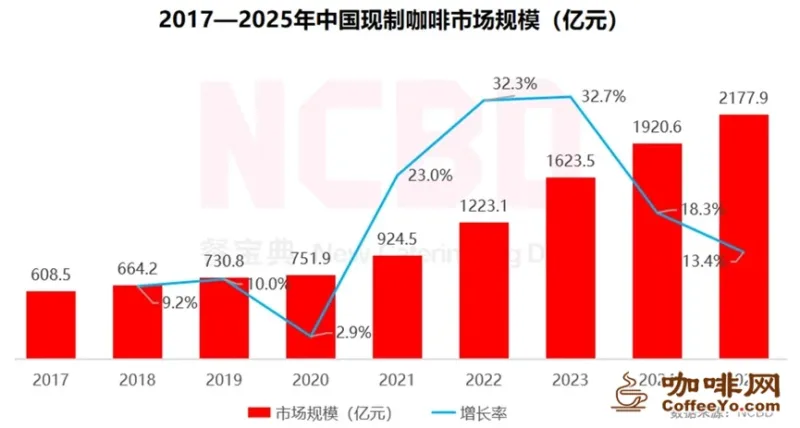
Having left behind the “scale is king” narrative, the industry has entered a stage of competing on experience and value.
On one hand, leading coffee brands are moving upmarket and widening their boundaries around products, stores and channels.
On products, they are innovating premium lines — Starbucks China launched a “champions’ set” this year, bringing drinks that won barista competitions down to frontline stores. On stores, they are entering high-end flagship and city heritage outlets to lift the spatial experience. On channels, they are turning store business into retail business, as Luckin has done by expanding ready-to-drink and reaching more channels.
On the other hand, Blue Bottle’s most direct rivals are also moving faster to claim the premium coffee mind — Peet’s Coffee, which posted double-digit growth in China in fiscal 2025, and Starbucks, which has accelerated localisation since finding Chinese partner Boyu Capital.
With the whole industry treating premiumisation as a strategic goal, whether Blue Bottle can stir China’s premium coffee scene comes down to two questions.
First, can rapid expansion and distinctive character coexist? Working with Luckin, can Blue Bottle keep its own uniqueness in China? After all, “slow and restrained” has always been part of its tone.
Second, can revenue growth and brand polishing move forward together? Under expansion pressure, do Centurium and Luckin have enough patience to polish the brand — Blue Bottle is still loss-making.
On social media some consumers have begun to voice exactly that worry: “If Blue Bottle ends up selling drinks that are just a pile of toppings, where does its confidence to charge so much come from?”
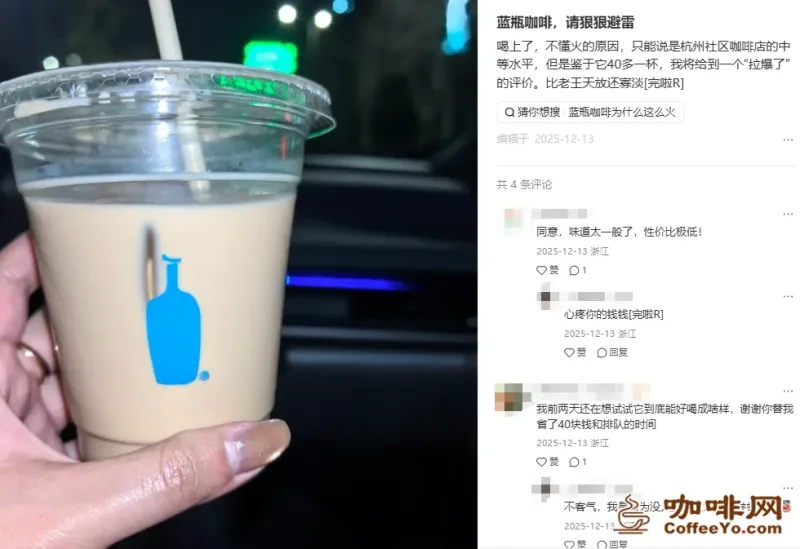
In the end, Chinese coffee demand is complex and varied, with opportunity and challenge together. In the past the “little blue cup” Luckin taught Chinese consumers to drink coffee at 9.9 yuan a cup; today the “little blue bottle” has to prove whether they will keep paying for a 40 yuan cup.
On that question, Chinese brands including Luckin and foreign arrivals such as Starbucks China have yet to offer a perfect answer. Can Blue Bottle?
Reprint Notice & Disclaimer
- This article is edited and compiled by coffeeyo.com and reprinted from Jiemian News, “‘Slow Brand’ Blue Bottle Coffee Gets Fast-Forwarded by Its ‘Chinese Patron'”. The original copyright belongs to Jiemian News and the original author. This reprint is for coffee-industry information sharing only and does not represent the site’s position; all data and views are subject to the original. We thank the original author for their work and sharing.
- Original: Jiemian News, “‘Slow Brand’ Blue Bottle Coffee Gets Fast-Forwarded by Its ‘Chinese Patron'”
- If you have questions regarding authorization, attribution, copyright, or any other matter, please contact us promptly and we will verify and cooperate. We also welcome coffee companies and industry media to exchange story leads with us.
- Contact coffeeyo.com: Tel 400-0000-641 (+86-18288016826) | Email 405854472@qq.com | Address: Jinghong City, Xishuangbanna, Yunnan Province
Related Reading
- Seesaw Coffee Operator Faces Bankruptcy Liquidation as Pioneer Specialty Brand Hits Crisis
 Yunnan Agricultural University and Starbucks China Forge Strategic Partnership to Advance High-Quality Development of China’s Coffee Industry
 COTTI Coffee Teams Up with Ethiopia’s Bunga University to Deepen Global Origin Cooperation
 Vietnam Coffee Exports: Volume Up 15.4%, Value Down 7.3% in First 9 Months
 Beyond Coffee: M Stand Sells Burgers, Cotti Fries Chicken in Search of New Growth
 Mixue Group and Yuexianhuo Sign Strategic Cooperation Agreement on Fresh Milk




 Liaoning ICP Security No. 21122402000217