
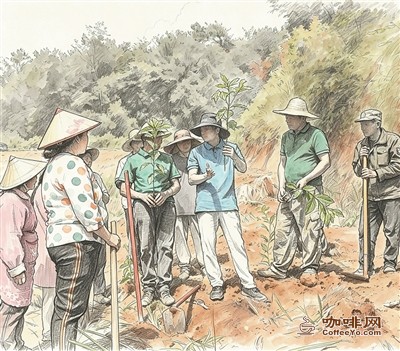
Arriving at Jianshan Village, Bailang Yi and Blang Ethnic Township, Shidian County, Baoshan City, Yunnan, the aroma of coffee wafts through the village from afar.
Lately, the first question villagers ask when they meet is, “Have you been to the coffee class in the fields?”
Not long ago, Shidian County’s first coffee farmer field school was inaugurated in Jianshan Village. There was no big stage for the launch — the classroom is set right in the 700-mu standardized coffee plantation base of Baoshan Fuqiu Coffee Estate.
In the plantation, a group of coffee farmers crouch in a circle around a coffee seedling; the instructor is Sun Xinquan, head of Baoshan Fuqiu Coffee Estate and a teacher at this field school.
Just two or three months ago, when the school first opened, villagers were full of doubts. “How could something so simple be hard?” Some felt that having farmed all their lives, they surely didn’t need teaching.
Hearing this, Sun did not rush to argue. In class, he held a coffee seedling in its nursery bag, gently brushed away the soil, and pointed at the roots: “Look, everyone — this main root is bent. If we don’t fix it now, once the fruiting period passes in two years, the tree will slowly decline.”
In the field, a villager murmured, “A bent root? Doesn’t it just grow the same once planted?”
“It’s different,” Sun looked up. “You used to grow corn and beans — you put the seedling straight in, add water and fertilizer, and it lives. Coffee won’t do that. The roots are fragile; the planting hole must be 60 cm deep, spacing 1.8 to 2 meters, and a bent root must be cut above the bend without damaging the fine roots.”
Dai Zhifu, crouching at the front, listened most attentively. “We used to grow everything the old way. Only now do I know that with coffee, a small detail off and it all falls apart.” He had thought coffee was simple — just dig with a hoe and done. Sun took them through repeated explanation and practice in the field; Dai Zhifu found the surface soil was severely compacted, and without loosening it the roots simply couldn’t penetrate.
“To master a farming skill, classroom talk alone isn’t enough — it has to be hands-on,” Sun said.
Coffee farmer Yang Zizhou was taught “hands-on.” Two years ago, hearing the coffee industry had prospects, he tried planting just over 3 mu. The trees stalled, leaves yellowed and dropped, and there was rust disease; the seedlings looked fine when bought but started failing soon after planting.
“What worried me most was having no way to fix it,” Yang said. “I didn’t know who to ask or where to learn.”
When the village opened the coffee farmer field school with expert teachers teaching in the fields, he hesitated at first. Seeing the first group of over 20 people go and report good results, he signed up for the second session — this time attendance doubled, well above the first.
“On sloping land, how to place and plant the seedling — it must be set at an angle to survive,” Yang said. “We knew nothing before; it’s all new.”
Watching his coffee trees slowly recover, Yang felt reassured: “I plan to expand to six or seven mu, managing these 3 mu well first, growing as I go.”
In Jianshan Village, more villagers like Yang are moving from waiting-and-seeing to wanting to plant. Someone asked, “How do we handle the seedling cost?” Sun said, “No need to pay upfront. New fruit offsets the seedling cost. We buy fresh cherries at a guaranteed floor price.”
Jianshan’s coffee industry is weaving a chain that links farmers and boosts incomes. First, exchanging fruit for seedlings solves villagers’ worry of “no money to plant”; then contracted management and guaranteed purchase solve the lingering fear of “who to sell to after planting”; plus the field school brings know-how to the fields, solving “don’t know how to plant, or plant poorly.” This way, villagers earn wages working at the estate and bring the skills back to their own land for extra income.
Sun said the school will continue hands-on training on scientific field management, green pest control, fresh-cherry primary processing, and quality improvement, raising farmers’ standardized production capacity.
The field school’s ambition reaches beyond a few mu of coffee. “We want to build a high-quality coffee growing region and do our best to help villagers earn more,” Sun said. “On the path of coffee, we will walk step by step with the villagers.”
Reprint Notice & Disclaimer
- This article was compiled and edited by Coffeeyo.com, reprinted from People’s Daily — “Coffee School Comes to the Fields.” The original copyright belongs to People’s Daily and the original author. Our reprint is for coffee industry information sharing only and does not represent our position; all data and opinions are subject to the original. We thank the original author for their creation and sharing.
- Original: People’s Daily — “Coffee School Comes to the Fields”
- If content authorization, attribution, copyright, or other matters are involved, please contact us promptly; we will verify and cooperate in handling at the earliest time. We also welcome coffee enterprises and industry media to exchange contributions with us.
- Coffeeyo.com contact: Tel 400-0000-641 (+86-18288016826) | Email 405854472@qq.com | Address: Jinghong City, Xishuangbanna, Yunnan Province / Tieling City, Liaoning Province
Related Reading
 Jiangsu Only Coffee College: Kunshan Coffee Industry Institute Approved
 Arabica vs Robusta: the two main coffee species explained
- A Coffee Bean ‘Ferments’ at the CIIE: Three Decades of Shanghai-Yunnan Collaboration
 Three Decades of Shanghai-Yunnan Collaboration: A Coffee Bean ‘Ferments’ at the Import Expo
 Cross-Border Arrival | A Coffee Bean: World Flavors Flowing Through the Trade Chain
 Why Yongde’s Coffee Beans Won Gold in Shanghai – A Taste of ‘Life in Yunnan: 365 Days’




 Liaoning ICP Security No. 21122402000217