
In mid-autumn October, within the coffee plantation area of the Meiman Coffee Estate in Dafeng Town, Chengmai County, coffee trees are laden with fruit — green and crimson berries densely dotting the branches. This Arabica small-holder variety, planted in 2018 with more than 2,000 trees in total, has fruited stably for several consecutive years, and is now gradually entering its mature harvesting window.
“The small-holder variety bears fruit on the entire branch — you can tell it at a glance,” said Zhou Jingnie, the estate’s coffee cultivation lead, lifting a cluster of red cherries by the field edge. Most specialty coffees on the market come from Arabica small-holder varieties. But this variety is naturally “finicky” — it prefers high altitude and large day-night temperature swings, and does not tolerate heat. Growing and stably fruiting it on low-altitude, hot and humid Hainan Island is extremely rare; there are almost no large-scale coffee plantations across the island.
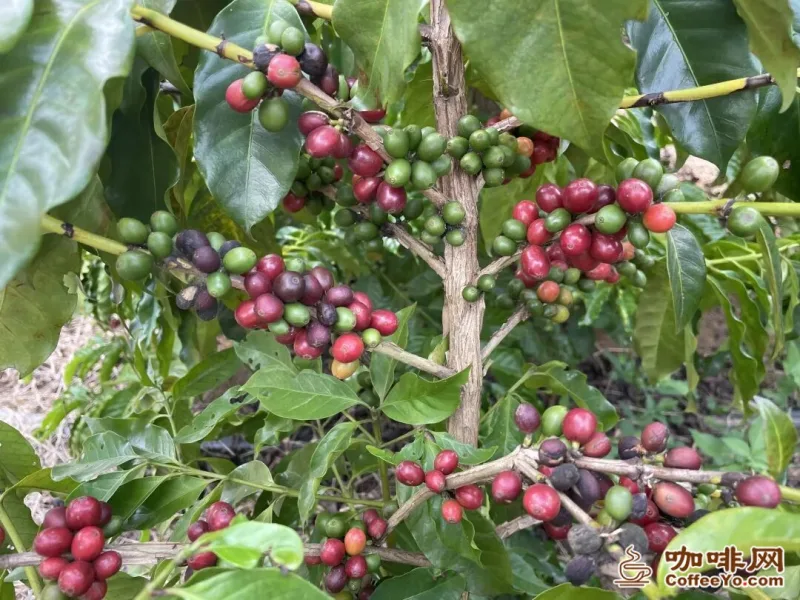
“It was truly a surprise, completely unexpected!” Weaving between the rows, Zhou pushed aside a branch heavy with fruit, his voice rising involuntarily. “Very unexpected — the growth is excellent, the fruit set is outstanding and fairly stable, and the cup quality is still quite good. Except for typhoon-affected years, the yield has been stable all these years.” This surprise did not come easily. When the trees were first planted, he had no certainty in his mind — he simply wanted to run a varietal adaptability trial. Over the past few years, the team screened varieties while matching the land to their needs, applying farmyard manure throughout and managing naturally and organically, only then coaxing these “finicky” coffee trees into bearing fruit-laden branches.
At the estate, reporters saw green and red cherries growing alternately on the same tree. “From green to red, then over-ripe, is only a week or two,” Zhou explained. The ripening window of coffee cherries is very short — once they turn red they must be picked promptly. The estate’s picking follows the rule “choose red, not green,” with workers hand-selecting cherry by cherry. Right now, this small-holder plot is entering its harvest season.
From trial planting to stable yield, the support comes from the terroir of Chengmai’s volcanic selenium-rich red soil. Dafeng Town, where Meiman Coffee Estate sits, was formerly an old overseas-Chinese farm, where scattered Robusta (Coffea canephora) medium-holder coffee was grown in earlier years. In 2018, Arabica small-holder was introduced, along with Liberica (Coffea liberica) large-holder coffee, together building a varietal trial block. Today, this coffee garden has become a “living specimen” for coffee varietal research in Hainan.
The Meiman Coffee Estate covers more than 300 mu (about 20 hectares) and is a provincial-level research and study practice base in Hainan, integrating coffee cultivation, picking experiences, and research workshops. According to Liu Jiansheng, the base project lead, the multifunction hall, restaurant, and coffee museum facilities are being renovated and upgraded, expected to be completed around next Spring Festival. Upon completion, the total area will reach over 8,000 m², and single-day reception capacity will rise from 750 to 1,200 visitors. Further research modules on farming, coffee, and intangible cultural heritage will be added, bringing more students into the fields to experience the full journey of “one coffee cherry becoming one cup of coffee.”
From the century-old coffee memory introduced by the qiaoxiang (overseas Chinese hometowns), to Arabica taking root on the low-altitude island and fruiting year after year, Chengmai’s volcanic red soil is writing a new chapter in its coffee story, growing Hainan coffee’s “new flavor.”
Reprint Notice & Disclaimer
- This article was compiled and edited by Coffeeyo.com, reprinted from China News Service Hainan’s “Arabica Small-Holder Coffee Achieves Stable Fruiting in Chengmai.” The original copyright belongs to China News Service Hainan and the original author. Our reprint is for coffee industry information sharing only and does not represent our position; all data and opinions are subject to the original. We thank the original author for their creation and sharing.
- Original: China News Service Hainan — “Arabica Small-Holder Coffee Achieves Stable Fruiting in Chengmai”
- If content authorization, attribution, copyright, or other matters are involved, please contact us promptly; we will verify and cooperate in handling at the earliest time. We also welcome coffee enterprises and industry media to exchange contributions with us.
- Coffeeyo.com contact: Tel 400-0000-641 (+86-18288016826) | Email 405854472@qq.com | Address: Jinghong City, Xishuangbanna, Yunnan Province / Tieling City, Liaoning Province
Related Reading
- Bean in Short Supply: A Taiwan Youth on Yunnan Coffee as a Shared Cross-Strait Stage
- Five Years, Eight Championships: Lincang Coffee Joins the World Stage
 Haikou ‘Union Cup’ Barista Skills Competition Kicks Off to Empower the Service Sector
 Yunnan Specialty Coffee Beans Deliver an ‘Excellent’ Report: Path to Value Leap
- Cross-Strait Tides Rise: A Taiwan Youth Farms Coffee in Yunnan, a Cup Bridging Both Sides
 2026 2nd Yunnan Treasure Coffee Green Bean Competition (Cup of Excellence Pilot) Concludes



 Liaoning ICP Security No. 21122402000217