
Brief (coffeeyo.com): In the coffee country of Baoshan, Yunnan, Shanghai–Yunnan cooperation is turning a crop once sold as raw beans into an experience — old office buildings becoming cafés and museums, estates becoming travel routes, and a single bean finding its way from the field to the visitor’s table.
China National Radio (CNR), Baoshan, 16 September (reporter Wei Wenqing) — September in Baoshan has brought one grey, rainy day after another. The rain has washed the summer heat out of Lujiangba in Longyang District, Baoshan, Yunnan Province, and lent the coffee estates an extra quiet. At the Xinzhai Coffee Culture Experience Park in Bawan Village, Lujiang Town, visitors sit in the café listening to the rain over a cup, while others step into the coffee-processing centre to follow a single bean from fresh cherry to cup.
“We deliberately leave the grounds in this cup, so visitors can watch a coffee bean turn into a drink,” says Xie Xianwen, general manager of Baoshan Xinzhai Coffee Co., Ltd.
Twenty-six years of growing coffee have let Xie Xianwen watch Lujiangba’s coffee industry change. In the past, local coffee was sold mostly as raw material — fresh cherries or green beans — along a short industrial chain, with little connection between planting and tourism. Today a bean moves from the field into the processing plant and on to the visitor’s table, and the industry is stretching from “selling raw material” towards “selling an experience”.
One starting point of that change is the Shanghai–Yunnan cooperation partnership.
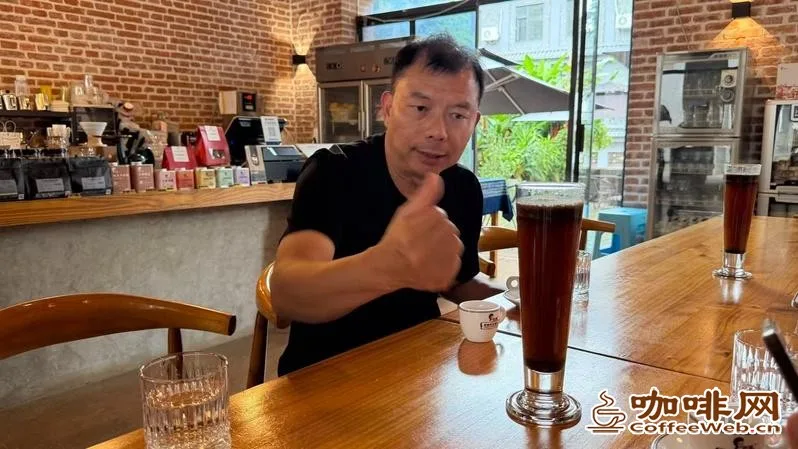
Xie Xianwen presents a signature drink (photo by CNR reporter Wei Wenqing).
New coffee businesses grow out of an old building
Bawan Village sits at the heart of Lujiang Town and is an important source of Baoshan’s celebrated small-grain coffee. Coffee growing has long been a pillar industry here, but infrastructure and tourism facilities were relatively weak, and the full value of the local coffee resources had yet to be released.
In 2024, Longyang District pooled RMB 2.9 million of Shanghai–Yunnan aid funds to build the Xinzhai Coffee Culture Experience Park project in Bawan Village.
An old township-government office block, idle for many years, was converted into a coffee-themed experience space. Coffee storage, roasting, tasting, a coffee museum, guesthouse rooms and dining were added step by step, along with an eco-friendly car park and landscaped features.
Walking through the park, weathered old walls play off the roasting equipment and exhibition spaces. Visitors can step into the coffee groves to pick fresh cherries, or take part in roasting, grinding and brewing.
“Visitors used to come mainly to look at the coffee groves. Now they can follow the whole experience, from picking right through to making and tasting,” Xie Xianwen says.
Coffee has also stretched from a drink to the dining table and to cultural products. Dishes such as coffee chicken, coffee-braised pork and coffee fish, together with handmade soaps made from spent coffee grounds, give visitors more ways to take part.
Today the Xinzhai Coffee Culture Experience Park receives around 300 visitors a day. In 2025 it welcomed more than 210,000 visits, generated over RMB 12 million in tourism revenue, and created local jobs for more than 20 villagers.
An old building left idle has found a new purpose because of coffee; a grove of coffee trees, too, has found a new way to be opened up.
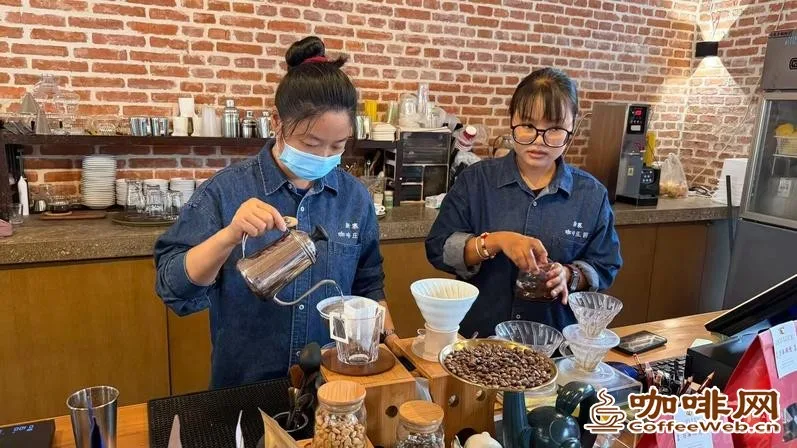
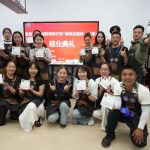
Most of the baristas at the coffee estate are local people (photo by CNR reporter Wei Wenqing).
From one estate to a whole industry chain
The change at the Xinzhai Coffee Culture Experience Park is no isolated project.
In recent years Longyang District has kept channelling Shanghai–Yunnan cooperation funds into the coffee industry, investing RMB 8.97 million in Bawan Village to build a coffee-industry cluster complex and further improve both the industry and its tourism facilities.
Chen Peng, a Shanghai aid-to-Yunnan official serving as deputy director of Longyang District’s agriculture and rural affairs bureau, explains that once such projects are complete, the assets belong to the village collective and are run on a “company + village collective + farmers” model, adding to collective income through revenue-sharing while drawing farming households into the industry.
The production side is changing too. In the past a picked coffee cherry mostly reached the market as fresh fruit or green bean; now the district is pushing products towards roasted beans, drip-bag coffee, instant powder and freeze-dried cold-brew powder.
With Lujiang Town as the core growing area, the district is also using the joint Minhang–Baoshan industrial park platform — through technology transfer, talent exchanges and Shanghai companies moving in — to move the coffee industry from primary processing towards deeper processing.
For Xie Xianwen, with 26 years of coffee growing behind him, a longer chain means more connections between farmers and the market. “For the coffee industry to grow, you can’t look only at the planting end; you have to link up processing, sales and consumption too,” he says.
From a cup of coffee to a tourism route
As the coffee industry extends downstream, the tourism offering is changing with it. Starting from Bawan Village, Longyang District has been adding signage, car parks and walking loops, stringing together villages such as Xinzhai, Nanhu, Xiaopingtian and Mangdan to explore a coffee tourism route.
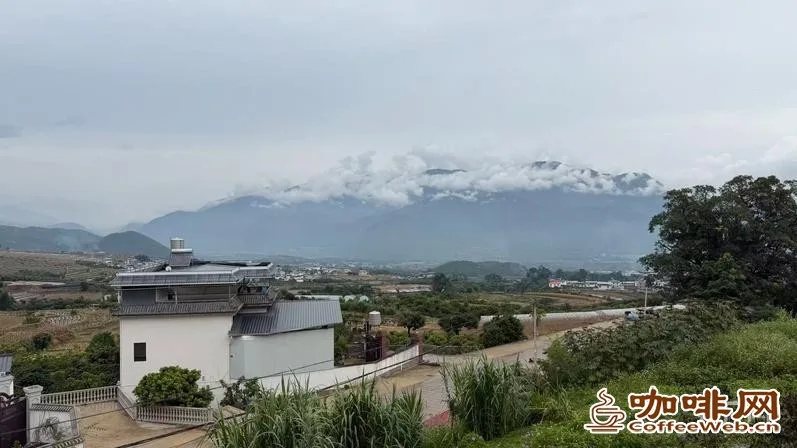
Clouds wreathing the Gaoligong Mountains beside Bawan Village (photo by CNR reporter Wei Wenqing).
In May this year the Xishan ESG Gaoligong Eco-Camp, beside the Xinzhai coffee estate, opened for business. Visitors can try making coffee, taste coffee-themed meals, and walk into the groves to take in the ecology of the Gaoligong Mountains. “Over the summer holiday, occupancy ran above 70 per cent,” says founder Yang Shan.
As new formats join in, visitors are moving from simply “looking at coffee” to “experiencing it, tasting it, staying over”. From one coffee estate to several tourism nodes, once-scattered plantations, villages and cultural projects are gradually forming fresh settings for spending.
The point where all this integration lands, in the end, is rising incomes. The Xinzhai Coffee Culture Experience Park is exploring models such as “company + cooperative + farmer + market”, linking growers to buyers through standardised planting and unified purchasing. The project creates nearby jobs for villagers and opens new room for them to run guesthouses and restaurants.
Longyang District has also built “Baoshan Barista” into a regional labour brand, using skills training to prepare coffee professionals for local companies and letting more people take part in the coffee industry chain.
At the same time, Shanghai and Yunnan have launched coffee-brand collaborations, blending Shanghai cultural elements with Baoshan coffee in co-branded products such as “The Age of Awakening”, “Twin Cities · Coffee” and “Mountains and Seas”, further widening the market for Baoshan coffee.
In recent years Shanghai–Yunnan cooperation funds have kept flowing into Baoshan’s coffee industry, from improving planting and upgrading processing to building brands, as capital, technology, talent and market resources steadily converge. From one-off project aid to deep cooperation along the whole chain, the partnership is injecting fresh momentum into Baoshan coffee.
The lawn of the Xishan ESG Gaoligong Eco-Camp is open to villagers (photo by CNR reporter Wei Wenqing).
A coffee bean from Lujiangba travels from the field to the processing plant, from a single drink to the dining table and the tourism scene, and in doing so helps more villagers find room to earn a living close to home. For Lujiangba, the change in the coffee industry is not simply about selling coffee farther afield; it is also about exploring how a grove, an estate and a village can be connected.
From “selling raw material” to “selling an experience”, a single cup of coffee holds a story of industrial cooperation spanning mountains and seas.
Reprint Note & Disclaimer
- This article is reprinted from Chinese media for information and cultural exchange. The views expressed are those of the original author and do not necessarily reflect the position of coffeeyo.com.
- All trademarks, brand names and logos mentioned belong to their respective owners.
- For cooperation, reprint or correction requests, please contact coffeeyo.com.
Reprint Notice & Disclaimer
- This article has been edited and compiled by China Coffee Network. The information and images therein come from public sources and the copyright belongs to the original author. This reprint is intended solely for information sharing within the coffee industry and does not represent the views of this website; all data and opinions are subject to the original article. Our thanks to the original author for creating and sharing it.
- For matters concerning content licensing, attribution, copyright or otherwise, please contact us promptly and we will verify and cooperate in handling them as soon as possible. We also welcome coffee origins, brands and industry media to exchange ideas and contribute articles.
- Contact China Coffee Network: Tel 400-0000-641 (+86-18288016826) | Email 405854472@qq.com | Address: Jinghong, Xishuangbanna, Yunnan Province / Tieling, Liaoning Province
Related Reading
 Three Decades of Shanghai-Yunnan Collaboration: A Coffee Bean ‘Ferments’ at the Import Expo
 Why Yongde’s Coffee Beans Won Gold in Shanghai – A Taste of ‘Life in Yunnan: 365 Days’
- Yunling Commentary: Yunnan Coffee Turnaround Hinges on Autonomous Pricing
 A ‘Travel Pack’ Reveals Another Possibility for Pu’er Baristas
- Bean in Short Supply: A Taiwan Youth on Yunnan Coffee as a Shared Cross-Strait Stage
- Five Years, Eight Championships: Lincang Coffee Joins the World Stage







 Liaoning ICP Security No. 21122402000217