
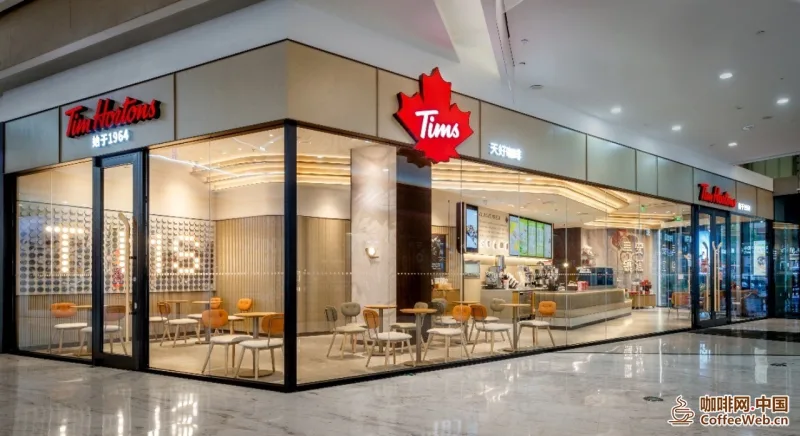
Brief (coffeeyo.com): Tims China’s first-half 2025 results tell a conflicted story: losses are narrowing and system sales are edging up, yet total revenue is shrinking. As homegrown chains race toward the 10,000-store mark, the “coffee + warm food” specialist finds itself squeezed in an RMB 16–25 price band that is rapidly emptying out.
Source: Sina Finance. On 26 August 2025, Tims China released its second-quarter results. System-wide sales came in at RMB 409.5 million, up 1.4% year on year; total revenue was RMB 349 million, down 4.9%; and the net loss was RMB 75.92 million. First-half revenue totalled RMB 650 million, continuing to shrink from RMB 700 million a year earlier, while the net loss narrowed from RMB 189 million to RMB 135 million. The report paints a contradictory picture: losses are narrowing and system sales are inching up, yet total revenue is contracting.
For a coffee brand that has been in China for more than six years, this state of “narrowing losses without growing revenue” reflects structural difficulties far more complex than the numbers alone suggest.
Closing stores, growing sales, cutting losses: three tensions in a transition
The most intriguing figure in Tims China’s first-half 2025 accounts is the divergence between system-wide sales and total revenue. In the second quarter system sales rose 1.4% year on year while total revenue fell 4.9%. The gap stems from a deliberate reshaping of the store network: a net nine stores closed in the quarter, comprising 40 newly opened made-to-order (MTO) stores and 49 closed non-MTO outlets, 41 of them small Tims Express units. The number of company-operated stores shrank from 618 in June 2024 to 537 in June 2025, directly pulling company-operated revenue down from RMB 322.3 million to RMB 281.9 million.
At the same time, other income grew from RMB 44.5 million to RMB 67.1 million, a jump of 50.7%, driven mainly by the expansion of franchising — franchised stores rose from 333 to 449. Tims is undergoing a deep shift in its revenue mix: the old model, in which large company-owned stores generated the sales, is contracting, while an asset-light model powered by franchised stores and retail is growing. Profit contributed by the franchising and retail business climbed 110.3% year on year, a figure with far more strategic meaning than the headline revenue decline.
The narrowing of losses deserves the same close reading. In the second quarter of 2025 the operating loss narrowed from RMB 54.7 million to RMB 47.78 million, while adjusted corporate EBITDA fell from RMB 3.3 million to RMB 2.2 million but stayed positive. Company-operated stores contributed RMB 27.2 million in profit, a contribution margin of 9.6%, down from 10.1% a year earlier. The main driver was cost compression — total costs and expenses fell from RMB 422 million to RMB 397 million — while pressure on the revenue side did not ease. This is “defensive loss-cutting”, not “offensive profitability”.
The “coffee + warm food” differentiation strategy was reinforced further in the first half. Food revenue rose 8.6% year on year and reached a record 35.2% of system-wide sales, up 2.8 percentage points from a year earlier. The launch of the “Light Lunch Box” range for the midday daypart was Tims’s key move to extend its warm-food advantage from breakfast into all-day occasions. But warm food naturally carries a lower gross margin than coffee, so a rising food mix lifts system sales while structurally weighing on the overall margin.
Expansion of the membership system offers another pillar of support. As of 30 June 2025, registered loyalty members reached 26.2 million, up 22.4% year on year. A growing member base means the brand’s reach is still widening, but turning “registered members” into “frequent customers” is a problem Tims has yet to solve. In the earnings report, CEO Lu Yongchen stressed “profitable growth as the core” and said the company would keep improving store-level unit economics. Yet with same-store sales still in negative territory, improvements to the single-store model rest more on cost control than on revenue growth, which raises questions about how sustainable that path is.
A squeezed middle under siege from 10,000-store chains: surviving on a 0.46% share
To understand Tims’s predicament, it has to be set against the sharply polarising competitive landscape of China’s coffee market. In 2025 Luckin Coffee held a 14.26% share with more than 30,000 stores, Cotti Coffee 7.65% with around 16,000, and Starbucks 3.73% with about 8,000. Tims China, with roughly 1,000 stores, held just 0.46%. In an era when leading brands dominate the market in units of ten thousand stores, a thousand-store Tims is being squeezed into a “middle layer”.
Wang Zhendong, chairman of Shanghai Feiyue Investment Management, puts his finger on the problem: Tims “has neither Starbucks’s third-place experience and brand pull, nor the scale and value-for-money of Luckin and Cotti”. With 8,000 stores, Starbucks has built a brand moat around the “third place”; even under pressure from the price war, its China same-store sales still grew 2% in fiscal 2025 and its store operating margin stayed in the double digits. Luckin, for its part, has driven coffee prices below RMB 15 through extreme supply-chain efficiency and digital operations, with monthly transacting customers surpassing 110 million — a siphon effect on price-sensitive consumers.
Tims sits squarely in the RMB 16–25 price band. Yet according to data from the Hongcan Industry Research Institute, average per-customer spending on coffee drinks nationwide fell from RMB 41 in September 2023 to RMB 26 in September 2025, while the share of stores priced below RMB 15 rose from 29.8% to 36.9% — leaving a “vacuum” in the RMB 16–25 band. That vacuum exists not for lack of brands trying, but because within this range consumers either opt for the cheaper, more convenient Luckin or Cotti, or for the better experience and stronger brand of Starbucks or Manner. Tims’s “coffee + warm food” tries to build a moat there through a differentiated product mix, but the barriers around warm food are far weaker than imagined. Bagels, sandwiches and the like have a low barrier to entry in China, and convenience stores, bakery brands and even new-style tea chains are moving into the occasion quickly.
The second-quarter 2025 same-store sales figures reveal how serious the problem is. System-wide same-store sales growth was -17.8%, against -4.8% a year earlier; for company-operated stores it was -17.3%, against -3.6%. That deterioration is far steeper than the industry average. It should be noted that part of the sharp decline comes from the fading of a high base created by delivery subsidies — the subsidy war among delivery platforms in the summer of 2024 inflated order volumes for tea and coffee brands, and the withdrawal of those subsidies in 2025 created a tough comparison base. But even stripping that out, Tims’s same-store performance is weaker than leading brands such as Luckin. Luckin’s company-operated same-store sales growth in the second quarter of 2025 was -5.3% — also negative, but a far smaller drop than Tims’s. More telling still, Luckin kept relatively stable same-store figures on a base of more than 30,000 stores, while Tims slid nearly 18% at a scale of just a thousand stores. That suggests the problem is not simply the external environment but the brand’s own weak customer stickiness and repeat-purchase rate.
The delivery war hit Tims especially hard. At the earnings call, CFO Li Dong acknowledged that comparable transactions fell 16.3% year on year, comparable average ticket size fell 1.5%, and delivery orders dropped from 8.2 million a year earlier to 7.2 million. Delivery accounts for a relatively high share of Tims’s orders, so the brand is correspondingly more dependent on platform subsidies; once those subsidies were withdrawn, a drop in order volume was almost inevitable. This also explains why Zhang Guohua made “winning consumers back” his top priority rather than expanding the store network.
Management’s response is shifting. In June 2025, former CEO Lu Yongchen was elevated to group chairman, and Zhang Guohua, who had held posts at consumer-goods companies including Nestlé and Feihe, took over as CEO. Zhang set out a clear strategy of “deepening presence in first-tier and core cities while expanding stores prudently”, moving the emphasis of expansion from scale to store quality and scenario penetration — transport hubs such as airports, high-speed rail stations and motorway service areas, as well as high-frequency consumption settings like office buildings, hospitals and schools. The logic is sound: with leading brands blanketing lower-tier markets on a scale of tens of thousands of stores, Tims has neither a cost advantage nor brand recognition there, whereas in the office buildings and transport hubs of first-tier cities its “coffee + warm food” mix is more likely to reach consumers with high-frequency, everyday needs.
The trouble is that prudent expansion means revenue growth will slow further, while Tims is still loss-making and holds limited cash. As of 30 June 2025, cash and cash equivalents plus restricted cash stood at RMB 179 million. In December 2025 the company issued USD 89.9 million in convertible bonds; in June 2026 it announced a further USD 55 million convertible bond issue alongside the management change. Financing injections and a management overhaul proceeding in tandem hint that investors’ confidence in the current growth path is being tested.
The fundamentals of China’s coffee market remain sound — penetration keeps rising, consumption frequency is steadily climbing, and Luckin’s management even believes “the ceiling for store numbers is still very high”. But that growth dividend is concentrating among players with either scale barriers or an extreme brand premium. Logically, Tims’s “coffee + warm food” is a valid point of differentiation, and the push into the lunch daypart plus the rising food mix show the market accepts the strategy. Yet between “being differentiated” and “having a moat” lie the systemic tests of brand mindshare, supply-chain efficiency and a profitable single-store model. When a coffee brand must simultaneously withstand Luckin’s price pressure, Starbucks’s brand pressure and the convenience of convenience-store coffee, whether 26.2 million members and 1,028 stores provide enough defensive depth is, frankly, not an optimistic answer.
This article was produced with the aid of AI tools to gather and organise market data and industry information, together with assisted analysis and writing.
Reprint Note & Disclaimer
- This article is reprinted from Chinese media for information and cultural exchange. The views expressed are those of the original author and do not necessarily reflect the position of coffeeyo.com.
- All trademarks, brand names and logos mentioned belong to their respective owners.
- For cooperation, reprint or correction requests, please contact coffeeyo.com.
Reprint Notice & Disclaimer
- This article has been edited and compiled by China Coffee Network. The information and images therein come from public sources and the copyright belongs to the original author. This reprint is intended solely for information sharing within the coffee industry and does not represent the views of this website; all data and opinions are subject to the original article. Our thanks to the original author for creating and sharing it.
- For matters concerning content licensing, attribution, copyright or otherwise, please contact us promptly and we will verify and cooperate in handling them as soon as possible. We also welcome coffee origins, brands and industry media to exchange ideas and contribute articles.
- Contact China Coffee Network: Tel 400-0000-641 (+86-18288016826) | Email 405854472@qq.com | Address: Jinghong, Xishuangbanna, Yunnan Province / Tieling, Liaoning Province
Related Reading
 ‘All-Ice’ Coffee Goes Viral! Will the Next Hit Be Your Personal Favorite?
- Hong Kong’s Dyee Coffee Lands in Qianhai, Building a Specialty Pour-Over Outpost
 Ken Yue Coffee Opens Egg-Tart Pop-Up in Hangzhou: Sweet Craft, Reinvented Classics
 World Cup Enters the Breakfast Slot: Can Coffee-Tea Brands Turn Traffic into Orders?
- ICE Agricultural Futures Mostly Rise at Close; Coffee Futures Up 3.28%
- ‘Sleep Cafés’ Become a New Favorite Among Seoul Office Workers







 Liaoning ICP Security No. 21122402000217