
At a Glance (China Coffee Network): Luckin’s 10th-anniversary collaboration with the game Honor of Kings sparked controversy by printing ten pro players’ real likenesses on packaging; some customers requested non-collab cups while fans came for specific players. Luckin rolls out a new collab nearly every week, yet collab disputes keep surfacing.
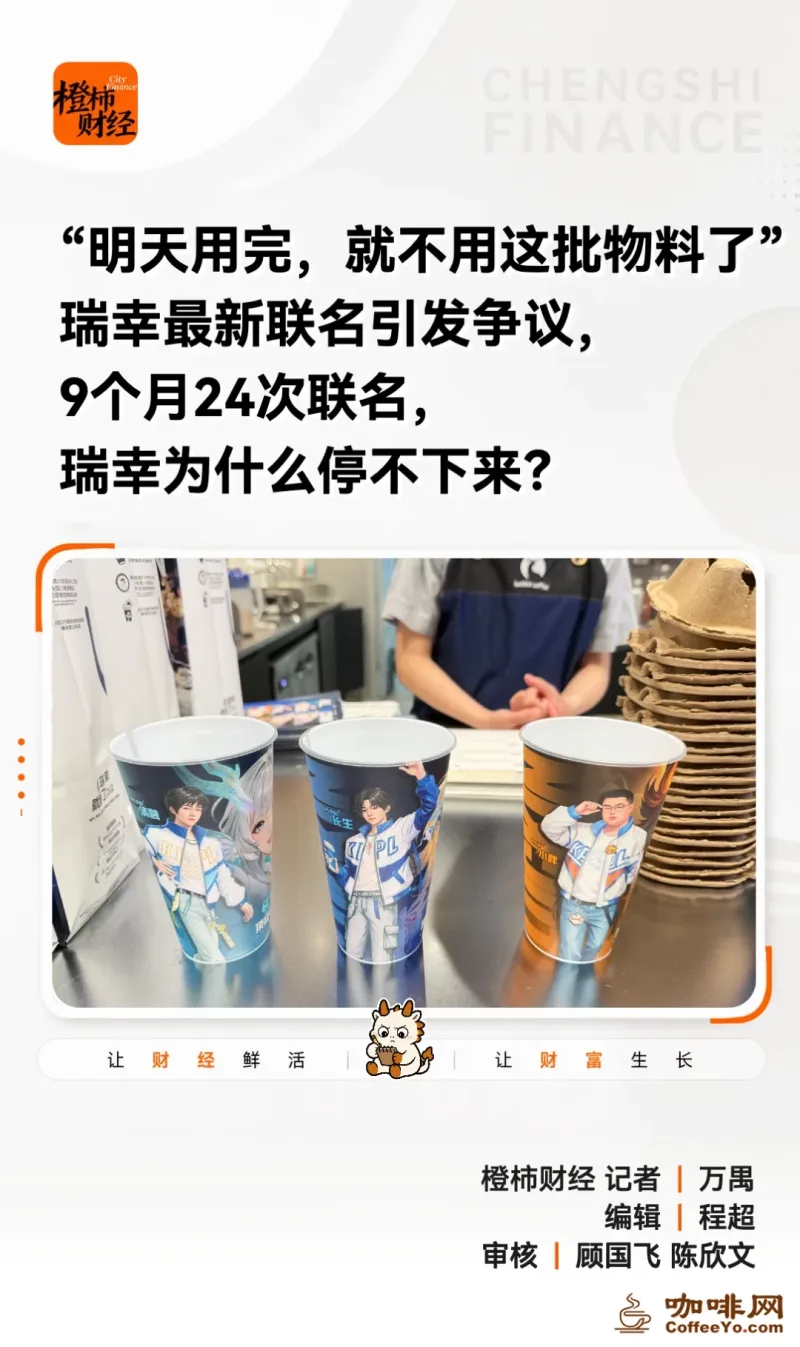
Luckin is back in the hot search again—this time over a collaboration.
It started when Luckin Coffee and the popular mobile game Honor of Kings launched a 10th-anniversary collaboration, printing the real likenesses of ten professional league players on product packaging and sparking controversy.
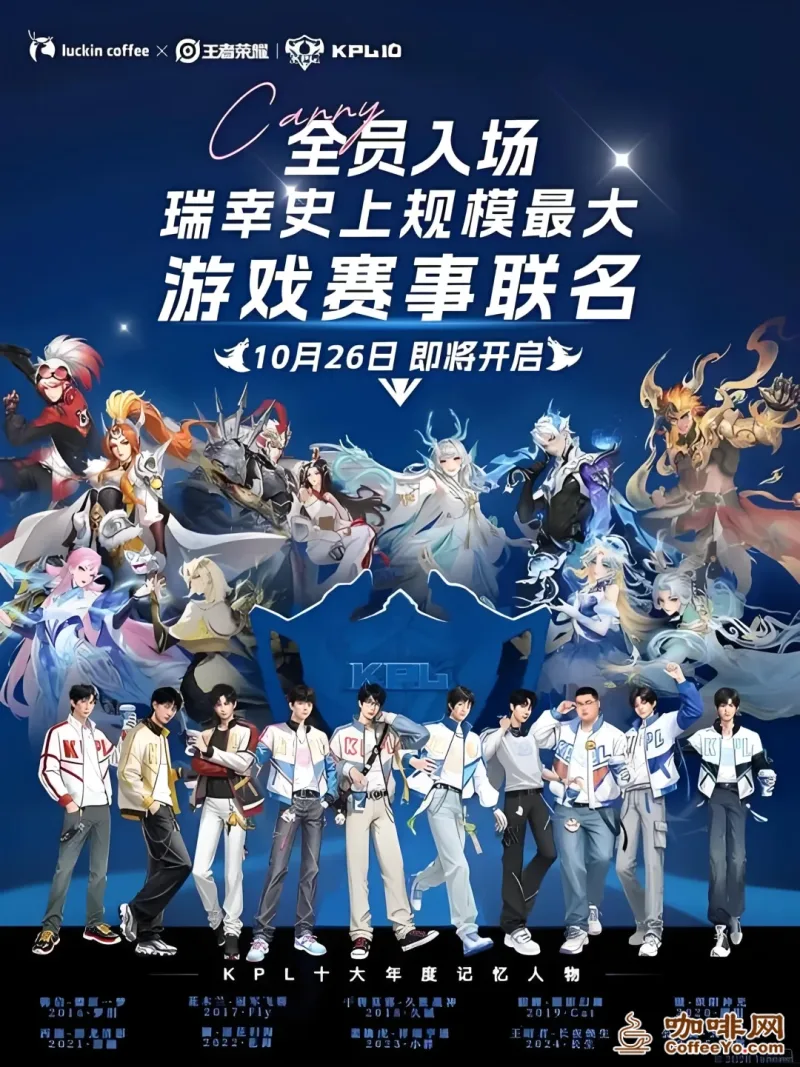
Some netizens felt they don’t play the game and only wanted a cup of coffee, yet received merchandise of a stranger—like paying to cheer for a celebrity they don’t know.
Fans were also unhappy, feeling the players’ likenesses were their very reason for buying the collab, yet Luckin pushed them onto people who couldn’t care less, dragging their idols into eye-rolls from uninterested onlookers. “Can’t the brand just let each side get what they want?”
Appeasing neither side, Luckin keeps doubling down on collabs. In contrast, some new tea-drink brands have actively cooled their collaborations this year. Why can’t Luckin stop?

This afternoon, Chengshi Finance visited a reasonably located Luckin store in Hangzhou.
A store clerk said that in her memory, the store launches a new collab almost every week—”if it does well, it runs for two weeks.”
This time, the Luckin × Honor of Kings rule is: customers who buy an iced super-large drink, as long as they add no note, get the collab cup by default. The clerk observed that over the past two days, some consumers uninterested in Honor of Kings specifically noted in the mini-program “no collab cup.” “As long as there’s a note, we respect it.”
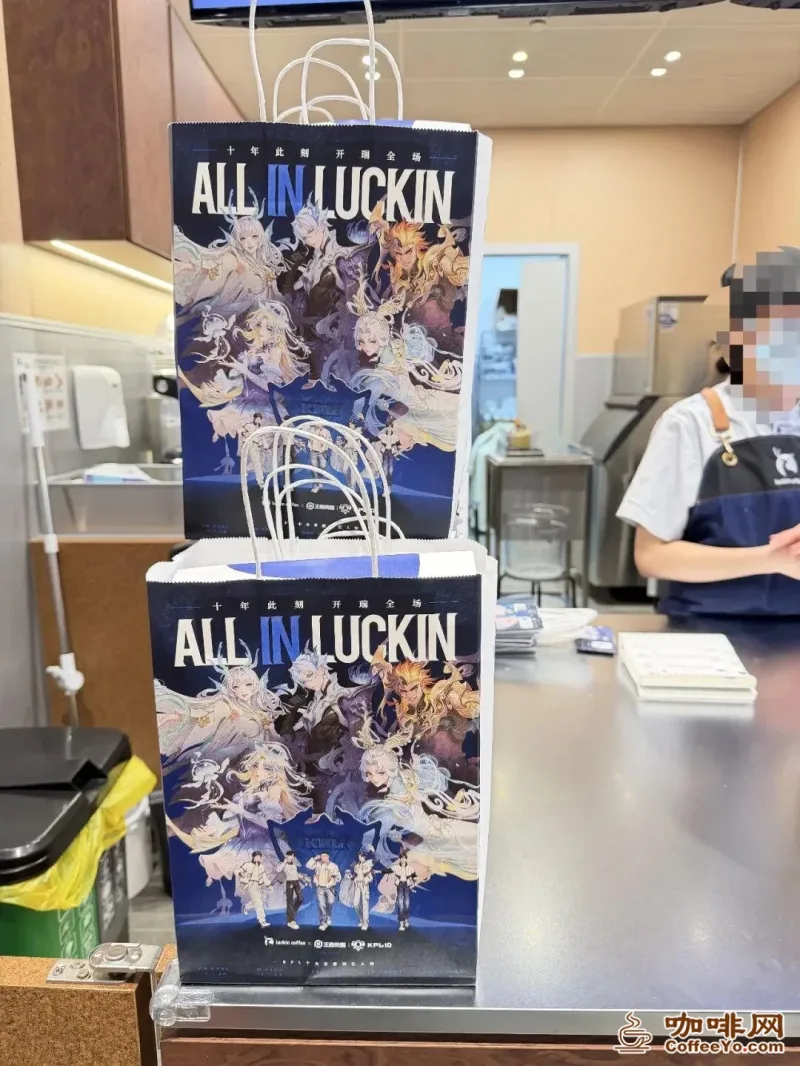
On the other side, some esports fans came specifically to the store asking for the cup of popular player “Changsheng.” However, the clerk also noted such consumers are “not that many,” and even fewer ask for another player “Xiaopang’s” material cup.
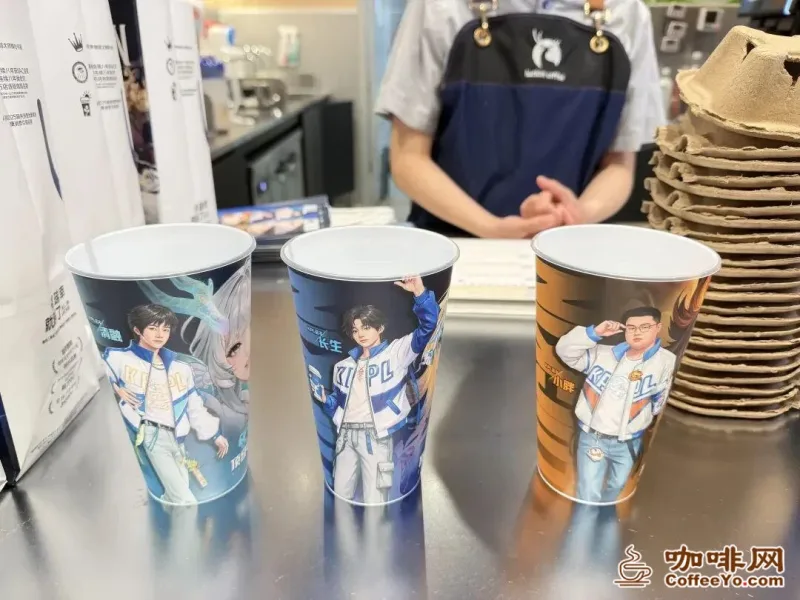
“Tomorrow morning the cups are expected to run out, and we’ll stop using this batch of material.”
This is not the first time Luckin has felt pushback over collab boundaries this year.
Back in August, Luckin launched a Qixi collaboration with a serialized animation, but it contrasted sharply with previous sell-out launches. At the time, Chengshi Finance visited various Luckin stores in Hangzhou, and a clerk revealed the collab products’ sales heat was lower than before—”we didn’t sell many cups today.”
Many netizens posted when the collab cups went on sale that they didn’t know the couple at all—”why should I ‘chip in’ for strangers’ romance?” Luckin’s customer service responded then that the partner was an animation IP and the collab would proceed as planned.
Luckin is no stranger to the sweet taste of collabs.
In 2023, Luckin’s collaboration with Kweichow Moutai on the Sauce-Flavor Latte sold over 5.42 million cups on its first day, with sales surpassing ¥100 million.
A cup of coffee became, at once, news, a hot social topic and a hit product—giving Luckin a replicable template: a collab isn’t just a new wrapper for the product, but also accomplishes topic spread, user acquisition and sales conversion simultaneously.
Luckin wasn’t the only one to taste the sweetness. Over the past few years, collaborating with popular IPs was once a common tactic for tea-drink brands to drive sales and buzz.
For example, when Guming launched its collab with the popular IP “Lotus Tower,” the brand’s mini-program crashed within a minute of opening due to too much traffic.
When Chabaidao collaborated with “Tears of Themis,” some stores sold out of combo sets.
HEYTEA’s co-branded special with “Dream of Splendor” sold over 1.4 million cups in its first week.
In 2025, Auntea Jenny’s collab with Monet’s painting “Woman with a Parasol” saw collab-item sales surge 300% year-on-year.
“In my analysis, a brand’s biggest aim in collaborations is still to boost sales,” a PR staffer at a tea-drink brand told Chengshi Finance, adding that especially facing the huge anime fan base, a well-done collab can indeed deliver a sales “big result” in the short term, with fans and organic promoters spreading it for free across the web.
For brands, collaboration thus became a relatively clear growth path: the IP brings attention, fans spread it voluntarily, and stores complete the sales conversion.
So Luckin, having tasted the sweetness, kept raising its collab frequency. According to incomplete statistics released by industry media “Lei Bao” in September, in the first nine months of 2026, 19 major domestic made-to-order tea and coffee brands ran 145 IP collaborations, of which Luckin accounted for 24.
But past success doesn’t mean every collab achieves the same effect. By incomplete count, including this Honor of Kings pro-league collab, Luckin has triggered controversy in at least five collaborations this year.
In February, Luckin’s collab with Line Friends saw a consumer notice that a character’s radical was misprinted on the cup sleeve’s Chinese slogan.
In June, the Hello Kitty collab’s limited-edition tag printed “HELLO” as “HEELO.”
During the Qixi period in August, Luckin’s collab with animation IP “Wang Huanjun and Zhang Binzhi” was mocked by consumers as “chipping in for strangers’ romance,” and the IP’s art style was questioned by some netizens as similar to multiple Japanese animations.
In September, Luckin’s collab with “Siam Lipe” again saw netizens notice the sticker pack chosen had the original meaning “so bad it makes you cry,” questioning whether the brand understood the meme before putting it on packaging.
These controversies aren’t all the same in nature—some are material printing and review issues, some involve disputes over the IP itself, and others stem from the brand’s understanding of subculture and the sense of boundary between collab materials and ordinary consumers.
But for Luckin, which launches a collab less than every 12 days on average, any oversight in IP screening, content review, material production or consumer communication can be amplified by store scale.
Collabs can still bring brands sales and buzz, but it’s clearly no longer a business that only tallies licensing fees, material costs and sales. Conversion effects are harder to replicate, while execution risks accumulate in high-frequency scheduling.
This year, some tea-drink brands have proactively cooled collaborations.
For instance, last year’s collab fanatics—Chabaidao (18 times a year), Cotti (18), Auntea Jenny (14) and Nayuki (17)—significantly slowed their pace in this year’s first quarter. According to Lei Bao’s statistics, their collab counts in Q1 dropped to 2, 3, 2 and 0 respectively.
A staffer at another leading tea-drink brand also told Chengshi Finance the brand did few collabs this year, only one coffee-spokesperson related partnership, with main energy still on new product R&D. “To be honest, collabs do have a positive impact on brand sales.”
But in that staffer’s view, for the larger base of ordinary consumers, the focus is still whether the drink tastes good. “For example, I don’t play Honor of Kings—give me a plain cup and I’m happy to drink it.”
Reducing collabs isn’t entirely because collabs are too expensive. A new-tea-brand staffer told Chengshi Finance some collabs consume exchangeable rights between both sides and don’t necessarily require high licensing fees.
What makes brands wary is another thing: “We’re very wary of consumers saying we can’t sell without collabs; what matters most now is proving ourselves through brand and product.”
Unlike these brands actively giving collabs a “cool-down,” why does Luckin keep stubbornly doubling down?
Financial data offers another angle.
In Q2 2026, Luckin’s total net revenue was ¥15.886 billion, up 28.5% year-on-year; sales and marketing expenses were ¥925 million, up 56.1% year-on-year—nearly double the revenue growth rate.
This shows that for every extra yuan Luckin earns, the marketing money spent is accelerating. Collabs are the big chunk of marketing expenses; top IP licensing fees start in the tens of millions, plus material production, channel rollout and promotion, making each collab a sizable outlay.
More noteworthy is the same-store sales growth curve.
In Q3 2025, Luckin’s company-operated same-store sales still grew 14.4%, then dropped straight to 1.2% in Q4. In Q1 2026 it turned to -0.1%. The company mainly attributed the Q2 performance to a high base formed by heavy delivery-platform subsidies in the same period last year.
But two consecutive quarters of negative growth show the playbook of opening stores and subsidizing new users is rapidly losing traction.
The financial report doesn’t itemize collab costs, and same-store changes can’t be directly attributed to collabs. But putting the two sets of data together still raises a real question: as stores keep expanding, can high-frequency marketing deliver stable per-store growth and repurchase?
For Luckin, collaborations can both create new growth and sustain the rhythm of new launches and consumer attention. It’s just that when collabs shift from occasional surprises to the norm, brands must calculate not only how much a single campaign sells, but also whether consumers are fatigued and whether stores can meet the needs of different crowds.
A collab can explain why consumers order today, but it can’t alone answer why they’ll come back tomorrow. For Luckin, more important than “who’s next to collab with” may be how much appeal the product, price and store experience still offer when there’s no IP on the cup.
Chengshi Interactive · Metropolitan Express, Reporter Wan Yu
Editor Guo Zhijie
Reviewer Luo Yi, Chen Xinwen
Proofreader Peng Shenlei
Reprint Notice & Disclaimer
- This article is compiled and edited by China Coffee Network (coffeeyo.com), and is reprinted from NetEase’s “‘We’ll Stop Using This Batch of Material Tomorrow’—Luckin’s Latest Collab Sparks Controversy.” The copyright of the original article belongs to NetEase and the original authors. This reprint is for the sharing of coffee industry information only and does not represent the position of this site; all data and views are subject to the original. We thank the original authors for their work and sharing.
- Original: NetEase “‘We’ll Stop Using This Batch of Material Tomorrow’—Luckin’s Latest Collab Sparks Controversy”
- For matters regarding authorization, attribution, copyright, or any other issues, please contact us promptly and we will verify and cooperate in handling them. We also welcome coffee producing regions, brands and industry media to exchange and contribute content.
- Contact China Coffee Network (coffeeyo.com): Tel 400-0000-641 (+86-18288016826) | Email 405854472@qq.com | Address: Jinghong City, Xishuangbanna, Yunnan Province
Related Reading
- Bean in Short Supply: A Taiwan Youth on Yunnan Coffee as a Shared Cross-Strait Stage
- Five Years, Eight Championships: Lincang Coffee Joins the World Stage
 Haikou ‘Union Cup’ Barista Skills Competition Kicks Off to Empower the Service Sector
 Yunnan Specialty Coffee Beans Deliver an ‘Excellent’ Report: Path to Value Leap
- Cross-Strait Tides Rise: A Taiwan Youth Farms Coffee in Yunnan, a Cup Bridging Both Sides
 2026 2nd Yunnan Treasure Coffee Green Bean Competition (Cup of Excellence Pilot) Concludes



 Liaoning ICP Security No. 21122402000217