
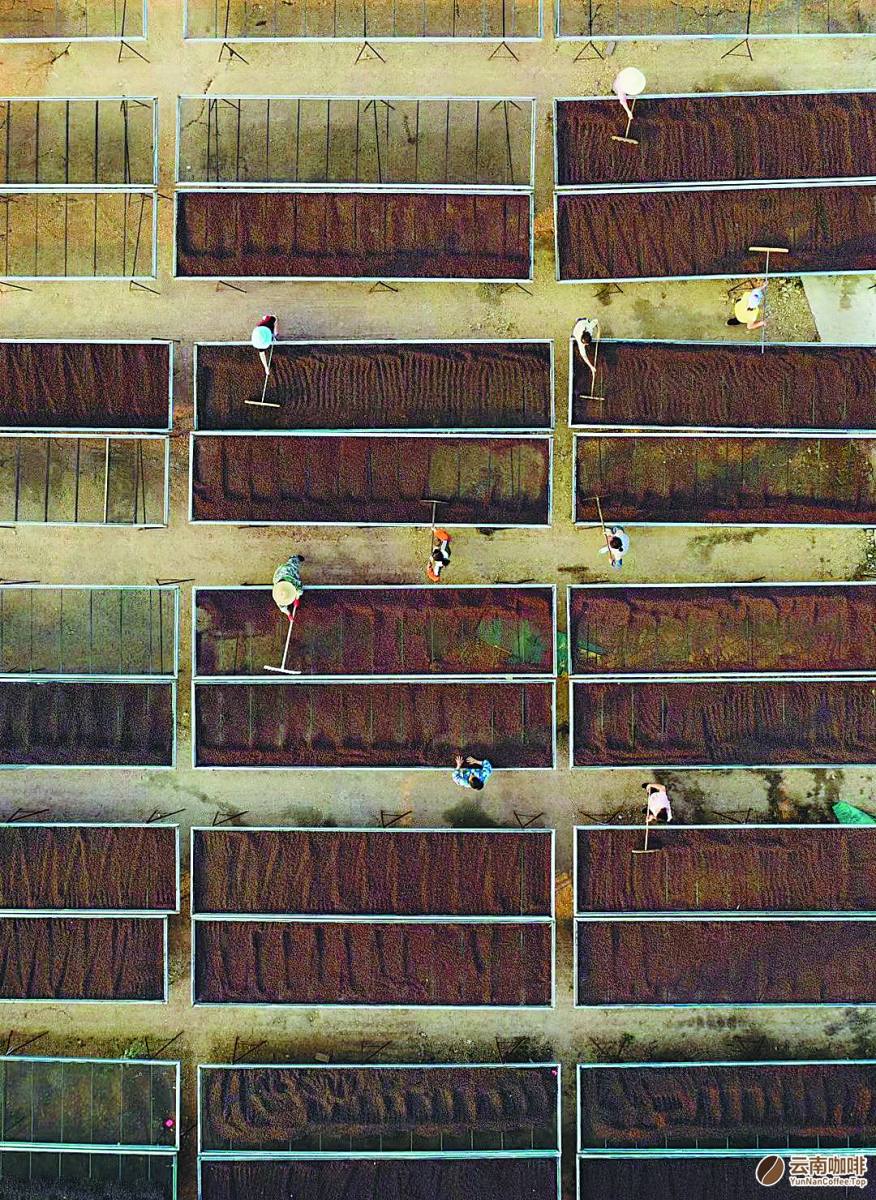
In the coffee plantation in Pu'er, Yunnan, farmers are drying coffee beans. [Image/Xinhua News Agency]
The domestic market is thriving with diverse product sales, expected to reach 144 billion US dollars by 2025
As Chinese consumers become increasingly savvy coffee drinkers, Yunnan Province in southwestern China is planning to grow more high-quality coffee beans and establish itself as an important global coffee production region.
Yunnan is the largest coffee growing area in China, utilizing its high altitude and favorable climate conditions to cultivate high-quality coffee beans. The coffee beans produced in this region usually have a strong fruity aroma, a mellow taste but not bitter.
In early August this year, the Yunnan Provincial Government issued a document requiring an increase in the deep processing of legumes and the production of premium coffee products in the province. By 2024, the province's high-quality coffee bean production will account for 30% of its total output, and the deep processing rate of coffee beans will reach 80%. Deep processing refers to the use of industrial drying and grinding methods.
The guide also points out that Yunnan will further develop new products such as coffee capsules, drip bag coffee, and espresso to meet the increasingly diverse needs of avant-garde coffee enthusiasts in China.
The climate in Yunnan coffee producing areas is complex and diverse, and different regions adopt different cultivation techniques to adapt to various conditions. Our goal is to select excellent varieties with high quality, high yield, and disease resistance, "said Huang Jiaxiong, a researcher at Yunnan Academy of Agricultural Sciences.
Huang said that the economic output of Yunnan's coffee industry can be improved. Promoting green and efficient planting techniques and better initial processing techniques can improve the taste and quality of coffee, ultimately increasing the production of high-quality coffee in Yunnan and further expanding its market share.
Brazil is the world's largest producer of coffee beans, accounting for over 30% of global coffee trade. Last year, Brazil experienced drought and frost during the harvest season, resulting in a nearly 20% year-on-year decrease in coffee bean production, according to data from the Brazilian Food Supply and Statistics Agency Conab. However, this also provides more growth opportunities for coffee bean producers in Yunnan.
According to statistics from the Yunnan Academy of Agricultural Sciences, Yunnan exported 11000 tons of coffee beans last year, of which raw beans accounted for 79% and deep processed beans accounted for about 20%.
The average yield of coffee beans in Yunnan is 2000 kilograms per hectare, which is 2.28 times the global average yield. According to the data from the college, in terms of unit yield, coffee cultivation in Yunnan has reached the highest level in the world.
Li Lihong is a coffee trader from Baoshan, Yunnan, and the founder of Baotai'an Coffee Co., Ltd. in Baoshan Town. Before founding the company in 2012, he had traveled to major coffee growing regions such as Brazil and Colombia to learn coffee cultivation.
At present, the company's annual sales volume of coffee beans exceeds 2000 tons. Last year, it opened six chain stores selling coffee products in Yunnan. This year, the company plans to open new chain stores in Beijing, Kunming in Yunnan Province, Chengdu in Sichuan Province, Wuhan in Hubei Province, and Guangzhou in Guangdong Province.
Li said, "Our main products include coffee beans, coffee powder, and instant coffee. In the next three years, we plan to expand our production line, including freeze-drying coffee powder, and establish a new production line to produce cold brew coffee
We also plan to further cooperate with local vocational schools to establish factories to train students. Once they graduate, they can become qualified coffee producers, "she said.
Yunnan began large-scale coffee cultivation in 1952, and in recent years, the increasing popularity of coffee in China has also promoted the establishment of more coffee companies.
The coffee tree variety cat poop fruit has a shorter stem but larger fruit and seeds, accounting for over 95% of the total coffee production in Yunnan. The college stated that the region needs to explore new varieties.
So far, Yunnan has introduced over 6000 coffee germplasm resources from Ethiopia – seeds or plant parts used to cultivate new coffee varieties, and has selected more than 300 new varieties from major coffee producing areas such as Brazil, Portugal, and India. Future international cooperation and resource exchange can introduce more high-quality coffee germplasm resources from overseas markets and discover new varieties. In addition, China also plans to develop new domestic soybean varieties.
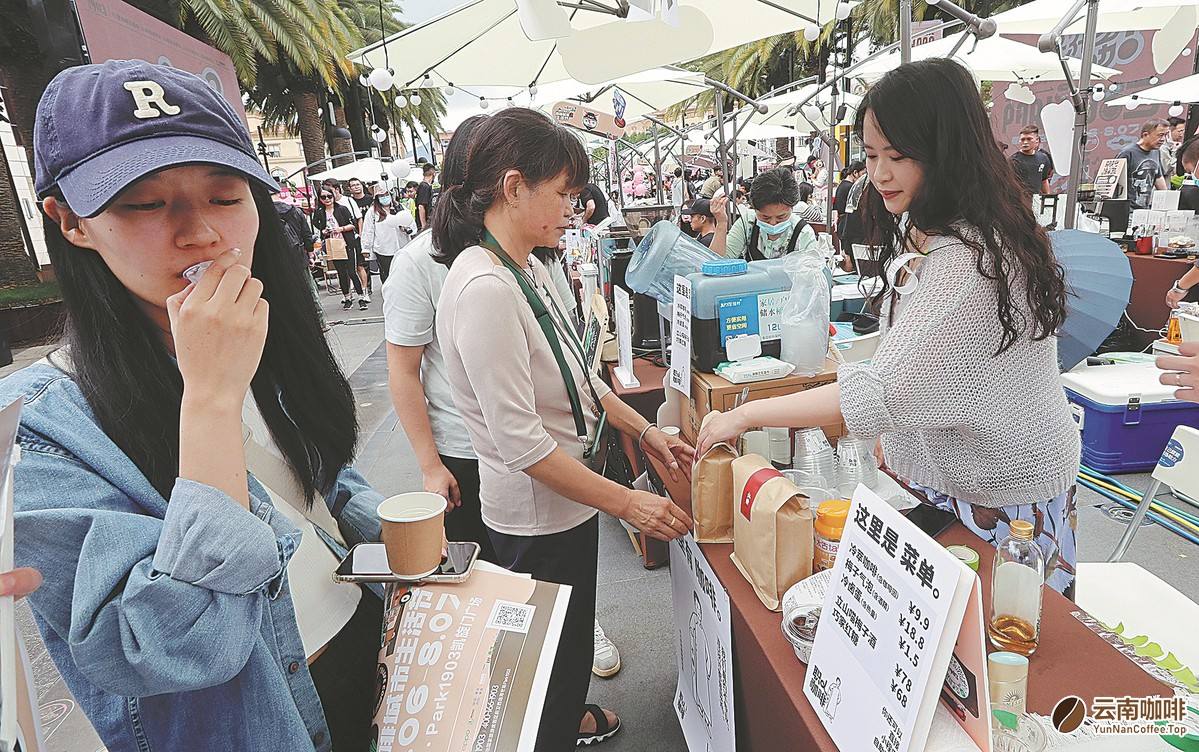
In August, visitors tasted various products at the Coffee Expo held in Kunming, Yunnan.
According to iResearch, a market research company in China, the coffee planting area, yield, and bean output value in Yunnan accounted for over 98% of the country's total last year.
By 2025, the sales revenue of China's coffee market is expected to exceed 1 trillion yuan (approximately 143.8 billion US dollars), which is about three times the current figure. In 2021, the sales revenue of the domestic coffee industry reached 381.7 billion yuan. According to iResearch data, the number of chain coffee shops is less than 13% of the total, which means that ownership in the industry is highly dispersed.
With the rapid growth of coffee drinkers in China, the country is becoming one of the world's most important coffee consumption markets, boosting confidence in the Yunnan coffee industry.
According to a report released by Ele.me, Shanghai has been leading in coffee consumption for three consecutive years nationwide. Beijing, Hangzhou, Zhejiang Province, and Guangzhou followed closely behind.
As of June 30th, there were 7857 coffee shops in Shanghai, surpassing New York, London, and Tokyo. According to a report from Meituan, an online food ordering and delivery service provider, an increasing number of coffee retailers in Shanghai are using coffee beans produced in Yunnan.
Although there is still a lot of room for development in the cultivation of beans in Yunnan, its development has also been limited to some extent. The cultivation of beans in Yunnan is mainly concentrated in mountainous areas, where large-scale mechanized planting is relatively difficult, and most of the planting and harvesting still rely on human labor.
Huang said that in addition, most coffee growing areas in Yunnan are located in high-altitude areas, which sometimes suffer from temperature fluctuations and drought.