

As is well known, coffee is a 'health star'.
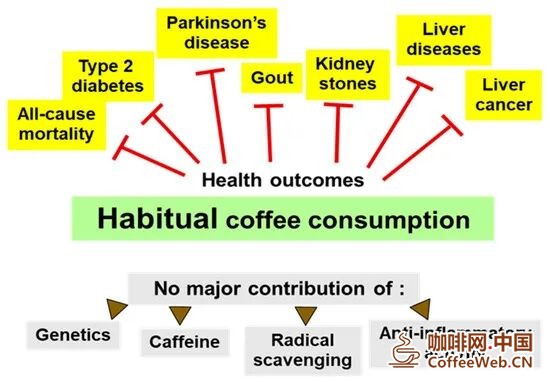
In addition to refreshing, a large number of epidemiological studies have shown that coffee drinking is also associated with reducing the risk of type 2 diabetes, Parkinson's disease, liver disease and death.
However, coffee contains hundreds of bioactive ingredients, and the scientific community is still piecing together a vast puzzle of how these ingredients affect the human body and bring these benefits.
▲ Reference materials for coffee bean ingredients: Tomohiro Ishiwaki's "You Don't Understand Coffee"
A recently published large-scale population study in Finland provides a new clue to our understanding of this issue: behind the various health benefits of coffee, there may be a bridge constructed by the "sex hormone and endocrine" pathways.
People who love to drink coffee
Less fat, relatively more muscle
Researchers from Oulu University in Finland analyzed data from 2264 participants (average age 46, 47% male) from the "Northern Finland 1966 Birth Cohort".
The researchers not only asked them how much coffee they drank, but also conducted a fairly comprehensive physical examination. This includes body composition, blood pressure, blood lipids, fasting blood glucose and insulin, oral glucose tolerance test, as well as hormone indicators such as total testosterone, free testosterone, and sex hormone binding globulin.
As a result, it was found that there were no significant differences in BMI, waist circumference, and waist to hip ratio among different coffee intake groups based on traditional indicators. But higher precision analysis shows that people who drink more coffee:
Lower body fat percentage
Less total fat mass
Smaller visceral fat area
Higher skeletal muscle mass
That is to say, even if two people have exactly the same weight and BMI, the one who drinks coffee regularly is likely to have "less fat and more muscle" in their body.
▲ Card made food:
The study also found that higher coffee intake was associated with lower levels of circulating branched chain amino acids in both male and female participants.
In the past, many studies have found that the BCAA in blood is high for a long time, which is related to the increased risk of obesity, insulin resistance, type 2 diabetes and fatty liver [2]. This indicates that coffee may protect blood sugar stability by affecting amino acid metabolism.
Drinking coffee, even hormones have changed
A more remarkable discovery is the regulation of the sex hormone network by coffee.
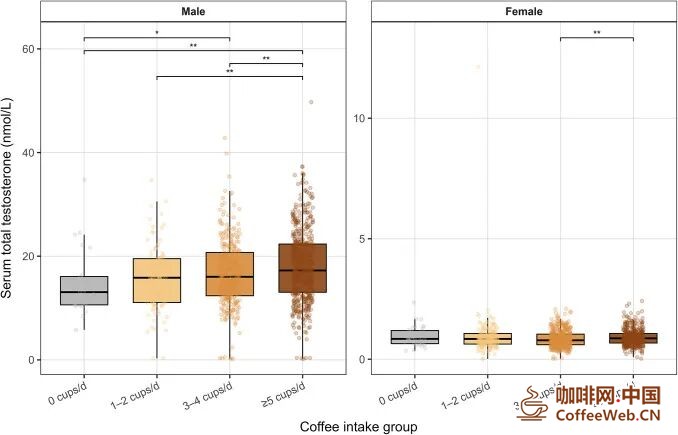
This difference is more pronounced in males.
Research has found that among male participants, the higher the coffee intake:
The more favorable the insulin response and insulin sensitivity are;
The higher the levels of total testosterone and bioavailable testosterone,
The concentration of sex hormone binding globulin (SHBG) is relatively high.
Free testosterone and free androgen index slightly decreased
In males, serum total testosterone levels increase with increasing coffee intake. Compared with non coffee drinkers, men with moderate intake (p<0.05) and high intake (p<0.01) had significantly higher levels of testosterone. Image: Reference [1]
The changes in women are not as obvious.
Among female participants, higher coffee intake is mainly associated with increased SHBG and decreased levels of free sex hormones.
After deducting the effects of lifestyle factors such as BMI, exercise, smoking, and diet, this hormone imprint still persists. This means that people with higher coffee intake exhibit a very unique endocrine characteristic in their bodies.
Why is coffee healthy?
Hormones provide new clues
Here we need to recognize this recurring indicator: the sex hormone tuberculosis globulin.
Simply put, it is like a "hormone transporter" in the blood, mainly produced by the liver, specialized in capturing and transporting sex hormones such as testosterone and estrogen, regulating their activity in the body.
But the role of this' porter 'is far more than just transportation. Research has found that it is also a "warning device" for the body's metabolic health
Previous studies have found that low levels of total testosterone and SHBG in males are often associated with obesity, insulin resistance, and metabolic syndrome; In both men and women, lower SHBG is also associated with a higher risk of type 2 diabetes [3,4].
Researchers speculate that the antioxidant components such as chlorogenic acid found in coffee may quietly stimulate the liver to produce more such "transporters", leading to a more rational distribution of hormones in the body and indirectly improving body fat and blood sugar health.
Prospective epidemiological studies have consistently found that habitual coffee consumption is associated with multiple clinical outcomes and a reduced risk of all-cause mortality. This includes reducing the incidence of type 2 diabetes, Parkinson's disease, gout, liver fibrosis, non-alcoholic fatty liver, cirrhosis, liver cancer and chronic liver disease. Source: Reference [5]
However, it should be noted that this is an observational study that found a "health coincidence" (correlation), which does not necessarily mean that drinking coffee can directly cure the disease or forcibly change hormones (causal relationship).
So, don't drink it recklessly as a "miracle drug". For most people, as long as they don't feel flustered or affect their sleep, drinking 1-2 cups of sugar free and low milk black coffee in moderation every day, while also enjoying this metabolic dividend, is the most comfortable and healthy choice!
Editor | Hawthorn
The above information is only for popular science and should not be considered as medical advice
Cannot replace the individualized judgment of doctors on specific patients
Original title: "What is the physical difference between drinking coffee every day and never drinking