
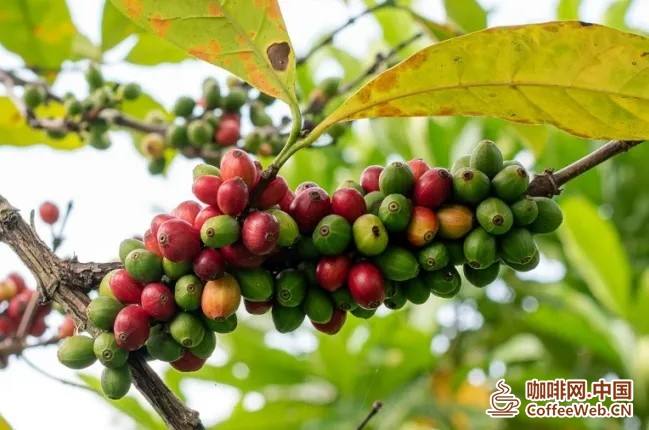
With climate change, coffee trees around the world are on the brink of extinction. Nowadays, scientists are seeking solutions to safeguard coffee, the world's most popular beverage.
After being brewed, Liberica coffee has the aroma of jackfruit, mango and other tropical fruits. Image source: Shutterstock
Almost all of the 10 million tons of coffee beans consumed globally each year come from two varieties: Robusta coffee, which has a rich but slightly bitter taste, and Arabica coffee, which has a more delicate taste. Unfortunately, once the temperature rises a few degrees Celsius, Arabica coffee trees will suffer heavy damage or even die; The Robusta coffee tree requires a large amount of water, and once it encounters drought, its yield will sharply decrease.
For this reason, researchers are racing against time to conduct research that not only keeps coffee enthusiasts around the world alert, but also preserves the livelihoods of many coffee farmers in low-income countries. At present, there are many response plans, such as improving the adaptability of the two main coffee varieties, domesticating closely related wild coffee species, and using clever chemical processes to extract more flavor compounds from coffee beans.
Kassahun Tesfaye from Addis Ababa University in Ethiopia said that Ethiopia is the birthplace of Arabica coffee, and people take pride in it. The coffee ceremony is also a bond that maintains the country's diverse culture and social exchanges.
The Ethiopian government is establishing nature reserves to protect the natural genetic diversity of Arabica coffee, and has also planted over 12000 Arabica coffee trees at the Ethiopian Institute of Biodiversity and the Ethiopian Agricultural Research Institute.
The government of the country hopes that this batch of germplasm resources will provide materials for cultivating Arabica coffee that is resistant to high temperatures and drought. Tesfaye pointed out that unlike other coffee species and even humans, Arabica coffee has four complete sets of chromosomes in its cells, indicating that it was born 50000 years ago through natural hybridization between two coffee species. We have a sufficient gene pool to address the challenges posed by climate change
As global temperatures continue to rise, the planting areas of Arabica coffee can only continue to migrate to high-altitude areas to maintain suitable temperatures, which is not easy for small coffee plantation owners. Another solution is to plant other coffee trees that are more adaptable to climate change. At present, there are a total of 134 known wild coffee species worldwide, and a few varieties have been planted due to climate adaptation, including Libirica coffee and Highland coffee.
Since the late 1990s, Aaron Davis from the Royal Botanic Gardens (Kew Gardens) in the UK has led his team deep into Africa to search for various wild coffee species. He also searched for forgotten specimens from the ancient specimen museum in Qiu Yuan. According to his estimation, the team has completed a scientific description of approximately one-third of the known coffee species worldwide.
Davis travels to major coffee producing regions around the world to observe the survival challenges faced by farmers and their corresponding solutions. He found that the core of all successful cases is the replacement of planting varieties.
In humid and rainy areas, farmers will give up Arabica coffee and switch to Robusta coffee; However, other regions choose Libirica coffee because this variety has better heat resistance than Arabica coffee and consumes less water.
But for a long time, the coffee industry has been skeptical of this method because few wild plants can be transformed into high-yield and delicious coffee crops. In Davis' view, the biggest challenge at present is to cultivate high-yielding coffee varieties that are easy for farmers to grow.
At the same time, some researchers have taken a different approach, exploring how to gain more revenue from the increasingly scarce supply of Arabica coffee.
There is still a lot of room for optimization in the extraction process. Christopher Hendon from the University of Oregon Eugene found that grinding coffee beans at temperatures below freezing can result in smaller coffee particles, but it does not necessarily mean that the finer the grinding, the better the taste. Particles that are too fine will agglomerate due to electrostatic forces, reducing the surface area in contact with water and thus decreasing the amount of chemicals entering the solution; Fine tuning the grinding process, such as slightly wetting coffee beans before grinding, can effectively reduce clumping.
Another unexpected discovery is that coffee beans with coarser grinding can actually extract more high-quality flavor compounds, but this only occurs when the extraction pressure is as low as 7 standard atmospheres, while the conventional extraction pressure of commercial coffee machines is about 10 atmospheres.
Hendon stated that chemical analysis is also crucial for screening alternative coffee varieties and improving the flavor of finished products. At present, chemical research related to coffee is still in its infancy, and researchers are building a reproducible and standardized flavor detection system.
The analysis of ingredients is very difficult, and quantifying the flavor score is even more challenging, "Hendon said. A cup of regular coffee contains over 2000 organic compounds, and the concentration of each substance is greatly affected by factors such as the place of cultivation, cultivation method, and degree of roasting, resulting in significant differences.
Tesfaye believes that researchers should be most concerned about the future of coffee, as "many discoveries and knowledge are generated after drinking a cup of coffee".