
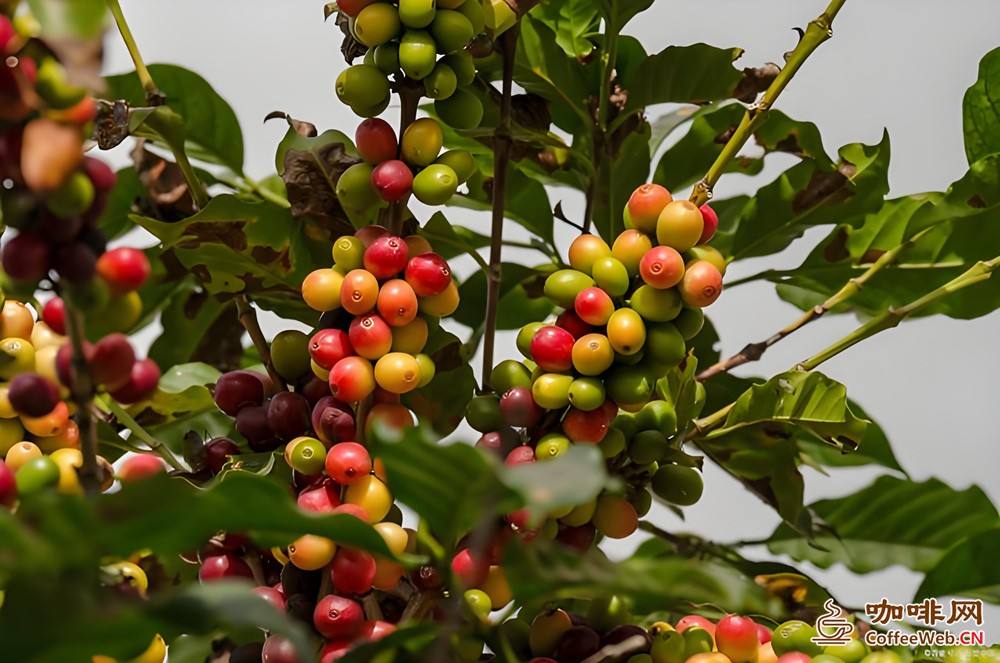
Yunnan small grain coffee refers to a type of Arabica coffee grown in Yunnan Province, China. Here is a detailed introduction about it:
Historical origin: In 1904, French Catholic priest Tian Denong planted a seedling of Tie Pika coffee from Vietnam on the back wall of a Catholic church in Zhukula Village, Pingchuan Town, Binchuan County, Dali Prefecture. This marked the beginning of Yunnan coffee.
Planting areas: Yunnan coffee planting has expanded to 10 production areas, including Pu'er City, Baoshan City, Dehong Prefecture, Lincang City, Nujiang Prefecture, Xishuangbanna Prefecture, Wenshan Prefecture, Dali Prefecture, Chuxiong Prefecture, and Honghe Prefecture, with the first six being the main production areas.
Variety types: The main varieties include Tiepika, Bourbon, and Katim. Tie Pi Ka is a recognized high-quality variety with a rich aroma; Bourbon production is relatively high, and its flavor is comparable to that of tin card; Katim is a hybrid of Kadura and Timor species, with 25% Robusta ancestry and greatly improved flavor after modification.
Taste and flavor: Yunnan small grain coffee has a neutral overall taste, fragrant but not bitter, strong but not intense, slightly sour and comfortable, with a light jasmine fragrance and refreshing fruit acid flavor, and a long-lasting aftertaste. Beans grown at high altitudes and lightly baked have higher acidity and weaker bitterness, while those deeply baked have a slightly higher bitterness.
Quality advantage: Yunnan small grain coffee is planted in the global coffee golden planting zone at 26 degrees north latitude. Its biggest advantage is its high freshness. Compared to imported coffee beans, it can be roasted within a few days, better preserving the flavor of the coffee.
Industrial development: By 2024, the coffee planting area in Yunnan Province will be 1.267 million mu, with a yield of 146000 tons. The export volume of coffee will increase by 358%, and it will be exported to 29 countries in Europe, America, and Asia, becoming an important representative of China's coffee industry.