

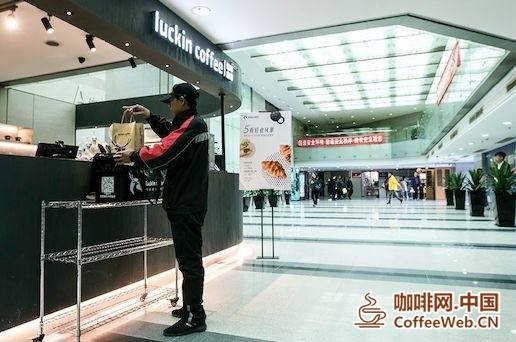

Internet coffee represented by Ruixing is accelerating its attack on traditional coffee such as Starbucks. Will it be a zero sum game?
Reporter Xie Yunzi from China Entrepreneur
Photography | Deng Pan
As 2018 came to an end, Luckin Coffee began to accelerate its pace. On December 12th, Luckin Coffee received a Series B financing of $200 million, with Liu Erhai, founder and executive partner of Joy Capital, becoming a director. Luckin Coffee also entered Meituan and opened API interfaces with more companies.
On January 1, 2018, Luckin Coffee conducted a trial operation at Beijing Galaxy SOHO, and it only took 5 months for Luckin Coffee to become the second largest player in the Chinese coffee market from scratch. According to data provided by Yang Fei, COO of Luckin Coffee, as of May 2018, Luckin Coffee has 525 stores nationwide. On July 11th, Luckin announced the completion of its Series A financing of $200 million, with a valuation of $1 billion. This number doubled again five months later, increasing to $2.2 billion. This also means that Luckin Coffee has sufficient financial reserves to continue its rapid expansion strategy.
According to official data, as of December 25, 2018, Luckin Coffee's 2000th store was born in Shanghai. The latest store opening plan displayed on the Luckin APP is the Suda Tiangong store located in Suzhou – the store's serial number is 2558.
In the Chinese market, Internet coffee represented by Ruixing is accelerating its attack on Starbucks and other traditional coffee, but is this a zero sum game?
Starbucks strengthens offline image
On the other hand, Starbucks, which has always been placed on the opposite side of Luckin Coffee, has not slowed down its growth advantage in the Chinese market. It is worth noting that although Starbucks has launched its food delivery business, it still strengthens its offline stores. The two have different genes and advantageous business scenarios.
Public data shows that in the fiscal year 2018 (October 1, 2017 to September 30, 2018), Starbucks China added 585 new stores and entered 17 new cities. As of early December 2018, Starbucks has opened over 3600 stores in more than 150 cities in the mainland Chinese market.
At the investor conference in May 2018, Starbucks President Johnson also said that the number of stores in Chinese Mainland would reach 6000 by 2022, and would continue to deepen cooperation with Ali. In September 2018, Starbucks and Elemente jointly launched the delivery service "Special Star Delivery", which is considered to be the breakthrough of traditional giants under the siege of Internet coffee.
Earlier, according to the self media "Industry Storm", "the problem of low sales in Starbucks' food delivery business is widespread" and "Ele.me's delivery order volume is far lower than that of some unofficial errand and purchasing stores". And consumer Xiao Yang also told China Entrepreneur magazine that he chose to use the mini program "black hand" to purchase Starbucks products on behalf of others because the third party does not have to bear excessive delivery costs.
We cannot disclose the sales data of Zhuanxingsend, but we can be certain that the launch of Zhuanxingsend has brought more demand and customers to our stores. Zhuanxingsend is currently in its initial development stage, and compared to the sales growth brought by this business, we are more concerned about bringing more convenience to customers, "said a Starbucks spokesperson to" China Entrepreneur "magazine.
That is to say, in Starbucks' view, stores are still the unique brand value and core. "We are proud of the high quality and unique third space experience created by customers". At the same time, the person also said that Starbucks will still focus on stores in the future, but this is the "barrier" that Internet coffee represented by Ruixing has always wanted to break.
Since its establishment, Luckin Coffee has hoped to break the cost structure of relying on stores to attract customers in the coffee industry through big data.
Luckin uses algorithms to calculate store location, business efficiency, and store purchase quantity, and has been heavily advertising on channels such as WeChat and Focus Media from the beginning. Luckin's marketing team has revealed that in the first three months of 2018, Luckin spent over 8 million yuan on advertising on social media. At the same time, Luckin Coffee is rapidly expanding its offline stores, hoping to break the boundaries of coffee consumption through a combination of offline and online methods, and create the concept of "infinite scenes". Of course, this is also similar to what Starbucks CEO Schultz previously called the "fourth space".
At present, Luckin Coffee has four types of stores: flagship store, Youxiang store, express delivery store, and takeaway kitchen. Among them, the takeaway kitchen accounts for about 20% and mainly serves as a front warehouse. In the view of Pan Yuxin, a partner at Langran Capital, the front-end warehouse is the greatest value of Luckin Coffee. "The front-end warehouse is the key to achieving unlimited scenarios for Luckin Coffee, and unlike fresh fruits, coffee has a lower degree of loss.
The fresh business logic has enabled Luckin to gain more capital favor, but the story between Starbucks and Alibaba continues. On December 14, 2018, Starbucks announced the launch of a new online retail store. When customers order a cup of coffee in the Starbucks store, whether they open the Starbucks app, Taobao app or Alipay app, they can scan the code to complete payment and star card points without jumping. This is the first time that Alibaba Group has fully opened its connected ecosystem to brands.
Shortly thereafter, Luckin announced the opening of API interfaces for enterprise customers, and in the spirit of "the enemy of the enemy is a friend", quietly joined Meituan on December 19th. API is an interface, but through this interface, enterprise users can share coupon and other data with Luckin Coffee. However, this cannot be compared to the data integration between Starbucks and Alibaba. The active users of Starbucks and Alibaba have reached 600 million, and Luckin Coffee has been constantly controversial while rapidly expanding.
Platformization of images is the key to Luckin Coffee's profitability
Before announcing its Series B financing, Luckin Coffee increased the amount of free delivery fees in Beijing and Shanghai, raising the average customer price from 35 yuan to 55 yuan.
In response to this, the official response from Luckin Coffee to China Entrepreneur magazine: "Currently, only Beijing and Shanghai have raised the minimum threshold for free delivery fees. In the next step, Luckin Coffee will still adopt different methods to subsidize users at different times, providing high-quality coffee to customers on the basis of high cost-effectiveness and convenience. Our established strategy is to quickly occupy the market through subsidies, and losses are in line with our expectations
In August 2018, Luckin Coffee launched a half price light food service, adhering to the strategy of quickly occupying the market through burning money subsidies.
That is to say, Luckin will still need to burn money to gain market share for a considerable period of time in the future. If we only calculate direct costs, Starbucks' gross profit margin per cup is around 50%, while Luckin Coffee's is much different, "Yao Ning, General Manager of Ruiyide's Marketing Services Department, told China Entrepreneur magazine." It took Starbucks about five years to achieve comprehensive profitability in mainland China, but the times are completely different now
It can be certain that at the beginning of brand establishment, losses are a normal state. Luckin Coffee CEO Qian Zhiya believes that every penny burned by Luckin Coffee can be exchanged for users. According to Luckin Coffee's response, the company will still insist on providing moderate subsidies to users, but the specific subsidy methods and intensity will be adjusted appropriately depending on the business situation. Some analysts believe that under the previous aggressive spending, Luckin Coffee may intend to gradually narrow the subsidy intensity in some markets, which may cause Luckin Coffee to lose some users. The key issue still lies in whether the subsidies invested earlier have brought user stickiness, or whether the subsidies have resulted in a "repeat purchase rate" for the product.
From the data, Luckin Coffee has 12 million users and sold a total of 85 million cups of coffee, with an average consumption of about 7 cups per user. Luckin Coffee's official statement states that the current retention rate of old customers is very high, and coffee is a beverage that is frequently and heavily consumed. As long as we do a good job in user profiling and CRM (customer management), we will not worry about the issue of repeat purchase rate.
According to a screenshot obtained by Curiosity Daily, which is said to be part of Luckin Coffee's Series B financing business plan, Luckin Coffee expects its revenue to reach 763 million yuan in 2018 and 18.5 billion yuan in 2021. Luckin has not made an official response regarding this revenue plan, but this figure is almost 24 times the revenue that Luckin hopes to achieve in 2018.
In Yao Ning's view, the demand for coffee in the market will not increase rapidly in the next two to three years. "In the context of an economic downturn, it is difficult for coffee consumption to experience explosive growth. If Luckin wants to increase its revenue 24 times in 2021, it can only seize most of the current market share of Starbucks and other brands. Of course, it is difficult for the outside world to make a judgment until Luckin confirms this number
However, it can be certain that Luckin Coffee will become more of a platform in the future, selling other products besides coffee. Pan Yuxin even believes that "platformization" is the key to Luckin Coffee's profitability.
After the B-round financing, Liu Erhai, founding and executive partner of Joyful Capital, became a director of Luckin Coffee. However, unlike Luckin Coffee's previous attitude of viewing Starbucks as a competitor, Liu Erhai referred to Luckin Coffee as "data coffee" in an interview with Sina Technology and firmly believed that in the future, data coffee will become a supplement to offline coffee formats such as Starbucks.
In Liu Erhai's view, having experience in both online and offline operations of the Shenzhou series is the key to Luckin's rapid and large-scale expansion. Meanwhile, with the increasingly improved network infrastructure, the Chinese coffee industry has ushered in a turning point from niche demand to mass consumption.
Of course, Liu Erhai also believes that Luckin still faces significant challenges.
The real opponent of the picture
To be sure, the fast horse racing enclosure has made Ruixing have few rivals in China, even far more than the early "Lian Coffee", and become a synonym for Internet coffee. Nevertheless, Luckin's sense of crisis still exists. Earlier, Qian Zhiya also told the media that Luckin will use 3 billion yuan in cash to deal with potential competitors. So, who are Luckin's potential competitors?
"If other giants also spend a lot of money to support other Internet coffee brands, they will form a real competitive situation with Ruixing." In Pan Yuxin's view, Internet coffee may have touched the traditional coffee brands, but Ruixing's impact on Starbucks is not as great as expected.
More voices believe that the current coffee users are mainly divided into two parts: first, young people who firmly believe that mobile phones can solve all life needs, and they are also the main target group of Internet coffee. In addition, a portion of users consume coffee for social purposes, with business interactions mainly concentrated at Starbucks, and private socializing mainly at Korean brands such as Man Coffee and ZOO COFFEE.
That is to say, in the existing coffee user pattern, Internet coffee users do not completely overlap with users of traditional coffee stores. Social networking will eventually be launched offline, and the delivery mode is not enough to make Starbucks loyal users defecte. Of course, unlike Liancoffee, Luckin Coffee not only provides convenient online services for users, but also implements the concept of "unlimited scenarios".
During an interview with Guo Jin, co-founder of Luckin Coffee, "Chinese Entrepreneur" obtained a set of data: Luckin Coffee's online to offline order ratio was around 7:3, and in the following months, Luckin Coffee opened a large number of "self pickup stores" (only counters, mostly located in office buildings, where consumers take their coffee away after placing an order), significantly reducing the gap between online and offline orders. Of course, this also confirms that Luckin's user profile is mostly composed of white-collar workers living in office buildings and cubicles.
In addition, compared with Starbucks, Luckin Coffee's "pure Chinese" heritage has more advantages. It can open stores in the Forbidden City without being criticized, and because it is not constrained by store costs, it can be used as a small pickup shop or even a central kitchen delivery point. Luckin Coffee can acquire more low floor area shops similar to bookstores or office buildings, with higher penetration rate and more beneficial to enhancing brand image. Of course, the premise of all of this is that Luckin's logic of "digital technology leading store operations" can be smooth.
But just as "Starbucks itself is not the one that defeats Starbucks", for Internet coffee, the growing number of "new tea drinks" cannot be ignored.
In the "2019 China Beverage Industry Trend Development Report" released by Meituan, it was pointed out that as of the third quarter of 2018, the number of freshly made tea beverage stores in China reached 410000, an increase of 74% within a year. The new growth mainly comes from consumers' replacement of conventional beverages and the demand for "healthy tea drinks" from consumer groups. And the report also shows that more than half of consumers of freshly made tea drinks hope that businesses can provide convenient services such as "pre ordering (ordering first, then self pickup)". Compared to coffee, Chinese consumers naturally have a higher acceptance of tea drinks.
Earlier, Guo Jinyi told China Entrepreneur magazine that Luckin Coffee hopes to become an "equal rights advocate" for Chinese coffee and achieve its goal in the education market through subsidies.
Luckin Coffee's CMO, Yang Fei, said, "Today's Luckin Coffee has at least figured out its profit model (making money from each order), subsidy model (investing first and then negotiating), and marketing model (having its own traffic pool)
"Starbucks has been the representative of American coffee for 20 years. Ruixing wants to represent Chinese local coffee brands, which still needs to be settled at present. What is Chinese local coffee still needs to be discussed together." In Yao Ning's view, Internet coffee brands need to be alert to the appearance of "expansion for expansion", and can not violate the most basic business logic. "It is fundamental to pay attention to the nature of products and profitability, after all, the money burned will eventually be earned back".
Xie Yunzi xieyunzi@iceo.com.cn
On duty editor: Gao Huanhuan Reviewer: Yang Qian