
Recently, the reporter learned from Meituan that from May 1st to the end of June, there were 376 new coffee shops in Guangzhou. At the same time, the Guangzhou Commodity Exchange stated that the trading volume of coffee beans from January to May 2026 reached 12409.92 tons, which is more than 10 times that of the whole year last year. The vigorous vitality of terminal consumption is in line with the rapid growth of upstream trade transactions, and the coffee industry map in Guangzhou is undergoing profound changes.
Currently, the Guangzhou Commodity Exchange is innovating its model to efficiently bring global coffee green bean resources to Guangzhou, promoting key links such as import, warehousing, processing, and settlement to gather in Guangzhou, fully unleashing Guangzhou's trade potential, and helping Guangzhou upgrade from a consumer terminal to a hub of the entire industry chain.
Green coffee beans achieve 'whole in and zero out'
In the past, we had to obtain goods from several raw bean traders, and different traders made beans from different production areas, which made communication very cumbersome. Moreover, we had to gather enough whole containers (about 18 tons) to get relatively good prices. If the whole container of raw beans couldn't be used up at once, storing them would also take up rent, "said Zhou Heqing, the relevant person in charge of Huasheng Coffee Guangzhou Company, which specializes in roasting coffee raw beans.
This is a typical dilemma of traditional coffee trade, and the electronic warehouse receipt system launched by Guangshang has changed this situation. Through the "whole in and zero out" mode, coffee green bean trading enterprises can store bulk imported green beans in designated bonded warehouses, generate electronic warehouse receipts, and sell them to manufacturers in batches as needed, achieving full container loading and separate bill out, reducing the pressure of tax capital occupation.
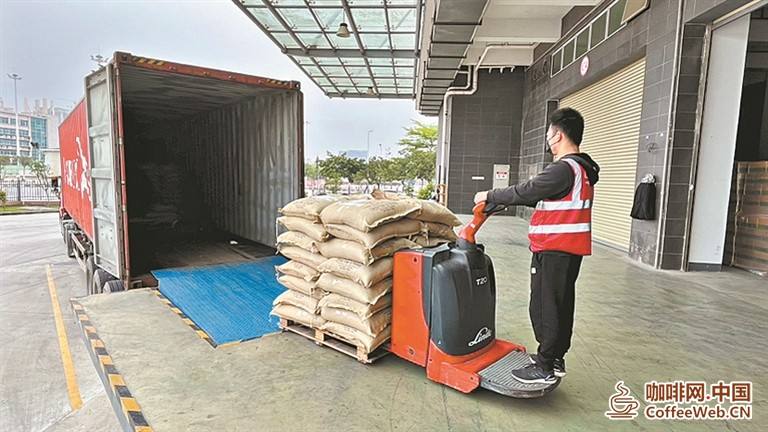
The coffee beans from the coffee raw bean trader are out of stock.
For trading clients such as Huasheng Coffee Guangzhou Company, the Guangshang platform also brings convenience. You can centrally select goods on the platform, which is the first layer of convenience; the Guangshang platform can help us connect with foreign soybean shippers, handle complicated procedures such as shipping and customs clearance. For example, our roasters only need to connect with bonded warehouse spot goods, saving a lot of intermediate links and significantly reducing procurement costs. Guangshang also has a subsidy, and the bonded warehouse stores coffee beans for a 3-month rent free period. I don't need to clear customs and pay taxes for the whole container of beans I buy, as long as I pick up the goods gradually within 3 months. This way, we don't have to go to Shanghai to purchase goods, we can purchase from Nansha, and transportation costs are also reduced, "said Zhou Heqing.
Zhou Bing, Chairman of Guangzhou Commodity Exchange, stated that under the traditional model, imported green beans need to pay customs duties and value-added tax before entering the domestic market, while the bonded trading mechanism is completely different: goods entering the bonded warehouse are temporarily exempt from customs duties and value-added tax, and taxes are paid according to the actual outbound volume; Traders holding warehouse receipts can transfer goods to different distributors in a bonded state without the need for prior tax payment. Bulk stockpiling can cause price fluctuations, and different distributors can transfer warehouse receipts under bonded status without occupying so much capital
The value of digital warehouse receipts is not just about breaking them down. Relying on blockchain certification technology, the entire process data of each batch of coffee beans from origin to delivery is uploaded to the chain, achieving "traceable source, traceable destination, and accountable responsibility". This has turned agricultural products that were previously "invisible and intangible" into digital assets that can be circulated and financed.
In addition, digital warehouse receipts enable fast online credit, shortening the payment cycle for small and medium-sized traders by nearly half. Zhou Bing stated that in the long term, the platform will connect with Zhengzhou Commodity Exchange, establish a mutual recognition channel for warehouse receipts, achieve integration of warehousing and supervision, and unify the industry standardization system. The person in charge of an import and export company in Guangzhou introduced that using warehouse receipts as collateral financing has solved the cash flow problem. Previously, we seized the opportunity of low-priced hoarding in Ethiopia at the end of the season and used production capacity for pre-sale transactions, which increased our profit margin. The inventory turnover rate has increased from 1.2 times to 3.5 times, and the capital efficiency has been nearly doubled.
Yunnan's premium beans reshape pricing initiative
The bulk commercial coffee beans have a mature pricing system with ICE (Intercontinental Exchange) futures as the core, and the prices are relatively transparent. However, the coffee bean production areas in Yunnan have always faced an awkward situation: with an annual output of about 100000 tons of raw beans, which accounts for the vast majority of domestic bean production, they have long lacked a say in pricing.
In March of this year, Guangshang Exchange officially established the "Menglian County Coffee Green Bean Trading Special Session", set up a registered delivery warehouse in Menglian, and introduced a pricing mechanism of "benchmark transaction price+variety premium discount". This model takes the price of mainstream commercial beans as the benchmark, sets differential premium according to the production area, grade, flavor and storage cycle of coffee beans, and gradually forms an open and transparent regional price index through the continuous precipitation of transaction data on the platform. Zhou Bing introduced that he hopes to use this platform to help Yunnan production areas accurately discover prices and take the initiative in pricing.
At the same time, independent coffee shops and boutique bean roasters in Guangzhou can also use this price reference to understand and purchase Yunnan's premium bean resources.
In response to the pain points of coffee farmers' concentrated selling of beans during the production season and price pressure, the platform has simultaneously launched a flexible mechanism – coffee farmers can choose to sell their stored raw beans at an appropriate time, withdraw payment on demand, or realize one-time third-party cash flow through the platform. In the past, coffee farmers had to sell at low prices during the production season, but now they can wait for a good price, "Zhou Bing said. The platform synchronizes with supporting agricultural insurance, stabilizes upstream supply, and connects the complete chain of "direct procurement from production areas – digital warehousing – national distribution".
Behind this model is a larger strategic vision of Guangzhou Commodity Exchange – to gradually cultivate the influence of "Guangzhou prices" through spot trading in the context of coffee futures not yet being implemented. Zhou Bing expressed his hope to make Guangzhou an important pricing reference for coffee trade, allowing good beans from Yunnan production areas to enter the national and even global markets through here.
Make Guangzhou a core coffee resource allocation hub
On May 28th, the China ASEAN characteristic agricultural product digitization service platform was officially launched in Hekou, Yunnan. On that day, the first 30 tons of Vietnamese Robusta coffee beans were traded through an online system.
The innovation of this transaction lies in utilizing the policy advantages of cross-border trade and the online services of digital platforms to directly connect Vietnamese coffee beans from border production areas to domestic downstream buyers, greatly improving trade efficiency. With the implementation of the Regional Comprehensive Economic Partnership Agreement, coffee trade between China and ASEAN continues to grow. Guangzhou, with its location and platform advantages connecting domestic and international markets, has enabled more coffee beans from different production areas to be traded and distributed here, continuously increasing the scale and influence of coffee trade in Guangzhou.
Zhou Bing stated that Vietnam's imported coffee beans have long been among the top three in the Chinese market, and a large portion of Vietnam's beans enter the domestic market through traditional small-scale border trade, with low standardization and scattered procurement by small and medium-sized buyers, resulting in insufficient quality stability. After connecting with the bonded warehouse system through the China ASEAN characteristic agricultural product digitization service platform, Vietnamese green beans can enter the Hekou registered delivery warehouse in bulk to complete standardized grading and storage, forming compliant and transferable electronic warehouse receipts. Domestic buyers can pick up goods in small quantities as needed, which not only ensures quality stability but also reduces the procurement threshold for small and medium-sized merchants, further enriching the coffee category supply on the Guangzhou platform and attracting more global production area resources to settle and gather.
Guangshang has established a three-dimensional warehousing network with Nansha Free Trade Zone as the core and Qingdao Free Trade Zone warehouse as the fulcrum, consisting of "port bonded+origin warehouse+national distribution warehouse". Zhou Bing stated that bonded trading is a long-term business plan of Guangshang Exchange and is still being continuously improved.
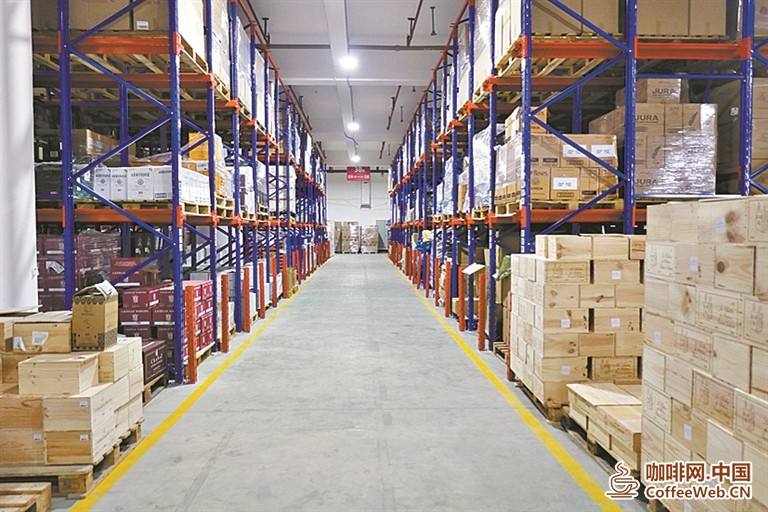
A bonded delivery warehouse for coffee beans located in Nansha.
The settlement process is also innovating. Guangshang Institute collaborates with multiple banks to create a cross-border settlement and supply chain finance platform, promoting direct settlement of coffee trade between China and Vietnam in RMB. In 2025, Guangshang Exchange also completed the first domestic coffee bean transaction settled in digital RMB, achieving synchronous delivery of funds and goods through smart contracts. Based on the RCEP rules and the location advantage of Guangzhou Port, coffee beans from ASEAN countries such as Vietnam can be picked up through Nansha Port in just 1 to 2 days.
Data shows that relying on these innovative models, the trading volume of coffee beans on the Guangshang Exchange platform has jumped from 1134.8 tons for the whole of last year to 12400 tons from January to May 2026.
Our goal is to make Guangzhou a core coffee resource allocation hub, "said Zhou Bing. With the continuous release of the influence of "Guangzhou Price" and the successful hosting of the 2026 Guangzhou Coffee Culture Season, the Guangshang Exchange platform will continue to inherit and transmit through innovative trading models as a lasting driving force for industrial development. The trade of green coffee beans is driving the acceleration and collaborative upgrading of the entire coffee industry chain in Guangzhou.