
Brief (coffeeyo.com): Luckin is paving the way to relaunch its IPO. A cross-border deal just shook the market: Middle East heavyweight Mubadala made a ~1 billion US dollar strategic investment in Luckin — the largest single bet by a Middle Eastern sovereign fund on China’s made-to-order coffee track in recent years.
This article is from the WeChat public account “Haokan Business,” author Haokan Business, editor Anxin.
Luckin is already paving the way to relaunch its IPO.
Recently a cross-border transaction stirred the market: Middle East heavyweight Mubadala made a strategic investment in Luckin Coffee, with a deal size of about 1 billion US dollars.
Per public disclosure, Mubadala did not directly inject capital or take equity in Luckin; rather, it bought a portion of Luckin’s senior convertible preferred shares from Centurium Capital, Luckin’s controlling shareholder, for total consideration of about 1 billion US dollars.
The sellers were two Centurium entities, CCM Lucky and Centurium Fund I, which transferred 82.937 million and 158 million shares respectively — a combined 241 million Luckin preferred shares.
The buyer, Success Cup Limited, is a wholly owned subsidiary of the CCM Success Fund. Centurium Capital is the general partner (GP) of the CCM Success Fund, and Mubadala is the core limited partner (LP).
One could say this transaction is merely Centurium “moving money from its left hand to its right” — swapping the LP behind it: bringing in a new LP, giving the old LP a cash-out exit, while extending Centurium’s investment horizon on this tranche of Luckin equity.
So this deal did not change Centurium’s stake in Luckin; Centurium still controls a combined 22.08% beneficial ownership and remains the largest shareholder.
Once the share transfer completes, as long as Mubadala’s holding stays above 5%, it gains the right to appoint one director to Luckin’s board.
This is the first time since Luckin’s 2020 self-exposed financial fraud that it has introduced a new strategic investor. Mubadala’s 1 billion US dollar takeover of part of the equity also set a record for the largest single investment by a Middle Eastern sovereign fund in China’s made-to-order coffee track in recent years.
Having pulled off a stunning reversal in the coffee market, Luckin needs to win once more in the capital market. It is not hard to see they are already laying the groundwork to relaunch the IPO.
Centurium’s In-and-Out Maneuvers
Mubadala is the UAE’s second-largest sovereign wealth fund, with 385 billion US dollars under management. As a top Middle Eastern backer, its takeover of part of Luckin’s equity was bound to draw market attention.
But for Centurium Capital, this was just one of its many Luckin equity maneuvers.
At the end of February 2025, Centurium held 31.3% of Luckin; by this September that stake had fallen to 22.08%.
Behind the decline, beyond directly selling some shares for cash, Centurium mostly distributed its Luckin holdings proportionally to the LPs behind the fund.
Per public disclosure, from March 2025 to September 2026, Centurium’s holding entities sold a combined 55 million-plus Luckin Class A ordinary shares, cashing out over 200 million US dollars.

Yet of Centurium’s roughly 8-percentage-point drop, the vast majority was not share sales but distributing stock proportionally to the fund’s LPs.
From June to October 2025, Centurium entities Cameleer L.P. and Cameleer II L.P. transferred about 177 million Class A ordinary shares to their respective LPs proportionally. In other words, the holders of this tranche of Luckin stock shifted from Centurium to its LPs, which sharply lowered Centurium’s direct stake in Luckin.

As a Luckin shareholder, Centurium has long stressed its long-term optimism about Luckin’s business model and prospects. Over more than six years, Centurium has backed that words with real money.
As early as 2018, Centurium invested 100 million US dollars to become a Series A investor in Luckin. Before the IPO, Centurium had put nearly 180 million US dollars into Luckin, holding 11.84% and ranking as the largest institutional shareholder.
After Luckin’s self-exposed fraud, in 2021 — when capital was broadly exiting — Centurium led a 250 million US dollar financing round, supporting Luckin’s overseas debt restructuring and SEC settlement.
In 2022, Centurium led a consortium to acquire the shares of Luckin’s management that had been liquidated; after the deal, Centurium became Luckin’s controlling shareholder with over 50% voting rights. By February 2023, multiple Centurium Cayman entities held 32.7% of Luckin with 55.7% voting power.
Centurium taking control not only ended prolonged equity infighting but helped Luckin thoroughly restructure its governance. With shareholder support, management led Luckin step by step back to its peak. One could say Centurium was the single most pivotal force in Luckin’s phoenix-like rebirth.
Why, starting in 2025, did Centurium’s Luckin stake begin to fall?
The key lies in Centurium’s fund cycle. In March 2018, Centurium’s first dollar fund began fundraising, closed its first 1 billion US dollar tranche in June, and invested in Luckin that July. Eight years on, Centurium needs to provide exit channels for the fund’s LPs.
Luckin delisted from the Nasdaq main board in June 2020 and later moved to the OTC Pink sheets. There, though liquidity is poor and price swings are violent, trading continues.
As Luckin’s business improved, its share price climbed sharply — 1.38 US dollars/ADS on delisting day; by September 18, 2026, the close reached 35 US dollars. Roughly calculated, that is a gain of over 25 times.
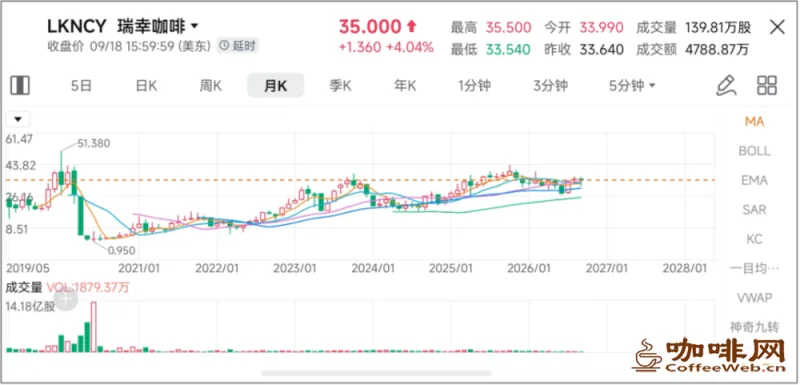
To meet LP exits, Centurium had several paths: selling shares via public markets or block trades, distributing equity directly to LPs, or “swapping the cage and moving the bird” — using a new LP to replace some old LPs. From Centurium’s current practice, all three were used, but the focus was on the latter two. The recent Mubadala cooperation sells the equity rights of about 241 million preferred shares — formerly held by some old LPs — to Mubadala, with Centurium as GP continuing to manage that tranche.
Mubadala is not a short-term financial investor but a strategic one. Through this move, Centurium keeps firmly emphasizing one thing: long-term optimism about Luckin’s business model and prospects.
For Li Hui and the Centurium he founded, Luckin is already a special existence of great significance.
Centurium was Li Hui’s start after ending a decade-plus career in foreign PE — positioning itself as a “new-generation local PE.”
Luckin was Centurium’s first investment and once its signature deal. The fraud not only briefly shamed Centurium’s reputation but seriously disrupted its second dollar-fund fundraising rhythm.
Rise where you fell. Today, Luckin — China’s dual No. 1 in store count and revenue — is Centurium’s masterpiece of perseverance and revival, the best proof of its professional vision and capability.
To this day, perhaps no one expects Luckin’s next successful IPO more than Centurium.
Luckin’s Open Strategy: Globalization and Governance
That Luckin is now plotting an IPO relaunch is understandable. As early as the Q3 2024 earnings call, management responded to outside concerns, saying it would keep watching the US capital market but had no specific timetable for returning to a US main board.
But to relaunch an IPO, Luckin needs a new growth story, a healthier governance structure, and long-term money willing to pay.
Domestic coffee competition is brutal; Luckin’s growth has clearly slowed. This year’s Q2 revenue grew 28.57% — arguably its lowest record ever.
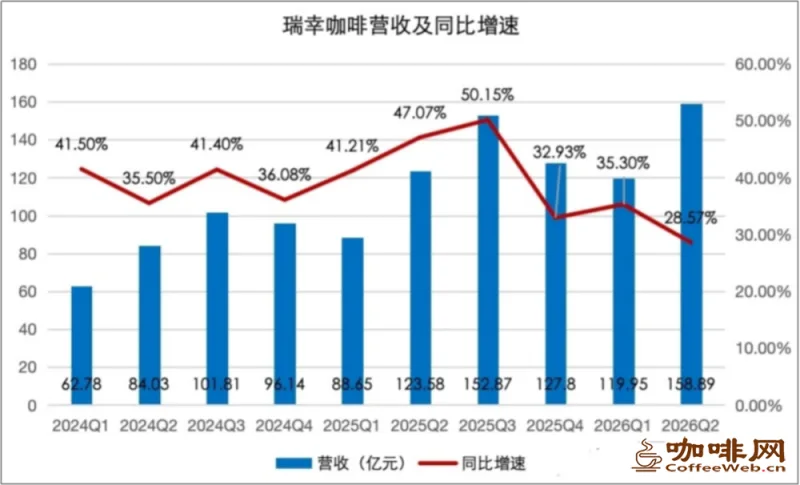
One point worth vigilance: the scale dividend is fading. Stripping out growth from new stores, Luckin’s same-store sales growth at directly operated stores keeps falling: 14.4% during last year’s Q3 delivery wars, to −5.3% this year’s Q2 — a near-20-percentage-point drop in four quarters.
To open new growth, Luckin officially went overseas in 2023, first stop Singapore. By end-Q2 2026, Luckin’s overseas stores reached 223, 0.6% of its global total; Q2 net added 46, of which Malaysia 31, Singapore 7, US 8.
Luckin is still early overseas, with small revenue and a far slower store pace than at home. But conversely, there is much to do in overseas markets — globalization is Luckin’s new growth story.
Behind Centurium bringing Mubadala into Luckin, globalization is the shared design of all three parties. The head of Mubadala’s private equity for Asia said, “We look forward to working shoulder to shoulder with the Luckin management team to support the company’s next phase of growth in China and international markets.” Centurium likewise said, “We believe Mubadala’s deep industry accumulation, global vision, and resource network will help Luckin keep innovating and achieve long-term development.”
Mubadala’s 1 billion US dollar entry as a Luckin shareholder is also the first time since Luckin’s blowup and delisting that a top international sovereign fund joined as a new strategic shareholder.
The 2020 fraud is Luckin’s biggest scar in capital markets. Bringing in a top global sovereign fund as a new strategic shareholder clearly endorses the repair of Luckin’s historical negative label and lowers international capital’s qualms about its internal controls and compliance.
Meanwhile, overseas institutional investors prefer listed companies with diversified shareholder structures. Luckin’s structure of a single PE in heavy control is a clear shortcoming; it may make institutions worry about the independence of operations and governance, in turn affecting valuation and subscription willingness.
After the deal, Mubadala will become Luckin’s second-largest shareholder with a chance to appoint a director. Luckin’s shareholder pool will upgrade from “local PE control” to a diversified “local PE + global sovereign fund,” helping optimize governance and strengthen capital-market confidence.
Why a Middle East Fund?
Mubadala is a sovereign investment platform wholly owned by the Abu Dhabi government, currently managing about 385 billion US dollars — a typical industrial sovereign fund of the Middle East.
In global capital markets, Mubadala is a force to be reckoned with. As early as 2015 it entered China and opened an office here in 2023.
In its low-profile years in China, Mubadala’s name was not a household word, yet it invested in many well-known projects — Meituan, Kuaishou, BOSS Zhipin, XPeng, and recently IPO’d SHEIN among them.
Beyond consumer tracks, Mubadala has deeply deployed AI, chips, and cloud computing in China’s tech sphere; in biomedicine it invested in Haisen Biotech and UCB China, among others.
In style, Mubadala does not simply chase short-term financial returns but seeks quality industrial targets, sharing China enterprises’ growth dividends while leveraging their globalization capacity to meet Abu Dhabi’s diversification goals.
In other words, relying on oil wealth to push Abu Dhabi out of the straitjacket of a single-energy economy is Mubadala’s underlying logic.
In fact, Mubadala is a microcosm of today’s Middle Eastern capital. Geopolitical risk and the strategic need for “de-oiling” transition push Middle East funds to accelerate their eastward push.
Per Global SWF data, Middle East funds’ allocation to Asia-Pacific assets rose markedly. Especially the Saudi Public Investment Fund and Abu Dhabi Investment Authority showed a clear strategic pivot in 2024–2026 — from traditional European and US real estate and bonds toward more active Asia-Pacific (especially China) equity and industrial investment.
By end-Q1 2026, the two Middle East headline sovereign funds — Abu Dhabi Investment Authority and Kuwait Investment Authority — held a combined 21.762 billion yuan in heavy A-share positions, up about 141.48% year on year.
In Hong Kong, Middle East sovereign funds have also become important “strategic ballast.” Data shows their cornerstone-investment participation in Hong Kong IPOs rose from 18.5% in 2024 to 38.8% in Q1 2026.
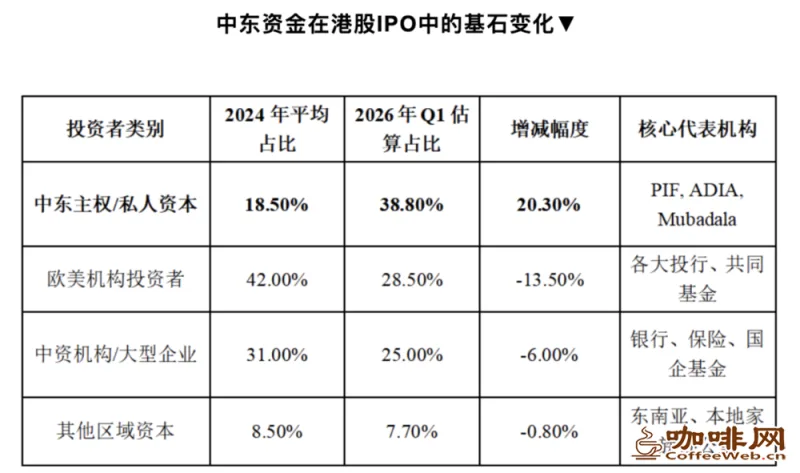
Middle East funds differ markedly from traditional US capital. US capital weighs short-term earnings swings and secondary-market liquidity and is highly sensitive to geopolitical risk. Middle East sovereign funds, funded by long-term national reserves, prize long-term industrial synergy.
Back to Mubadala: its primary-market entry into Luckin will undoubtedly endorse and ballast Luckin’s upcoming IPO, drawing more Middle East money and even other global institutions.
Yet, with hard tech dominating global capital markets today, as the era of cheap capital ends and geopolitical tensions persist, new-consumer and internet companies’ valuations stay under pressure.
Luckin, having missed its golden window, needs some timing and favorable conditions — beyond human effort — to win once more in the capital market.
Reprint Note & Disclaimer
- This article is compiled and edited by coffeeyo.com. The materials and images herein are sourced from public channels and the copyright belongs to the original authors. This site reprints them solely for information sharing within the coffee industry and does not represent our stance; all data and views are subject to the original source. We thank the original authors for their work and sharing.
- For matters concerning content authorization, attribution, copyright, or any other issues, please contact us promptly. We will verify and cooperate in handling them without delay. We also welcome coffee-growing regions, brands, and industry media to exchange and contribute articles with us.
- Contact coffeeyo.com — Tel: 400-0000-641 (+86-18288016826) | Email: 405854472@qq.com | Address: Jinghong City, Xishuangbanna, Yunnan / Tieling City, Liaoning
Reprint Notice & Disclaimer
- This article has been edited and compiled by China Coffee Network. The information and images therein come from public sources and the copyright belongs to the original author. This reprint is intended solely for information sharing within the coffee industry and does not represent the views of this website; all data and opinions are subject to the original article. Our thanks to the original author for creating and sharing it.
- For matters concerning content licensing, attribution, copyright or otherwise, please contact us promptly and we will verify and cooperate in handling them as soon as possible. We also welcome coffee origins, brands and industry media to exchange ideas and contribute articles.
- Contact China Coffee Network: Tel 400-0000-641 (+86-18288016826) | Email 405854472@qq.com | Address: Jinghong, Xishuangbanna, Yunnan Province / Tieling, Liaoning Province
Related Reading
 ‘All-Ice’ Coffee Goes Viral! Will the Next Hit Be Your Personal Favorite?
- Hong Kong’s Dyee Coffee Lands in Qianhai, Building a Specialty Pour-Over Outpost
 Ken Yue Coffee Opens Egg-Tart Pop-Up in Hangzhou: Sweet Craft, Reinvented Classics
 World Cup Enters the Breakfast Slot: Can Coffee-Tea Brands Turn Traffic into Orders?
- ICE Agricultural Futures Mostly Rise at Close; Coffee Futures Up 3.28%
- ‘Sleep Cafés’ Become a New Favorite Among Seoul Office Workers



 Liaoning ICP Security No. 21122402000217