
In the National Day golden week just ended crowds poured across the country. As the Lukes and Floras left the city CBDs, coffee went with them, out of office towers and urban business districts. It was once tied more to metropolises, commuting and offices.
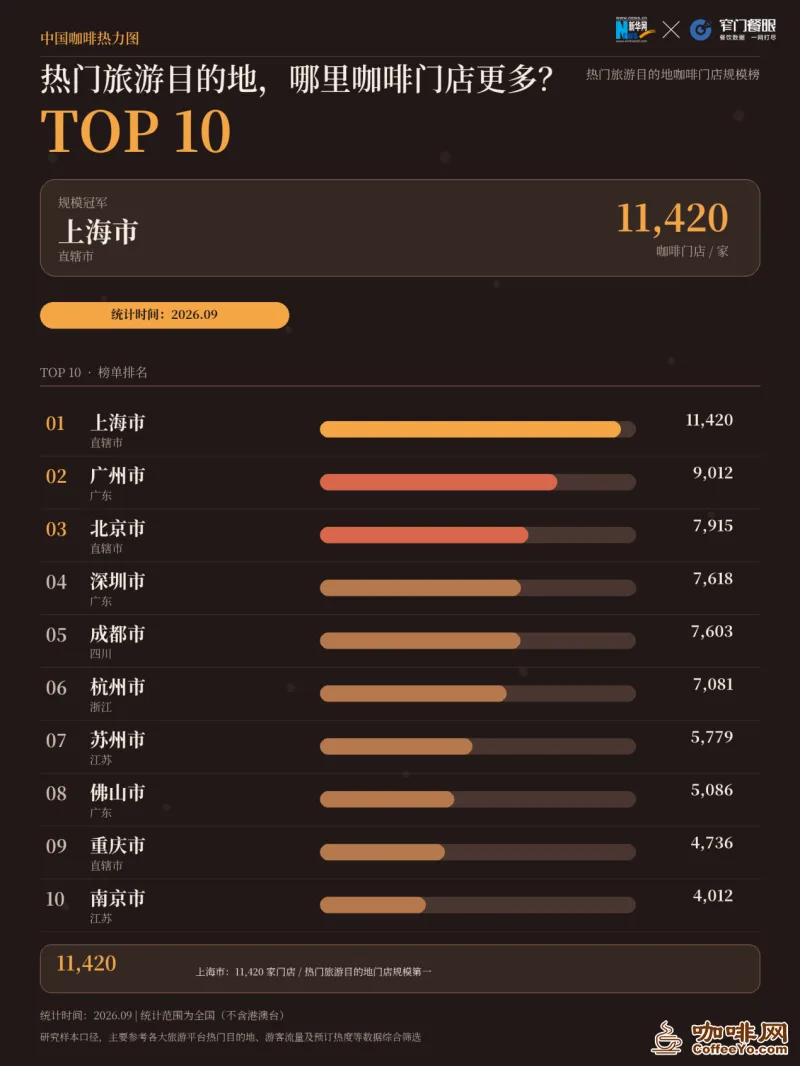
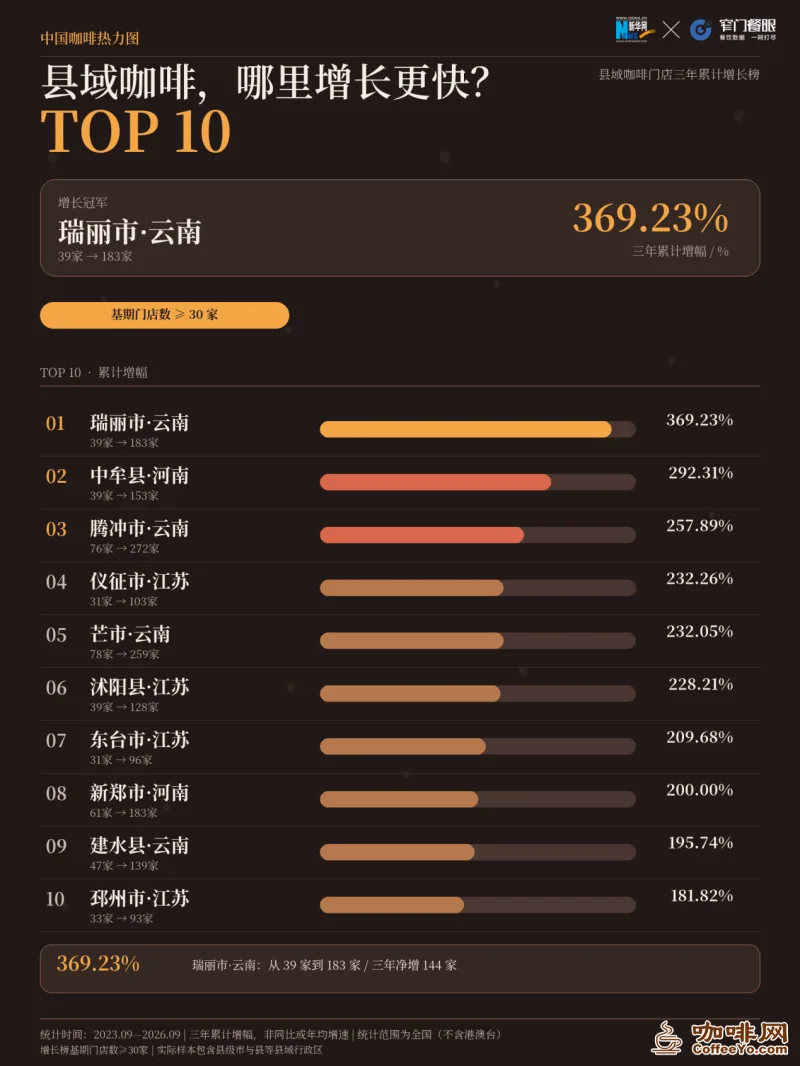
Shanghai has long been seen as the place in China with the strongest coffee culture, with 11,420 coffee shops, more than any other city in the country and in the world, and in areas dense with business districts and office towers the shops cluster at striking density. Data are now rewriting that impression: the city with the highest “coffee concentration” in China is no longer Shanghai, the total number of coffee shops in county-level areas already exceeds that of new first-tier cities, and in a small border city such as Ruili the number of stores grew by more than 360 percent in three years.
Coffee’s reach into a wider market depends on chains’ continued expansion. Relying on scaled store networks, leading brands bring high-quality coffee to more consumers. Take Luckin Coffee: its network already covers regions at every tier, from city business districts to counties and townships, from office buildings and communities to transport hubs.
But store coverage is only a change on the supply side. Once people leave their familiar commuting circles, does coffee consumption break out of its old boundaries? Xinhuanet, together with Kuaimen, recently released the China Coffee Heat Map, using data to observe the regional distribution and consumption trends of China’s coffee market. The wave of cultural tourism is the most direct window on this change and on the expansion of consumption.
Coffee Density in Lhasa Higher than Shanghai? Coffee Flows to Tourism Hot Spots
Over the past three years coffee shops have gradually moved out of core urban areas, extending to county towns, borders, highlands and tourist destinations.
As a leading coffee chain, Luckin’s store layout also reflects the trend: east to Fuyuan in Heilongjiang, west to Kashgar in Xinjiang, south to Sanya in Hainan and north to Mohe in Heilongjiang, with its highest store near the Jokhang Temple in Lhasa, Tibet. From core cities to border highlands, from daily commuting to tourism consumption, Luckin’s store layout has become a microcosm of the double expansion of China’s coffee market in both geography and scene.
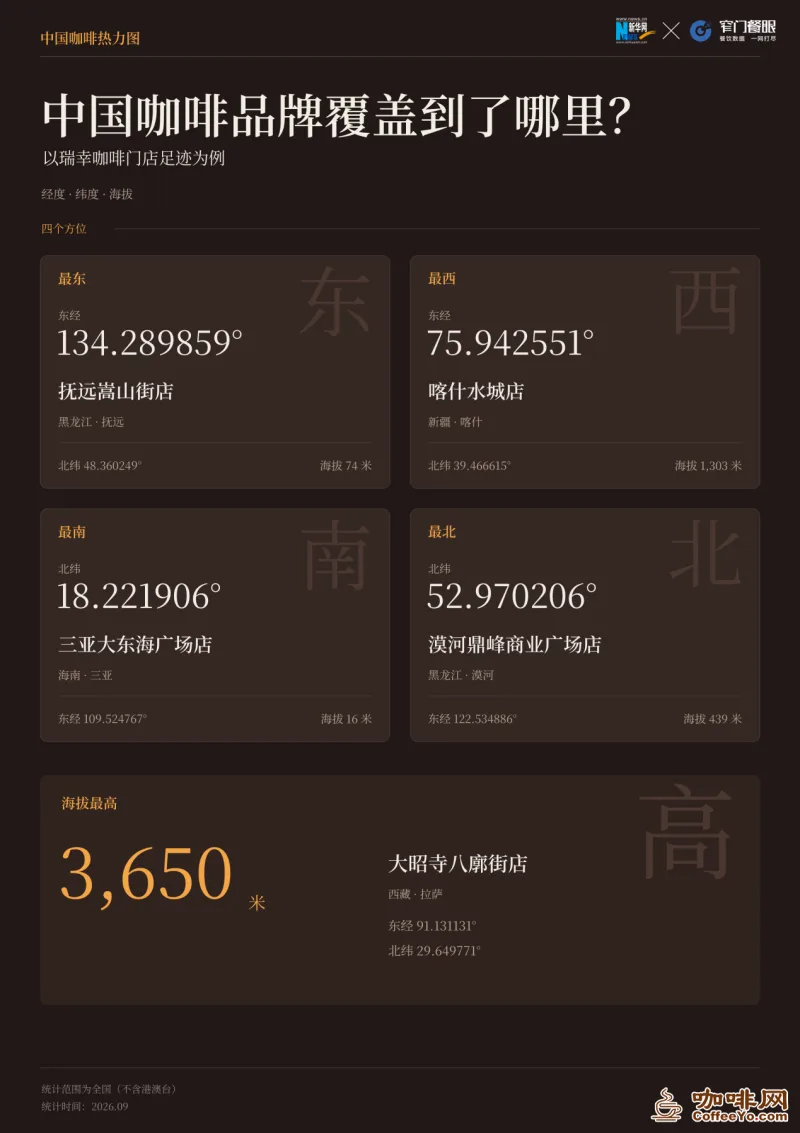
Data are the most direct evidence. As of September 2026 China had 254,600 freshly made coffee shops, a net increase of 106,700 in three years, overall growth of 72.12 percent, with the network covering 31 provincial-level regions, 365 cities and 1,889 county towns.
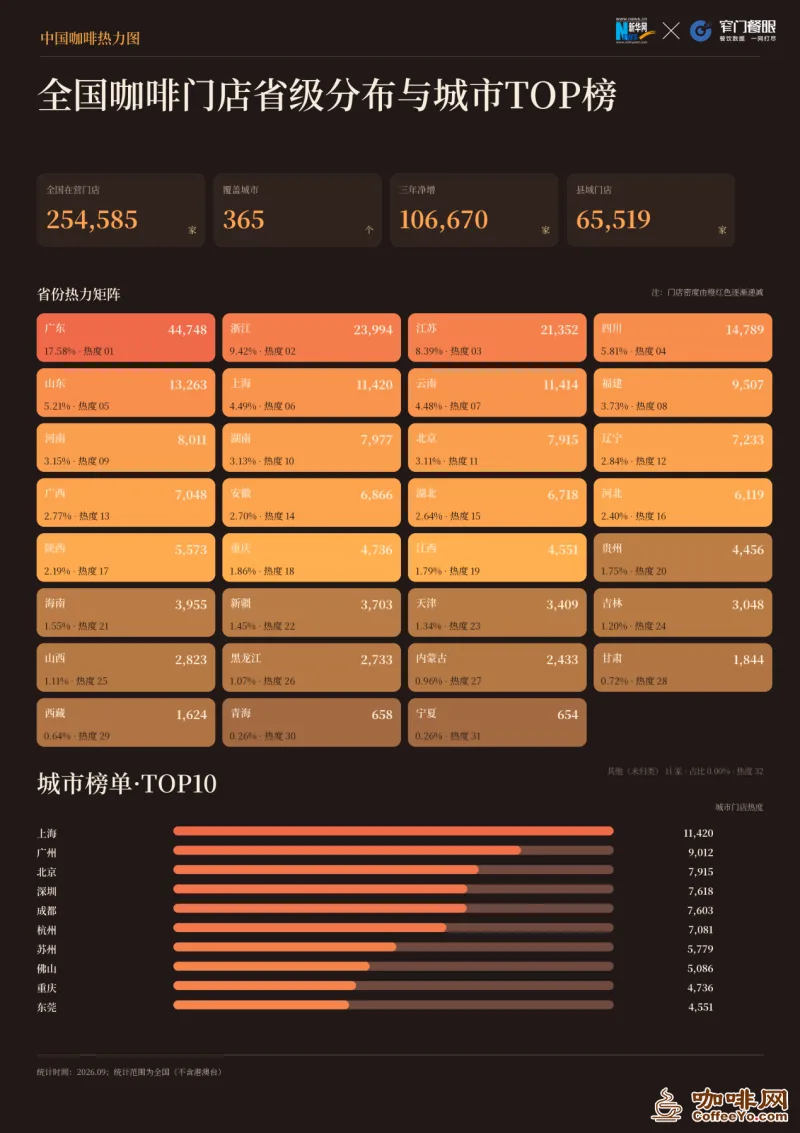
County-level areas are one of the most noteworthy markets in this round of coffee expansion. County coffee shops now total 65,500, up 103.41 percent in three years, more than in new first-tier cities, and about one in four coffee shops nationwide is in a county-level area.
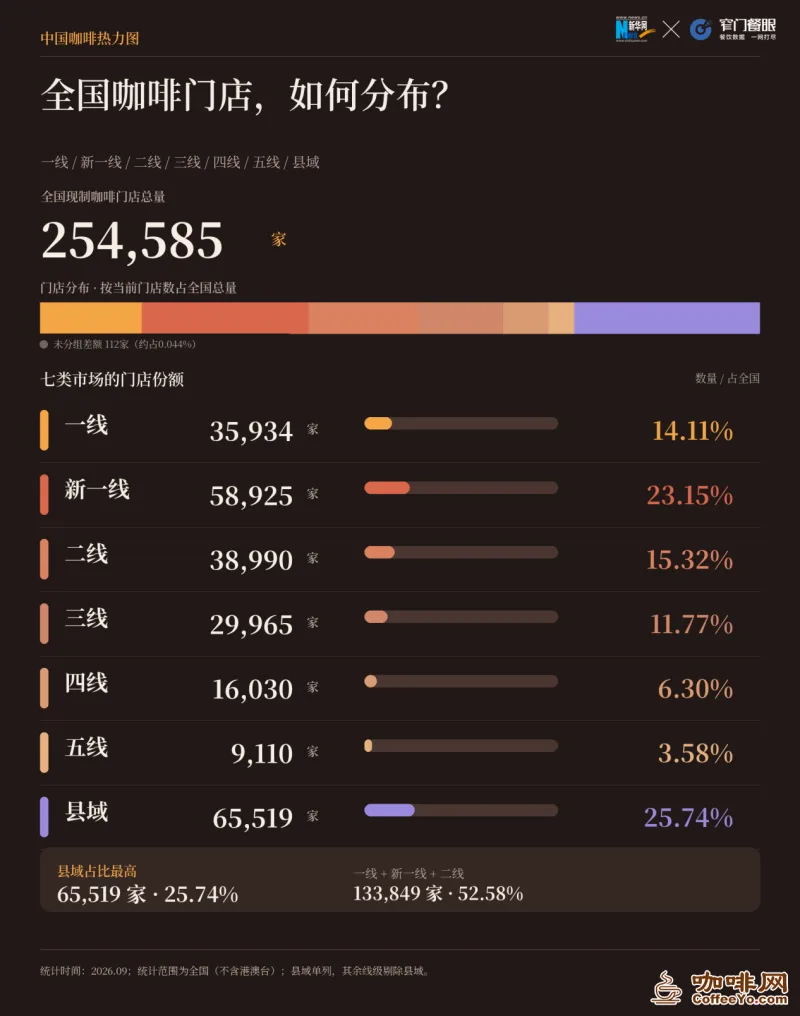
More noteworthy still: 97.88 percent of the net new county stores over three years came from places that already had coffee shops. County coffee growth therefore comes more from continued densification of existing markets than from simply starting from zero. Dali and Kunshan now each have more than a thousand coffee shops.
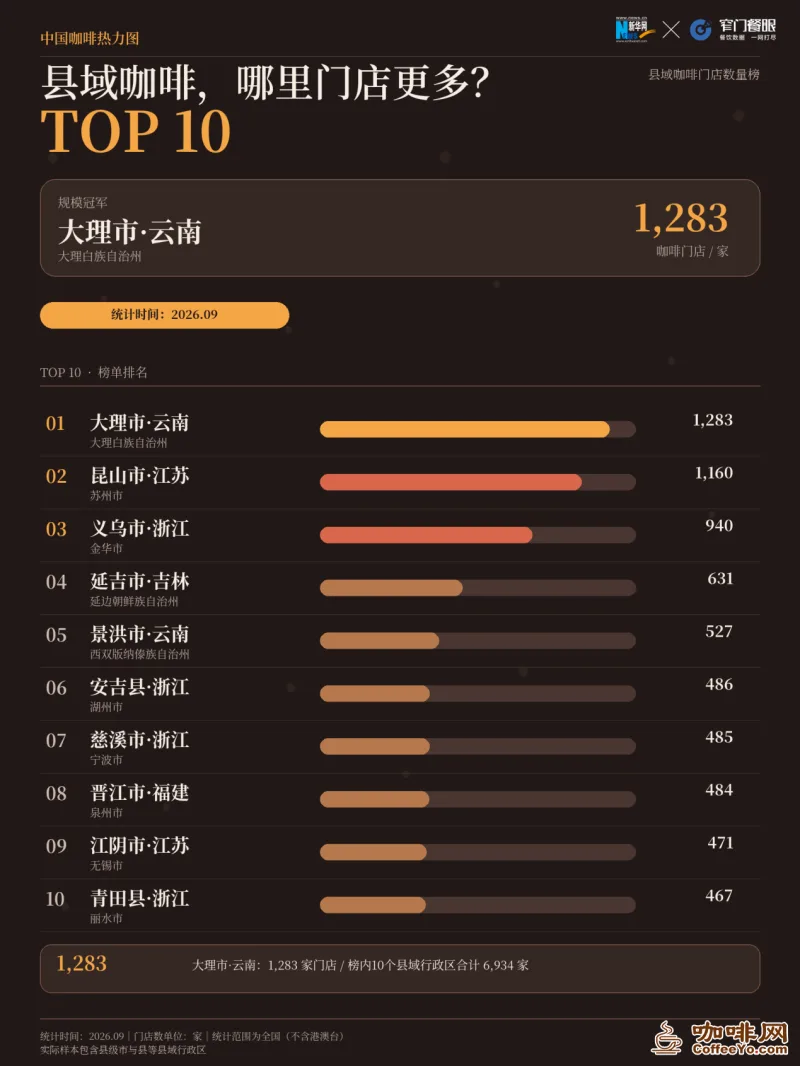
Take Dali: as a representative tourist destination it has more than a thousand coffee shops, ranking first among county-level markets by scale.
Tourist destinations are becoming a new growth space. The top ten tourist destinations by store scale added a net 22,700 stores in three years, with Shanghai, Beijing and others still growing from a high base.
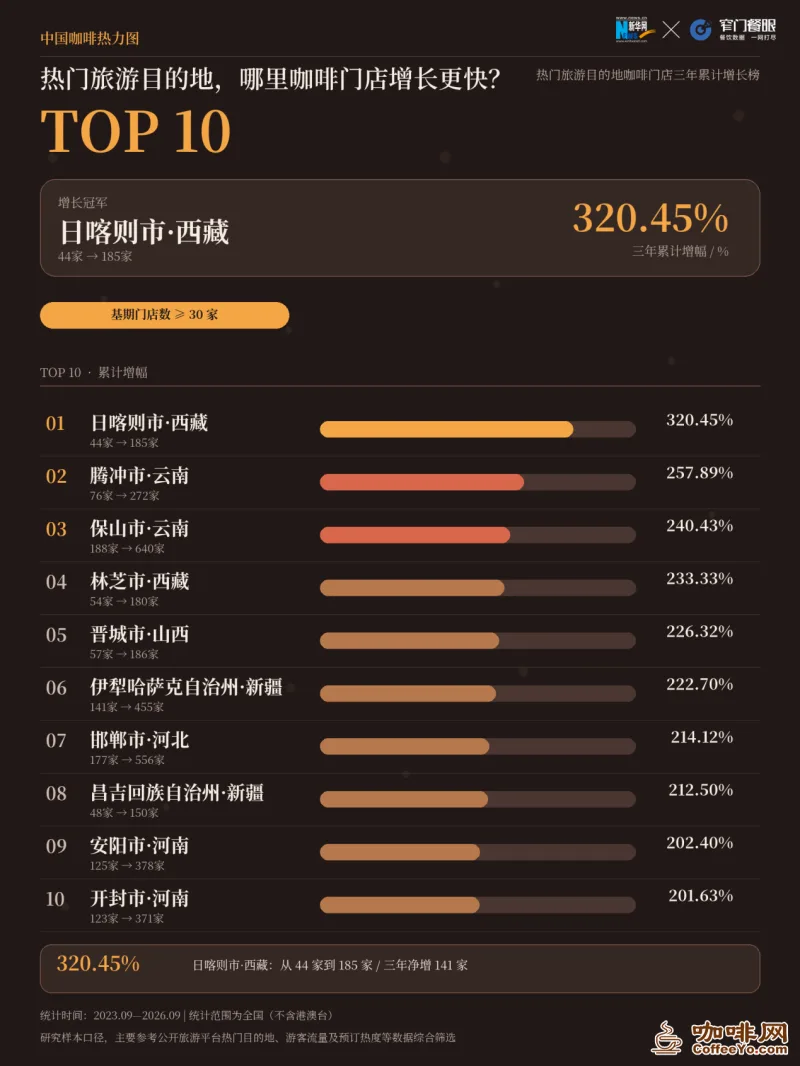
The fastest growth, however, is mostly in areas that were not previously dense with coffee shops. Among the top ten tourist destinations by growth, Tibet, Yunnan and Xinjiang take six places: Shigatse grew 320.45 percent in three years, Tengchong 257.89 percent and Nyingchi 233.33 percent. A group of highland and border tourist destinations is becoming a new growth region for the coffee market.
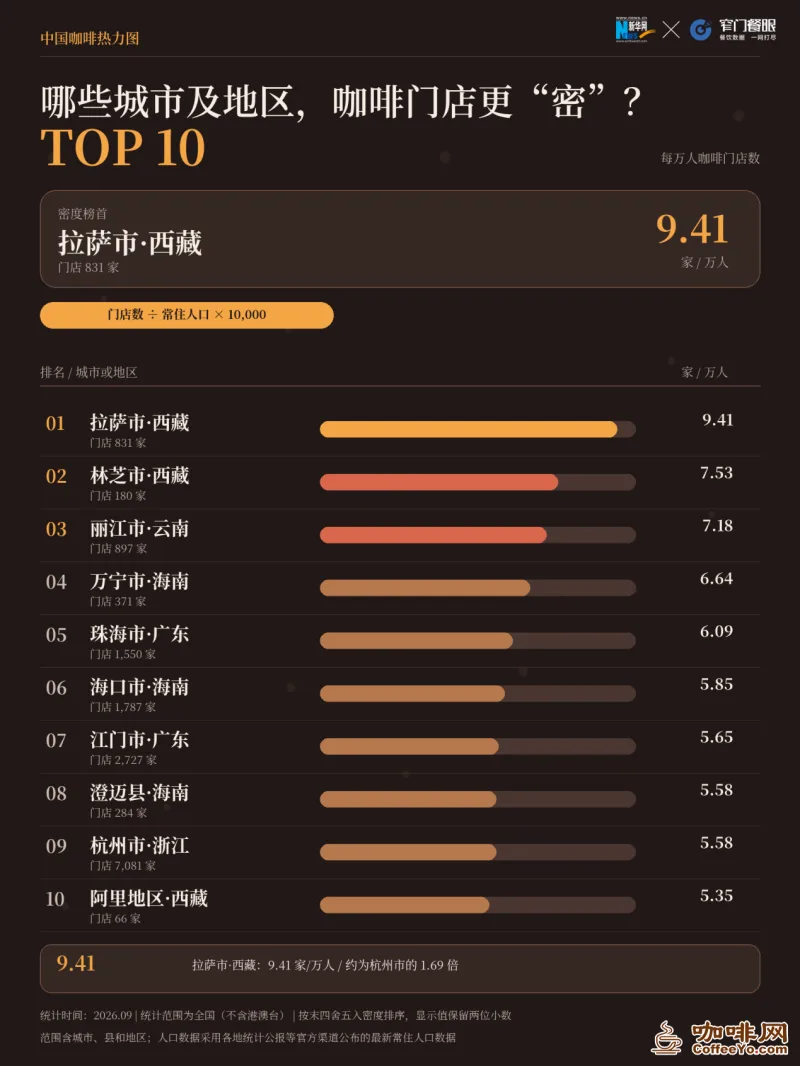
A set of sharply contrasting figures shows the geographic shift in coffee consumption more clearly. Shanghai has more than 11,000 coffee shops, among the highest totals in the country, but measured against permanent residents it has 4.59 shops per 10,000 people. By contrast, tourist destinations such as Lhasa, Lijiang and Nyingchi have already surpassed Beijing, Shanghai and Guangzhou in store density: Lhasa ranks first nationally with 9.41 per 10,000 people and Nyingchi reaches 7.53. This also suggests that looking at coffee consumption in tourist cities requires accounting for floating populations such as visitors.
The data show where stores open; tourism consumption shows why people drink coffee on a journey.
From a Commuting Necessity to a Travel Habit: How Coffee Follows People
Behind the geographic expansion is a change in coffee consumption scenes. In daily city life coffee is tied more to work and commuting; in a travel setting the time, place and motivation of consumption all become more varied. People need rest and refreshment on the road, want somewhere to sit in an unfamiliar city, or stop because of a distinctive store or a local signature drink, and coffee thereby becomes part of the journey.
Coffee itself is a category suited to “following the crowd”: high consumption frequency, and with a standardised supply chain it can enter different cities and scenes quickly. For chains, standardised operations guarantee consistent products and service, while localised store design provides a new reason to visit.
This combination is very visible in Chaoshan. Arcaded old streets and traditional snacks interweave with coffee shops, and the daily routes of local people overlap with the travel routes of visitors. Luckin’s store in the Little Park neighbourhood of Shantou sits at exactly such an intersection, serving both residents and visitors.
Ruili presents another picture. Border-gate culture, coffee-producing areas and travel routes interweave, making coffee a window through which visitors can experience the local industry and regional culture. In the past three years Ruili’s coffee shops rose from 39 to 183, and distinctive stores such as Luckin’s Jiegao national gate store opened, becoming part of the local cultural tourism scene.
Even in first-tier cities with mature coffee consumption, coffee is extending from a commuting necessity into city wandering and cultural leisure. In Beijing, for example, coffee has moved further into parks, bookshops and art spaces, and Luckin has opened a store in the old hutong alleys of Yonghegong Street.
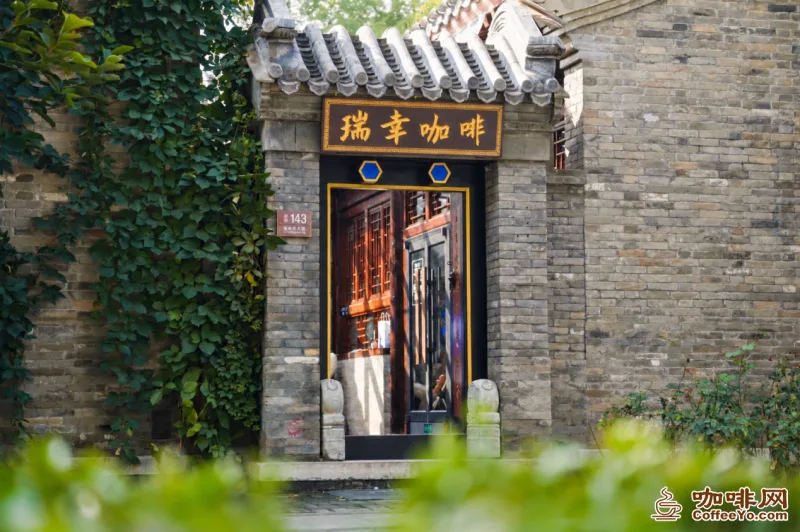
Beyond geographic expansion, coffee is blending into more life scenes and opening new growth space for the industry. But county markets develop unevenly and cultural tourism consumption fluctuates between peak and off seasons. For chains continuing to expand into these markets, scale is not enough: they also have to solve supply and operating problems in different regions.
Double Expansion in Geography and Scene: The Industry Enters a New Stage
The expansion of market boundaries is also changing the logic of competition. Brands used to fight mainly for prime locations in core business districts and office towers; now competition extends to comprehensive capabilities such as supply chain assurance, cross-regional operations and localised scene innovation.
Leading brand Luckin offers a sample for observing this change. In the past year China sold about 11 billion cups of freshly ground coffee, of which Luckin sold about 4.1 billion: roughly one in every three cups comes from Luckin. In the National Day holiday just past Luckin’s weekly cup volume exceeded 100 million, further demonstrating its scale. Behind that scale is the continuing extension of the store network from core cities to county towns and tourist destinations.
The wider the coverage, the higher the demands on the supply chain and quality consistency. Luckin has built a full-chain, high-quality supply chain covering raw material procurement, processing, warehousing and logistics and store delivery, supporting more than 30,000 stores with standardised production, efficient fulfilment and store operations. This is an important basis for keeping product quality and consumer experience consistent across regions.
While expanding coverage, Luckin is also trying to link stores with local culture and tourism scenes. Its store on Yuanlin Road by the Lion Grove Garden in Suzhou blends in classical garden imagery, the Hefei Garden Expo Park store draws on Huizhou architecture, and the Lugang Wanda store in Xiamen builds a consumption space around the character of a coastal city. Beyond standardised supply, these distinctive stores help coffee fit better into local daily life and give visitors a richer local experience.
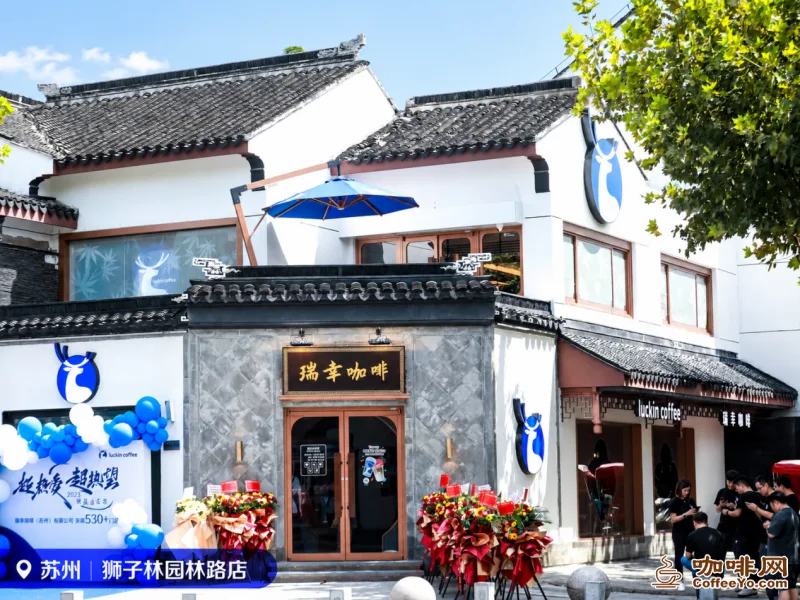
This case shows that the double expansion of China’s coffee market in geography and scene requires both standardised supply to safeguard quality and distinctive stores adapted to local culture and consumer demand.
As the boundaries of geography and scene keep expanding, China’s coffee market is entering a broader space for development. From core cities to more towns, from office commuting to leisure travel, coffee is blending into more and more people’s daily lives.
But the broader the market, the more complex the operational test. Facing differences in county market development and seasonal swings in cultural tourism consumption, competition will no longer be limited to store numbers and coverage but will test brands’ supply chain assurance, cross-regional operations and localisation capability. These comprehensive capabilities will also be an important support for the sustained and steady development of China’s coffee industry. (Source: Lanjinger News)
Reprint Notice & Disclaimer
- This article has been edited and compiled by coffeeyo.com and reprinted from Lanjinger, “Young People Head to County Towns, and Coffee Shops Follow: China’s Coffee Map Is Being Redrawn”. The copyright of the original text belongs to Lanjinger and the original author. This reprint is intended solely for information sharing within the coffee industry and does not represent the views of this website; all data and opinions are subject to the original article. Our thanks to the original author for creating and sharing it.
- For matters concerning content licensing, attribution, copyright or otherwise, please contact us promptly and we will verify and cooperate in handling them as soon as possible.
- Contact coffeeyo.com: Tel 400-0000-641 (+86-18288016826) | Email 405854472@qq.com | Address: Jinghong, Xishuangbanna, Yunnan Province
Related Reading
 How ‘Sea-Flavored’ Coffee Blooms Across Dongtou
- Health Guide: How to Enjoy Your Coffee the Healthy Way
 Study: Regular Coffee and Tea May Lower Dementia Risk, but More Is Not Better
 Frontline Story: A ‘Mobile City Coffee Bar’ Arrives by the Grand Canal
 Yantai’s Wind Tastes of Coffee
 In Zhenyuan, a Cup of Coffee and a Waiting Train






 Liaoning ICP Security No. 21122402000217