


Brief (coffeeyo.com): At the 2026 World Robot Conference, robots stepped out of the demo booth and into everyday life — making coffee, aiding the elderly, and even performing surgery — as China pushes “AI + consumption” into real scenarios.
BEIJING, Aug. 24 (Xinhua) — When Robots Begin to “Understand Life”
Long queues formed in front of the jianbing (Chinese crepe) robot booth, and exoskeleton walking-assist devices helped the elderly climb stairs… At the 2026 World Robot Conference, products close to residents’ consumption scenarios could be seen everywhere, as frontier technology is being turned into tangible everyday life and extending into people’s livelihood scenarios.
New Tech Experiences in Eating, Playing and Living
Walking into the robot consumer street created for the first time at the conference, multiple robots acted as “chefs,” making coffee, jianbing, cotton candy and other foods on site. In front of the jianbing-robot booth, many people held up their phones to record the whole cooking process. A Beijing resident, Mr. Liu, took a bite of a freshly made jianbing and said, “Tastes good — hard to believe a robot made it.”
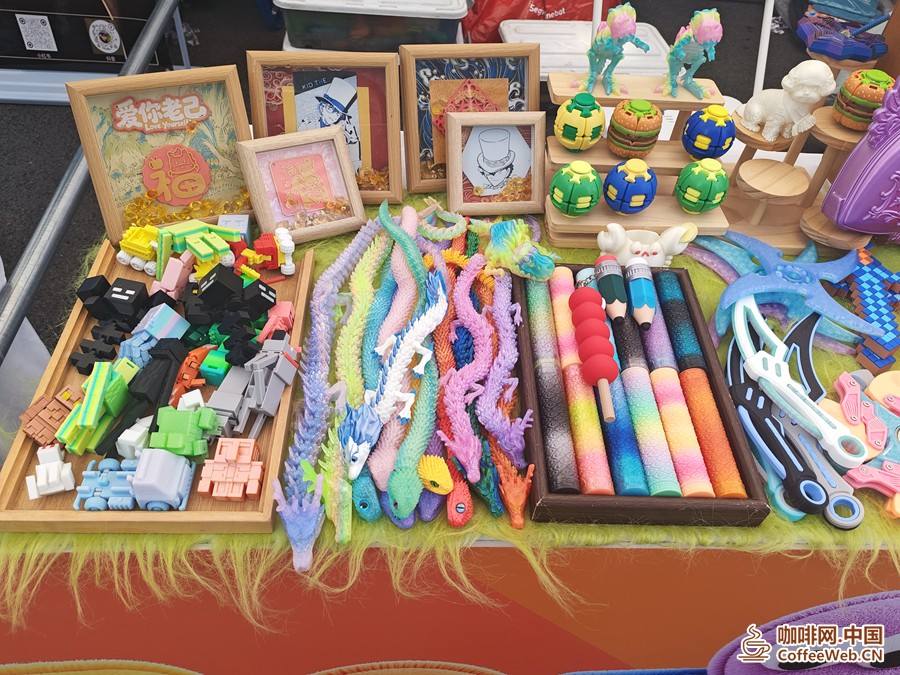
On August 19, 2026, 3D-printed toys were on sale at the “2026 E-TOWN Robot Consumer Festival.” Photo by Kong Lingjia, Xinhua.
A portrait-drawing robot completes a character portrait in tens of seconds, and 3D-printed toys in the exhibition area are dazzling; to the audience, robots are no longer unreachable frontier concepts, but a cup of coffee, a jianbing, a toy — visible, tasteable and takeable.
“The consumer street adopts an indoor-outdoor dual-block layout, creating an immersive consumption scenario of ‘tech + food + cultural creativity,'” said Meng Yanpei, director of the commercial operations division of Beijing Yizhuang Robot Technology Industry Development Co., Ltd. The outdoor consumption area focuses on “everyday buzz,” with various viral snacks, cold drinks and desserts meeting visitors’ dining needs. The indoor block focuses on real-life applications of robot services — for example, welcome robots provide guided-tour experiences, and AI traditional-Chinese-medicine diagnostic robots offer health-regulation advice. “We hope to push robots from exhibits toward consumer goods, letting visitors feel up close the practical value of robots in catering, healthcare, home and other fields,” he said.
“Robots are moving from booth demonstrations to real life,” said Duan Yanbiao, chief product officer of Yunji Technology, noting that diverse consumption scenarios are making the industry face the needs of the real world.
Smart Equipment Eases Elder-Care and Medical Pain Points
If entertainment robots bring a sense of “novelty,” robots in the medical and health field focus on people’s essential daily needs.
The Speed-Walk power-assist exoskeleton wearable device exhibited by the 21st Research Institute of China Electronics Technology Group Corporation can provide a gentle pushing force for the user’s walking. The device optimizes its algorithm for stair-climbing and slope-climbing scenarios, automatically adapting to flat ground, stairs and mountain climbing without manual switching. Liu Kaixuan, product manager of the institute, said the product has been piloted in some subdistricts of Huangpu District, Shanghai, truly benefiting the elderly population.
Another people-friendly service close to the public comes from a Beijing Yizhuang enterprise — Feiba Technology’s smart dental service pod. The vehicle is equipped with a dental chair, an implant robot and an oral CBCT (cone-beam CT of the oral and maxillofacial region), covering everything from teeth cleaning to implant plan design. “Many elderly people find going to the hospital troublesome, so we park the vehicle downstairs in the community, provide basic diagnosis and then advise on treatment,” said Chen Yizhou, senior product manager of the company, noting that the firm is exploring pilots around Beijing, with basic diagnosis, screening and teeth cleaning able to enter community service.
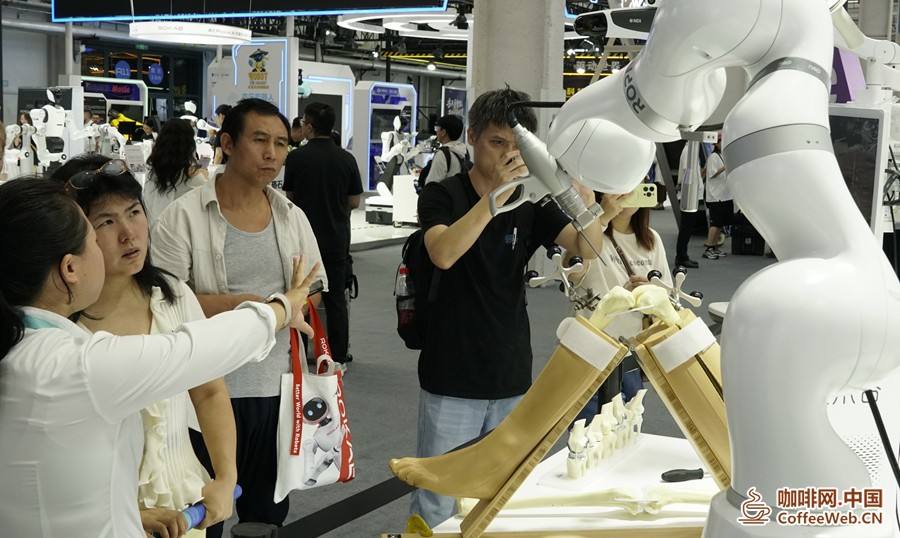
A surgical robot for bone procedures photographed at the 2026 World Robot Conference on August 19, 2026. Photo by Li Xin, Xinhua.
“For robots to achieve ‘livelihood landing,’ the key is not stacking up technical parameters, but finding real, high-frequency, unmet pain points,” said Xiong Youjun, general manager of the National and Local Co-built Embodied Intelligence Robot Innovation Center.
Robots’ landing is not just a technical proposition, but also one of business-model and institutional innovation — only when enterprises dare to invest, users can afford to use, and supporting systems can keep up, can robots truly move from the exhibition hall into life.
Robots Shift from Tools to Life Participants
At the venue, children played chess against robots, and the human-machine interaction was full of fun; robot dogs could complete multiple interactive tasks such as follow-along companionship and environmental inspection, flexibly shuttling through the exhibition area; humanoid robots could perform life-like operations such as heating bread and folding clothes, bringing future home-life scenarios before the audience’s eyes.
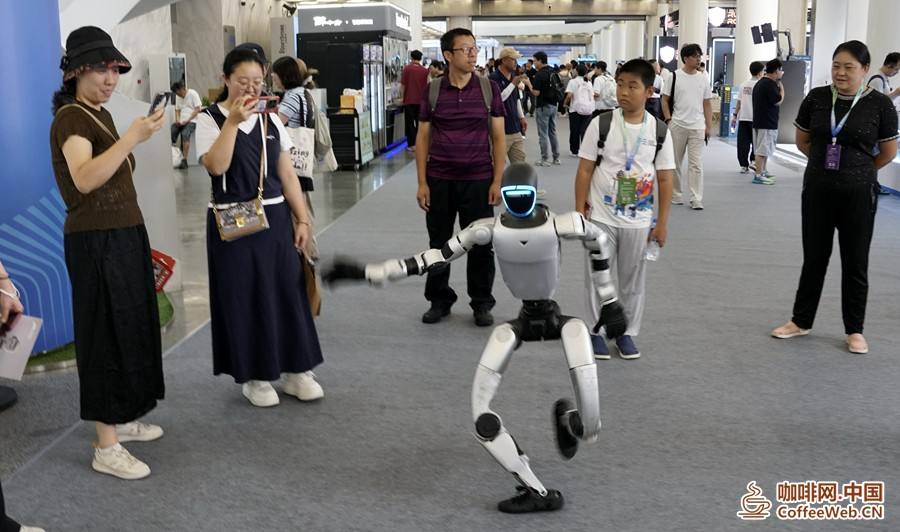
A robot performing a dance for the audience on August 19, 2026. Photo by Li Xin, Xinhua.
“Robots are not just cold machines; they can also have warmth,” several on-site visitors believed, noting that from educational enlightenment and emotional companionship to home services, robots are surpassing the “tool” positioning to become participants in life.
The successive appearances of robots in different forms are a microcosm of policy guidance and market demand resonating at the same frequency. To promote the deep integration of artificial intelligence and consumption, eight departments including the Ministry of Commerce issued the “Implementation Opinions on Accelerating the Development of ‘Artificial Intelligence + Consumption,'” proposing, for key groups such as the “old and the young,” to accelerate application demonstrations of new AI products such as elderly-care robots, companion robots and AI life assistants, and to enhance capabilities such as emotional companionship, health monitoring, transfer-assist walking and smart housework.
“In the short term, home robots will first enter people’s homes with companionship and human-machine interaction capabilities, gradually completing simple household tasks,” said Xi Yue, co-founder of Robot Era. Once the supporting business model matures, it will help accelerate home robots’ landing in home scenarios.
Some industry insiders believe that the current strong demand and rich scenarios in the livelihood field are a key breakthrough for unleashing the potential of new-quality productive forces. Livelihood-service robots will become an important carrier for new-quality productive forces to integrate into the social operation system and realize value transformation. When hard-core technology reaches ordinary people in the most down-to-earth way, robots will better benefit humanity.
Source: Xinhua — Planning: Wanfang, Zhanpeng; Lead author: Kong Lingjia, Zhao Yujiao, Kang Wei.
Reprint Note & Disclaimer
- This article is reprinted from Chinese media for information and cultural exchange. The views expressed are those of the original author and do not necessarily reflect the position of coffeeyo.com.
- All trademarks, brand names and logos mentioned belong to their respective owners.
- For cooperation, reprint or correction requests, please contact coffeeyo.com.
Reprint Notice & Disclaimer
- This article has been edited and compiled by China Coffee Network. The information and images therein come from public sources and the copyright belongs to the original author. This reprint is intended solely for information sharing within the coffee industry and does not represent the views of this website; all data and opinions are subject to the original article. Our thanks to the original author for creating and sharing it.
- For matters concerning content licensing, attribution, copyright or otherwise, please contact us promptly and we will verify and cooperate in handling them as soon as possible. We also welcome coffee origins, brands and industry media to exchange ideas and contribute articles.
- Contact China Coffee Network: Tel 400-0000-641 (+86-18288016826) | Email 478203668@qq.com | Address: Jinghong, Xishuangbanna, Yunnan Province / Tieling, Liaoning Province
Related Reading
 Deep Mountain Freshness in Changbai Mountains: How a Korean Pine Nut Passes the Freshness Test
 New products unveiled to expand agricultural trade
- Luckin Coffee joins the fray? Are home appliance companies worried?
 Focus on APEC: Building a Better World Together – Shenzhen APEC Meeting Offers Profound Insights
 Wuhua District, Kunming City, Yunnan Province, established the Coffee Industry Youth League Working Committee to gather the power of "coffee" youth
 Observation of the Great Wall | From Duck Shed Coffee to Thousand Acres of Rice Waves: Zhejiang's Thousand Million Project, What Can Hebei Learn?


 Liaoning ICP Security No. 21122402000217