
Brief (coffeeyo.com): From first-tier cities to the new tier-ones, “Coffee Chat”—a workplace-social ritual of one cup and one conversation—is quietly trending among China’s young people, who step outside their circles to widen their edges through cross-industry talk. But as it scales, expectations diverge: some find a career pivot, others only a letdown.
“211 grad, left the ‘Big Four’ for tech; hoping to meet friends in internet / education / self-media; post long valid” “I do overseas marketing (MKT); curious about different industries; weekend city-center café works” — such invitation posts are everywhere on social platforms. The comment sections are just as lively, with “raising hand” and “DM’d you” alternating; some seriously reply with their background, others cut straight to: “I’m free this weekend.”
From Beijing, Shanghai, Guangzhou and Shenzhen to the new first-tier cities, Coffee Chat—”drink coffee and talk”—this workplace-social format is quietly trending among young people. One cup, one conversation: more and more young people are willing to carve out leisure time to show up. No longer confined to their fixed circles, they hope to widen their personal edges through cross-boundary exchange, actively learn about industry ecosystems, accumulate diverse information, and gather reference for career choices and personal growth.

Many “Coffee Chat” invitation posts on social platforms.
Stepping out of one’s own circle
Enjoying topic exchange beyond the boundary
One afternoon after returning to China, “Painter” sat in a café across from a stranger she had known for less than an hour. The air carried the toasty scent of ground beans; the two young women talked for over two hours, from each other’s work to the books they’d recently read, then to how they each rearranged life after a breakup.
This is the trendy Coffee Chat—a workplace-social format that gradually emerged overseas in the last century, translatable as “coffee meet-up.” Essentially a relaxed but clearly purposeful informal exchange, it is mainly used for information swapping and building connections.
“Painter” works as a software engineer in the U.S. On this trip back, during a one-and-a-half-month holiday, she would hit five or six cities, each with friends waiting to meet her. But she also wanted to meet strangers. After all, having not been back for four years, she vaguely felt a layer of information gap between herself and her domestic peers; she wanted to use Coffee Chat to slowly take that fuzzy strangeness apart, bit by bit.

“Painter’s” invitation post.
Since last year, “Painter” has tried Coffee Chat in the U.S. Talks with foreigners were mostly about work—job-switch timing, industry winds—with clear topic boundaries; with Chinese people it was different, the conversation naturally sliding beyond work into interests, gossip, travel. She enjoys this kind of talk not because she gains information, but because the conversation itself can yank her out of her daily routine, letting her briefly step into someone else’s life for a look, then return.
Xiao Lin is also someone who wants to “walk out” of her own days. After more than four years at a big tech company, she felt many things were pushed along by inertia: commute, meetings, off-duty… promotion windows open only once or twice a year; sometimes a project runs long, and halfway through, leadership says priorities shifted and it stops.
“That sense of meaninglessness seeps in little by little. Days pass one after another, yet it’s unclear which direction I’m actually heading,” Xiao Lin said; she began considering whether to start a side hustle in the future.
That is also one reason she wanted to schedule Coffee Chat: to see how people in a similar state, or those who’ve already been through it, think and choose.
Recently she had a Coffee Chat with someone also trying a side hustle in e-commerce. Their exchange was less about who advises whom and more about sharing states. One line from the other person inspired her: “I don’t want the side hustle to become another ‘main job,’ otherwise you’ll keep adjusting direction to please the market and end up back in a state with no life of your own.”
In that exchange, although the other shared more, Xiao Lin felt the real gain wasn’t merely how much information she got, but seeing another person apply a different set of judgment criteria when facing choices.
Xiao Lin said she will keep joining Coffee Chat. She hopes to meet more people in physical industries—say, those running handmade shops, market stalls, freelancers, digital nomads—to learn the real difficulties they hit doing side hustles, and to hear the fun and rewards. “I’m not sure whether I’ll do something similar in the future, but I want to first see where those who’ve already started are now.”
Up to five chats a day
Those who “book coffee” fall into roughly three types
Keiko, 26, now works in brand overseas marketing. Four years ago, while studying law as a postgrad in London, she had only one question in her head: after studying law so many years, besides being a lawyer, what else can I do? Around then, browsing social platforms aimlessly, she first saw the term “Coffee Chat” and thought she’d try—maybe talking with someone completely different in background would reveal that unseen path.
She met a dozen-plus people in the UK—in art, jewelry, cross-border e-commerce, media. The deepest impression was a man just over 30: a Chinese vocational-college graduate who’d been a teacher for a few years, then applied for Australia’s WHV (working-holiday visa), painting walls and waiting tables in Australia, banking experiences classroom learning can’t teach. Later, from a vocational diploma he applied into a University College London advancement program while also running cross-border e-commerce—besides classes, only packing and shipping. What surprised Keiko more was that this young man turned the experience into a vocational-study-abroad business and thrived. That chat made Keiko feel for the first time how vast life can be.
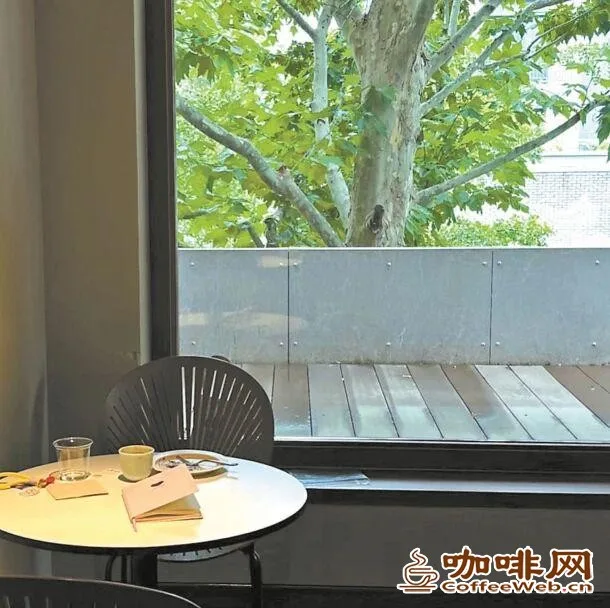
A corner of a coffee shop.
At first, worried about awkward silences, Keiko would pre-list a few questions in her phone memo. After more chats, she gradually needed no preparation—”the rhythm of conversation becomes natural like muscle memory.” She also slowly found her own fit: one-on-one digs deeper around a topic; a small gathering of four or five hears more voices and rarely goes cold.
She observed that those coming to Coffee Chat fall into roughly three types: the fiercely “rolling” (grinding) ones always charging forward, wanting information and broader horizons; the confused ones wanting others’ experience to point the way; and the simplest—those who just love socializing and hearing stories. Keiko feels she touches all three, perhaps living each mindset at different life stages.
Right after returning to China, Keiko almost formed a habit: whether on a business trip or traveling, wherever she arrived she’d pre-book a Coffee Chat. Plane lands, luggage to the hotel, straight to meet people. At her peak she booked five Coffee Chats in a single day.
To date, Keiko has met over a hundred friends. When inviting people to Coffee Chat, she often carries a “casting wide goodwill” mindset; she doesn’t expect a single chat to bring immediate return.
Positive impact
Building a network, enlightening career development
Coffee Chat brought Keiko tangible positive influence—even her later decision to switch fields was talked out over coffee.
Back then, she met a hometown acquaintance on a social platform she’d never met in person. The other did overseas cross-border e-commerce, and Keiko had privately studied the industry for a while, so she proactively invited them out for coffee. They sat for over an hour; she poured out her understanding and confusion about the industry, and the other offered to help revise her résumé and do an internal referral. That’s how she crossed from law into brand overseas marketing.
Now successfully switched and having found a field to deepen in, Keiko’s Coffee Chat focus narrowed—no longer broad invitations, but concentrated invites to industry friends. “No matter the circle, past 30, many great opportunities come through insider referrals; everyone looks after their own. So why not start building my own network now?” she said.
Some people first joined Coffee Chat not for job-hunting or switching, yet harvested unexpected career opportunities—A Yue is one.
A Yue’s company mainly does AI short-drama production and virtual-idol incubation. In the early startup phase he’d arrive at the office at noon, grind until midnight, running straight for one or two months with almost no breathing room. “Constant output, constant catering to the client’s needs, exhausting—I really wanted to hit pause.” It was then he noticed Coffee Chat, feeling it might be a small window to breathe outward.
From 2025 to now, A Yue has scheduled a dozen-or-so Coffee Chats—not many, but he takes each seriously. He sets no constraint on invitees’ professions: technical, content, management all fine. What he cares about is what’s discussed and whether there’s collaboration potential, but he doesn’t force it—as he puts it, “because there’s no expectation, anything we talk about is icing on the cake.”
The youngest he met was a fresh graduate with drive in their eyes and a trace of bewilderment; the oldest around 40, a seasoned practitioner who spoke little but every sentence landed on point. “The young mostly come to learn about the industry; the older often carry specific needs or confusion,” A Yue said. As an AIGC (AI-generated content) director, talking with different backgrounds, things seemingly unrelated to film often hand him unexpected material and inspiration. “Those topics may not be immediately usable, but they sit in the brain, pulled out when the right project comes.”
To date, Coffee Chat has brought A Yue’s company two or three actual collaborations. A traditional post-production company interested in AI felt A Yue’s team’s direction and technical depth matched their needs, and signed several projects. Another chat partner’s company happened to need AI training, and the two smoothly partnered.
Sometimes, what’s comprehended from a single conversation is more valuable than a collaboration. It doesn’t show on a contract, but quietly changes A Yue’s angle on work.
He met a former Alibaba executive whose two daughters were academically weighed down. She spoke of her life state: as long as she didn’t manage the kids’ studies, the three were the best of friends, stuck together with endless talk; but the moment she managed studies, the kids frowned and began to resent her. She wanted to build an AI product to take on the “villain” role—managing the kids’ study progress, pulling herself off that seat, becoming the daughters’ friend again.
A Yue was deeply inspired, not only because the idea was interesting, but because the other’s product logic always started from herself. He kept turning it over: the “self-as-user” logic might be the most solid way to understand user experience. Now he’s brought this idea into his own startup: can the content we make and the directions we choose help more people? If the thing itself is altruistic, walking that underlying logic, the odds of success may be a bit higher.
Mixed reviews
Requires participants’ own judgment and screening
As more people join, evaluations of Coffee Chat are no longer single. Some found an entry to switching careers, some saw another way of living through it, and some arrived full of expectation only to hide disappointment.
This disappointment often comes from the gap between real experience and expectation. A netizen shared that the other person sat down and started pitching products, circling back to their own business in three sentences; others complained that an afternoon of talk yielded neither new information nor emotional resonance…
Such voices, though few, have made some re-examine Coffee Chat.
Xiao Lin has observed the format itself. She feels that in China’s social context it is actually a relatively fresh state—between information exchange and making friends, between utilitarian and non-utilitarian. Xiao Lin said that previously people mostly met strangers through group activities: clubs, book clubs, seminars—first showing up in those settings, then slowly developing a relationship you could invite one-on-one, the whole process like “slow simmering over a low flame.” But Coffee Chat compresses the process: more direct, more efficient, and more in need of participants’ own judgment and screening—whether the other is worth sitting down with for an hour. “Everyone has their own screening standard, and that standard decides who you meet, and where that conversation ultimately goes.”
In A Yue’s understanding, the purpose of Coffee Chat most of the time is information exchange across industries. Talk about work direction, talk about industry dynamics, stay on the professional level—that’s good. He’s less inclined to discuss aesthetics or the deep feelings behind content creation, because once that topic opens, a slight misstep slides into some kind of “showing off.” “What you think is good, the other may not agree, but once you express it too forcefully, it looks like showing yourself off.” He also dislikes over-sharing private topics, finding it a bit rude and easy to lose the conversation’s center of gravity.
Reality is indeed so: most people finish one Coffee Chat and drift apart, WeChat sitting quietly in the contacts, an occasional Moments update the only reminder they once met.
Yet sometimes, some people pass through that cup of coffee and into each other’s lives. Last year Keiko invited a Guangzhou girl; after chatting they added WeChat, expecting, as in most cases, the story to end there. But later, because their experiences were similar and they hit it off, the two grew close—from occasional messages to weekly contact, contact extending from online to offline. When the other was hospitalized sick, Keiko specially took the high-speed train from Shenzhen to Guangzhou to visit her.
Now they chat three or four days a week about recent life. Keiko said that after starting work she hadn’t made such a good friend again—”the story just happened naturally.”
Keiko treasures every meeting with a new friend. “Eating alone is eating, drinking coffee alone is drinking, so having one more person sit down to talk can never be wasted.” Keiko said that after every chat she notes some reflection in her memo—whether she listened seriously, and what inspiration she gained. As for “expectations” of the chat partner, she said, people our age probably all understand: keep expectations as low as possible for everything, don’t clutch too tight, and you’re more likely to catch something unexpected. “My expectations have always been very low; even if this time the other stands me up (breaks the appointment), it’s fine, I’ll just do what I do.” (Interviewees in this article use pseudonyms)
By Wang Jingyi, reporter of Beijing Youth Daily.
Reprint Note & Disclaimer
- This article is reprinted from Chinese media for information and cultural exchange. The views expressed are those of the original author and do not necessarily reflect the position of coffeeyo.com.
- All trademarks, brand names and logos mentioned belong to their respective owners.
- For cooperation, reprint or correction requests, please contact coffeeyo.com.
Reprint Notice & Disclaimer
- This article has been edited and compiled by China Coffee Network. The information and images therein come from public sources and the copyright belongs to the original author. This reprint is intended solely for information sharing within the coffee industry and does not represent the views of this website; all data and opinions are subject to the original article. Our thanks to the original author for creating and sharing it.
- For matters concerning content licensing, attribution, copyright or otherwise, please contact us promptly and we will verify and cooperate in handling them as soon as possible. We also welcome coffee origins, brands and industry media to exchange ideas and contribute articles.
- Contact China Coffee Network: Tel 400-0000-641 (+86-18288016826) | Email 405854472@qq.com | Address: Jinghong, Xishuangbanna, Yunnan Province / Tieling, Liaoning Province
Related Reading
 How ‘Sea-Flavored’ Coffee Blooms Across Dongtou
- Health Guide: How to Enjoy Your Coffee the Healthy Way
 Study: Regular Coffee and Tea May Lower Dementia Risk, but More Is Not Better
 Frontline Story: A ‘Mobile City Coffee Bar’ Arrives by the Grand Canal
 Yantai’s Wind Tastes of Coffee
 In Zhenyuan, a Cup of Coffee and a Waiting Train







 Liaoning ICP Security No. 21122402000217